Saturday, March 12, 2016

Jones Plantation Quilts Liberty County, Georgia

Green and red hexagon quilt on display at the Midway Museum
in Liberty County, Georgia. On the left another quilt (?)
in front of a photo of Mary Jones Jones.

Mary Jones Mallard recalled life in the main house on Maybank plantation before the Civil War:
"We used to gather round the hearth---Father reading aloud, Mother knitting or sewing. ....Brother Joe with his paint box ....and I think I used to make mittens or sew my hexagon quilt."
Perhaps the quilt above.

Quilt at the Midway Museum

Midway is south of Savannah, Georgia, along the Atlantic coast.

Charles Colcock Jones Sr (1804 – 1863)

Midway in the 1950s. 
Charles Colcock Jones was minister
at the Old Midway Church before the Civil War.

Chintz quilt made by members of the Jones family at
 Montevideo plantation in Liberty County, Georgia, about 1855. 
92" x 91".
Collection: Kenan Research Center at the 
Atlanta History Center

The high-style chintz quilt above is also attributed to Mary Jones's family.

Picture of Mary Jones Jones in the 1860s from Special
Collections at Tulane University

Mary Jones Jones (1809-1869) often mentioned quilts in her letters. In 1862 she referred to a chintz spread on her bed. In 1850 Mary informed her sons that their aunt, although feeble "quilted her laid-work [applique] quilt at Mrs. Winn's." In 1852 Mary wrote niece Laura that she was in Philadelphia, shopping for chintz: "I will try to find the birds and butterflies for [Betsy's] quilt."

At the Midway Museum: A chintz quilt in a frame????

Birds from Philadelphia?

From a snapshot of a bedroom from the web.

After the war in November, 1865, Mary wrote her daughter to see if she'd left her knitting when she visited. "If when Robert comes down he would bring my quilt patches and scraps from my trunk."

In 1861 Mary Jones Jones sent a quilt to her young granddaughter Mary Jones Mallard: "Tell my dear little granddaughter Grandma sends a little quilt for her bed...perhaps you could make Lucy quilt it."

That Lucy was a slave is obvious. One might ask someone to quilt a bedcover---or make someone quilt it.

Photograph of Montevideo Plantation, end of the 19th century
 from Robert Quarterman Mallard's book 
Montevideo-Maybank, Some Memoirs of his Sunny Childhood.

Montevideo was in the low country where malaria was endemic. People of African heritage had a genetic resistance to the mosquito-borne disease. Plantation owners fled to homes in higher ground in the summer, one reason the Jones lived at both Montevideo and Maybank.

1850 Census of Georgia Slave Owners
showing the Charles C. Jones family of Liberty County
as one of the state's largest slave-holding families with 107 people
at their various plantations.

The Children of Pride by Robert Manson Myers,
letters and papers of the Jones family,
is the source for several of these quotes.

Charles Colcock Jones Jr., officer in the Confederate Army,
became a Georgia historian collecting family
papers and objects that have endured in various institutions.

In his memoir Mary Jones's son-in-law Robert Quarterman Mallard pictured former slaves posing by the elder Charles Jones's grave at Midway Cemetery. He did not identify them. 
I included a photo of the Jones quilt at the Atlanta History Center
in my book Facts & Fabrications: Unraveling the History of Quilts and Slavery. 
Can we classify it as a slave-made quilt?

The Jones plantation quilts are examples of the problems in considering whether a quilt was stitched by enslaved seamstresses.

As I wrote in that 2006 book:
"We cannot know which family members had a hand in any particular quilt. There is a real possibility, as with any American quilt passed down in a family that held slaves, that enslaved women made part or all of it. On one hand, documented slave-made quilts are rare; on the other quilts made by slaves are quite common. The problem is finding evidence of the seamstress's identity."

Many books about the Jones family of Liberty County have been published. Here are three with an overview of their Civil War era letters and diaries.

The Children of Pride by Robert Manson Myers,


There are two versions of The Children of Pride, the latest "a compact, illustrated volume for new readers and for all those who so greatly admired the original monumental edition." The older 1972 book (1800 pages) won the National Book Award (not the Pulitzer Prize as I mistakenly wrote in Facts & Fabrications.)


Erskine Clarke's Dwelling Place: A Plantation Epic was published in 2005.

Read about Charles Colcock Jones's 19th-century publications at this link:

Wednesday, March 9, 2016

Dixie Dairy Sampler from 2013


Dixie Diary by ColvinKiwi, 2014

The Block of the Month a couple of years ago was Dixie Diary. Did I ever show you Dorry at ColvinKiwi's finished quilt?  She emphasized the simple pieced blocks in a geometric set and added corner blocks of her own design. The set fabric is from Basic Gray at Moda.

Su Gardner did the long arm quilting.

See many more pictures at Dorry's post here:

And here's Dustin's top.

I provide the block ideas. They provide the creativity.

Look at Dustin's "Tops to Be Quilted" Flickr page:


Dixie Diary from Cookie's Creek

It is gratifying once in a while to see that SOMEBODY actually followed my pattern. That would be Barbara at Cookie's Creek.


I'm still a big fan of pink and brown as you can see in the current Old Cambridge Pike line for Moda.


Shop owners and teachers looking for a historical Block of the Month might want to kit Dixie Diary for a beginner's piecing and applique series in Old Cambridge Pike.

The free patterns are still on the blog. See links to each below:


Label:


Saturday, March 5, 2016

Southern Relief Fair on a Quilt

Crazy quilt recently offered in an online auction.

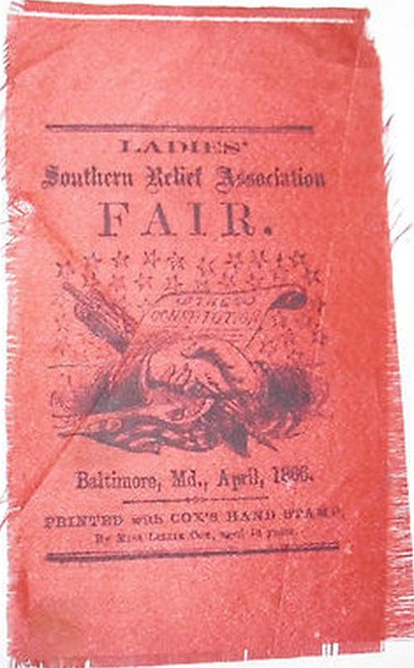
Among the embroidered patches are several ribbons,
notably this souvenir of the Ladies Southern Relief Association Fair
in Baltimore, April, 1866.

The quilt is dated 1885, nineteen years after the Baltimore Fair.


Another ribbon features successful Presidential candidate Grover Cleveland, a Democrat.

Ribbon dated 1881, perhaps from a reunion of the Old Dominion Guard.

The Fair ribbon also was printed on red silk.

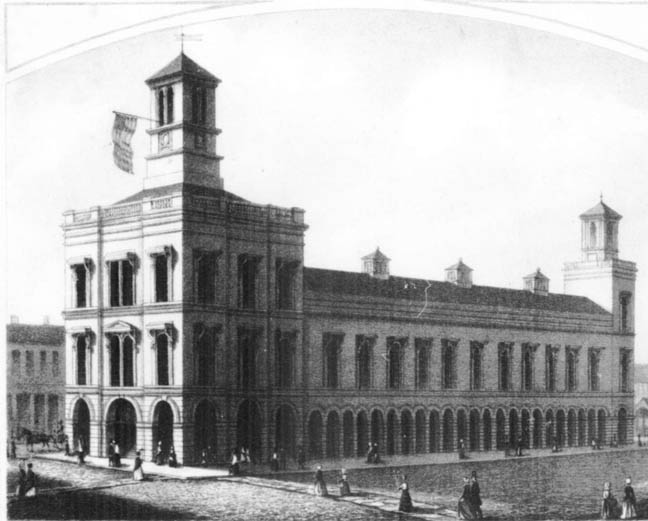
The Southern Relief Fair took over the Maryland Institute building from April 2 to April 13, 1866. About $165,000 was raised to buy food and supplies for destitute people in the South. Baltimore in a Union state was conspicuously lending a hand to a defeated enemy.

The Maryland Institute Building opened in 1851.

The Baltimore Sun mentioned that the women had set up 52 tables, "laden with their profuse variety of wares, fabrics, &etc....are all neatly trimmed with evergreens and ornamented with flowers." 

Mary Custis Lee, wife of General Robert E. Lee, is reported to have donated an embroidered cushion and U.S. First Lady Eliza Johnson sent a floral bouquet.

Descriptions of the needlework displayed are limited. Virginia's Staunton Spectator effusively described what sounds like Berlin work pictures:
"The tables were gay with fabrics of every texture and quality, wrought by the cunning fingers of the fairest and brightest of the ladies in the land; portraits and landscapes, and historical compositions for artists of 'credit an renown'...."

Berlinwork or needlepoint pictures like these
from the period couldn't have been all the fancywork on display,
but this is what the reporters seem to be describing.


The Fair sounds more like a Northern Sanitary Fair than a pre-War ladies' handwork bazaar. The large amount of money was raised by donations of commercial items from food to farming equipment and livestock.

The building lasted into the 20th century.

Confederate Colonel John B. G. Kennedy described the Fair to a fellow Southerner:
 “The ladies of Baltimore have come out handsomely in behalf of the suffering people of the South. They got up the great “Southern Relief Fair” amid the sneers and jeers of the Black Republican crew ... Donations to this fair have poured in from all parts­­ even England, Yankeedom, and New York have helped to swell the fund…. Articles of all kinds ­­ mammoth steers, mules, horses, houses and lots, wood, coal, flour, groceries, lumber, dry goods, machines, farming utensils, drugs, patent medicines, toys, soaps, telegraphs and the Lord knows what. Those who could not send material gave money… If you dislike the North, my dear friend, please do not include Baltimore in your denunciations."
The Fair was organized by the society women of Baltimore and their Ladies' Southern Relief Association, which reported on the disbursement of moneys in September.


The chair was Jane Grant Gilmor Howard, a prominent Baltimore matron who'd been painted by Thomas Sully about the time of her wedding in 1818.

Jane Grant Gilmor Howard (1801-1890) by Thomas Sully,
Collection of the Maryland Historical Society.

Inspired by Mrs. Howard's Baltimore Fair, several other Northern cities organized Southern Relief Fairs. These post-War relief fairs for former Confederates were not as well documented as the wartime fairs, particularly the Union Sanitary Commission Fairs. Sectional prejudice continued to dictate what was published. 

Read more about Jane Gilmor Howard here:

Wednesday, March 2, 2016

Stars in a Time Warp Tops

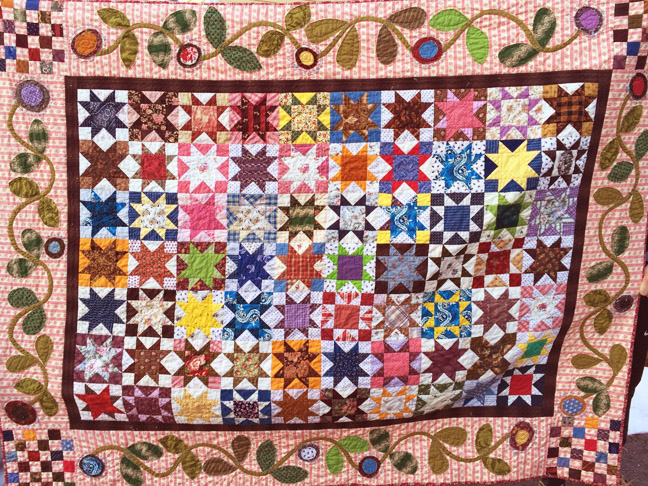
Stars in a Time Warp by Kyle
Center medallion


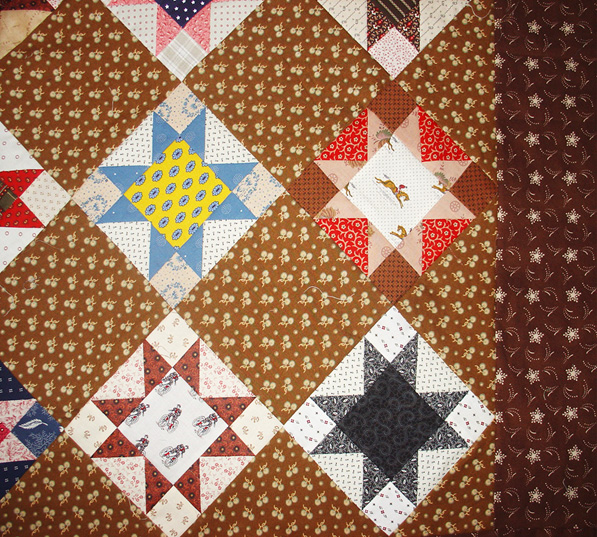
Kyle's 72 stars with a French General border print and center block from Di Ford's Antique Wedding Sampler.
http://kyleredente.blogspot.com/2016/02/bs-to-5th-power.html

Now that it's March, 2016
 [Let's hear it for spring in the Northern Hemisphere!] 
you will want to finish your 2015 projects.

Or not. You might prefer to sit on the porch and read.

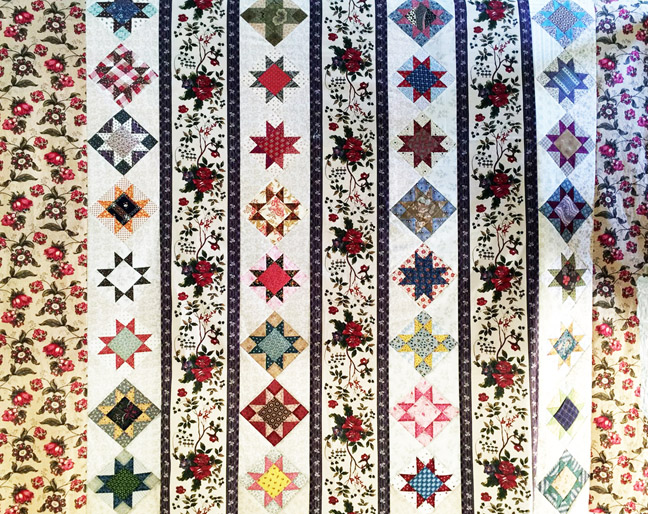
Well, anyway, here are some Stars in a Time Warp tops for inspiration.

Randy at Barrister's Block
56 stars

Sharon V

Sylvia at Treadle Stitches (Her second)


Maureen at Pursuit of Quilts

48 stars in a strip set.

Fun with Barb---finished

And Cynthia's at WabiSabi quilts is quilted and bound!