Showing posts with label Slavery. Show all posts

Saturday, October 22, 2011

43 Right Hand of Friendship

Right Hand of Friendship
By Becky Brown

Right Hand of Friendship can remind us of the networks of help that continued to form an "Underground Railroad" throughout the Civil War.

While slavery's foundations began to crumble in 1861, the system continued in most places until the War was over in 1865. Near St. Louis, Missouri, a border state that never joined the Confederacy, Archer Alexander and his family lived in slavery through much of the War. 

His slave-holding neighbors helped the Confederate cause in small ways by burning bridges to confound Federal patrols. When he heard of a planned bridge attack, Archer impulsively ran to a Union neighbor's home with information. Realizing the consequences his spying would earn him, he kept running---into the city of St. Louis where he was fortunate to meet the family of William Greenleaf Eliot, a Unitarian minister with abolitionist sympathies. Eliot agreed to hire him and offered to buy his freedom and that of his wife Louisa, left at home with no idea of what had happened to Archer.


William Greenleaf Eliot,
a friend to many slaves.

Louisa received a welcome letter assuring her of her husband's safety and the generous offer of freedom, but had to dictate a sad reply:

"MY DEAR HUSBAND,--I received your letter yesterday, and lost no time in asking Mr. Jim if he would sell me, and what he would take for me. He flew at me, and said I would never get free only at the point of the Baynot, and there was no use in my ever speaking to him any more about it. I don't see how I can ever get away except you get soldiers to take me from the house, as he is watching me night and day. If I can get away I will, but the people here are all afraid to take me away. He is always abusing Lincoln, and calls him a old Rascoll. He is the greatest rebel under heaven. It is a sin to have him loose. He says if he had hold of Lincoln he would chop him up into mincemeat. I had good courage all along until now, but now I am almost heart-broken. Answer this letter as soon as possible. I am your affectionate wife, LOUISA ALEXANDER"

Archer, the Eliots and the Louisa's neighbors formed new plans. The Eliots offered to shelter Louisa and daughter Nellie. A neighbor agreed to carry them in his oxcart to the city for payment of $20. Clad only in day dresses without bonnets or shawls so as not to raise suspicion they were planning to travel, Louisa and Nellie sauntered to the road near their cabin where they'd agreed to rendezvous. The farmer hid them under the cornshucks in the wagon and casually walked along, leading his oxen to the city as farmers did every day. Despite questioning by suspicious locals, the escape was a success.

Letters sent by the U.S. Post Office during the War looked much like ours today
with envelopes, 3 cent cancelled stamps and a date cancellation.

Louisa and Archer could not read or write, yet they managed to carry out a complex plan by mail. We often think of illiterate people as being deprived of any written communication (a possible reason for all the stories about secret visual codes in tales of slavery) but we should realize many social systems were in place to assist those who needed help.  In Louisa's case sympathetic neighbors took dictation and carried their correspondence, acting as an informal and illegal post office.

Archer Alexander so impressed William Eliot that the minister wrote his story as a legacy for the Eliot grandchildren, hoping to keep the story of slavery alive for future generations. Eliot eventually published the account in the 1880s. William Eliot's school, the Eliot Seminary, became Washington University. One of the grandchildren for whom he wrote the Alexanders' story grew up to be T. S. Eliot, the modernist poet.


Archer, a handsome man into his old age, became the model for sculptor Thomas Ball who had a commission from former slaves to create a statue of Lincoln the Emancipator. Freedom's Memorial, a portrait of Lincoln and a kneeling slave, can be seen in Lincoln Park in Washington D.C. In the sculpture Archer Alexander assumed the pose of the shackled, kneeling slave---the image that had represented the antislavery movement for over a century.

Today that image rankles. Archer seems to symbolize passivity, a man waiting to be rescued. But it is important to recall that the kneeling slave had great meaning for blacks and whites during his life time. The man in shackles signified both a sympathy for the slaves' plight and a willingness to act.


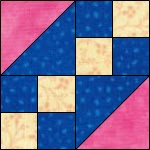
The quilt block Right Hand of Friendship was published by Hearth and Home magazine in the early 20th century. It is BlockBase #2831.


Cutting an 8" Finished Block
A Cut 4 background squares 3-1/8".
B Cut 1 background, 1 dark and 1 medium square 3-7/8". Cut each into 4 triangles with two diagonal cuts. You need 4 of each.


C Cut 1 dark and 1 medium square 3-1/2". Cut each into 2 triangles with one diagonal cut. You need 2 of each.


Read William Greenleaf Eliot's book: The Story of Archer Alexander: From Slavery to Freedom at the Documents of the American South webpage.

Saturday, May 21, 2011

21 Underground Railroad


Railroad by Becky Brown

Railroad can symbolize the end of the Underground Railroad, a change in the strategy of escape from slavery.

At the end of May, 1861, Union General Benjamin Butler refused to return three escaped slaves to a Confederate officer, disobeying the Federal law known as the Fugitive Slave Act, which dictated that runaways must be returned to their owners. Because Virginia was at war with the United States, Butler confiscated the slaves, declaring them contraband of war.

This Union cartoon lampooning one of the FFV's
 (First Families of Virginia) was printed on an envelope.
Printers created a variety of humorous and patriotic stationery for both sides.

The news of Butler's decision spread throughout Virginia. Within two months he reported he was sheltering and feeding hundreds of refugees called "contrabands," who sought asylum with Butler's army at Fortress Monroe.


Contrabands, Newport News, 1861, drawing by Alfred R. Waud.

Butler, an attorney from Massachusetts, had long been an anti-slavery advocate. In his report on the contraband situation in July he wrote: 
"I have, therefore, now within the peninsula, this side of Hampton Creek, nine hundred negroes, three hundred of whom are able-bodied men, thirty of whom are men substantially past hard labor, one hundred and seventy-five women, two hundred and twenty-five children under the age of ten years, and one hundred and seventy between ten and eighteen years, and many more coming in....
My duty as a humane man is very plain. I should take the same care of these men, women, and children, houseless, homeless, and unprovided for, as I would of the same number of men, women, and children, who, for their attachment to the Union, had been driven or allowed to flee from the Confederate States...."


Timothy O'Sullivan photographed refugees fording
the Rappahannock River in 1862. People continued to seek shelter with
 the Union Armies throughout the war. Many camps held thousands.

Butler's decision changed the refugees's status as well as their strategies. No longer forced to make their way alone to a Northern state, slaves poured into Union Army camps in the South. The days of the Underground Railroad were over as contrabands replaced runaways.

The Railroad block is BlockBase #1312

Cutting an 8" Finished Block

A Cut 1 medium and 1 dark  square 4-7/8". Cut each in half diagonally. You need 2 medium and 2 dark triangles.


B Cut 4 light and 4 dark squares 2-1/2".


The block, which creates a strong diagonal line across the quilt, has many published names including Railroad, Railroad Crossing and Jacob's Ladder.

Ruth Finley gave the pattern the name Railroad Crossing in 1929 in her book Old Patchwork Quilts. Here's a tattered version from about 1900. Finley also pictured a nine-patch variation she called Underground Railroad in that book.


Underground Railroad  Nine Patch block by Gloria Clark.
BlockBase #1695.

See more photographs documenting the faces of people held in slavery by clicking on this PDF from the National Humanities Center Resource Toolbox

Two humorous envelopes on the subject of Butler's decision.

In the lower cartoon the refugee running towards Fortress Monroe shouts at his former master, "Can't Come Back No How, Massa. Dis chile's CONTRABAN."

The "humor" in the dialect may not translate today but the cartoons as stationery show the effect of Butler's ruling in the popular culture.

See more of these Civil War envelopes or covers in the collection of the Library Company of Philadelphia by clicking here:

Saturday, March 12, 2011

11 London Square

London Square

London Square recalls Great Britain's role in the American Civil War. England was our greatest trading partner and cotton was the currency. Many in England supported the emerging Confederacy with its crop that was so vital to the English economy.


Fanny Kemble
painted by Thomas Sully

Among the English who were horrified by the thought of a new independent slave-based nation was actress Fanny Kemble. Through her writing she changed attitudes and the course of the American Civil War.

Fanny about the time of the Civil War

Frances Anne Kemble was born into a prominent theatrical family in London and became an American celebrity during a tour in the 1830s. Beautiful, bright and spirited, she fell in love with Pierce Butler, a member of a powerful and wealthy Southern family, temporarily living in Philadelphia.
The Butler rice plantations were in the Georgia delta
of the Altamaha River on St. Simon's Island and nearby islands.
 See the darker yellow square for Butler's Island south of Darien.

After their marriage, she accompanied him home to his Georgia rice plantations where she discovered the enormous Butler fortune was based on slavery, a system she could not accept. While there, she kept a detailed journal in the form of letters, recording slavery's horrible human toll.


"The Nursery" on Hilton Head Island in 1862 or 63.
Library of Congress
Fanny's accounts include much about motherhood in slavery.

The Butler's marriage suffered from Fanny's attitudes about slavery and a woman's place, as well as from Pierce's neglect and bullying. In 1849 they obtained a very public divorce in which Fanny lost custody of her daughters and gained a national reputation as a scandalous woman.


Pierce Butler at the time of the divorce, 1849

When the Civil War broke out she was back in England, distressed to find British politicians favoring the South. The Confederacy hoped to win British recognition, a diplomatic gesture that would go a long way to establishing its legitimacy as a nation rather than as a mere rebellious region.


Fanny realized she could use both her fame as an actress and her skill as a writer to convince the English that the Southern cause was wrong. 

"I have sometimes been haunted with the idea that it was an imperative duty, knowing what I know, and having seen what I have seen, to do all that lies in my power to show the dangers and the evils of this frightful institution." 
She published her Journal of a Residence on a Georgia Plantation in London in 1863. The shocking book changed public opinion, influencing England to remain neutral during the War.


London Square by Becky Brown

London Square is a variation of the popular late-19th-century design also called Ocean Waves. (See #3163 in BlockBase.) The name was published by the Famous Features syndicate in the mid 20th century. We can use it to recall Fanny Kemble's courageous and clever move to shape public opinion.


Cutting an 8" Finished Block

A - Cut a dark square and a medium square 6-7/8". Cut each in half with a single diagonal cut. You need one dark and one medium triangle.

B - Cut 4 light, 2 dark and 2 medium squares 2-7/8". Cut each in half with a single diagonal cut. You need 7 light, 4 dark and 3 medium triangles.


While you sew you can watch a dramatization of Fanny Kemble's marriage. Enslavement: The True Story of Fanny Kemble was released in 2000 starring Jane Seymour as Fanny and Keith Carradine as one of the top ten bad husbands ever. Click here to read more:


Read  Journal of a Residence on a Georgia Plantation in London at Google Books.
Click here:


But beware: Fanny did not pull any punches in describing the horrors of slavery in these letters. It is not a pleasant read.


Saturday, February 26, 2011

9 Birds in the Air

Birds in the Air
by Becky Brown who writes:

"My 'birds' are a little flock of blue birds - my grandmother called them the blue birds of happiness!"
In 1861, as Southern states seceded, leaders justified their actions by expressing fears their Northern sisters were determined to abolish slavery in the entire Union. Florida's secession proclamation cited, "recent indications of the strength of the anti-slavery sentiment of the free States.” 

In fact, most Northerners continued to ignore slavery's injustices and posed no threat to the South's "peculiar institution." Yet the minority who felt obligated to oppose human bondage were persistent and vocal.


Abolitionist was the name for an activist who demanded the end of slavery. In 1784 the "Pennsylvania Society for Promoting the Abolition of Slavery and for the Relief of Free Negroes Unlawfully Held in Bondage" was organized to reflect Quaker resistance to slavery.

The Philadelphia Antislavery Society photographed in 1851
Women were active members of the antislavery societies.


A cartoon satirizing Martin VanBuren's attempt
to reach out to anti-slavery activitists
features a female abolitionist, a favorite caricature.

Abolitionists used a symbolic image of a kneeling slave, which had been designed to represent English anti-slavery societies and produced as a ceramic medallion by English potter Josiah Wedgwood in 1787. The idea of a durable, small china logo was brilliant publicity.

Copies of the kneeling slave (and a female equivalent) are found on all manner of goods---posters, dinnerware, and textiles---on both sides of the Atlantic.

The shackled woman on abolitionist china.

One antislavery activist recalled purchasing "children's handkerchiefs at auction. Among them were those on the subjects of temperance, Sunday-schools, and abolition of slavery. The latter were particularly striking---a negro kneeling and chained, with the motto, 'Am I Not A Man and A Brother?' "

 
Quilt attributed to the years 1830-1860,
made by Deborah Coates, Pennsylvania.

Quaker Deborah Coates might have cut a piece from a similar handkerchief for her silk quilt, one of the few surviving quilts with a reference to slavery. Deborah and her husband Lindley were active in anti-slavery politics and the Underground Railroad.

In a central patch is a small copy of the abolitionist image with the words
"Deliver me from the oppression of man."

After Deborah's death in the 1880s, her offspring cut the abolitionist quilt in half, one side for each branch of the family. When their descendents decided to rejoin the pieces, they removed the binding and found the small image of the African man, which had been cut in half and hidden for decades.

The quilt pattern she used was a variation of a popular block pieced of triangles. In 1929 quilt historian Ruth Finley listed names: Birds in the Air, Flying Birds or Flock of Geese. Although we cannot know what Deborah Coates called the pattern, the idea of birds in the air seems particularly appropriate for a block to recall the abolition societies.

Patti Butcher Poe made this adaptation of
Deborah Coate's quilt for my book
Quilts From the Civil War.

Cutting the 8" Finished Block


A - Cut 3 light and 2 dark squares 3-1/2"
Cut each in half with a single diagonal cut. You need 6 light triangles and 3 dark.


B - Cut one dark square 8-7/8". Cut it in half with a single diagonal cut. You need one of those triangles.
Becky wrote that she sprayed starch on the triangles to stabilize them as the seams are on the bias.


The Coates quilt is now in the collection of the Lancaster Quilt and Textile Museum. See more about the museum at their website.
http://quiltandtextilemuseum.com/qt/?page_id=42
Read more about the antislavery image on two blogposts I've done.
http://barbarabrackman.blogspot.com/2010/11/abolitionist-embroidery-2.html

And read more about Deborah Coates on the Sesquicentennial Blog maintained by the State Library of Kansas. Scroll down a bit.
http://kansas150slk.blogspot.com/2010/09/kansas-quilters-and-kansas-quilts.html


Saturday, February 19, 2011

8 Cotton Boll

Cotton Boll

The Cotton Boll block remembers Dolly Lunt Burge (1817-1891) and other Southern plantation owners who made their livings off cotton---and the slaves who made it all possible.
Dolly was Northern-born but moved to Georgia after marrying her first husband. Widowed the first of three times, she married Thomas Burge and actively helped him run his plantation during their eight years together. She, like so many other women, spent the War years alone. Much of her diary is filled with short descriptions of her work and the supervision of the slave labor on the large farm.

Freed slaves at Port Royal, South Carolina in 1862
The women are preparing cotton for the gin building behind them.
Photo by Timothy O'Sullivan from the Library of Congress.


Cotton cultivation was central to Dolly's plantation---ginning, picking, selling and planting cotton. Her daughters Lou and Sadai were a pleasure to her in her widowhood, although Lou caused concerns, beginning with her adolescent rebellions.

"Lou is making a bed quilt but says she is never going to cut up pieces of cloth again for such work that only poor white folks made bed quilts that the rich buy blankets."
Concerns over Lou grew serious as she wasted away with tuberculosis. Dolly, Sadai and the slaves Martha and Mary strugged on after Lou's death, with Dolly keeping accounts of hardship and high prices.

A greenback from the State of Georgia depicts a load of cotton at top left

"I have hundreds of dollars in my pocket book & yet I cannot buy a yard of calico to make my Sadai a sunbonnet it cannot be had. For weeks she has been wearing a bunch of rags for her bonnet is nothing else. Yesterday however Aunt Polly Davis gave me a peice of a dress of hers which I shall gladly make up to day."


Unknown women about 1865
The pair in the back are wearing cotton striped dresses,
 quite a popular look in the 1840s and '50s.
Many women recut dresses of old fabric into new styles during the war.


Unknown woman in cotton dress about 1870.


Cotton was the basis of the Southern economy and the basis of North/South trade. Raw cotton went North to be processed into printed calicoes. With wartime trading stopped, cotton prices escalated and cotton fabrics became impossible to find, particularly in the Confederacy.

This week's block is a variation of one published as the Cotton Boll quilt in the Kansas City Star in 1941. The Star pattern featured white triangles representing the "bolls". See #4103 in BlockBase (I added extra seams to make it easier to piece.)

Cutting for an 8" Finished Block

A - Cut 4 dark rectangles 3-3/8" x 6-3/8". Or use the template drawn in Electric Quilt on this PDF. Click here:
http://www.barbarabrackman.com/8CottonBoll%20A.pdf

NEW LINK (as of 9/1/2011)
https://acrobat.com/#d=T6bYTokmiEbjgkuuih74fQ
The gray rectangle on the sheet should print out close to 5" x 6"

B - Cut 4 light squares 2-7/8". Cut each into 2 triangles with one cut. You need 8.

Piece the block by adding B triangles to either side of the A shape. Make four squares and piece into a four-patch.

Becky stitched her version from a striped print. She rotary cut the pieces rather than using a template. Here's how she assembled it.
She then cut the corners to make an 8-1/2" square. 

Here's Becky's second block.

Dolly Lunt's diary was first published in 1918 as A Woman's Wartime Journal: an Account of the Passage over Georgia's Plantation of Sherman's Army on the March to the Sea, as Recorded in the Diary of Dolly Sumner Lunt (Mrs. Thomas Burge). There is a recent edition pictured at the top, edited by Christine Jacobson Carter.
Read the 1918 publication at the Documenting the American South website by clicking here:
http://docsouth.unc.edu/fpn/burge/menu.html