

Reproduction star of toile by Becky Brown

Here's the repro furnishing fabric she started with.

Vintage block about 1830
"Printed linens done by copper-plates; they are excessive pretty." Mary Delany.

Vintage block about 1830
The corners are toile-style monochrome prints.
Artists have used metal plates to
produce etchings, engravings and other paper prints since the 15th century. Fabric printers used a similar
plate process with inks to make handkerchiefs, religious hangings and other
textiles in the 17th and early 18th centuries but coloring agents
were fugitive, fading with light, time and washing.

It wasn't until 1752 that Dublin textile manufacturer Frances Nixon adapted traditional mordanting techniques to plate technology by printing colorfast madder colors on linen. Nixon's breakthrough chemistry combined Eastern dyeing processes with a mordant thickened to the right consistency for the intaglio process. Mary Delaney recorded a shopping trip soon after his discovery. A friend, she wrote, "made me go with her to…see a new manufactory that is set up there of printed linens done by copper-plates; they are excessive pretty…."
Vintage quilt, early 19th-century
Toiles among the Indiennes and dark ground chintzes.
The toiles pieced into patchwork may be
linen or fustian (a linen/cotton combination).

Vintage quilt about 1830 set with toile squares.
A description: Monochrome scenic prints of fine lines.
A description: Monochrome scenic prints of fine lines.
Nixon moved to England to open a printworks and
within a few years copperplate fabric was London's newest fad. V isitor Benjamin
Franklin shipped his wife a box of goods in 1758 that included "fifty-six
yards of cotton, printed curiously from copper plates, a new invention, to make
bed and window curtains…."


Reproduction block by Becky Brown
Plate prints with fine incised lines
produced greater detail than wood blocks, even wood blocks with added pins and
metal lines. Designers could render flowers and birds with biological exactness
and experiment with new subject matter like portraits, landscapes, literature and current
events. The complexity of the designs dictated that the prints be monochromes, single color plus white.

Aurora's Chariot, a vintage toile
Copper plates measured about a meter (a yard) square, allowing a larger
design canvas than possible with hand-applied wood blocks. The large repeat
created fabric suitable for drapes and upholstery, as Franklin intended to use it, but copperplate
was also made into clothing. Abigail Adams visited a London woman in 1784, admiring her dress of a
"delicate blue and white copper plate calico."
b0YJiBw~~_3.jpg)
In 1759 the French government
lifted its decades-old cotton printing restrictions and invited Swiss brothers,
textile printers Frédéric and Christophe-Philippe Oberkampf to establish a
plant near the royal court at Versailles
in a town called Jouy-en-Josas.

The factory at Jouy-en-Josas by J.B. Huet
The workers are not tending gardens. That is colored yardage laid out
in the sun to bleach.
Most Oberkampf fabrics were printed with wood
blocks but their factory at Jouy is remembered primarily for high-style
copperplate printing.

An Oberkampf chintz. The selvage says:
"Manufactured by Oberkampf at Jouy near Versailles. Colorfast."
Although many other European factories printed with
plates, the term Toiles de Jouy
(fabric from Jouy) came to describe it all. Toiles de Jouy, pronounced Twahl duh ZHOO-ee, is usually shortened
and anglicized to toile.

Two toile-style prints in an early quilt
Americans included toiles or copperplate prints in their quilts from the late eighteenth century through 1860 or so. The women who made these stylish quilts probably called the fabric "copperplate" rather than toile.

Figures are added with fine lines rather than large areas of color.

I own this early-19th-century star quilt bordered with a faded chintz. Toiles are pieced into several of the blocks. You find small pieces in patchwork up into the Civil War era. The fabric was durable; the fashion for toile interiors faded.
By the middle of the 19th century toiles were so out of fashion that a dry goods merchant described the remnants in his shop, "bits of calico and copper-plate, or furniture-patch," as rubbish. By the end of the century the look was quaint and old-fashioned, something satirist Marietta Holley could use to add a rustic note to a story about country folk who recovered a baby's "little high chair…with bright copperplate calico."
Reproductions

Repro star #29 by Barbara at Cookie's Creek.
She used a toile to set off her blue and
red lapis print center.

Williamsburg Medallion from Patchalot
The chain of squares border here is similar to the one in my old quilt above.

Chintz star; toile background
by Bettina Havig
We are trying to get a specific look with reproduction toiles:
Look for scenic or botanical monochrome prints.

Bon Voyage by Kaari Meng for French General
Look for brown on white

Bon Voyage depicts a balloon ascension.
Red on white

Mary Koval's Palampore line
Blues both dark and light on white


Blue Toile Quilt, by Judy Martin (I think.) (Wendy says Kim McLean.)

Avoid this popular decorating look if you want to reproduce the look of patchwork toiles. The repro toile above (a wallpaper) has an added red ground. Printers could add blotch grounds to toiles. Many blotch ground chintzes feature wood block backgrounds added to monochrome roller prints. But then they aren't monochromes any more.

I'd call it a chintz and not a toile.

A purple ground with Edwardian ladies.
Monochromatic but pure nostalgia not history.

Waverly upholstery fabric with chickens.
One could cut those chickens out for the toile
and use the yellow and red background for a chintz.

Avoid black on white. It's a fashionable look in contemporary decorating but there were no black toiles (perhaps a dark brown or dark blue but no true black.) Reliable black dyes for cotton just weren't available until the end of the 19th century.

Lily Pulitzer toile
And no green toiles if you are looking for historical accuracy.
Printers could not print yellow over blue to get green---it wouldn't register.
They might do single step greens but those are rare.
What to Do With Your Stack of Stars?
Float Them in a Sea of Toile.

Vintage star quilt about 1820 sold at Skinner.
I love to see this contest between the patchwork and the print.
Each tries to dominate.

Quilt about 1820, collection of the Grand Rapids Museum
When toiles created a classic decorating fashion quilters responded with their own design style---A very busy design style (see last week's post).

Edyta Sitar took this photo of the details in the Museum's quilt
set with red toile in a brown border.

Another take on the nine-patch: Brown set, red border

From Rocky Mountain Quilts: Red set,brown border

I could go on but you get the picture.

Simple Gifts, reproduction quilt by Marsha McCloskey
Marsha McCloskey and Sharon Yenter updated the
look in what they called Blended Quilts.

Toile Exchange by Vivian Helena
Vivian's group traded toiles and stars pieced of toiles. Vivian set her exchange blocks with more toiles in a star sashing.
One More Thing About Toiles
Toile is a fashion term rather than a technical term. The early toiles were produced by copper plates 36" long but printers learned to get the same look with roller prints.
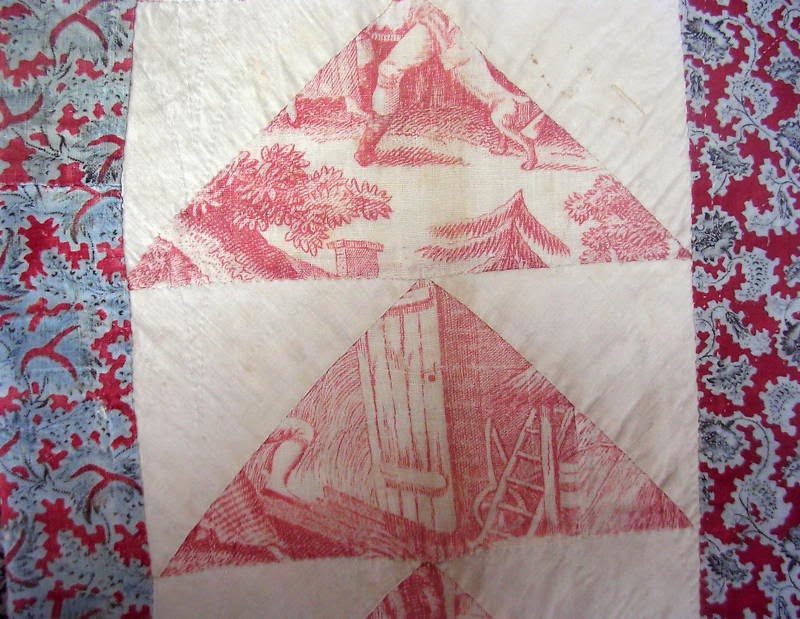
How do you know if the toile is plate printed or roller printed?
It's impossible to tell in a small swatch.

Collection of Historic New England
But if you have a bigger piece as in the early quilt above (I assume it is a bed-size quilt) you can measure the repeat. Plate prints have a large repeat of about a yard or meter. I'm guessing the quirky quilt above features true plate prints.

However, most of the toiles I've seen in American quilts are roller printed.

It's easy to gauge the repeat in border strips.

The roller print repeat is about 15"-18". Even in
a photo you can guess that the repeat in the border toile above
is not 36". It's not a copper plate print.
It's a roller print done in plate-style.

This strip quilt of two toiles from Skinner auctions
also has short repeats typical of roller printing.

Find the top of the image and the bottom
and measure it top to bottom.

I can tell from the photo that it's the small repeat typical of copper roller prints.

A roller-printed toile
What you are buying today are silk-screened toiles...

....which can feature a large repeat. They lack the detail found in the vintage fabrics printed
by copper plates or cylinders.


.jpg)


