Saturday, May 11, 2013

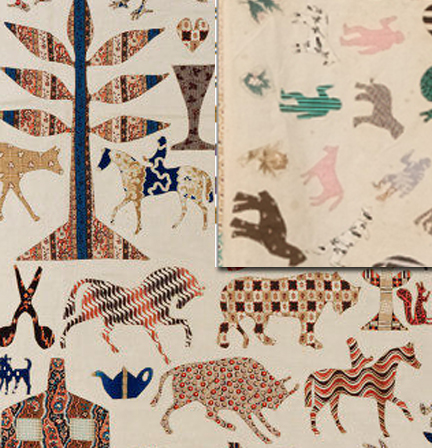
Civil War Quilt???


This unquilted counterpane has been in the collection of Vermont's Shelburne Museum since 1952.  In the original Shelburne catalog published in 1957 curator Lilian Baker Carlisle began her catalog entry with:

" This spread, illustrated and described in American Quilts and Coverlets by Florence Peto, was found in New Jersey and shows textiles much older than the Civil War period....Traditionally this counterpane was made by a Civil War veteran whose nerves had been shattered by his wartime experiences. After he was invalided home, he started this quilt as a therapeutic measure..."

She was using information from dealer and collector Florence Peto who found the quilt and probably sold it to the Shelburne. In her book Peto described the fabrics as "chintz, Scotch ginghams [woven plaids I assume], and paisley-patterned calicoes, all characteristic of the period..." 

Peto saw symbolism in the imagery:
"Crescent moons, hearts, and fat, complacent doves may have been introduced to the militant picture to humor a wife or sweetheart."

The central area has appliqued human figures around a star or sun.

This woman with something in her hand seemed familiar to Carlisle & Peto
as La Belle Chocolatiere
(The beautiful waitress in the chocolate shop)

from this 18th century pastel drawing by
Jean-Etienne Liotard,


which became part of the image of the American Baker's Chocolate Company in the 1880s.


Following a field of triangular patchwork are more human figures, men on horseback alternating with men on foot.
The last border is a variation on the patchwork field.

There seems to be a difference of opinion between Carlisle and Peto. Could it be that the quilt is made of  "textiles much older than the Civil War period." rather than "characteristic of the [Civil War] period."

Two British quilts with similar figures

It's foolhardy to try to date fabrics from photographs. The best evidence available from photos is style. This unquilted, finished counterpane has much more in common stylewise with British quilts than American.

I just doubt that it is an American Civil War commemorative.

More next week after I marshal my arguments.

Saturday, May 4, 2013

Dixie Dairy 5: Tokens of Dried Roses

Block 5
Tokens of Dried Roses

 12" version with a 1" frame, set on point
By Sandi Brothers.


Block 5
Tokens of Dried Roses
8" Version


Sarah Morgan's grief over lost memories is echoed in a sawtooth star.

Dried flowers pressed in an album dated 1867

Union and Confederate armies clashed near the Morgan houses in early August. Sarah's home was severely damaged, not from shelling but from vandalism by the victorious Yankees. The women left the Asylum and  moved from friend's house to friend's house, landing at a plantation twenty miles north of Baton Rouge. At the end of August sister Miriam returned from a trip home to their battered neighborhood.

Andrew D.Lytle 
Baton Rouge with the State Capitol in the distance

August 25, 1862 Linwood, East Feliciana Parish

"She says when she entered [our] house, she burst into tears at the desolation. It was one scene of ruin. Libraries emptied, china smashed, sideboards split open with axes, three cedar chests cut open, plundered, and set up on end; all parlor ornaments carried off…. They entered my room, broke that fine mirror for sport, pulled down the rods from the bed and with them pulverized my toilet set, taking all Lydia's china ornaments I had packed in the wash-stand. The debris filled my basin and ornamented my bed. My desk was broken open. Over it was spread all my letters, and private papers, a diary I kept when twelve years old, and sundry 'tokens of dried roses, etc,' which must have been very funny, them all being labeled with the donor's name and the occasion. Fool! how I writhe when I think of all they saw…Lilly's sewing-machine had disappeared; but as mother's was too heavy to move, they merely smashed the needles."

Library of Congress

Sewing machines were considered the machinery of war because uniforms were sewed on them. Union soldiers often destroyed machines when they came upon them. Breaking the needles was enough. With the blockade Southerners had a hard time getting replacements.


The pieced block has a BlockBase number.
BlockBase #2830
Aunt Eliza's Star

Cutting 12":
A:  Cut 1 square 6 1/8".
B: Cut 4 squares 4 1/2" for the background.
C:  Cut 3 squares 5 1/4". (1 of background, 2  for star points).  Cut each into 4 triangles with 2 diagonal cuts.

You need 12 triangles.


Cutting 8":

A:  Cut 1 square 4-1/4".
B: Cut 4 squares 3-1/8" for the background. (3-3/16" is the larger measurement if you use the BlockBase 1/16th" default)
C:  Cut 3 squares 3-7/8". (1 of background, 2  for star points).  Cut each into 4 triangles with 2 diagonal cuts.


Make 4 corner units out of square B and the triangles. Then make diagonal strips.


Optional applique
Applique a star or a heart after piecing.

Go back to the January 5, 2013 post to see a JPG with the heart and the star.


A soldier occupies a Southern mansion.
William Waud, 1864
Library of Congress

Saturday, April 27, 2013

The Medallion Set

Civil War Sampler by Ruth
She's finished the 2011 series of blocks.

Ruth at Country Log Cabin writes:


"Finally finished my CW quilt and you can find pictures of it here:
I am very happy to have it finished. I quilted it myself on my Janome 6600. "

I certainly like that fake medallion set---I guess it's a fake because it's really blocks on point alternating with pieced blocks shaded in concentric rows.

Several people used it--- like Karen D above

And Karen in Tucson

 Tora Quilt

Dutch Quilt Cat


And Domy R

If you haven't done all the 50 plus blocks from that series you might think about this set for fewer blocks
It would work for 9...

As in the center of Tora's

Or 25
As in the center of Ruth's

As well as for 49 plus 4 corners as in the finished tops above.
Here's a post with instructions:


Saturday, April 20, 2013

Circuit Rider's Quilt---An Ohio Commemorative


The Circuit Rider's Quilt
by Jenifer Dick, copy of a quilt in the collection of 
The Art Institute of Chicago

See the original quilt here:

Few quilt have the name recognition of the Circuit Rider's Quilt, an Ohio album, that has been romanticized over the past hundred years by the woman who donated it to the Art Institute and by several twentieth century quilt writers. Most recently it was a block-of-the-month in the Kansas City Star and a pattern book by Jenifer Dick---an excellent source for mid-19th century applique designs.


Although most of the history associated with the quilt has to do with the minister for whom it was made, I thought it might have some connection to the Civil War. Like many other samplers of the 1860s it features a Union shield in the center.


The shield from the original quilt.

Might we consider it a Civil War quilt or a commemorative?
I assume that there is no date actually inscribed on the quilt. The Art Institute caption and most writing dates it to 1862, which makes one think it would qualify as a Civil War quilt, but Susan Price Miller, who did an extensive study of the quilt for an American Quilt Study Group paper, dates it to 1867, based on genealogical information about the signers.

We can hypothesize that it's a Civil War commemorative quilt, however, because of the Union shield in the center. Above and below the shield are the names Augustus Troth and A.J. Troth.  Miller assumes this "symbolizes his status as a Civil War veteran." He was a private in the Ohio Infantry in the war.

The quilt was presented to George Warvel, a minister in the the Church of the United Brethren in Christ. Over the years it has come to be called The Circuit Rider's quilt, although Warvel was not a circuit rider. Miller discusses the mythmaking behind the quilt in her paper.

Miller found out more about Augustus Troth, most of it scandalous. It appears he had an affair with his wife's hired girl and left town abandoning both the wife Lizzie Troth, the servant Nancy and her child Orie. The women raised the child together. See some discussion of the scandal by descendants here:
http://archiver.rootsweb.ancestry.com/th/read/PREBLE_CO_OH/2005-03/1109803377

Jenifer Dick
Circuit Rider's Quilt
Another set for the blocks that were a 
Block of the Month pattern in the Kansas City Star

UPDATE
Jenifer Dick, author of the pattern book The Circuit Rider's Quilt added some information. She believes the quilt's name is correct as the minister for whom it was made did ride a circuit. In her book she outlines all the circuits, stations and missions he served at in his career –"All information," she says, that "I got directly from the United Brethren Church archives in Ohio. They consider him a circuit rider, so I never questioned that part of the story…
She adds:
"The reason the quilt is dated 1862 is because that’s when he left the Low Chapel where the congregation who made the quilt were. He left the appointment when he enlisted in the 167th Regiment of the Ohio Infantry , Company E. 100 days service (as a Chaplain). After his service, he did not return to Low Chapel and was onto another circuit. It would be highly unlikely that congregation would have waited 5 years to make him the quilt (not improbable though.) "

I say: Either date I think we can classify it as a Civil War quilt.

-------------
Read Susan Price Miller's "The Circuit Rider's Quilt: Romance and Reality" in Uncoverings 2009, Volume 29 of the Research Papers of the American Quilt Study Group. Order it here:
http://www.americanquiltstudygroup.org/UCDetail.asp?ID=29

Here's the abstract describing the paper:
In 1919, the Art Institute of Chicago accessioned an appliquéd album quilt which had been donated by Emma Blanxius Hodge, called the “Circuit Rider's Quilt.” Accompanying information described it as having been presented to George C. Warvel, an Ohio minister. An article published in 1923 portrayed Warvel as an iconic circuit rider of the frontier, and this romanticized story was repeated in print media throughout the twentieth century. The disparity between the romance and the reality of the quilt's story serves as an illustration of the powerful influence of the Colonial Revival movement in twentieth-century America, the roles of collectors and magazine writers in perpetuating popular stories, and the important contributions possible through partnerships between committed quilt researchers and museum curators.

I think it's enough evidence to qualify the sampler as a Civil War commemorative. I added it to my Pinterest Page Quilt Civil War.
http://pinterest.com/materialculture/quilt-civil-war/
Saturday, April 13, 2013

What's Up?

Amy at Lexington Quilter

Amy's using French General Prints


I've found many blocks from the Dixie Diary Block of the Month pattern up on the internet.

RCCheryl


Karen at Breezy Point Quilts

She's making two using Jo Morton's Alexandria prints
On her blog she says she "got sucked into it." Yay! That's my job.

Pinkdeenster is incorporating scraps of old embroidery.


Kookaburra Calling has added a second layer to the applique,
which works nicely.

And WonesmartCookie has added 
another little something to the applique.


Those above are from our Flickr Group:
http://www.flickr.com/groups/civilwarquilts2011/

I also found a few posts on other blogs....

 CookiesCreek is using pink and brown.

Reems Creek Chronicles

Keep posting those pix!

Saturday, April 6, 2013

Dixie Diary 4: Asylum


 Block 4 Asylum
8" Version

A simple block built of squares and rectangles represents Sarah Morgan's first asylum.
At the end of July, 1862,  new Confederate threats to retake Baton Rouge threw the town into a panic over the coming battle. The Morgan family---babies, mother, slaves and sisters Miriam and Lilly---ran with the rest of the civilian population to a large school for the deaf and the blind on the outskirts of town. Their refuge at the Asylum was the first in a series of exiles.

The School for the Deaf became a temporary home
 for the Morgans and after the war for
Louisiana State University.

July 24, 1862, the Asylum
"Yes; that must be the date, for one day and two nights have passed since I was writing here. Where shall I begin the story of my wanderings? I don't know that it has a beginning, it is all so hurried and confused.  But it was Tuesday evening that the Federals were seized with a panic which threw the whole town in alarm. They said our troops were within eight miles, ten thousand in number. …

Imagine what effect this had on the inhabitants! Soon, an exodus took place, in the direction of the Asylum, and we needs must follow the general example and run, too. In haste we packed a trunk with our remaining clothes, - what we could get in, - and the greatest confusion prevailed for an hour. Beatrice had commenced to cry early in the evening, and redoubled her screams when she saw the preparations; and Louis joining in, they cried in concert until eight o'clock, when we finally got off.

What a din! Lilly looked perfectly exhausted; that look on her face made me heartsick. Miriam flew around everywhere; mother always had one more article to find, and the noise was dreadful, when white and black assembled in the hall ready at last. Charlie placed half of the trunks on the dray, leaving the rest for another trip; and we at last started off.

Besides the inevitable running-bag, tied to my waist, on this stifling night I had my sunbonnet, veil, comb, toothbrush, cabas filled with dozens of small articles, and dagger to carry; and then my heart failed me when I thought of my guitar, so I caught it up in the case; and remembering father's heavy inkstand, I seized that, too, with two fans. If I was asked what I did with all these things, I could not answer. Certain it is I had every one in my hands, and was not very ridiculous to behold."


This is not Sarah but illustrates that guitars
were the same size then as they are now---
too big to take with you on the run.
We have not heard the last of the guitar.

A caba must be a container of some kind. Seventeen people from the Morgan houses fled to the asylum, including Lilly's five children, ranging from a girl about 9 years old to toddler Louis and baby Beatrice.


Sunbonnet-wearing southern refugees from Harper's Weekly.

BlockBase #3210 is the basic pieced block,
 Blocks in a Box.


Cutting 12"
A:  Cut 3 squares 4 1/2".
B: Cut 2 rectangles 4 1/2" x 12 1/2"
Cutting 8"

The red measurements use the 1/16th inch default in BlockBase
A:  Cut 3 squares 8-1/2" x 3-1/8"  (3-3-16")
B: Cut 2 rectangles 3-1/8"  (3-3/16")

It should say:
A: Cut 3 squares 3-1/8" (3-3/16")
B: Cut two rectangles 8-1/2" x 3-1/8"  (3-3/16")

UPDATE I just fixed the 8" cutting directions in October. It's been wrong for 6 months but I guess the block is so simple nobody noticed until Doreen did. Thanks, Doreen.


Optional applique
Go back to the first post January 5, 2013 to see a JPG with the heart and the star.


Saturday, March 30, 2013

A Confederate Textile

Silk handkerchief about a yard square
with blue/gray border
from the Railsplitter blog

While there are many Union textiles, particularly dress-scale prints, Confederate partisan prints are rare. The reasons are complex but have a great deal to do with the lack of a textile printing industry in the south.

Reproduction of a Union print from my 
Moda Civil War Reunion collection

The mills were in the north.

But there were mills in England that would take commissions. An English manufacturer printed this handkerchief featuring portraits of Confederate heroes. In the center is Confederate President Jeff Davis with generals in the corners.

Those pictured, beginning at 12 o'clock:

  • Morgan (?)
  • Stonewall Jackson at 1:00
  • John Mason at 3:00
  • Robert E. Lee at 5:00,
  • Raphael Semmes at 6:00
  • Pierre Beauregard at 7
  • John Slidell at 9:00
  • and Johnson at 11:00 (perhaps James Johnson)
The black and white photos are from Getty Images, which describes the dark version as a "Confederate cotton handkerchief printed in London, 1860." The Railsplitter blog noted "Examples are known in purple and powder blue."

One would imagine these textiles are rare indeed.

At the end of the nineteenth century there was some discussion of them in the press, including the New York Times, which in 1894 described two versions: a red silk example in good condition owned by Walter Aldrich of Providence, Rhode Island, and a worn white square with a blue border (much like the one at the top of the page) owned by Mrs. William Daingerfield Peachy of Washington, D.C. Lelia Russell Meem Peachy inherited it from her father Dr. Andrew Russell Meem. (See a picture of Lelia Peachy here: http://www.flickr.com/photos/27841557@N03/2594760859/

"About each of the vignettes is a wreath of finely executed cotton plants and fern leaves." The Times attributed the origins of these relics to two sets of twelve handkerchiefs ordered by Judah Benjamin when he was in England during the war."

The piece at the top recently sold at auction, and I've found references to a few other examples including one in a display (loaned by Miss Green) at the Confederate Museum in Richmond described in an 1898 catalog, which also mentioned the survivor in Providence, Rhode Island. An example in the Hall of History in North Carolina was described in a 1914 catalog and one in a Kenosha, Wisconsin public collection was described recently. The catalog of the 1888 Virginia Exposition listed a square loaned by Captain C.F. Johnston.

Questions
How many of these were printed?
Is that black and white photo really of a cotton bandana or were they all silk?
Did Benjamin actually order them when he was doing diplomatic work in London during our Civil War? The 1898 Confederate Museum catalog added to the romance with a story that Miss Green's piece was "One of twelve said to have been ordered from England by Judah P. Benjamin. Was rescued when on its way to this country from the Alabama when she sunk. Only one other [the Providence example] is said to have been saved....


Sinking the Alabama.

Rafael Semmes is pictured on the bandana. He was the commander of the CSS Alabama, another Confederate commission built in England in 1862 to harry Union shipping and run the blockade. The Alabama was sunk by a Union boat in French waters in 1864.


The CSS Alabama had it's own romance. Combining the story of the bandana with the boat seems to go a little too far in the mythmaking department. It's enough to know these were printed in small runs in various colors, that they made it through the blockades to the Confederacy and that so many survived. Now all we have to do is find a scrap of one in a crazy quilt.

Another question---since one has to be skeptical:  Benjamin escaped to England after the Civil War. Did he order these as post-War souvenirs?