Saturday, May 12, 2018

Lydia Hamilton Smith and a Movie Quilt


Tommy Lee Jones & S. Epatha Merkerson as 
Antislavery Activists Thaddeus Stevens & 
Lydia Hamilton Smith in the 2012 movie Lincoln


Always being up on the latest in cinema I just got around to
watching Lincoln, the Steven Spielberg version.

People had talked about the quilt on the bed at Lydia Smith's and Thaddeus
Stevens's 1865 Washington house.

I thought it was a good pick as far as historical accuracy, patchwork pattern and fabrics. The director and the art director obviously wanted to make a statement in that shot and such a vivid pattern certainly offers a visual counterpoint to the vivid image of the Congressman in bed with his black partner.

Green calico print in a block dated 1848


In the imaginary world here Lydia Hamilton Smith, a Pennsylvania native, might have made a quilt just like this or brought one from her home in Lancaster, Pennsylvania. The sepia movie palette has toned down the colors but I'd guess the stars are various bright colored prints set with overdyed green calico squares. The sashing looks like a California gold print.

California gold, a tiny chrome orange figure on a white ground---
very mid- to late-19th century.

The nine-patch star block, one of the oldest of patchwork designs.


Thaddeus Stevens & Lydia Smith

Well, the quilt is accurate. How accurate is the image of Stevens and Smith in bed?

They were quite the item of gossip in Civil-War era Washington. If you read the papers you'd be familiar with the story. For example in June 1868 the Idaho Semi-Weekly World had some gossip:
"Mrs. Thad. Stevens---The mulatto paramour of Thad. Stevens, generally known as 'Mrs. Thad Stevens' was robbed in Lancaster (Pa.) lately, at the railroad depot, of $100 in greenbacks and three Mexican silver dollars, one diamond breastpin....This woman's former name was Smith. She was the wife of Jacob Smith....but through the influence of Thad. Stevens she left her husband and became his mistress and his housekeeper which double position she has filled for many years! "
In September, 1866 Wisconsin's LaCrosse Democrat printed a short rant about "Good Thaddeus! sweet paramour of the mulatto wench of Lancaster!"

Their Lancaster house on Queen Street is
being developed as a historic site.

We can hope Lydia was not unduly upset by such political meanness. Even after her death in 1884 the Raleigh, North Carolina Farmer & Mechanic referred to her as "the mulatto 'wife' of Thad Stevens, the virulent South-hater who forced the Reconstruction villainy upon our people."


Lydia Smith is an interesting woman without much public record yet. She is reputed to have worked with Stevens in assisting escaped slaves before the war and during the Civil War was active in soldiers' aid activities. After Stevens died in 1868 she bought a Washington boarding house with money he had left her in his will. 

Lydia's boarding house on Newspaper Row had a view of the Willard Hotel, the
large building on the corner in this photo of the Union victory parade in 1865.


A more respectful obituary of Lydia Smith that was copied
in several newspapers in 1884.

See Stevens's underground railroad activities in the Lancaster house application for National Parks Service status on the Network to Freedom in this PDF:

Christa Achtenberg won a ribbon for her star
quilt inspired by the movie quilt.

And Jeanne at Spiral tells us she loved the movie and made a quilt too.
http://spiralj2.blogspot.com/2017/05/blockheads-week-9.html


Wednesday, May 9, 2018

Southern Charm

Collection of the Charleston Museum #1992.45.2
106" square.

The Charleston Museum's annual quilt show comes down at the end of this month. Piece by Piece: Geometric Quilts features pieced quilts from their estimable collection. I noticed that this featured quilt, an Irish Chain variation, has a lot to do with our Antebellum Album block for this month, the block I'm calling Quaker Pride.

Becky Brown's Block #4 plus 2 setting blocks

I figured out that the Charleston quilt is two
separate blocks. 

The block of blue chintz is a double
nine patch much like the alternate block in our official set---different proportion.
The block that looks like the Quaker Pride album on point is
actually the same block shaded differently.

I've seen this simple and effective pattern in a couple of other quilts. MESDA has this pretty child's quilt from the Marion family in South Carolina. Again the double nine patch is a consistent fabric with the alternate album scrappy. A striped chintz border frames it.

Harriet Kirk Marion (1782-1856)
Berkeley County, South Carolina 58" x 44"
Collection: Museum of Southern Decorative Arts MESDA

On the reverse: a label added later says this small quilt was made for her granddaughter Harriet Marion Palmer born in 1830.


My third example is also Southern. I found it in the Georgia project book Georgia Quilts: Piecing Together a History.
This one is red and green and looks later than the chintz examples, perhaps made about 1860.
 The caption:
"Aunt Ollie's Quilt (Irish Chain Variation.) Makers said to be slaves on the Northern Glover Plantation near Albany (Dougherty County, Georgia.) 101" x 109".

I drew it up in EQ. It's a block of 25 squares based on a grid of 5.
I used 2" finished squares cut 2-1/2". Each block finishes to 10".

One block is shaded like this.

The other block is shaded like this

49 Blocks makes patchwork 70" x 70"
It would make a great charm quilt if you could control the shading
into light, mediums and darks.

With a chintz border of about 6" it would be 82" square

It's a cool design but it IS a large quilt made completely of 2" squares.
A crib quilt may be more do-able. Note the vintage examples that are over 100".

See more quilts in the Piece by Piece: Geometric Quilts at the Charleston Museum. It's up till May 31.
https://www.charlestonmuseum.org/exhibits/current/30/piece-by-piece

Saturday, May 5, 2018

Dastardly Border Ruffians


In the years before the Civil War a border war was fought in Kansas where free-state and slave-state emigrants came to vote on the territory's future status. Things got ugly as you can see by this testimony before a Congressional committee.


Elizabeth Thomas described an 1856 raid by Border Ruffians (primarily Missourians) who raided the homes of antislavery settlers, hoping to terrorize them into returning to the east. Mrs. Benjamin S. Hancock was one of the victims. They carried off her flour ("flour was very dear at that time,") her pots and kettles and a ham. She wailed to no avail.
John "Randolph, who commanded them, came up and ordered him to...pay no attention to the cries of those abolition women---that they would cry for everything. I know that there was a lot of quilt-blocks; they were blown and scattered over the prairie, having been nearly torn to pieces."


Now, that is mean.

Wednesday, May 2, 2018

Antebellum Inking Ideas

Quilt block in the collection of the Philadelphia Museum of Art.

The Philadelphia Museum of Art has a couple of groups of album blocks with beautiful inking. And they have good shots of the signatures, which can be quite inspirational. Here are a few from a set of star blocks attributed to Malinda Gamble.


To see these click here:
http://www.philamuseum.org/collections/search.html
Search for QUILT BLOCK. You can't right click to save these so you might want to do a screen capture if something captures your eye.

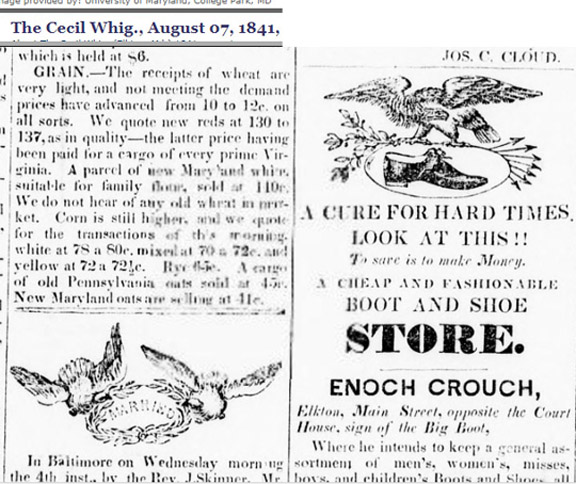
Maryland's Cecil Whig 1841

The album signers may have themselves been inspired by newspaper illustrations. Publishers could commission or buy small engravings for the masthead or advertisements.

Baltimore Daily Clipper, 1846

Saturday, April 28, 2018

Memorial Quilt for an Ohio Soldier

The Ohio quilt project documented a memorial quilt from
1869 with two mourning blocks lamenting the death
of Lewis A. Hulse.

"Lewis. A. Hulse. 
Member Co A 69th Reg O.V.I. 
Died Feb 16th 1863, at Nashville Ten 
From a wound received at the Battle 
of Stone River Age'ed 18 years"

Lewis's older sister Loretta Emeline Hulse Ayers, known as Emme, is said to have pieced and inked the family record quilt. It seems she copied the text from his tombstone in Rose Hill Cemetery in Mason, Ohio.

"Lewis Albert
Eldest son of
David & Ernestine Hulse
Member Co A 69th Reg O.V.I. 
Died at Nashville Tenn
 Feb 16th 1863, 
From a wound received at
The Battle of Stone River 
Aged 
18 years & 4 D's"

The quilt is discussed on pages 118 and 119 in the book
Quilts in Community: Ohio's Traditions


The Hulse family lived in Butler County, north of Cincinnati, Ohio on a farm near Pisgah.

A local history tells us about Lewis who was "born Feb 12, 1845. Energetic and patriotic, he enlisted Sep 1862, in the 69th Ohio Volunteer Infantry. At the battle of Stone River, the first battle he had an opportunity to be in, he was acting as a scout. On the morning of Dec 31 he was shot down, although living until Feb 16, 1863."


The Battle of Stones River [the current Tennessee spelling] is also known as the Second Battle of Murfreesboro and took place between December 31, 1862 and January 2, 1863.


Lewis appears to have been wounded in his leg, probably cared for in a makeshift hospital like this one pictured in a postcard from about 1910.
"During the late war, Pisgah furnished a score of men for the army, out of which a full dozen either were killed outright, died in hospital, or from the effects of the hardships and exposures of camp life soon after returning home. Lewis A. HULSE, son of David HULSE, was a mere lad when he shouldered his musket for the army. He was wounded at the battle of Stone River, and died in camp."
Loretta Emeline Hulse was born September 7, 1842. She is buried in the same graveyard (with a misspelled record on Find-A-Grave.) She married James Ayers and had at least one son, dying at 51 years old in 1893. Her quilt is a memorial to her and her brother.


Wednesday, April 25, 2018

Antebellum Album 4: Quaker Pride

Antebellum Album 4: Quaker Pride by Mark Lauer

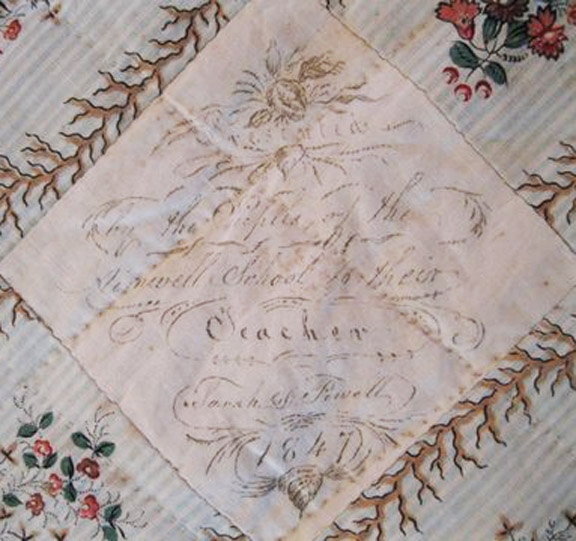
Block from the Aimwell School Quilt, Philadelphia, 1847.
 Collection of the Historical Society of Moorestown, New Jersey.


This month's block is found in a lovely Quaker quilt made for a 30-year-old Philadelphia teacher. 

"Presented by the Pupils of the Aimwell School to their 
Teacher, Sarah D. Powell, 1847." 


We saw the quilt at the AQSG meeting in New Jersey a few years ago.
I recognize Karen Alexander, Ginny Gunn and me admiring the fabrics.

The Aimwell School, on Cherry Street below 
10th, photographed by Robert Newell, about 1870.

Sarah Dutton Powell was born in Nether Providence, Pennsylvania, in 1817. Her own schooling was at the Quaker Westtown School in Chester County, where she graduated with the class of  1838. 

Embroidered sampler featuring the Westtown School
founded in 1799, near Philadelphia.

When Sarah was a student the female curriculum at Westtown still emphasized sewing. A short history of the sewing room there:
"Sewing was generally taught in girls' schools over the country; it was a special recommendation to a teacher that she could make a handsome sampler—at times that was the main object in attending school....In 1815 we are told that 'two weeks out of six were passed by the little girls in the sewing-room, no matter what their proficiency in the art.' "
The Committee of Instruction eliminated the sewing course in 1843 after Sarah's graduation.

Quaker needlework traditions with their early 1840s emphasis on friendship quilts undoubtedly influenced the fad for signature quilts. As a major Quaker academy Westtown School attracted Southern students whose parents valued Quaker or Friends culture over any North/South prejudices. So we can imagine that schoolmates from both sides of the Mason-Dixon line signed album blocks.

Westtown in 1840.
The school claims to be the
oldest co-educational school still operating in the U.S.

Westtown takes great pride in its over 200 year history, but the Quaker girls' school where Sarah taught was three years older. Founded by Anne Parrish (1760-1800) to give poor girls a proper education, she charged no tuition. Named for an educational goal, the Aimwell School was supported by contributions until it closed in 1923.

Sarah's quilt might have been made as a going away gift by her Aimwell students or as an engagement celebration. She married Isaac Leeds of Moorestown, New Jersey on March 28, 1849 at Philadelphia's Twelfth Street Meeting.

 Twelfth Street Meeting House

Block 4 by Becky Brown

The Block
Our fourth album block has remained popular as a signature pattern since the 1840s.

Emily Vandergrift Snyder's Philadelphia quilt
recorded the death of her husband and three of her children.
See the whole quilt in the collection of the Los Angeles County Museum of Art here:

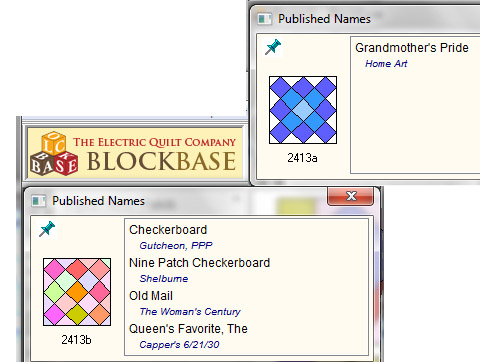
As #2413a & 2413b in BlockBase it has several published names.


Names include Grandmother's Pride so I've called this month's pattern Quaker Pride because of its popularity with Quaker album quiltmakers.

Cutting a 12" Block


A—Cut 2 squares 2-7/8”. Cut each in half diagonally. 

 You need 4 small triangles.

B—Cut 2 squares 5-1/4”. Cut each into 4 triangles with 2 cuts.


You need 8 large triangles.

C—Cut 13 squares 3-3/8”.

Two blocks by Denniele Bohannon


The Civil War & After

Like several other young women followed here Sarah Powell Leeds did not live to see much of the Civil War. She died at 44 in July 1861, leaving five children three to ten years old. We can guess that she and a sixth child died at a time when almost 60 of every 1,000 births resulted in the mother's death.

The red vertical line is British data for 1860.
In 1990 the U.S. maternal death rate was 8.2 per 100,000; 
In 2007: 12.7 per 100,000. 
When Sarah died the rate was 6,000 per 100,000.

Statistics were no better in 1889
when this spirit photo of a motherly ghost
was published.

+
Pat Styring
A little applique, a little fussy cutting.

Again Sarah's quilt probably survived because she did not. Her children may have treasured it as a relic: "Sacred to Memory" to use an old-fashioned term.

Sentiment for April
For the Quakers a dove of peace

Mark's second block in traditional color

See the Aimwell School Quilt files here at the Quilt Index:

And Lynda & Mary show several details of the blocks at Quaker Quilt History:
http://www.quakerquilthistory.com/2012/11/anne-parrish-and-aimwell-school.html
http://www.quakerquilthistory.com/2013/12/literacy-numeracy-and-useful-work.html


Quilt dated 1851 in an ad from antique dealer Susan Parrish.
Three of the blocks are this month's pattern.

 Westtown Reunion in the 1880s