Saturday, August 11, 2018

Unlikely Civil War Story with an Early Quilt

Civil War Handkerchief Medallion by 
Susannah Johnson Justice
Michigan State University Museum
#85.0180

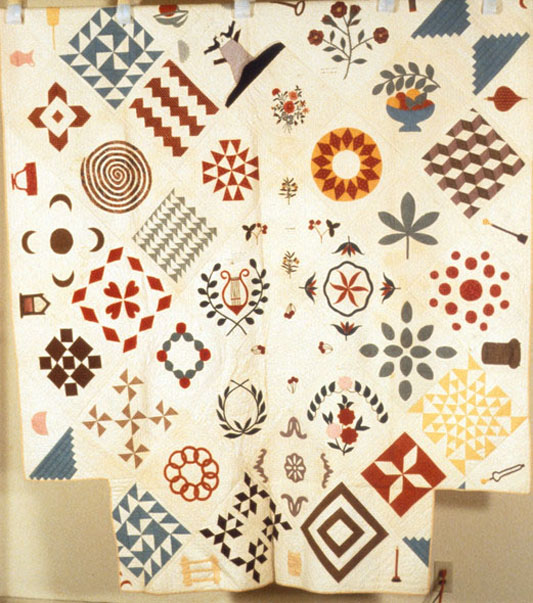
An unusual quilt with a Civil War tale. According to museum notes:
"This pieced quilt has been passed through four generations of Susannah Johnson Justice's family....[She] fashioned the quilt in 1875 to commemorate her country's centennial and as a memorial to her late husband Jeremiah Justice.....Susannah had a large handkerchief, reported to have been carried by her husband in the Civil War. In 1875 she decided to use it to make a centennial quilt in honor of the centennial which would be celebrated the following year."
The 1876 Centennial inspired a resurgence in quiltmaking and many quilts have links to the celebration. This framed center style in this one looks older, however.

The quilt is 68" x 70"  almost square.


I calculated that the center piece is about 36" square.
It certainly looks like a bandana or kerchief. 

The quilt's style and fabric look earlier than 1876 or even 1856. The center square is
really no help in dating as they were produced over such a long period
and so popular.

Kerchief, about 1820, England, about 29"
Collection of the Victoria & Albert Museum

Two printed in England in the early 19th century.

Kerchief, about 1810, England
Collection of the Victoria & Albert Museum
about 35 inches


A soldier might well have carried a similar red handkerchief with him during the war but
the frame style and the other fabrics look to be decades earlier than the Civil War.

The brown chintz as an outer border (the lower strip) is a fabric typical of pre-1840 quilts
like the medallion documented in the Connecticut project in the
collection of the Litchfield Historical Society

This one is dated to the 1820s.


The Justice quilt may well have been a family heirloom passed down from the Justices or the Johnsons. And somehow a Civil War/Centennial story became linked with it.

Susana Johnson Justice (about 1813 - 1887)
The photo looks to be from about 1860 when she
was in her late forties.

More from the museum notes:
"Susannah Johnson was born somewhere in Pennsylvania ca. 1813. Before 1820 her parents had moved to Tuscarawas County, OH. She was married in Holmes County, OH, March 6, 1834 to John Justice, who died January 11, 1849 in Wood County, OH. She then married his younger brother, Jeremiah, who was several years younger than she, and moved to Fulton County, OH. There Jeremiah enlisted in the Civil War along with his nephews/stepsons. 
"None of the families today know what happened to Jeremiah after he was mustered out at Louisville, KY, in August 1865, exactly 3 years after he entered service, but he had been in ill health much of that time and it is assumed that he soon died.

Private Jeremiah Justice of Company H, 111th Ohio Volunteers, was "declared unfit for further field service" and transferred to the Invalid Corps in November, 1863.

Veteran's ribbon from the 111th O.V. I.
Ohio Volunteer Infantry
"About 1867 Susannah and all her children, married and unmarried, moved to Campbell Township, Ionia County, MI."


An 1872 county directory lists Mrs. Susan Justice on Campbell Street. Thomas Jefferson Justice her son, born in 1843. He and brother Wesley, born in 1839, were veterans of the 67th Regiment OVI. Both are listed on the bronze tablets on Fulton County, Ohio Soldiers Monument completed in 1918. 


Clarksville, Michigan was the closest town to rural Campbell Township.
It just seems unlikely the quilt was made in Michigan in the 1870s.

Wednesday, August 8, 2018

Alternate Set for the Antebellum Album

Watercolor of a quilt date inscribed 1847 from the 
W.P.A.'s Index of American Design

The quiltmaker was Caroline Lusk of New Baltimore, New York; the painter Jenny Algrem in 1938. The quilt has been in the collection of the Brooklyn Museum since 1925.

Lucy Irene Blowers, about 1849, Fabius, New York

Caroline's quilt with its on-point set and minimal appliqued edge design is similar to another New York album quilt that Linda Lipsett showed in her book Remember Me.


The idea of setting our Antebellum Album blocks on point with sashing and an appliqued edge block occurred to me. If you enjoy applique it's a nice option.

You'd really have to enjoy applique to do this set and border
from a New Jersey quilt from Stella Rubin's inventory.

It's Block #6 Friendship Star set on the diagonal
with three or four simple appliques in the edge triangles.


Now Barbara Schaffer has noticed this appliqued edge to a pieced quilt too.

Inspired by Lucy Blowers's quilt Barbara stitched a mini.
The block is #7 Chimney Sweep.

Antebellum Album
63.75" x 63.75"

I had a very similar idea for this alternate set using the leaves from the Brooklyn Museum's quilt.
Above, the first seven blocks on point. For this set you need 13 blocks instead of twelve.

I drew the quilt up in EQ with 3" finished sashing. My mockup is rather crude but it shows that you need 8 large triangles with applique and then 4 corner triangles


Applique Patterns

Here's a modified version of the three-lobed leaf in the Brooklyn Museum's album,
one piece, no stem. The two-lobed leaf is for the corners.


To Print:
  • Create a word file or a new empty JPG file. 
  • Click on the image above. 
  • Right click on it and save it to your file. 
  • Print that file. Check to be sure the inch box is an inch. 
  • Add seam allowances when you cut the fabric. 

Applique Backgrounds
7/8 of a yard for the background triangles.

The finished block size is 12" so the 8 edge triangles backgrounds should be cut like so:


Cut 2 squares 18-1/4". Cut each into 4 triangles with two diagonal cuts. You need 8 triangles.

For the 4 corner triangles:
Cut 2 squares 9-3/8". Cut each in half diagonally with one cut. You need 4 triangles.

Sashing Fabric: 3 yards. You should be able to get the binding out of that too.

Cutting the Sashing 
18 strips 3-1/2" x 12-1/2"
2 strips 3-1/2" x 18-1/2"
2 strips 3-1/2" x 48-1/2"
2 strips 3-1/2" x 78-1/2"
What about that 13th block?

You could use four of the tri-lobed leaf for a center applique. Put some fancy inking in the center of the center block.


Saturday, August 4, 2018

Major Henry Chew's Civil War Quilt: Chimney Sweep


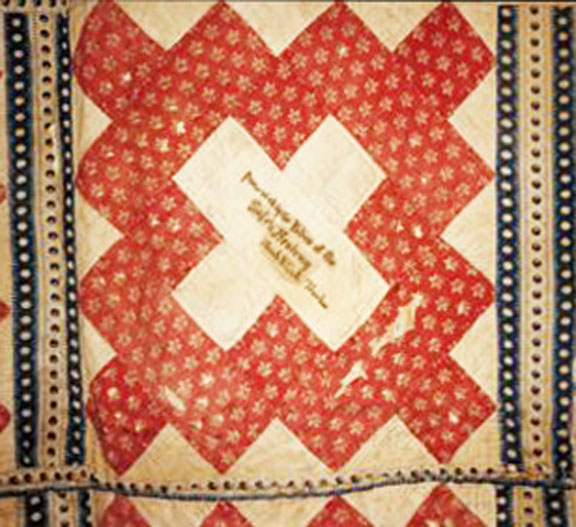
"Presented by the Ladies at the Salem Academy, Miss A..... teacher."
The name may be Miss A.R. Dall
New Jersey's Salem Academy was founded in 1818.

This month's pattern for the Antebellum Album BOM is the very popular Chimney Sweep signature design. Here's a quilt with a connection to a school and the Civil War.


The quilt is in the collection of the Salem County Historical Society in New Jersey and was documented in the New Jersey project. Notes say, "Quilt was carried through the Civil War by Captain Henry Chew."

Major Henry Franklin Chew (1837-1918)
of Camden, New Jersey

According to the Camden County history Henry Chew attended the Friends' Academy in Salem. (Salem had several schools---the quilt says Salem Academy.) He became a wheelwright, a specialty carpenter, before he enlisted in his early twenties. After the war he practiced as a dentist, marrying Marietta Fogg (1845-? ) on December 6, 1868. They had two daughters Helen and Mary.

Henry took this quilt on a long journey reflected in its current appearance. Chew commanded the Ninth New Jersey Regiment Company I and then the Twelfth New Jersey Regiment.

Drum with a record of the 12th NJ Regiment Battles.

Monument at Gettysburg Battlefield to
Chew's regiment

Why Henry in his teens or early twenties deserved such a quilt is unknown. The Quilt Index records say that some of the names on the quilt are Lippincott and Richmond.


Similar quilt. "Margaret Bellinger's Album Quilt"
Dated 1850
The album pattern stitched of Turkey red prints was an antebellum fashion.

1847, Huldah Brewester, Greenville, Connecticut

 In the fad for friendship quilts it was something of a late-comer, however. Other patterns were fashionable beginning in 1843 but this one doesn't show up until 1847.

Blocks dated 1847 to 1854 in a quilt top in the Connecticut
Historical Society from Hartford, Enfield & Fair Haven

1847, Connecticut, Found in the Connecticut project.
Photo from the Quilt Index

 I have several examples of Chimney Sweep designs with blocks dated 1847 but haven't seen any earlier.
1847 on the blocks, Hopkinton, Rhode Island
Found in the Rhode Island project.
Photo from the Quilt Index

A New England invention?

New Englander Ruth Finley recorded the name Chimney Sweep in her 1929 book:
"For such readers as in their youth missed the precarious joy of climbing on roofs and thus becoming intimate with chimney tops, it may be of interest to add that the blocks of the 'Chimney Sweep', made of brick shaped patches and squares, have a not unduly far-fetched resemblance to the opening at the top of the oldest type of American house chimney."
See more examples at this post:

Wednesday, August 1, 2018

Antebellum Albums: A Sampler of Samplers

From the Massachusetts project & the Quilt Index

Each month I post an antique sampler or two with the monthly block.

From an online auction in 2002

I chose the twelve blocks in this years B.O.M. from my files of pictures of signature sampler quilts with pieced blocks.

From the Oxford Female Academy in Chester County, Pennsylvania,
Collection of the Chester County Historical Society

 I have a lot larger file of antebellum albums that are predominantly appliqued---but pieced is the theme.


I picked twelve pieced blocks that I saw with some frequency, ignoring the
quirky blocks that seem one of a kind.

Quilt from the Robbins family dated 1842-1843, Gloucester County,
New Jersey project & the Quilt Index.

Although quirky blocks would be a great topic for a B.O.M.

Quilt for Sophia Blake Sawyer,
Collection of Historic New England
No spirals, ever!


I didn't choose popular blocks that required show-off piecing either.

Quilt from the Sykes family, New Jersey, DAR Museum


Although show-off piecing would also be a good B.O.M

Tried to keep the set-in seams (Y-seams) to a minimum.

From the Massachusetts project & the Quilt Index

A B.O.M. with all Y-seam blocks might be good
for personal growth but probably not going to have a lot
of stitchers quilting along.

For George Washington Reed, 1846, Luzerne County, Pennsylvania
from a Bonham's auction

Section of a quilt shown in the Baltimore Sun
from their morgue.

So be aware I am looking out for you in choosing
the twelve blocks. 

Requirements:
1) Popular in pieced samplers.
2) Not so hard that there is crying involved.
(either for me in drawing the pattern or you in piecing the block)