Saturday, May 7, 2011

19 Missouri Star


Missouri Star by Gloria Clark


Missouri Star can remind us of Mattie Lykins Bingham who represents well the torn loyalties of the people of Missouri. Wife of two Union sympathizers, she maintained her Confederate allegiances to her death in 1890.


Mattie about 1875.

In early May, 1861, Confederates seized arms in Kansas City and gathered near the St. Louis Arsenal intending to confiscate weapons there. Federal troops raided their camp and marched the captured Confederates through St. Louis inspiring violence from rebel bystanders. The St. Louis Riots increasing hostilities between the country residents with roots in Kentucky and Tennessee and the city dwellers, recent immigrants from Germany and Ireland. The Union armies might control the cities but no one could control Missouri's rural areas.  

Mattie, born in Kentucky in 1824, married Kansas Citian Johnston Lykins, a former missionary to the Kansas tribes, who made a good deal of money in real estate. Although her banker husband was a Unionist in a Union town, Mattie was an outspoken Southron, to use a period word.

Missouri remained a Union state. In 1863 the Federal forces governing Kansas City banished her to the country for the duration. She was suspected of spying for Confederate guerillas, particularly blamed for their deadly raid on the Union town of Lawrence, Kansas. Kansas Citians told of her waving to her husband on the shore as the riverboat took her to her exile, calling to him to take care of his laundry.

After the War Mattie returned to Kansas City and became the woman behind local campaigns to remember The Lost Cause. She organized Confederate burial grounds, an orphanage and an old soldiers' home.

A weathered angel watches over children
 at a school on the site of
Mattie's Confederate Orphanage in Kansas city.


After Lykins's death in 1878 she married former Union officer George Caleb Bingham. Bingham, a well-known artist, painted "Order Number Eleven," depicting the banishment of Southern sympathizers from their homes in 1863.


A detail of Bingham's Order Number Eleven.
Get your applique needles ready,
 we'll be doing a quilt pattern named Order Number Eleven in a few months.


Mattie left a will directing that all Bingham's paintings be sold to fund the Missouri Confederate Home. She's buried between the graves of her two husbands at Kansas City's Union Cemetery.


Missouri Star is #2154 in BlockBase and my Encyclopedia of Pieced Quilt Patterns. The name was given to this star by the Nancy Cabot column of the Chicago Tribune in 1933.


Cutting an 8" Finished Block

A Cut 4 squares 2-1/2" light.
B Cut 2 squares of medium and 2 squares of dark each 3-1/4". Cut each into 4 triangles with 2 cuts. You need 4 triangles of each.


(See below of another idea for these triangles if you are working small.)
C Cut 1 square 5-1/4" light. Cut it into 4 triangles with 2 cuts. You need 4 triangles.


D Cut 2 dark squares 2-7/8". Cut each into 2 triangles with 1 diagonal cut. You need 4 triangles.


E Cut 1 medium square 3-3/8".


Another idea for the star points B if you are working small. Instead of using the measurements for B cut 8 more triangles the same size as D but fussy cut them across a stripe. (Make yourself a transparent template from one of your D pieces so you get the stripe right.)


The beneficiary of Mattie's will:
The Confederate Home of Missouri


Read more about the remarkable Mattie Lykins Bingham in my book on the Civil War on the Missouri/Kansas border: Borderland in Butternut and Blue.
Click here:


And read more about George Caleb Bingham by clicking here:

Rose Ann Findlen has published a new biography of Mattie through the Jackson County (Missouri) Historical Society. Click here to read about Missouri Star: The Life and Times of Martha A. "Mattie" (Livingston) Lykins Bingham:


Woman with a reading glass

Mattie's been in the news in Kansas City lately. A very lucky woman bought an unsigned portrait of a woman in a Missouri antique shop. It looks just like Mattie to me, and many people believe it to be a lost Bingham painting of his third wife.  

Missouri Star
by Becky Brown

Saturday, April 30, 2011

18 Union Square


Union Square can represent the Union recruits,
eager to sign up in the spring of 1861.


Individual Union states were responsible for raising troops to fight the new war. Using the same organization that worked during the War with Mexico in the 1840s, local militias volunteered under charismatic commanders. Ohio's George McClellan was state militia commander, Major General of Volunteers, and exceptionally good at attracting troops.Young men were drawn by patriotism and promises of glory, much to their mothers' anguish.


Milan Ohio April 20, 1861

"Dear Carlos
Likely you have heard about the war down South….You may have heard that Mrs. Dan. Hamilton tried to stop Will, who had enlisted at Springfield---she was too late---he had marched before she got there---She is said to consider it a greater affliction than any previous one, which have been many and severe."
H. Colton


The photographs are from a Flickr Group and the Library of Congress called Civil War Faces. The Liljenquist Family recently donated their rare collection of almost 700 ambrotype and tintype photographs to the Library of Congress in remembrance of the Union and Confederate soldiers who served in the American Civil War. Click here to see the soldiers: 


I brightened up the portraits a bit so you can see how young some of the boys are.

These beautiful photograph cases may give you quilting ideas for mid-century reproductions.


Recruiting units later used bonuses and a draft as well as patriotism and honor to attract soldiers.


Union Square is BlockBase #2417, given that name in the Nancy Cabot column in the Chicago Tribune of the 1930s.

Cutting an 8" Finished Block

A - Cut 4 dark squares 2-1/2"
B - Cut 4 medium squares 2-7/8".


 Cut each into two triangles with one diagonal cut. You will need 8 triangles. You may want to cut these triangles a little larger, say using a 3-1/4" square, and then trim them.

 C - Cut 5 light and 4 dark squares 2-3/8" for the center nine patch.


The letter above is from The Colton Letters: Civil War Period 1861-1865, edited by Betsey Gates. McLane Pub., 1993. The letters are from a large Ohio family of young men and women.


Saturday, April 23, 2011

17 Comfort Quilt


The Comfort Quilt
by Becky Brown

Woven comforters warmed many patients

The Comfort Quilt pattern, given that name in the Kansas City Star in 1940, has two meanings. The patchwork looks like a geometric woven comforter pattern---bedcoverings were often called comforts in the 19th century. The design can also serve to remember Dorothea Dix and the Civil War nurses on both sides who comforted the wounded and ill.

Dorothea Dix
From the National Portrait Gallery
 at the Smithsonian Institution

On April 22, 1861 the Union Secretary of War accepted social reformer Dorothea Dix's offer to organize an "Office of Women Nurses." Despite disapproval from female society and from male doctors who believed women did not belong in hospitals, Dix recruited thousands. Women answered her call for nurses  who were "sober, earnest, self-sacrificing, self-sustained, calm, gentle, quite active and steadfast and willing to take and to execute the directions of the surgeons."

A nurse and her patients take the air
 in Fredericksburg in 1864

Dix's reputation has suffered from the backlash of ridicule that often results from a woman's assuming a position of power. Diarist George Templeton Strong described her as a "philanthropic lunatic," and journalist Jane Swisshelm called her "a self sealing can of horror tied up with red tape."

Dix devoted her life to reform,
first in the care of the mentally ill
 and then with Army hospitals

Even those who respected her agreed she could be dictatorial and demanding. As nurse Georgeanna Woolsey put it,
"We have had an encounter with Miss Dix, that is rather the way to express it. Splendid as her career has been, she would succeed better with more graciousness of manner."

A field hospital with a nurse second from right.
She has been identified as Cornelia Hancock.
Don't tell Miss Dix about that hoopskirt.

Dix's Plan for Nurses outlined the rules:

"No women under thirty need apply to serve in government hospitals. All nurses are required to be plain-looking women. Their dresses must be brown or black with no bows, no curls, no jewelry and no hoop skirts."
Charlotte Wilson in New York soon heard of the nurse recruitment:
"I went this morning to the Cooper Institute to see the operation of an admirably organized society for the relief and aid of the sick and wounded soldiers. This society is in communication with Miss Dolly Dix who informs them of the wants of the Washington Hospital….There is an organized body of Nurses, being trained here in the Hospital. One of the first questions asked a woman who is ambitious to become a Nurse is whether she is over thirty. None under that age are accepted. It is wonderful how many find it impossible to confess they are over thirty."
We smile today with Charlotte at all the obstacles put in the way of the women who wanted to help. In this first month of the proposed 30-day war, no one had any idea what lay ahead in the hospitals.


Cutting an 8" Finished Block.
 Scraps of indigo blue prints would add to the
look of a woven coverlet. The pattern is BlockBase #2031

A- Cut 8 blue squares 2-1/4"
B- Cut 4 light rectangles 2-1/4" x 5".
C- Cut 4 light rectangles 2-1/4" x 1-1/2"
D- Cut 1 blue square 1-1/2"
C- Cut 4 light rectangles 2-1/4"


Read more about the role of nurses in Chapter 5 of my book Civil War Women. Click here for more information:

Several nurses published their memoirs and diaries in the 19th century. Read Louisa May Alcott's Hospital Sketches at Google Books by clicking here:

And Georgeanna Woolsey's Hospital Days by clicking here:

Here's a block from our Flickr group by A.E.A. Quilts

And one by Ellen from American Homestead


Saturday, April 16, 2011

16 White House


White House by Becky Brown

The White House block can remind us of Washington City, the U.S. capitol perched on the Virginia state line. As the Lincolns settled into the President's House during the first weeks of the War, Washingtonians were choosing sides and leaving the city.


The White House
Photograph attributed to 1860-1880

Elizabeth Lindsay Lomax lived near the White House on G Street. A widow in her sixties, she was born in Virginia and married to a Virginian, an Army officer who'd died twenty years earlier leaving her to raise their large family.


Painting by A. Meyer from the Library of Congress
The unfinished capitol dome loomed
over the city in the first years of the War.


Trinity Episcopal Church
Early 1860s

Elizabeth's diary gives a vivid account of living in the nation's capitol in the week after Fort Sumter. Her youngest son, 25-year-old Lindsay, was in the U.S. Army, a graduate of West Point. He and his friend Jeb Magruder spent time at Elizabeth's house that week. 
April 16, 1861
Rained all night.
Reported again last evening that Virginia has seceded, but it is not believed.
Events crowd so fast that I cannot relate them in my diary.

April 18
Virginia has seceded!! Heaven help us.

April 19
Visitors all day long.
Many people are leaving the city. Great excitement and unrest.

April 20
Mary Buckler and Julia went to Alexandria [Virginia] this morning to see Emily Page, and found difficulty in returning home, crowds everywhere and soldiers on guard and everything in a disturbed state.
The Jefferson Davis house in Washington,
 abandoned by the family in 1861.


An artist's depiction of Massachusetts troops in
Baltimore attacked by Confederate sympathizers.
April riots in Baltimore and Washington
 frightened residents into leaving the cities.


April 21
This has been a frightfully exciting day. Riots here and in Baltimore, many persons shot, also a heartrending day for Lindsay and for me. …This evening Lindsay told me that he had sent in his resignation; Colonel Magruder has also sent in his resignation from the army and will go to Virginia tomorrow where Lindsay will join him…

Lindsay's April 21st letter of resignation to his U.S. Army commander was published in her diary. Here is the first paragraph.


Dear [Lt. Geo] Bayard:
I cannot stand it any longer and feel it my duty to resign. My State is out of the Union and when she calls for my services I feel that I must go. I regret it very much, realizing that the whole thing is suicidal....

Lunsford Lindsay Lomax, 1835-1913  

The White House pattern is a variation of mid-20th-century block, designed first by Nancy Cabot in 1937 and modified by the Famous Features syndicate. The 1930s blocks included small nine patches or stripes in the outer squares, a little too much piecing for an 8" block (It's BlockBase #1146). Here I've changed the pieced stripes to a fussy-cut striped print.

Cutting an 8" Finished Block

A- Cut 4 dark, 4 striped and 4 light squares 2-1/2". You want to fussy cut the striped squares by lining one up against the right side of the ruler and doing the same with piece B when you cut it. That way the stripes will realign when you piece A and B together.


B- Cut 4 squares of striped fabric and 2 squares of light 2-7/8".


Cut each into two triangles with a single cut.
Use only the striped triangles that match piece A---you'll get one out of each square you cut. Save the other parts for another block. You need 4 striped and 4 light squares.


GigiBrod's block from the Flickr group

Elizabeth Lomax's diary was published in 1942.  It's not available online (it IS on the subscription site Ancestry.com) Your library may have a copy.

Elizabeth Lindsay Lomax, Leaves From an Old Washington Diary, 1854-1863. Lindsay Lomax Wood, editor. Dutton, 1943.
Her son Lindsay went on to become a Major General in the Confederate Army. He survived the War to become president of the school we call Virginia Tech and active in many veteran's associations and causes.
 
An updated look with a stripe by LJ Bush from the Flickr site with a new pattern piece combining A and B.
 

Saturday, April 9, 2011

15 Fort Sumter

Fort Sumter
The Fort Sumter block was given that name in the Chicago Tribune's quilt column in the 1930s.
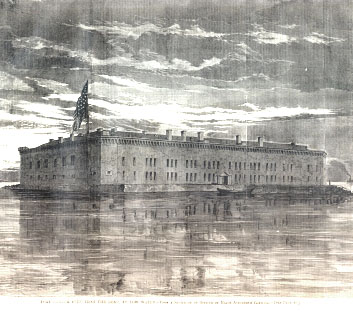
In Charleston 150 years ago this week,  Mary Chestnut's husband was negotiating with the Yankees before the Confederate bombardment of the Union fort in Charleston's harbor.
"His interview with Colonel Anderson [Federal commander at the Fort] had been deeply interesting, but Mr. Chesnut was not inclined to be communicative. He wanted his dinner. He felt for Anderson and had telegraphed to President [Jefferson] Davis for instructions—what answer to give Anderson, etc. He has now gone back to Fort Sumter with additional instructions….


Colonel James Chesnut, Jr. during the War
I do not pretend to go to sleep. How can I? If Anderson does not accept terms at four, the orders are, he shall be fired upon. I count four, St. Michael's bells chime out and I begin to hope. At half-past four the heavy booming of a cannon. I sprang out of bed, and on my knees prostrate I prayed as I never prayed before.


There was a sound of stir all over the house, pattering of feet in the corridors. All seemed hurrying one way. I put on my double-gown and a shawl and went, too. It was to the housetop. The shells were bursting. In the dark I heard a man say, 'Waste of ammunition.' I knew my husband was rowing about in a boat somewhere in that dark bay, and that the shells were roofing it over, bursting toward the fort."


Mary watched the battle from the
 roof of her house in Charleston,
a scene pictured in Harper's Weekly, May 4, 1861

Fort Sumter guarded Charleston's harbor. This map adapted from Wikipedia shows the bombardment that Mary Chesnut witnessed. The Fort (the red star) was fired upon from points on land north, east and west.


The Fort before the shelling.
 Picture from Harper's Weekly, April, 1861.

The quilt block, named by the fictional Nancy Cabot who wrote the quilt column for the Chicago Tribune in the 1930s, seems to symbolize the Fort in the harbor. The central nine-patch can stand for the building. The blue triangles around it can stand for the water in the harbor.

In actuality the Fort is a five-sided structure.

The red shapes in the corners can symbolize the lines of fire from the shore.


Cutting an 8" Finished Block

A - Cut 4 red rectangles 3-1/2" x 2-1/2". You'll trim the outside points at 45 degree angles when you've finished piecing the block.
B - Cut 2 blue squares 3-7/8". Cut each into 4 triangles with two cuts. You need 8 triangles.

C - Cut 4 light squares 1-1/2".
D - Cut 4 dark rectangles 1-1/2" x 4-1/4".
E - Cut 1 medium square 4-1/4".


The block has two variations, found as number 2423 or 2461 in BlockBase. Another name is Four Points.


An account of the the week's news
 in the Chicago Tribune, April, 1861


Mary's portrait from her book

Witness the War from Mary Chesnut's point of view by downloading her diary or adding this site to your favorites:
You can check it every week to get her perspective as a Confederate government insider who is perceptive enough to foresee the horrors ahead.

LAST MINUTE UPDATE

Fort Sumter by "Sewprimitive"

"Sewprimitive" posted this block early this morning on the Flickr group. She copied the pictures above onto fabric and created the Fort Sumter block out of the period graphics. Very clever!