Saturday, December 24, 2022

Why a Sanitary Commission?


Library of Congress
Sanitary Commission in the field, 1863, Alexandria, Virginia

Brady Studios Photograph
Men who administered the Sanitary Commission during the Civil War:
William Van Buren, George Templeton Strong, President Henry Whitney Bellows,
 Cornelius R. Agnew & Oliver Wolcott Gibbs

The Union's Sanitary Commission worked best when the men who ran the organization cooperated well with the women laboring at the grassroots level. Above, the top brass who saw a need for such an organization in the first weeks of the war. 

Brady Studios photo of the White House in 1861

When civic-minded New Yorkers attorney George T. Strong, his father-in-law Samuel Ruggles and Unitarian minister Henry Whitney Bellows visited Washington to confer with the War Department's Medical Branch they were so dismayed by hospital conditions and the logjam of bureaucracy in the Union Army they decided to act on their own.

"The old Medical Bureau was, by the universal consent of all but its own members, the most narrow, hidebound, fossilized, red-tape-y of all the departments in Washington. It was without influence or weight...Lincoln actually did not know who the Surgeon-General was." George Templeton Strong

Surgeon General Dr. Clement Alexander Finley (1797-1879)
His term of office was less than a year. The Sanitary Commission convinced
Lincoln to give them a say in his replacement.

William Hammond replaced Finley in 1862.

In June, 1861 Lincoln signed an executive order establishing a Sanitary Commission. Initial goals were to facilitate the distribution of supplies Northerners were gathering, assistance the War Department ignored. The Commission absorbed the early women's aid groups such as New York City's Women's Central Association of Relief.


During the war almost 300 local aid societies operated under the Commission, raising five million dollars in cash donations and the equivalent of fifteen million in supplies including clothing, food and bedding. They organized supply depots, railroad and ship transportation for patients and supplies and staffed dozens of hospitals, all run by the men's standing committee in New York who met daily. 

 Sanitary Commission warehouse at 244 F Street
in Washington

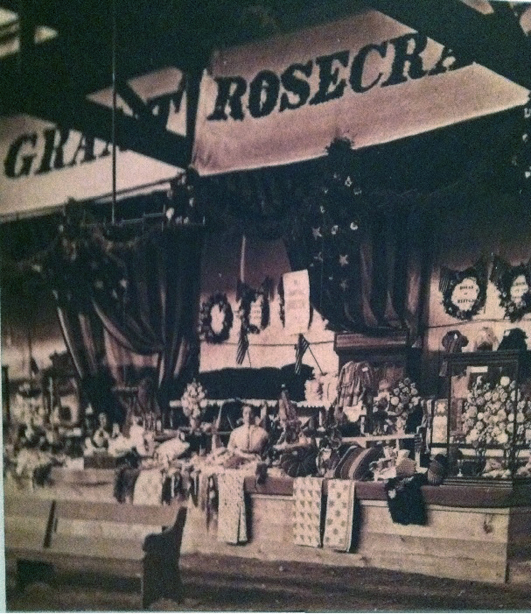
When initial enthusiasm for soldiers' aid flagged in 1863 members worked hard at public relations, staging fundraising Sanitary Fairs in war-weary cities. The profitable fairs revived interest in their mission.

A quilt at New York City's Metropolitan Fair

Philadelphia Headquarters

Tables selling needlework at the St. Louis Sanitary Fair

The Sanitary Commission was indeed a remarkable organization.

Wednesday, December 21, 2022

Atlanta Garden: 2023 Pieced Block of the Month


Time to start thinking about next year's Block-of-the-Month pattern for piecers. The last block for this year's American Stars was posted on December 14th, 2022. American Stars was rather challenging. Next year's Atlanta Garden will be simpler, based on nine patch blocks with narrow center strips. Look for monthly patterns on the second Wednesday of each month,

Jeanne Arnieri's setting blocks

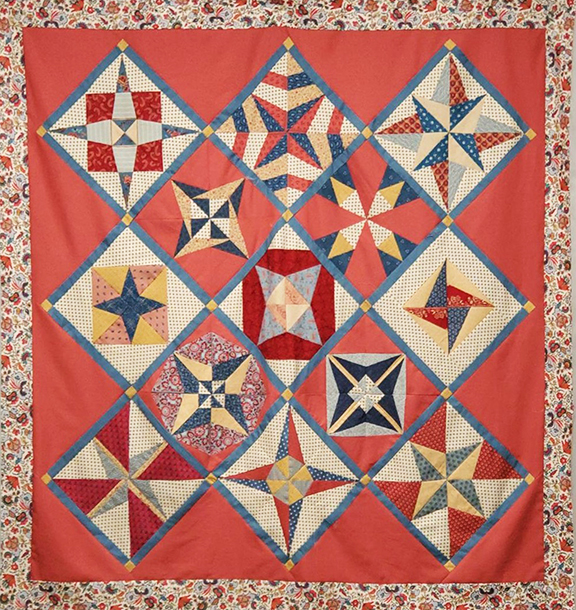
The "official set" alternates a simple nine patch with 12 related blocks
The first pattern will be published here on January 11, 2023.

We began working on the quilt last summer when Russia invaded Ukraine and we were all horrified to hear of the bombing of civilian targets. How do people live under such terror? I thought about Londoners in the Blitz and then Atlantans during the Civil War.

I found a diary in the digital files of the Atlanta Historical Society kept by Carrie Mabry Berry (1854-1921), daughter of a well-to-do builder in a growing city. By the time she was seven the Civil War had commenced. When Sherman's siege of Atlanta began in 1864 she was ten and her father bought her a diary.

Her first entry:

"The shells we dread. One has busted under the dining room." 

An Atlanta garden during the war with a "bomb-proof" cave to protect the family from shelling.

We'll follow her and her family---full of mysterious spies---and see how people adapt. Atlantans soon learned to listen to the shells, gauge what kind they were (timed to explode after landing or exploding on impact) and venture out until an ominous sound sent them back to the "bomb proof."  

Here's the pattern for the alternate block. Each month's pattern, mostly rotary cut, comes in two sizes.
10" blocks in the official set will give your a 50" square field of patchwork.
15" blocks = 60"


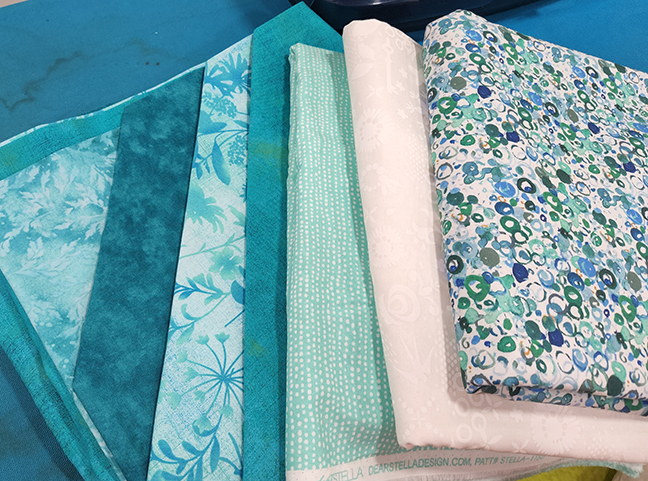
All the monthly blocks will have the same size strips and square in the middle. Corners will vary, but not be too difficult. Our teenage model maker Addie has created a lovely quilt in these aqua colors. You might want to enlist a young stitcher in the project.

More fabric ideas from the model makers:

Becky Collis went through her stash of reproduction prints
and found reds and blues to contrast with browns and a swirly cream
background.

Jeanne is doing two sets.


Becky Brown is tracking far afield.

Denniele is using all solids and one print.

Dorry Emmer

You'll need 13 of these setting blocks in addition to the 12 monthly patterns.
Electric Quilt 8 estimates of yardage

Atlanta


Here's our public Facebook group
AtlantaGardenQuiltBOM

You can buy the pattern package with rotary instructions for Atlanta Garden's 12 blocks in my Etsy Shop:

We'll do an applique BOM next year too. Starting in March, 2023.

More later.

Saturday, December 17, 2022

Susan Barbour Evans Helps with a Hospital Quilt


New England Quilt Museum
Soldiers' Aid quilt

 "I made one square quilt and bound it...."
"I went to the 'Knitting Society,' at Mrs. Metcalf's they sent me a special invitation I had a real pleasant time. I made one square quilt and bound it for a quilt for it was a foot square. they are going to send a box this week, two quilts and lots of stockings, hospital stores etc."

Susan Barbour Evans, Damariscotta, Maine to her sister Emma Sargent Barbour Whitney in Cambridge, Massachusetts, April 13, 1865.

Susan's letter at the end of the Civil War is more evidence
of the popularity and practicality of these individually bound
 "potholder quilts" in New England and particularly Maine.

The New England Quilt Museum's soldier's quilt has
bound blocks almost 12" square. 

Curator Pam Weeks believes the quilt above may have been organized by Rebecca A. Sibley in Boston in 1865. Many of the surviving quilts made for hospitalized soldier's bedding date to the end of the war in 1865. They may never have been shipped or might have received light treatment before going home with a mustered-out soldier. Thousands were used and used up.


Pam has found several references to New Englanders making soldiers' quilts by finishing them one block at a time. Persis Andrews Black helped with an album quilt for the minister's wife. She called it both an album quilt and a "variety quilt" in her diary, which probably refers to the variety of patterns in a sampler.

Maine Historical Society
Persis Sibley Andrews Black (1813-1891)
with daughter, 1844
by Caroline Hill Barker Wardwell 
"I have at last made my square to Mrs. Davis Album Quilt & it is really beautiful...is only one foot square quilted & bound.
Persis's "beautiful block"
I do not approve of this way of making a quilt for the Minister’s wife, but I have a great deal of esteem & admiration for the lady & ... I wish to see the variety quilt finished as it wanted only half a dozen of the required 70 before I made mine."

Read more about this quilt in a section by Pamela Weeks in Laurie LeBar's Maine Quilts:

https://www.google.com/books/edition/Maine_Quilts/KX0WEAAAQBAJ?hl=en&gbpv=1&dq=Louisa+Griffin+Davis+Paris+Hill+maine&pg=PA63&printsec=frontcover 

Susan Barbour Evans wrote numerous letters to her sister Emma, in which she told her about fabric,  fashion, prices and quilting in Maine. Below Susan was probably discussing a quilt the family was making for brother William's bride-to-be Julia Battis of Roxbury, Massachusetts.
"I have seen those kind of quilts like Julia's. Mrs. Shaw...took the premium at the State fair at Augusta, it was splendid---Mrs Hunnewell and mrs. Marshall also had them not quite so elaborate---They make elegant patchwork quilts here. I saw two last week, which were being made for a young bride they were of pink and white, very handsome---but not so pretty as white, of course Mary's pink and white one has been a treasure to me." Susan to Emma, September, 1863 

(Mrs. Shaw may be milliner Miss E. D. Shaw who entered hats in the local fairs in 1862 and 1863-but could find no reference to any quilts by a Shaw.) Were "those kind of quilts" made up in finished and bound squares?

On New Year's Day in 1862 Susan's family enjoyed roast goose, molasses candy and popcorn and had a party. 
"In the P.M. we put a comforter into the frames and tacked it before night. I think we shall quilt this week."
Susan's letters to her sister are published in a collection of letters written to Emma by family and friends. Read the book:
Shirley Blotnik Moskow, Emma's World: An Intimate Look at Lives Touched by the Civil War Era 

Wednesday, December 14, 2022

American Stars #12: Kaleidoscope Star for The Grimkes


#12 Kaleidoscope Star for the Grimkes by Jeanne Arnieri

The Grimkés became Americans in the early 1730s when brothers Frederick and John Paul Grimké emigrated to Charleston in the colony of South Carolina. Frederic was born in the German principalities in 1705; Jean Paul Grimké was born in France in 1713. 

John Paul married Mary Faucheraud (1722-1791) and in 1852 their son John Faucheraud Grimké was born. Like many Charleston elite John went north to school at the College of New Jersey in Princeton. He then sailed for England to attend Trinity College at Oxford in England and when he returned to South Carolina became active in the new American independence movement.

College of New Jersey in 1764
Princeton University Collection

John Faucheraud Grimké (1752- 1819) in 1791
By John Trumbull, Yale University Art Gallery

John F. Grimké fought for colonial independence, achieving the rank of Colonel, captured and exchanged after the 1780 Siege of Charleston, one of the rebels' worst defeats. He fought in Savannah in 1779 and Yorktown in 1781. His family's pension application tells us that his widow was awarded an annual pension of $600 from 1836 till her death in 1839. See their application here:

1788, John F. Grimke was the Charleston's Intendant, the mayor.

John F. followed the standard career for a Charleston aristocrat, becoming a politician (mayor and a state legislator in the 1780s, Associate Justice of the state's Court of Common Pleas) and marrying well. In 1784 he wed Mary Moore Smith, daughter of  wealthy planters Thomas and Sarah Moore Smith of Berkeley Parish.

Mary Moore Smith Grimke (1764-1839)
Watercolor on ivory in the Gibbes Museum's
Miniature collection was painted by Pierre Henri in 1791.

Between 1785 and 1805 Mary gave birth to 14 children; 11 survived to adulthood. They spent their winters in Charleston in this evolving, enormous house at 321 East Bay Street, purchased in 1803.

The Blake-Grimke house (here the back) has been restored and is now a law office.

Belmont

And their summers at Belmont, a plantation up by Spartanburg in Union County, waited on by enslaved servants. Louise W. Knight lists 17 in 1819:
  • Nancy, elderly and "useless"
  • Will, ditto
  • Rhina, “plain cook, washer, ironer,”
  • George “coachman & shoemaker,”
  • Sam, "coachman,”
  • John, house servant,”
  • Prince, "house servant in training"
  • Bess, ladies' maid with 4 young children
  • Maria, ladies maid and seamstress
  • Margaret, ladies maid and seamstress
  • Peggy, "plain washer and ironer,”
  • Dick, “plain cook.”
The Grimké family lived in the Heyward-Washington House, 
now owned by the Charleston Museum, 
when Sarah was young. 

Mary Smith Grimke was not one of those "beloved mistresses" of nostalgic memory. Her daughters recalled her violent dealings with the slaves whom she had beaten often. She struck them herself when in a temper. Her second eldest daughter Sarah Moore Grimke, rather traumatized by this home life, despaired of spiritual sustenance. When her father John Faucheraud Grimke became mysteriously ill in 1819 Sarah in her late 20s accompanied him to Philadelphia for medical advice.

Sarah Moore Grimke (1792-1873) adopted Quaker garb

There Sarah encountered Quakerism, finding antislavery sympathy and religious direction that changed her life. Her father was told to seek sea air and they moved to a boarding house by the Atlantic in Long Branch, New Jersey where John died in August. Sarah returned to her unhappy home life in Charleston, her main joy sister Angelina 13 years her junior. Angelina looked up to Sarah and followed her into the Quaker faith and abolitionism.

Angelina Emily Grimke (1805-1876)
William L. Clements Library Collection
University of Michigan

Kaleidoscope Star by Denniele Bohannon

These rebellious sisters who became Quakers and moved north were quite influential in the American antislavery circuit of speakers and authors. Brother Henry (1801-1852) was rebellious in more conventional southern male fashion. After first wife Selina Simmons Grimke died in 1843 he began a domestic relationship with enslaved Nancy Weston (1810-1895) with whom he fathered three sons: Archibald in 1849, Francis in 1850 and John born in 1852 after Henry's death in a typhoid epidemic.

Archibald, Francis and John Grimke
took their father's name.
Henry did not free Nancy or his sons (possibly because it was illegal) but willed them to white son Edward Montague Grimke, who treated his half brothers as slaves as did Sarah and Angelina's sisters Eliza & Mary Grimke, single women who lived with nephew Montague in Charleston, according to the 1860 census. 

The census's 1860 slave schedule lists 4 young people
living at the Grimke home; none of the boys are the right ages for
Nancy's sons but ages for these unnamed people were not accurate.
The boys also may have been living with their mother in the city.

Family Search
In 1853 daughter Eliza had sold 4 people from brother Henry's estate: Jacob, Charlotte, Jean and Doe to William H. Houston for $2,120.
.
January, 1853, Henry's estate sells 33 people.

An undistinguished Grimke, Montague's 1896 obituary tells us
he was wealthy, Christian and had many friends (Grimkes in
the North not among them.)

Sarah & Angelina, photos from the Civil War years

Henry's family kept the information about his second family secret from his abolitionist sisters. (Was anyone communicating with the notorious Sarah and Angelina?) But in 1868 Angelina read about an outstanding student named Grimke at Philadelphia's Lincoln University, a school for Black men. Discovering their nephews, the women helped with their college expenses. Archibald graduated from Harvard Law School, Francis from Princeton, both becoming Grimkes distinguished in diplomacy, the N.A.A.C.P. and the Presbyterian church.


Francis married Charlotte Forten, of another family of American stars, and lived in Washington D.C where he was minister at the Fifteenth Street Presbyterian Church. Their only daughter died as an infant but they helped raise brother Archibald's daughter Angelina Weld Grimke (named for her aunt Angelina Grimke Weld) who spent her adolescence with her uncle and aunt while her father was minister to the Dominican Republic, then Santo Domingo.

The Block
Kaleidoscope Star is an original block, designed for the
 fractured picture of the Grimkes.

The block, a form of Maltese Cross is adapted from the patterns in BlockBase's 2700s.

Print the pattern on an 8-1/2" x 11" sheet. Note the square inch for scale.

Kaleidoscope Star by Becky Brown

Later Generations
Angelina Weld Grimke (1880-1958)
The younger Angelina was raised by her father, Aunt  Charlotte & Uncle Francis.

Angelina was not a star in her own time but she has lately become one for the poetry, stories and plays she wrote and published while she was teaching in Washington. Her themes: The Black past and the frustrations of Lesbianism in a bigoted time.

Denniele's plan


John Grimke Drayton (1816-1891)

And just one more star Grimke:  American horticulturalist John Grimke Drayton, son of Thomas Smith Grimke, grandson of John Faucheraud and Mary Smith Grimke. Thomas Smith Grimke made a profitable marriage to South Carolina aristocrat Sarah Drayton whose family came from Barbados to establish the huge Magnolia Plantation along the Ashley River.

Magnolia in 1853

Alas, Sarah produced no sons. Rather than losing the Drayton name her father willed the land to his Grimke offspring on the condition they change their name to Drayton---the Grimke-Draytons. John Grimke Drayton inherited Magnolia in the 1840s becoming a gardener of note. 


Among the innovations he and his African-American crew introduced: A fashion for naturalistic gardens rather than formal English and French arrangements. They raised numerous species of camellias and azaleas, popularizing them in the United States.

After the Civil War Drayton opened the gardens to the paying public,
an innovation born out of financial desperation. Magnolia Plantation
 enjoys the reputation as the oldest public garden in the U.S.

Jeanne Arnieri's top

Jeanne's block #12 Photoshopped as an all-over design

And we are finished with American Stars.

American Stars by Becky Brown and the Country School Quilters,
made for a veteran.


And here are three more simple sets.

More finishes soon.

More Information on the Grimkes:

Watch an Episode of  PBS's American Experience about the sisters on You Tube

The Heyward-Washington House in Charleston: https://www.visit-historic-charleston.com/heyward-washington-house.html#gallery[pageGallery]/7/


See a post about Charlotte Forten Grimke here:

A new book by Kerri K. Greenidge is "a revisionist history of a pair of white abolitionist sisters," according to the New York Times. See a preview of The Grimkes: The Legacy of Slavery in an American Family.
https://books.google.com/books?id=VvhhEAAAQBAJ&pg=PT360&dq=Grimkes:+The+Legacy+of+Slavery&hl=en&newbks=1&newbks_redir=0&sa=X&ved=2ahUKEwjd_4LYlcL7AhXjMzQIHYxbA-0Q6AF6BAgHEAI#v=onepage&q&f=false

From a review in The Atlantic by Drew Gilpin Faust:
"Greenidge’s The Grimkes is not a story about heroes. Instead, it is intended as an exploration of trauma and tragedy. Like the studies of the Grimkes that have preceded it, the book reflects the challenges of our own time, but Greenidge, who is an assistant professor at Tufts, regards these not with optimism about possibilities for racial progress but with something closer to despair."