Wednesday, December 11, 2019

Yankee Notions: Fabrics


Yankee Notion of the tangible kind

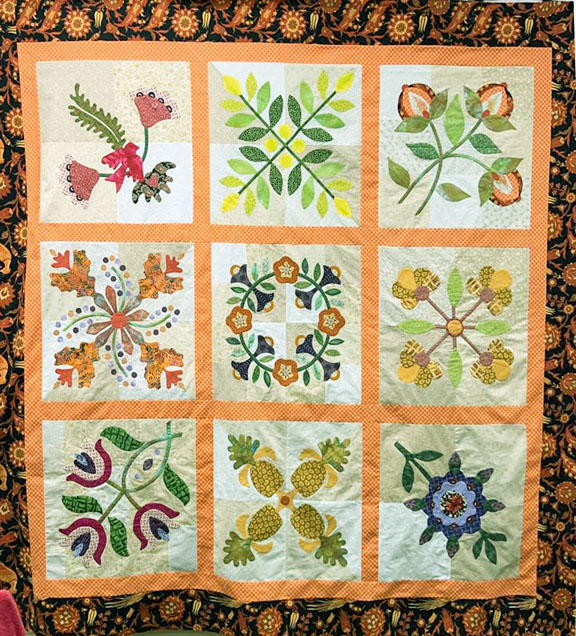
Our 2020 pieced block of the month begins here on January 8, 2020.


Every month you'll find a free pattern for a traditional block on the second Wednesday throughout the year. Yankee Notions will include instructions for 18-inch blocks and 12-inch blocks. You might want to consider a two-color sampler.

Like this mid-19th century album.

Red & white?

Late-19th-century sampler

Blue & White?
Orange & Turquoise?

66" x 87"
18" blocks set with 3" sashing
Add a 4" border to make a quilt 74" x 95"

For just the blocks for a Two-Color 12" Block Quilt you'd need 2-1/2 yards each of dark and light. Probably a minimum of 3 yards of each for the 18" Blocks

As the theme is American history, model makers Becky Brown & Denniele Bohannon are using a limited selection of red, white an blue fabrics.

Denniele's solids

Becky's using three prints.

For a Three-Color Quilt of 12" Blocks
You'll need 3 shades:
  • 1/2 Yards
  • 1-1/2 Yards
  • 1-3/4 Yards
You might want to go with a traditional selection of 
reproduction prints. Here are a few collections available now.

Hat Box from Andover

Each month will show a plan for a traditional block in pinks and browns---
sort of a chocolate & cinnamon version.

Yarra Valley from Max & Louise

Twelve blocks of 12". I'd guess you'd need 12 fat quarters.

Mary Koval's Rhapsody in Blue


And then there is Tula Pink's PomPoms:


I started a Facebook group YankeeNotionsBOM so we can post pictures and fabric ideas.
Click here: Ask to join.

Dachshund pincushion
A Yankee notion probably imported from Germany

See more about the historical theme here:
https://civilwarquilts.blogspot.com/2019/11/yankee-notions.html

Saturday, December 7, 2019

Battle Trophy

19" square
Here's a sorry old applique block found at a Philadelphia estate sale.
Sold again online recently.

It has an inked label on the reverse
and a couple of paper labels on the front.

"Taken at the
Battle of
Bristow [Bristoe?] Station
Aug 27. 1862"

Bristoe Station is in Prince William County, Virginia

The heavyweight paper label pinned to the front is in good shape.

But this paper label is in tatters.

The seller thought it might be a memorial quilt block made to honor
a soldier "Taken at the Battle of Bristow Station,
Aug 27 1862"

Another story for the inscription:
The block was stolen at the Battle of Bristoe Station

The National Park Service runs Bristoe Station Battlefield Heritage Park 
 southwest of the Manassas battlefield. This photo is from their page.


Bristoe Station was a small railroad junction with Confederate supply
trains passing through. Union troops aimed to destroy the tracks and
the equipment.

It was a train wreck, one of many in the area.

How did one small quilt block survive it all?

Library of Congress

Alfred Waud sketched the events of the battle now called of Bristoe Station, which actually took place October 13th. Historians call the August 27th encounter the Battle of Kettle Run or Union Mills. Battle names were niceties local civilians cared little about. Waud's drawing here is of a house taken over by troops who built a look-out tower on the roof.  Residents are camping in a tent.

"A.R.W. Oct 1862"

Waud was great at capturing the scene in a few strokes.
The figures look like woeful women staring at their occupied home.

It's one thing to steal a quilt for bedding, but awfully mean to steal a woman's unfinished quilt block. Yet, this was total war meant to terrorize civilians. My guess is that a Union soldier pocketed that quilt block and a year and as half later it was displayed at the Philadelphia Sanitary Commission Fair as a trophy of war.

Captured flags, armaments and other souvenirs were common displays.
The block may have been sold to raise money for the Sanitary Commission,
or just shown for smug inspiration.


What was planned for the end of those stems?

Saturday, November 30, 2019

Montana GAR Quilt


This fancy hexagon quilt is not the kind of quilt you'd expect to be connected the the GAR veteran's organization, but among the embroidered, elongated six-sided shapes are several referencing veterans.

"ANACONDA April 9, 1891" 
 "GAR" (Grand Army of the Republic)
"Men of Butte Honored"

76" x 60"
Collection Northwest Museum of Arts & Culture
Spokane, Washington

Curatorial notes tell us: "Both Butte and Anaconda are inscribed on this quilt, and both had GAR posts."

The Butte "Encampment," a reunion in 1911


William Henry Safford (1844 - 1919)

The Great Falls Tribune has done a series on Montana Civil War veterans like this one by Ken Robison on New Yorker William Henry Safford who joined the Union army at 16.


Spokane's Northwest Museum of Arts & Culture has a quilt show up right now. Memory and Meaning: Textiles from the Permanent Collection does not include this quilt but you can see more online. The exhibit is up through January 12, 2020.
https://www.northwestmuseum.org/exhibits/current-exhibits

Wednesday, November 27, 2019

Hospital Sketches - Done Deals

Karen at MooseBayMuses
Her own border idea. 

Vickie Wendel added three more blocks and her own border.

MoFabricNut on Instagram

Our Instagram page

Lisa Wagner

Nancy Cummings


Saturday, November 23, 2019

The Soldier/Cannon Calico

Skinner's Auction offered a piece of cotton 
"Calico made during Civil War 1861"

Fabric collectors and quilt historians discussed this print a few months ago on one of our social media pages. The print has a soldier (wearing what doesn't look much like a Civil-War-era outfit), a flag, a cannon and a pile of cannonballs.

The Art Institute of Chicago owns a sample book with
the same 3-color print, red, blue and a dark brownish black on white.


There are several related prints, subtly different.

The Henry Ford Museum has a lone star quilt with a couple of interesting prints that may indeed by Civil War commemoratives. The flag print here is red, blue and dark brown but the cannon and cannonballs are brown rather than red.


 The quilt looks to be 20 or 30 years after the war but the prints???

We got started on the discussion because Paula had an album block with the same print.

Some one appliqued the soldier and the cannon by a name suffering
from ink damage.

Pam Weeks designed an unpdated reproduction a while ago for New Castle Fabrics She based her design on a quilt "dated 1863 or '64 made for a soldier, in the collection of the Rochester, New York Historical Society."

The print, particularly the one with the red cannons, may indeed have been printed during the Civil War.


Laurette Carroll showed a tumbler in a charm quilt from the 1870s or '80s or later.
                                                           
Years ago Pam saw this dress and couldn't afford to buy it but
she took a good photo. I wonder if it's not a costume or pageant
dress with it's casual construction and trim.

There's a second, closely related print.


This one is seen more often. It's red, blue and brown again
but there is no soldier and no pile of cannon balls.


Terry Thompson and I did a reproduction print in our first Civil War collection decades ago.

The original

Block with the name Samuel Sweet, perhaps typeset onto the fabric


Rather faded.

I have a tiny piece in a scrappy top that looks to have been worked
on in the 1880s and then set with a blue/black neon print about 1910.

These prints must have been favored souvenirs used to the last scrap.

The Metropolitan Museum of Art owns a child's garment,
perhaps a boy's dress with the soldier and the cannonballs in the print

And the Smithsonian's National Museum of American History
has a similar dress but in the print without soldiers or balls.

Children's calico dresses are hard to date because style
changed so slowly in the 19th century.

Is one dress later than the other?

There is evidence that the print with the soldier and cannonballs was printed in the 1860s, but the second print might be from the 1870s, a reproduction done for the Centennial celebration.

Many prints were designed just for the Centennial.

Harriet Rebekah Bradbury Rich (1862-1959) donated this quilt to the Smithsonian in 1948. She remembered when as a 12-year-old she, her mother and grandmother pieced the blocks from Centennial celebration swatches that her father, a dry goods wholesaler in New Hampshire, had received in the mid-1870s. 


The Smithsonian's online photos show many prints, including some that are known to have been reproductions, such as the stripe drawn from a bodice that Martha Washington wore


And the small swatch with a portrait of Andrew Jackson, reproduced from
an earlier design.


But, alas, I see no swatches of any cannon prints with or without the soldier in the Bradbury quilt so my idea that there were two different prints, one in the 1860s and one in the 1870s isn't supported by this well-documented quilt.


Were both cannon prints, then, manufactured during the Civil War?