Saturday, October 8, 2016

Abigail Hopper Gibbons: Civil War Nurse

May 20, 1864
Hospital yard at Fredricksburg, Virginia

The photograph above, an iconic image of the Civil War, shows weary patients and nurse resting outside a field hospital. Photographer James Gardner (1832-?) with brother Alexander worked for the Brady Studios and spent a day in May with the Sanitary Commission.

http://www.loc.gov/pictures/item/2009630187/


On the reverse:
"This is one of the hospitals established by the Sanitary Commission in Fredericksburg, Virginia, during the Wilderness Campaign, in 1864. The wounded are from Kearney's Division, and are being cared for by the noble Sanitary Commission."


In the past few years the woman has been identified as Abigail Hopper Gibbons.


Abigail Hopper Gibbons
1801 – 1893

Gibbons is also in the center of this photograph taken by James Gardner the same day. The 
woman seated next to her is daughter Sarah Emerson.

Abby Hopper Gibbons was born a Quaker in Philadelphia. In 1833 she married James Sloan Gibbons (1810-1892) of Wilmington, Delaware, and they became important activists in the abolitionist movement in New York City in the decades before the Civil War.


Abigail and James Gibbons with children 

Lucy and William on the left, Julia right, Sarah between them, 1854.

Collection of Friends Historical Library, Swarthmore College.

William died the following year after a fall while at Harvard.


When the war began Abby left her daughters and husband in New York, traveling South to deliver goods for the Sanitary Commission. She soon saw the need for nurses. 

Read her letters, many of which concern her nursing work in the book her daughter Sarah edited.

Life of Abby Hopper Gibbons, Told Chiefly Through Her Correspondence by Sarah Hopper Emerson,
https://archive.org/details/lifeabbyhopperg00unkngoog

Dr. Mary Walker in her bloomer costume
after the war, wearing a medal.

She mentions "Dr. Mary Walker, a very little woman in bloomer costume who presides over the 
Indiana Hospital," which was located inside the construction project that would house the U.S. Patent Office in the late spring of 1862.

Gibbons continued her work helping slaves escape during the war. In 1862:
"I have met a great many...colored families...who are still with their masters, but laying plans of escape for themselves and their children. One poor soul said yesterday: 'The Lord has waited a long time, and he ain't going to stand it any longer.' When I go home, I shall get a pass for myself, daughter and servant.
You need not write back on this subject, as on several occasions the letters have come to us glued together after having been opened."
While she was working in the hospitals the anti-black civil disturbance known as the New York Draft Riots took place. The Gibbons home with its reputation of welcoming runaway slaves and supporting the Emancipation Proclamation was a target.

The Infuriated Mob Attacking Mrs. Gibbon's (sic) House.
July, 1863

Sarah's neighborhood in Chelsea
was called Lamartine Place.
The block still stands.
Her home is is now 339 West 29th St (near 8th Avenue).

Read about the Gibbons's antislavery activities and the destruction of their house during the Draft Riot in the Landmarks Preservation Commission report on the Lamartine Place Historic District here: 

This photo of Gibbons in later life shows her embroidering perhaps---or hemming a print.
She did record making quilts in November, 1833, soon after her marriage:
"I have been without 'help,' (to use a New- York expression) and to prevent a 'muss,' ...have been obliged to exercise myself. And my quilting, too, is but just accomplished. One of James' cousins from Wilmington has been spending a week or two with us, and were we not smart to quilt four comforts in three days?"

Sarah and Abigail, seated, May, 1864.
Sarah's husband William Emerson III died of tuberculosis
three months after their November, 1863, marriage.

See more about the Gardner photos:
https://npsfrsp.wordpress.com/2010/06/08/whos-the-woman-in-the-picture/

In 1893 Abby's daughter Lucy Gibbons Morse published a novel about her family's underground railroad activities before the Civil War.
Read Rachel Stanwood: A Story of the Middle of the Nineteenth Century for a view from her perspective.

Wednesday, October 5, 2016

Past Perfect: Shopping for Civil War Repros


When I used to travel and teach about making reproduction quilts my favorite classroom site was in a quilt shop. I could drag out bolts of fabric to show people the perfect prints to copy a certain era.

Bolts & bolts of fabric.
(I never had to put them back.)


My latest: Baltimore Blues

Of course I'd advise you to buy some of
the fabric I designed, but there are many other
great repro fabric designers.

Suedio's Stash

And I'd have people bring their stash of Civil-War-era fabric to class so I could
tell them what worked and what didn't.


I've been trying to figure out how to do that kind of
teaching online.

Some way I could digitally drag out bolts of fabric (mine and other designers)
to show what's a great reproduction.

Here's what I've come up with.

Pinterest Pages labeled Past Perfect.

This one for example:
MADDER STYLE: PAST PERFECT

I've been posting pictures of period quilts
in the fabric topic.
Union Square by Pam Mayfield 2001

Reproduction quilts for inspiration...
Suggestions for reproduction prints...
Above some old ones of mine. If you click on the picture
and then click again you'll go to the page I pinned from.

I show you other designer's repros too. Above, an old one from Pat Nickols.
You might have it in your stash or can find it online at Etsy, eBay or 
an online shop.

You also get information about the vintage fabrics' properties.
Sometimes if you click twice it takes you to a blog post I've done on the topic or to another site with more information. You'll recognize some of the posts and repros from our Stars in a Time Warp QuiltAlong.

I can add new fabrics and information as I find them on line.

Like this new stripe from Jo Morton's
Gratitude line.

If you keep up with my Madder Style page you'd know what was new and what was old.
Here's a link:

Next week I'll give you links to some other Past Perfect pages.

Saturday, October 1, 2016

Kissie and a Contraband Quilt


Silk Quilt passed on in the Gary family
Collection of the Anacostia Community Museum
1991.0097.0001

This embroidered silk nine-patch has an impressive family history.

Kissie Owen (1856-1945) was born into slavery near the Saluda River in Columbia, South Carolina. She recalled her early memories of the Civil War for her descendants, including stories of Sherman's Army coming through the neighborhood and the plantation mistress burying valuables for fear of losing them to the Yankees.

After the Union Army moved on Owen family slaves
including 8-year-old Kissie followed them. Kissie took
this elegant quilt with her and kept it all her life, passing
it on to her children.

The silk has deteriorated over the years. The squares have been
conserved with a net to keep silk shards from falling off.

Kissie recalled that this show quilt had a place of honor draped 
over a sofa in the main house.

After the War Kissie married Wylie Young and when widowed George Martin Gary. She lived in Newberry County, South Carolina, and spent the last twenty years of her long life in Washington D.C.
Her granddaughter Rhuedine Gary Davis, (1913-2005) donated the quilt to the Smithsonian Institution where it is part of the Anacostia Community collection. Rheudine is also remembered as an influential community activist in Washington.

Kissie Owens Young Gary is buried with second husband George at Mount Olive Cemetery in Kinnards, Newberry County, South Carolina.

See more about Kissie (was her given name Kissiah, a variation of the Bibilical name Keziah?)

http://collections.si.edu/search/results.htm?q=set_name:%22Kissie+Gary+Collection%22

Others in her family have done research on their geneaology.

http://griotgramgeneaography.blogspot.com/2014/11/the-owens-obstacle-course-ii.html?view=snapshot&m=1


Wednesday, September 28, 2016

Westering Women 9:Sage Bud for Fort Laramie

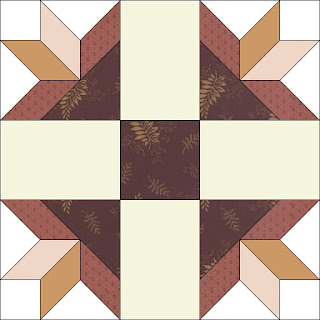
Westering Women Block 9: Sage Bud by Denniele Bohannon

This month's block is Sage Bud of Wyoming, named for trail landmark Fort Laramie in what is now the state of Wyoming.


A small city grew up around Fort Laramie where travelers could buy supplies, trade with natives camped around the fort and rest for several days.

Westering Women Block 9: Sage Bud by Becky Brown
"My sage bud is in full bloom. I did additional reading to learn a little more about sagebrush - it is the state flower of Nevada (Wyoming's is the Indian Paintbrush)."

Interactive map from 

Note Ft.Laramie (the red star on the trail)  is located far northeast of today’s city of Laramie.Today it’s a National Historic Site off U.S. Highway 26, 3 miles from the town of Fort Laramie.
"August, 1850.
Traveled 15 miles. This brought us to Fort Larimee which we were glad to see as here we crosst the Larimee fork of the Platte…This is a very pretty place to look at, it is so clean….They say there have 75 thousand pass here this season and some days there were 1500 here….The women are baking, washing, cleaning, and repacking the waggons as they do when we stop." Lucena Parsons

Fort Laramie, Indian Territory
from the American Heritage Center

 The following year Amelia Hadley was impressed by the settlement,
"which was beyond all expectation....On Main Street the buildings are brick 3 story high. Stores in the lower stories where you can get almost any thing you want....I could hardly contrive how they could get goods there."
Women could buy or trade for fabric here. Elizabeth Wood wrote a letter to her hometown newspaper:
"Cloth that can be bought for 16 cts. in Peoria...sells for 75 cts. per yard....I disposed of a worn and faded dress to the Indians for $3.50, which was purchased when new, in Peoria, at 10 cts per yard." 
The pattern is #1890 in BlockBase. In the 1930s, Workbasket magazine named a block for each state, giving this old block a new name. 


Sage is a common plant in the western plains, a distinctive pale blue-green color. Some blooms purple, some golden.

Cutting a 12" Block

A - Cut 4 squares 2".
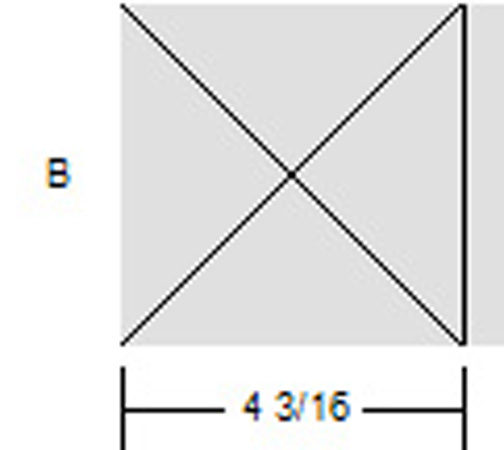
B - Cut 2 squares 4-3/16". Cut each into 4 triangles with 2 cuts. You need 8 triangles.

C- Cut 4 rectangles 5" x 3-1/2".
D - Cut 1 square 3-1/2".
E + E/R (E reversed or flipped over) - Cut strips 1-1/2" inches and cut 8 parallelograms using a 45 degree angle that are 2-7/8" long. Cut 8 more going the other direction. Or use the template below and add seam allowances.


F -  Cut 2 squares 3-7/8". Cut each into 2 triangles with 1 cut. You need 4 triangles. 

To Print:
  • Create a word file or a new empty JPG file.
  • Click on the image above. 
  • Right click on it and save it to your file. 
  • Print that file. Check to be sure the line indicated is 4-1/2". 
  • Add seam allowances when you cut the fabric.

Join the strips.


Deb Rowden's version of Sage Bud:
Sage green plants with a golden yellow bloom.


Read The Oregon Trail Journal of Elizabeth J. Goltra online. This web page is interesting because when you click at a point on the map Elizabeth's 1853 journal entry for that day pops up. The links start in April at the beginning of her trip and you read backwards from the bottom of the page to the top. See the entries for each month over on the right.
https://dsl.richmond.edu/oregontrail/?m=185304

Lucena Parsons's diary is in Covered Wagon Women: Diaries and Letters from the Western Trails, Volume 2, 1850.

Saturday, September 24, 2016

Lucretia Coffin Mott's Quilt

Quilt attributed to Lucretia Coffin Mott (1793-1880).
#1967.0016.001
Collection of the Nantucket Historical Association
Lucretia Mott was born on Nantucket Island, Massachusetts 
and visited family there throughout her long life.

Lucretia Mott was an extremely energetic and liberal thinking woman. Reading her biography is exhausting---While I am sitting on the porch reading about her she would have made 12 pies, dropped into House of Industry to check on the sewing projects the poor women were finishing and written six newspapers editors to tell them what's what.

Lucretia Mott sat for this portrait by 
Joseph Kyle in 1841 when she was in her late forties.
Collection of the National Portrait Gallery at the Smithsonian.
Sitting still was not her skill area.

Of course she made quilts. I've only found one attributed to her, the detail at the top of the page, but she wrote many letters and did mention quilts and quilting.

The letter is from Palmer's Selected Letters of Lucretia Coffin Mott.
Scroll down to see the reference.

In 1879 at 87 years old she, in her usual breathless fashion, told of a trip where she spied two quilts at the House of Industry [at least I think that is what she is talking about]:
"For $2 buying and bring away a very pretty red patchwork quilt red & mixed-calico not large---which I have concluded to send to Will & Nellie's attic spare chamber. She left another not so pretty which will do for Hannah's room..."
Women sewing in the House of Industry.
The Quakers provided a safe place to work and customer connections for women who 
sewed for a living.

 House of Industry about 1870 at
714-6 Catherine Street.
Free Library of Philadelphia

A 1919 city director describes the work of the House of Industry:
"b) Make new quilts and recover old ones. Products sold. Orders taken."

Read a little more about the House of Industry in its various incarnations as a female empowerment association:

Had it been 1859, Lucretia Mott would probably have passed up that red calico quilt. Mott and her husband were leaders in the Quaker antislavery movement and they felt strongly about abstaining "from the products of the slaves' labor": cotton, sugar, molasses, indigo, tobacco and rice.

James and Lucretia Mott enjoyed a long, companionate marriage.

When first married, her husband was partner with her father in James Mott and Company at 45 N. Front Street, a Philadelphia business selling cotton and wool fabrics. He was what was called a commission merchant, a retailer.

The Anti-Slavery Alphabet book
condemned the Merchant of the north.

In 1826 James Mott helped organize the  Philadelphia Free Produce Society and gave up the cotton trade, specializing in wool fabrics. He and Lucretia also ran a Free Produce Store. For the store they sought substitutes and certified non-slave produced items. The family cooked "Anti-Slavery Sweets," candy without sugar or molasses made more palatable by a rhyme in the packaging.
"Sweet as these sweets are, yet sweeter still
The soil that Freemen tread and Freemen till."

A free-produce sugar bowl from the collection
of the Museum of the City of London. 
Certified free labor sugar came from India.

Ruth Ketring Nuermberger, in The Free Produce Movement: A Quaker Protest Against Slavery described some of the rhetoric intended to influence women.
"The Society appealed to women generally to exert their influence by abstinence from slave labor products, and by instilling in their 'offspring a deep-felt sense of their duty [to give] the preference to the products of free labor.' ... It is true, some inconveniences will at first be unavoidable, the texture of your garments will perhaps be coarser than that of your accustomed wear, but they will cling less heavily around your forms, for the sighs of the broken-hearted will not linger among their folds...."
The James and Eleanor Clark family, English Quakers and textile producers,
all dressed in free labor cotton.
Courtesy of the Library of the Religious Society of Friends, London.
From Anna Vaughn Kett's dissertation.
Scroll down to see the reference.

The only acceptable cotton was Free Labor Cotton, of which very little was raised, sold or manufactured into cloth. So Quakers who abstained wore linen, silk and wool. These fibers seem luxurious to us today, but in the 1820-1850 period cotton was relatively novel, much too "gay" and quite fashionable. For decades Quakers had been wearing subdued silk and woolen (and combination fabric) clothing because cotton was perceived as too worldly.

Lucretia Mott's acceptance of plain clothing was not the sacrifice it might have been to a 20-year-old Unitarian or Methodist. But certainly rejecting slave-grown cotton in a fabric business was a sacrifice for the Motts, who had their financial ups and downs over the years, primarily due to their consciences.


This has been a long story to give us some background into the quilt attributed to Lucretia Mott by the Nantucket Historical Association. It was donated by one of her descendants Mrs. J. C. Richard Heckscher who also gave James Mott's waistcoat.

All we have to see online is a detail, which shows a quilt that seems to be silk and wool fabrics (some perhaps mixed fabrics of different yarns); the face seems very consistent with Quaker wardrobe. The shinier fabrics may be silk, some of the duller stripes seem to be wool. The gray check, a very small and not very gay (silk?) check, fits the Quaker palette. 
The back of the quilt is hard to figure out from a photo. Could it be a print, overdyed blue to make it plainer?

Lucretia Mott tends to be overlooked today as a feminist and antislavery hero, eclipsed by women younger than she, but her life is fascinating (well ----perhaps, interesting is a better word.) She had an attitude.

Photograph of Executive Committee of the 
Pennsylvania Anti-Slavery Society,  1851
Back Row: Mary Crew, Edward M. Davis, Haworth Wetherald, 
Abigail Kimber, Miller McKim,Sarah Pugh. 
Seated: Oliver Johnson, Margaret Jones Burleigh, 
Benjamin C. Bacon, Robert Purvis, Lucretia Mott, James Mott


The book I dawdled my time away on was Valiant Friend: The Life of Lucretia Mott by Margaret Hope Bacon. Bacon also wrote Mothers of Feminism, The Story of Quaker Women in America and the book reflects her knowledge of Quaker life and the early women's movement.

I'm also reading Mott's letters in Selected Letters of Lucretia Coffin Mott, edited by Beverly Wilson Palmer. Read the biography before tackling the letters.
See a preview of her letters with a reference to her and her mother differing on whether the quilt in progress needed a border or not.

Want to know more about LCM? See the Lucretia Coffin Mott Papers Project at Pomona College:
http://www.mott.pomona.edu/

Detail from Sarah Wistar's quilt
made by women who worked at the House of Industry
in the 1840s.

Read about two other House of Industry quilts at the excellent history blog Quaker Quilt History:

Patricia T. Herr," Quaker Quilts and Their Makers," in Jeannette Lasansky, Pieced by Mother, Symposium Papers (Lewisburg, PA: The Oral Traditions Project of the Union County Historical Society, 1988), 13.

Read more about the Free Produce Movement & Quaker fabric choices:

Anna Vaughn Kett. "Without Consumers of Slave Produce. There Would Be No Slaves. Quaker Women, Antislavery Activism, and Free-Labor Cotton Dress in the 1850s." Quakers and Abolition, edited by Brycchan Carey, Geoffrey Plank.

Anna Vaughn Kett. Quaker women, the Free Produce Movement and British anti-slavery campaigns : the Free Labour Cotton Depot in Street. Dissertation.

Ruth Ketring Nuermberger, The Free Produce Movement: A Quaker Protest Against Slavery (Durham, NC: 1942). Available on line.

Emma Jones Lapsansky, & Anne A. Verplanck. Quaker Aesthetics: Reflections on a Quaker Ethic in American Design.....