Wednesday, March 10, 2021

Hands All Around #3: Anna's Choice for Anna Alcott Pratt


Anna's Choice by Dorry Emmer
8" block in the colors of her winter garden

Anna Bronson Alcott Pratt (1831-1893)
It's not hard to spot Anna as an Alcott with her
mother's pretty hair and determined look.

Like her sister Louisa, Anna was not satisfied with that pleasant face and thought of herself as plain, as did Edward Emerson who lived across the road when they were growing up. (Perhaps he liked a flashier type like the youngest May.)


Anna's Choice by Becky Brown

Meg March, eldest of the Little Women, seems a fairly accurate portrait of Anna or Nan as Louisa -Lu- called her sister. Everyone else called her Annie. Dramatic contrast inspired the author to make the fictional Meg a little too good compared to impulsive tomboy Jo. (The sisters often noted Meg was prettier than Annie----sisters, got to love them.)
 
Meg married in the 1949 film

In the best tradition of feminine compliance the central event in Meg's life is her wedding. In Little Women she marries John Brooke, neighbor Laurie's orphaned tutor who enlists in the Union army, is wounded and returns home after a year to earn a living (if small) for his growing family.
Anna's beautiful wedding dress is periodically on display at Orchard House.  
"So she made her wedding gown herself, sewing into it the tender hopes and innocent romances of a girlish heart. Her sisters braided up her pretty hair, and the only ornaments she wore were the lilies of the valley, which 'her John' liked best of all the flowers that grew." Little Women.
John Bridge Pratt (1833-1870)

The real-life Annie Alcott married John Bridge Pratt a year before the war. Some say they met playing lovers in a production by the amateur group the Concord Drama Union but John Pratt was not an orphaned stranger to town like his fictional counterpart.

Marriage record, 1860

His parents Minot and Maria Pratt were Concord residents in the antebellum years with strong abolitionist reputations. Minot was a respected agricultural expert, two common interests with the Alcotts. After her sister Elizabeth died in 1858 Anna went to stay with the Pratts and soon she and John Pratt announced an engagement. They married two years later, rather old for their times; she was 29, John two years younger.

Anna's Choice by Denniele Bohannon (16")

John Pratt did not enlist; he occupied his Civil War years as a bookkeeper, a job he did not enjoy, but like his wife he saw his duty, which was supporting her and their two boys born in 1863 and 1865.
Those boys tells us much about how Anna spent her war years---probably rather happily, although there was never enough money and her husband supposedly had a temper.


1865 ad for Annie's father-in-law's agricultural business.

Annie spent some of the Civil War years living at the "Pratt Farm." Harriet Reisen in her Louisa biography indicated Annie and John had financial difficulties during the war, repeating her parents' "old pattern of moving from one untenable living situation to the next...the boys and Anna squeezed into Orchard House or the Pratt farm for months at a time while John boarded near his current job and joined them on weekends."

The Pratts' sons continued the family tradition of amateur theatricals.
 Here they are in their early 20s.

The Block

Anna's Choice from a late 19th-century Pennsylvania quilt


Anna's Choice (BlockBase #1141a) is the perfect star to remember the bride. The block is pieced of one triangle, shaded and turned to make an eight-pointed star with no Y seams.

Cutting: The HST triangle C.

8” Block (2-Inch Grid) C—Cut 16 squares 2-7/8”. Cut each into 2 triangles with one diagonal cut. You need 32 of different shades.

12” Block (3” Grid)
C—3-7/8” 

16” Block (4” Grid)
C—4-7/8”


Anna's Choice by Georgann Eglinski

Post Script

Meg March's fairy tale marriage to John Brooke was, of course, just a fairy tale as weddings are and marriages are not. In Little Women Meg's husband presents some problems of temperament. The Pratts ten-year marriage may have had similar issues but seems to have been loving. Anna's husband wrote old friend Alf Whitman in February, 1870:
"She is just the sweet dear woman you knew in the old days, so kind loving & patient with my many faults and peculiar ways."

Anna's Choice by Pat Styring
 
John also reveals in that letter that she lost her hearing in her thirties. Annie "as you probably know is deaf, almost entirely so, so that she is cut off from the world that most people enjoy, and yet so cheerful and uncomplaining through all...."

They were then living in Maplewood in the city of Malden, about 20 miles from Concord, "quite a pleasant country place" and John was commuting by rail to his bookkeeping job, a frustrating life.

This February, 1870 letter to Alf Whitman, perhaps John's last surviving
 letter, is in the collection of the Harvard Library.


More than bored, John seems in despair despite his love for his wife and sons.
And within the year he was dead.

Anna's surviving sisters Louisa and May were in Rome when they got the news that John had suddenly died at the age of 37 on November 27th. Louisa came home to take charge. Now rich with royalties from Little Women she helped Anna move home to Concord by buying the old Thoreau house on Main Street, which eventually became the Alcott family home as everyone aged.

Anna's Choice in my new Ladies Legacy fabrics...
should be in shops....

The "Old Thoreau House" still stands.
Here the widowed Anna raised her two boys, 7 & 5 when their father died.

Another way Louisa dealt with John's death was to write him into a new book Little Men. She knew she needed more income to support Anna. Ever the practical Alcott she decided to write a sequel to her best-seller. A fictional John Brooke may also have been a way to deal with her shock at his sudden death and her grief. The character Professor Bhaer tells of his brother-in-law Brookes's passing:
"He was only ill a few hours, and died as he has lived, so cheerfully, so peacefully, that it seems a sin to mar the beauty of it with any violent or selfish grief. We were in time to say good-by: and Daisy and Demi were in his arms as he fell asleep on Aunt Meg's breast. No more now, I cannot bear it."
And that literally is all we know.

As one blogger Compulsive Confessions wants to know:
"What in the name of ever loving hell does John Brooke die of in Little Men? It's like one day he's walking around all lalalalala and the next day he's dead. Quickly. In The Night."
Well, I'm not going to guess but you might want to. Poor Anna.

Bad news.

Vintage examples


255 Main Street, Concord
You can't miss Anna's house. It's yellow.

Anna's Choice by Addison

A Stellar Set

This month's set reflects quilts attributed to the Alcott family, three of which are strip sets.


I drew up a strip set in EQ8 for the 12" blocks, which when turned on point make a 17" strip. Alternated the three pieced strips with four plains strips finishing to 10".

12" blocks
68" wide x 91" long.

Twelve star sampler blocks make for a narrow quilt. You could add more stars to make it squarer.
And there are always borders. 

STRIP SET: 68” x 91”
12” Blocks set with 10” wide strips

Fabric: Buy at least 2 yards for the 4 strips cut 10-1/2” x 68-1/2”. More if you want to fussy cut stripes.
2 yards for light blue setting triangles.

Cutting the Setting Triangles
You need 18 large triangles (light blue here)


Cut 5 squares 18-3/4”.
Cut each into 4 triangles with 2 cuts.

For the ends you need 12 smaller triangles. Cut 6 squares 9-3/8” and cut each into 2 triangles.
 
Graves in Sleepy Hollow cemetery in Concord

Further Reading


Harriet Reisen's Louisa May Alcott: The Woman Behind Little Women is a clear-eyed, contemporary look at the Alcotts and their rough edges. She uses behavioral psychology to give us a view of the precarious mental health of these very creative people: Louisa's depressions and mania, Bronson's psychosis and Abba's despair. See a preview here:


Saturday, March 6, 2021

Elizabeth Siler's Civil War on the Western Frontier

Quilt signed in ink on the reverse E. Siler, 
probably made in Berkeley County, Virginia
 (now West Virginia) 1820-1840

I bought this quilt decades ago at a flea market in Platte County, Missouri. The seller told me it had been made in Virginia and brought to Missouri. 

The seller knew the inking said E. Siler. It's just a smudge now.

The name inked on the reverse was unusual enough that I could learn something about her, finding she immigrated from Berkeley County with her husband Philip Siler.

The scrappy patches are a mix of monochrome toiles in pink and brown
with smaller calicoes mostly browns (or at least they are brown today)
and notably some indigo blues that haven't faded. Quilting is wreaths
between the nine patches.

It is so faded and damaged it's hard to see her scrapbag.

A lot of fabric loss due to the iron mordants in the browns.

The pink toile here may be scraps from a pillar print.

The border is a red and brown stripe
The patchwork we might call Shoo Fly.

Now years later with today's terrific genealogy resources I can find out much about the maker, Elizabeth Robinson Siler born in Berkeley County in 1815 or so. She married neighbor Philip Siler in 1840 when they were in their twenties. They apparently lived in a small community called Tomahawk between Martinsburg and Berkeley Springs.
 

Tomahawk and Berkeley County are now in West Virginia but before 1863 the area was in the northern part of the state of Virginia. In 1846 the Silers took their two young children John William and Jane Rebecca to western Missouri, accompanied by Philip's brother Elias, his wife and children. 

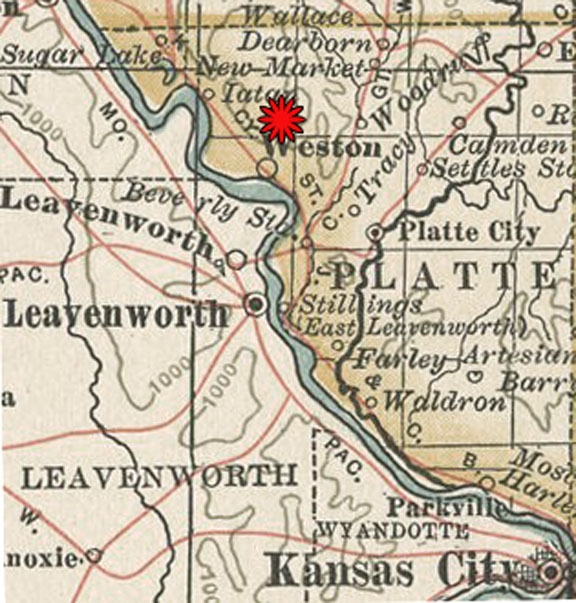
Weston, 1853

They settled about ten miles north of Weston, a thriving Missouri River town.


You may notice the river is south of Weston on this map. It removed itself in the 19th century finding another channel, leaving Weston high and dry and retro charming today.

The Silers settled in Marshall township in a hilly area not far from the Missouri River and east of the boundary to what was Indian Territory in the 1840s. The hills are rather remarkable for the Kansas City area--- a place often considered flat by the uninformed.


Mount Bethel's building dates to 1883 after Elizabeth had died.
The Silers are buried in the churchyard.

Religion may have been a motive for migration. Philip was described in the Platte County history as "an earnest and consistent member of the Cumberland Presbyterian Church." They were among the founders of Mount Bethel Cumberland Presbyterian Church in 1851.

The Cumberland Presbyterian denomination was formed in Kentucky over doctrinal differences in ministerial education. They advocated less preparation for ministers who would serve the rural frontier. It seems that Platte County was home to many Kentucky migrants of the sect. In his Annals of Platte County William McClung Paxton recalled that  "Hardshell Baptists were the leading denomination...their ministers were not educated and were seldom paid. The Missionary Baptists, Cumberland Presbyterians, Methodists and Disciples divided the people."  Was peaceful co-existence  a problem in Missouri as well as in Virginia?

View from the church yard

The Silers may have come to Missouri looking for congenial neighbors but Platte County in the years around the Civil War was a contentious place to be.

The 1850 census finds Philip and Elizabeth in their mid thirties as rather prosperous farmers with assets worth $3,200 and three children, Nancy having been born in Missouri soon after their arrival. Charles was born in 1858. 


1850 census from Family Search

The late 1850s were difficult economic times. Philip's assets had dropped by two-thirds according to the 1860 census and they may have lost their farm. He is recorded as a boarding house keeper worth $1,000. (Perhaps why the quilt is so worn---if four children didn't wear it out the boarders would have.)

 They also may have brought an enslaved girl with them from Virginia The 1860 slave schedule lists one unnamed 25-year-old woman, who would have been about ten when the Silers came west.

Elizabeth was fortunate that her boys were too young to become Confederate soldiers although John---17 when the war began---may have joined in the guerrilla warfare that made Platte County an informal battleground.

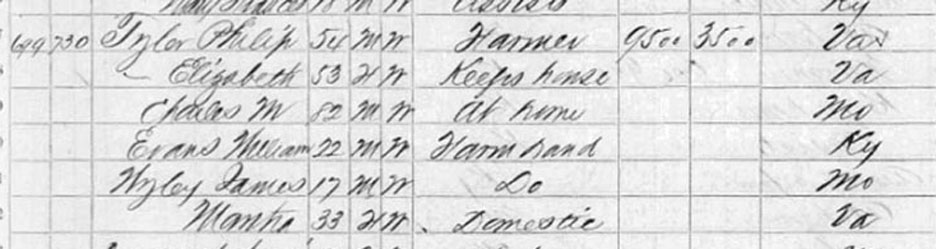
The first post-Civil -War census finds the family back on their feet again in 1870. The census taker who had such lovely handwriting seems to have been incompetent. He's listed them as Tylers, has 12-year-old Charles listed as 82 but still at home. Their land is worth $9,500 and other assets $3,500 (of course those numbers could be wrong.) Two farm hands live with them and 33- year-old Martha, born in Virginia, is a Domestic. This may indeed be girl brought from Virginia although she is listed as white. In 1860 she was defined as a Mulatto or mixed race.

Neither Philip nor Elizabeth lived to be recorded in the 1880 census. They died a few weeks apart in the winter of 1879. Elizabeth's grave has not been recorded in the Find-A-Grave index and they may have been buried in the same plot under the same headstone.

I  brought her quilt to Mount Bethel on a cold January day.

The quilt has survived quite a bit in the past 180 years or so. The story of the Civil War in Platte County is a complex tale of guerrilla warfare, shifting loyalties and unofficial militia groups, Bushwhackers, Jayhawkers, Red Legs and Paw-Paw Militia. We don't know what side the Virginia Silers took ---one really couldn't be neutral---but after the war daughter Nancy married Christopher Columbus Graves (1840-1924 ) remembered in the county history as serving "in the Confederate army from the beginning to the end of the war...wounded three times."


Weston doesn't look much different today (except for the missing river
at the end of Main Street.)

Next time you go to Weston take highway H north out of town and turn on Highway M to see some great hilly Missouri country and Elizabeth's church.

She was running out of fabric towards the end of the project.


One print instead of plain white in a corner.

Philip's Find A Grave site. No stone for Elizabeth.

Wednesday, March 3, 2021

Square in a Square Set for Hands All Around


Here's a set idea being discussed on our Facebook page
HandsAllAround:Alcotts

12 different star blocks, 13 alternate blocks of a square
inside a square.
Cutting for 8, 12 & 16" from EQ8 


Quilt about 1900 by Evalina White Allmott Chiswell Darby,
North Carolina Project & the Quilt Index

You get a lot of different effects by shading and setting the blocks on point, etc.


Susan E. Mueller is trying out the set here with Block #2.

13 stars, 12 alternate blocks
If you were careful with the shading you can get a
complex pattern going that really emphasizes the
alternate blocks.


EQ8 sketches

But since this is a sampler of stars
we might be better off with low contrast in the alternate
square in a square blocks.


Like this one circa 1900 from Donna Stickovitch's collection.

Monument Square, early 20th century.
Library of Congress

We'll call it Monument Square after the Concord park where the Civil War Memorial is located.