Wednesday, March 8, 2017

Yankee Diary: Susan B Anthony's Star


Denniele's Block #2
with a ghostly Susan B

March 8 is International Women's Day so we're celebrating today
with Block #2 from the Yankee Diary Quilt, Susan B.'s Star.


In the 1870s Susan B. Anthony was tried in the Canandaigua New York Courthouse for "knowingly voting without having a lawful right to vote." Carrie Richards, our Yankee Diarist, was living nearby at the time and undoubtedly well aware of the trial, which received national attention.

Read more about the Canandaigua trial here:
http://grandmotherschoice.blogspot.com/2012/11/10-new-york-susan-b-anthony-breaks-law.html


Daisyusanh posted her red,white & blue block on Instagram.
#yankeediaryquilt

Danice

Jeanne

Terry

Our Flickr page managed by Dustin:

Post your blocks on the Flickr page or Instagram or send pix to me and I'll post them for you.

MaterialCult@gmail.com

Saturday, March 4, 2017

Quilts Buried with the Silver 2 North & South

Cut-out-chintz block quilt in the Collection of the Charleston Museum.
Attached to the quilt is a note reading:
"Got wet and stained the night of Sherman's Raid."


Sherman's troops destroyed the Southern infrastructure
and terrified the population.

The North Carolina project noted they "documented a great many quilts that families believe were buried during the war. This may have been because the quilts were valued highly, or perhaps because they were suitable wrappers for silver and other family valuables."

Cotton Boll made by Temperance Neely Smoot
From the North Carolina project and the Quilt Index.
"According to the family this quilt was put in a trunk along with 
other valuables and hidden in a swamp to protect it from Union invaders.

It makes sense that most of the quilts with stories of being buried or hidden are connected to quilts by Southern women, as Yankee raids of Southern land were far more common than Confederate raids on the North.
Quilt buried on Clinch Mountain
Tennessee State Library

Jeananne Wright bought this quilt with a note pinned 
to it saying the Pope family buried the quilt 
for safekeeping before the Battle of Pea Ridge in Arkansas in 1862.

Quilt by M.E. Poyner, Paducah, Kentucky.
Collection Bill Volkening
Found during the Kentucky project
where the family noted it was buried to protect it from raids.

Quilt attributed to Catherine Nead (1793-?), Pennsylvania
The family was said to have wrapped their valuables in quilts
to carry them from Chambersburg, Pennsylvania, when
Confederate troops set the town on fire.

Chambersburg near the Maryland border was raided three times by Southern soldiers.

How accurate are the stories?
There is much evidence that quilts and other bedding were a prime target for raiding soldiers on both sides.


One of the more enduring tales about quilt patterns
is Ruby Short McKim's 1929 story about how the original quilt
in the pattern Order No 11 was stolen from the Kreegar family
by raiding Union troops.


Note the bedding being jayhawked off Missourians' porch in 
George Caleb Bingham's
painting of Order Number 11.

This high-style South Carolina chintz quilt was
stolen by a Union soldier and wound up at the Kansas
State Historical Society.

Rose Tree Quilt
Stolen from a Southern clothesline by a Southern soldier
who cut a hole in the center to wear it as a poncho.

From Southern Quilts: Surviving Relics of the Civil War by Bets Ramsey & Merikay Waldvogel.
http://civilwarquilts.blogspot.com/2011/10/40-order-number-eleven.html

See this recent post on Sheriff Jones losing a quilt during the pre-War Kansas Troubles.
http://civilwarquilts.blogspot.com/2017/02/sheriff-jones-loses-quilt-in-kansas.html

Cold soldiers were looking for blankets of any kind. Hiding the quilts seems logical even if burying them doesn't. Metal boxes, wooden trunks, rubber tarps might protect the quilts as well as the silver.

Wednesday, March 1, 2017

Way West: Blazing a Trail

Way West: Blazing a Trail by Barbara Schaffer

Barbara has finished her Westering Womne sampler!
She used traditional fabrics with the nontraditional set.

See more photos here:

I've been collecting pictures of innovative sets for samplers. Maybe one will inspire you to get these blocks on the road.

Whose? Set for 12 blocks: simple and balanced.

Cotton & Steel. Vice Versa, 2016 set for 16 Blocks.

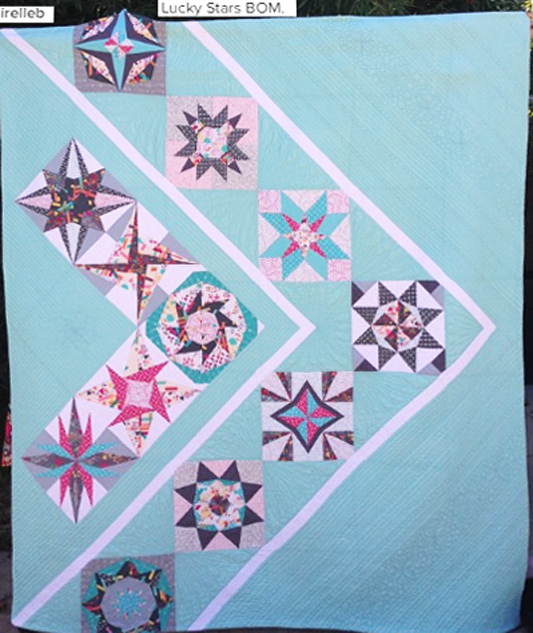
Irelleb posted this Instagram picture of her
set of Elizabeth Dackson's Lucky Star BOM
12 Blocks

Flying Squares set for 13 blocks from

See a few more innovative sets at this post:
http://civilwarquilts.blogspot.com/2017/01/way-west-set-for-westering-women.html

Saturday, February 25, 2017

Quilts Buried with the Silver 1

Whig's Defeat or Missouri Beauty.
The Arizona Quilt Project recorded this quilt's family names and story.
It was kept in a tree during Civil War battles to keep marauding soldiers from
stealing it.


Quilt books have told us stories about quilts being buried, hidden and
stashed away during the Civil War ever since people have been writing quilt books.


Marie Webster's 1915 book showed an applique Virginia Rose "buried along with family silver and other valuables to protect it from depredations by...soldiers."


The New Jersey project saw a quilt from Georgia
that came with the story that it had been buried there.
Most of these quilt pictures are from the Quilt Index.
I did a search for words like "buried", "hidden" and "Civil War."

McClure Family Quilt
Mountain Heritage Center Collection
Documented by the North Carolina project.
"Some of the information is family lore through our grandmother and some is from histories developed by various family members. The quilt supposedly was buried during the Civil War to keep it safe from Federal troops, probably stationed in east Tennessee. Another version has it that the family silver was wrapped in the quilt and buried to protect it from theft by the troops."

Often these are exceptional quilts, the family's best quilt.

Quilt by Adaline Green, the Arizona Project:
Hidden in a hollow log.

And often the quilts are damaged---with holes, fading
or stains.

Quilt by Mary Caroline Markett from the Michigan project.
 The silver was wrapped in the quilt and all were buried in an iron pot.


The Kentucky project documented this faded quilt, called Missouri Belle by the family, with the story that it was hidden in a haystack.


An unusual Arkansas quilt made of six swag borders looks to have been stitched of the end-of-the-19th-century solid colors that were so prone to fading to a dun-colored tan. The family story was more elaborate:
"Due to looting by soldiers and bushwhackers, the quilt and other family possessions were buried in a wooden box. The quilt was damaged, and the lighter shades of the fabric were used to mend it after the war."
That family myth is unlikely. A more accurate caption for the quilt above might be:
This post-Civil-War quilt was made from both fugitive and color-fast reds and greens. The applique colored with natural dyes like Turkey red retained a good deal of their color. The reds and greens derived from the new and experimental synthetic dyes lost most of their color and faded to tan.
But we are dealing with myth here. The stories of the quilts being buried and damaged tell us a lot about how families passed on stories of the Civil War. Sometimes accurate history is not the point.


Wednesday, February 22, 2017

Yankee Diary Block 2: Susan B.'s Star

Block 2 Susan B.'s Star by Barbara Brackman


From Carrie's Diary: December 20, 1855.
"Susan B. Anthony is in town and spoke in Bemis Hall this afternoon. She made a special request that all the seminary girls should come to hear her as well as all the women and girls in town. She had a large audience and she talked very plainly about our rights and how we ought to stand up for them, and said the world would never go right until the women had just as much right to vote and rule as the men.


 "She asked us all to come up and sign our names who would promise to do all in our power to bring about that glad day when equal rights should be the law of the land. A whole lot of us went up and signed the paper. "

Susan B. Anthony (1820-1906) at 28 years old, 
a few years before she
began her New York speaking campaign.


Susan B.'s Star by Becky Brown

Susan B. Anthony stopped in Carrie's town of Canandaigua on her second New York tour in 1855. She'd determined to speak in every county in the state of New York, traveling by railroad, sleigh and carriage to gather signatures for a petition demanding that the state legislature grant women child custody in divorce cases, control over personal earnings and the right to vote. 

Bemis Hall was in the top floor over the bookstore 
in the tallest building in the photograph here taken by 
Augustus Coleman in 1858. 

Anthony crossed the state from Long Island to Lake Ontario, speaking every other day. She used a gift of $50 from activist Wendell Phillips to print handbills and newspaper advertisements announcing her arrival and sold small publications to support herself. She often attracted a good-sized crowd. People came just to see the novelty of a woman addressing an audience, a rather alarming breach of propriety.

An Ulster County newspaper described a speech:
"At the appointed hour a lady, unattended and unheralded, quietly glided in [and] ascended the platform.. under 600 curious eyes...put her decorous shawl on one chair and a very exemplary bonnet on another, sat a moment, smoothed her hair discreetly, and then deliberately walked to the table and addressed the audience. She wore a becoming black silk dress [the reporter then goes on to describe her looks and hairstyle.] Her voice well modulated and musical, her enunciation distinct, her style earnest and impressive, her language pure and unexaggerated."

Petitions were a means of changing laws. 
This one from the Library of Congress collection
concerns Anthony's right to vote. 
Officials rarely acted no matter how many women signed.

Carrie was impressed enough by Anthony's afternoon speech to sign her petition and tell Grandmother Beals about it, who...
 "said she guessed Susan B. Anthony had forgotten that St. Paul said the women should keep silence. I told her, no, she didn't for she spoke particularly about St. Paul and said if he had lived in these times, instead of 1800 years ago, he would have been as anxious to have the women at the head of the government as she was. I could not make Grandmother agree with her at all and she said we might better all of us stayed at home."
Anthony's brazenness must have inspired another Canandaigua woman to speak in public that night. 
"We went to prayer meeting this evening and a woman got up and talked. Her name was Mrs. Sands. We hurried home and told Grandmother and she said she probably meant all right and she hoped we did not laugh."

Susan B.'s Star by Denniele Bohannon

The following year Susan B. Anthony began directing her attention to the abolitionist cause, signing on as an agent for the American Anti-Slavery Society, a cause Grandmother may have had more sympathy for.


Woman with a fabric flag pinned to her dress.
Cased photo from Swann Gallery auction.

Friendship Quilt (detail)  attributed to Susan B Rogers, Brooklyn, 
New York, NMAH Smithsonian Institution

Susan B.'s Star
The star with flags was inspired by a block in an 1867 quilt by/or for New Yorker Susan B. Rogers. See the quilt in the collection of the Smithsonian by clicking here:
http://americanhistory.si.edu/collections/search/object/nmah_556497

Block signed H. M. ? in Susan B. Rogers quilt.


Becky's in gray tones

The Block
Star and two flags appliqued to a 15" finished block.

For the background cut a square of fabric 15-1/2" x 15-1/2". Fold it in quarters and press to mark the center point.

For the flagstaffs holding up the flags.  Cut 2 strips that finish to 1/2" wide (cut 1" wide). Cut each 5-1/2" long.

The Star
The templates:
Print the template for an 8-1/2" finished star. Add seams.
Piece the five points together, join them and applique the star.


Denniele pieced each of her split star points from two templates. Cut 5 of those going one way and 5 going the other.

Note: she appliqued a second star over the point where 10 seams meet in the center, a good solution to a possible problem.


To Print:
  • Create a word file or a new empty JPG file. 
  • Click on the image above. 
  • Right click on it and save it to your file. 
  • Print that file so the star is 8-1/2" wide, which extends beyond the page. You'll lose two points but if you need them you can add them.
  • Add seam allowances when you cut the fabric.

Becky & I used a wide stripe and fussy cut it to shade the points. I cut 5 points with seams added, pieced them into a star and appliqued it.

Place the star so the central point in the block is slightly below the top star point.
Baste or glue it in place leaving room for the flagstaffs at the top.

The Flags

Make 4 flags this month, two waving left and two waving right. You'll use two in Block 2 and save two for later blocks. I appliqued mine. Below are piecing instructions too.


Fabric--- Flags are so iconic you can really push the imagery in the fabric and it will still read as a flag.

Mine are zigzags and polkadots but they look like a flag.


Appliqueing 4 x 5" Finished Flags

Pieced flags
This diagram is for the flag on the left above.
Reverse it for the flag on the right.

B is the starry field. Cut 4 squares 2-1/2" x 2-1/2"
A and C are the stripes.
For the bottom C cut 4 rectangles 2-1/2" x 5-1/2"
For the side A cut 4 rectangles 2-1/2" x 3-1/2"

Tuck the flag staffs under the star's top point and then tuck the flags under the staffs. Baste or glue and applique.


Block 2 will be set on the left top corner of the sampler.

Woman in a pageant costume, perhaps, with appliqued stars.

You can buy the paper patterns for the first four months of Yankee Diary from me at my Etsy Store:
https://www.etsy.com/listing/493172538/yankee-diary-bom-civil-war-quilts?ref=shop_home_active_1
Or a downloadable PDF
https://www.etsy.com/listing/506664289/yankee-diary-bom-civil-war-quilts?ref=shop_home_active_3
.