Wednesday, June 24, 2020

Cassandra's Circle #6: Varina Howell Davis's Briar Rose

Cassandra's Circle, Block# 6, Briar Rose by Becky Brown

The rose with thorns remembers one of Mary Chesnut's closest friends during and after the Civil War, Varina Howell Davis, married to Confederate President Jefferson Davis.

Varina Banks Howell Davis (1826-1906)
Collection of the Libraries at Louisiana State University
Her brooch pictures a dog. See another view below.
"Mrs. Davis was as nice as the luncheon. When she is in the mood, I do not know so pleasant a person. She is awfully clever, always." Mary Chesnut
Mary's husband James Chesnut spent time as President Davis's assistant in the Confederate capitol of Richmond. They had known each other when Chesnut and Davis were U.S. Senators in Washington representing South Carolina and Mississippi. Jefferson Davis had long been a spokesman for slavery and secession.

 Davis was a "Secessionist Square," Secretary of War in
President Franklin Pierce's cabinet, according to an 1853 newspaper
article comparing the cabinet to a quilt with Free Soil and Secessionist
Squares but no Union blocks.

There was infighting in 1861 when they all arrived first in Montgomery and then Richmond to begin their experiment in Confederate government.
"I think it provokes Mrs. [Davis] that such men praise me so. What a place this is; how every one hates each other...Mrs. Davis & Jeff Davis proving themselves any thing but [well bred by their talk.]" Mary Chesnut, July 3, 1861.
"The reason Mrs. Davis don't like me that I take up with the Wigfalls----& besides that, wherever I sit I am some how in the way! The president was excessively complimentary." Fourth of July, 1861.
Portraits of the Davises attributed to Jesse H. Whitehurst, Washington.
 John O’Brien collection
The Davises were an important part of Cassandra's Circle.

Varina may have been jealous or just irritated with the way Mary attracted a crowd of men to her conversation, creating bottlenecks at receptions. Another problem was Mary's friendship with Charlotte Wigfall, whose volatile husband despised Davis. (See last month's block.) Charlotte was reported by Mary to have called Varina "a coarse Western woman" --- Natchez, Mississippi being the West.

Briar Rose by Pat Styring
(with a few more berries)

 Mary wasn't any too fond of Jefferson Davis at first. His cool aloofness made her anxious.

But: "Mrs. Davis & I had a touching reconciliation."
"She was so kind!" Mary added later to that July 4th entry. And the Davises became close friends.

Varina with her namesake and 
youngest child born in June, 1864
After the war: "One perfect bliss have I. The baby..."

The women had much in common. They were of the same class, close in age, Varina three years younger. Both had been educated at French boarding schools (Varina's in Philadelphia, Mary's in Charleston); both were bright and rebellious and they might have amused each other with tales they'd heard about relatives greeting George Washington at the bridge in Trenton in 1779. Varina's Grandmother Keziah Burr Howell and her aunt Sarah Howell Agnew were among the New Jersey socialites dressed in white with Mary's mother-in-law Mary Cox Chesnut. (See Block #1 Washington's Plume.)

The Briars, 1904, Library of Congress
Varina grew up at The Briars in Natchez, her family supported by relatives

Varina's father William Burr Howell was son of Keziah and husband Richard Howell, Governor of New Jersey from 1793-1801. William sought his elusive fortune in Mississippi and found it in Margaret Kempe, heir to 2,000 Mississippi acres and sixty slaves, assets that disappeared over her marriage as her husband went bankrupt.

Margaret Kempe Howell (1806-1867)
At times Varina's mother took in sewing to support her family.

Varina's wedding photo, 1845
Altered versions of this photo float around the internet.
Don't believe everything you see there.

The Kempes and the Howells were friends with the Davis family. After visiting the Mississippi planters 18-year-old Varina married the widowed Jefferson Davis, twice her age.

The 1860 census shows the Davises with their three children
in Mississippi at their Brierfield plantation

"Dined at President Davis's...Mrs. Davis so witty." Mary Chesnut, May, 1861

1849 miniature on ivory of Varina Davis by
 New Yorker John Wood Dodge. 
National Portrait Gallery
Note the dog brooch.

Painter Dodge and his mother Margaret collaborated on some Union quilts during the war.

Mary Chesnut and Varina agreed on many things but Varina never shared South Carolina optimism about the Confederacy's eventual success and did not hesitate to show her feelings. The First Lady scandalized the South by abruptly leaving her husband's inaugural ceremony, a scene she later described as watching Davis as "a willing victim going to his funeral pyre."

In exile in Canada four years after defeat

Yet Mary defended both Davises for life.
"I will not sit still and hear Jeff Davis abused....And she...you would think to hear them he found her yesterday in a Mississippi swamp."
Shortly after defeat refugee Varina visited Mary in Chester, South Carolina:
"She left here at five o'clock. My heart was like lead, but we did not give way. She was as calm and smiling as ever...my dear Mrs. Davis...under altered skies."
The Block

Briar Rose

A rose with thorns symbolizes Varina's girlhood home "The Briars" and certainly her thorny experiences as Mrs. Jefferson Davis, the less than enthusiastic First Lady of the South. Varina recalled that she and her husband were gardening among their roses at the Mississippi plantation Brierfield when a messenger arrived with the news that Davis had been elected president of a provisional Confederacy.

Detail of a four-block rose by Susan Stayman made in Illinois in the 1850s,
 in the collection of the Helen F. Spencer Museum of Art at the University of Kansas.

Briar Rose is drawn from this impressive quilt called Moss Rose by the family. Several similar four-block quilts exist so the pattern must have been passed around.

Briar Rose by Susannah Pangelinan

Applique to an 18-1/2" square or cut it larger and trim later. Susannah's finishes to 12".


The Patterns
One Way to print these JPGS:

· Create or a new empty JPG file that is 8-1/2" x 11" or a word file.
· Click on the image above.
· Right click on it and save it to your file.
· Print that file out 8-1/2" x 11". Note the inch square block for reference.
· Adjust the printed page size if necessary. Do not use tools like "Fit to page."
· Make templates.
. Add seams when cutting fabric.

A little fussy cutting in the rosebud by Becky

My 9" block. I had to squeeze the pieces up
to fit. And that's regular old applique in the green smiley shapes.

But reverse applique is the traditional method.

Pat Styring's Blocks 1-6
Almost half done.

Extra Reading

Joan Cashin's First Lady of the Confederacy: Varina Davis's Civil War. 
Preview:
https://www.google.com/books/edition/First_Lady_of_the_Confederacy/Vi2Q-LFAJ3IC?hl=en&gbpv=1&dq=First+Lady+of+the+Confederacy:+Varina+Davis%27s+Civil+War&printsec=frontcover

See more about the four-block Moss Rose quilts here:
http://barbarabrackman.blogspot.com/2010/08/moss-rose.html

Saturday, June 20, 2020

Godey's Unionist Patterns

Godey's 1857


Account of a Missouri Fair, 1854

Mrs. E.C. Davis of St Joseph, Missouri won a prize with a silk quilt in the Buchanan County Fair in 1854. "The design of this quilt was the 'American Confederacy,' as represented in its constellation of stars, the States of the Union. Its pattern was after the style of quilted and knotted work. (See Godey for September.)"

This is a description of a quilt named American Confederacy seven years before the Civil War but Mrs. Davis must have been referring to the Union rather than the seceded states. Her quilt seems to have been stars representing the 33 states of the Union (Kansas, soon to be the 34th, had just been opened for Territorial settlement near St. Joseph.)

Her husband may have been a Dr. E.C. Davis who seems to have lived in various Missouri counties in the second half of the 19th century.

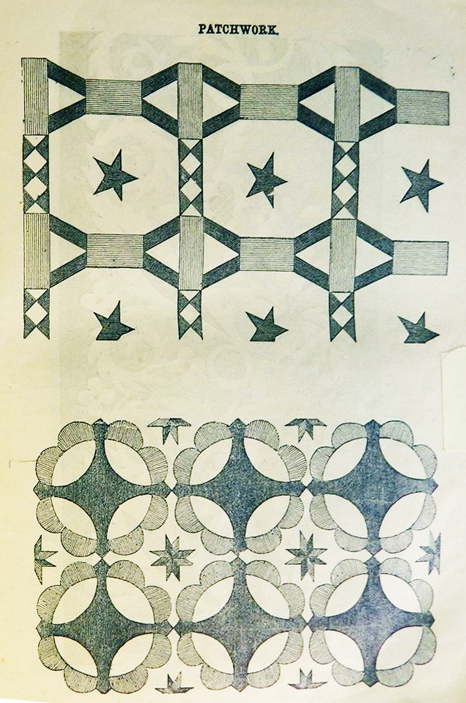
The reference to Godey's must be to this pattern published
in the September, 1854 issue of Godey's Lady's Book
(from the Internet Archive which has many issues online.)


We can assume the quilt was a silk star mosaic something like this, a style popular at the time. Perhaps the names of the states were embroidered in the stars.

1858

Godey's was quite influential at the time but not so much in the world of patchwork. Their patterns were often rather odd, undoubtedly meant to be pieced over papers. Nobody seems to have ever done so on the patterns above.

They published all kinds of needlework including this
"National Cushion" in 1858.

1858
Two applique designs. The lower one
a variation of Caesar's Crown, which was
often made---but how were those stars supposed to fit in there?


Editor Sarah Josepha Hale was fond of stars and as the war approached published some Union ornaments. A fierce Unionist, I'd guess she didn't know much about sewing patchwork. Her other needlework patterns look more practical.


1858
Little beaded bags to hold your coins.


Godey's American Slipper
Berlinwork slippers (needlepoint) were a popular
gift at the time.


Louise Wigfall is wearing a similar hair ornament
in this Civil-War-era portrait.

 Don't tell Mrs. Hale but Louise was a staunch Confederate, daughter of a well-known Southern fire-eater.
See more pictures of these headdresses here:
And more about Louise's family:

The rest of the account of the 1854 Missouri fair,
more description than one usually finds.

Wednesday, June 17, 2020

Hospital Sketches: Spring Finishes


Charlotte Schmidt-Brodalski's Hospital Sketches quilt
is finished.

This former art teacher/blogger is pleased to see how creative
stitchers have been in choosing colors, fabrics and borders
to make each version unique.

Charlotte seems to have taken a tip from chintz quiltmakers of
the early 19th century in scattering butterflies.

Her use of a medium gray patterned background offered a challenge in finding fabric to contrast, I'm sure. I tend to use very dark or very light backgrounds because it's easier to get the florals (particularly the greenery) to show. Charlotte did a great job.

Linda Pyke's anniversary quilt also shows clever planning in the backgrounds. The color's off in this photo but you get an idea. She used a four-patch behind the applique, but rather than random
light squares she arranged them to create a lighter glow in the center. She also filled up some of the pattern's empty spaces with hearts, dots & birds.

She writes that she, "Once used a cheetah fabric for a background. As long as you have contrast between the background and the applique or pieced block you're good."

Sue sent Mark Lauer a picture of his beauty in the classic colors on white in the machine.

And here it is finished and on the bed. Beautiful!

Lois Griffith's has the same traditional look as Mark's. She added shapes
and altered blocks and quilted it on her regular machine.

More dots!

 Randi Merlau's, also with a pieced border is quilted, bound and labeled.

Peggy Sandfort's with it's four-patch background is back from the longarmer.

Check our Facebook page as people finish this project.

Saturday, June 13, 2020

"The Union Forever"

"The Uni-on for ever" 1850
Quilt by Elizabeth Helm Walker Stone (1828-1898), Kentucky
Wintherthur Museum
Gift of Martha Walton Coonley in honor of great-great grandmother, 
Elizabeth Helm Walker Stone, her grandmother, Laura Kinkead Walton
and great-aunt, Robert Rodes Stone Kinkead.

The Winterthur Museum's online catalog has several photos of this beautiful silk hexagon quilt. See a link below.
In the center an eagle is embroidered with the words
"The Uni-on for ever"

Elizabeth Helm Walker Stone was about 22 when she dated this quilt in 1850. The quilt and genealogical records tell us she was from a privileged family in Madison County, Kentucky.
The 1860 census's slave schedule lists 28 people living under her husband Robert Rodes Stone.

Despite being a slaveholder Elizabeth seems to have had strong Union sentiments as did Robert Rodes Stone (1817-1893) who attended Harvard Law School and became a Colonel in the Union Army. They married in 1844 and the year the quilt was dated had one child Anne Rodes Stone, about five.

Corner embroidery

His obituary tells us that his father had "a large landed property...he preferred the simple, independent life of a country gentleman, which he never abandoned until the war and emancipation made it no longer pleasant or desirable....He married Elizabeth Helm Walker, one of two daughters of a prominent citizen of Madison County."

Elizabeth's obituary records she was born in Woodford County at "Helmsley, the ancestral home of her mother" near Versailles, Kentucky. The Helmses, originally from Virginia, remained a prominent Kentucky family.

Lexington Historical Society

After the Civil War Robert and Elizabeth moved with the times, relocating to Lexington where Robert became a banker, described as "a wealthy capitalist" after his death. Their two daughters Laura, born in 1854, and Annie eventually shared "the magnificent estate" left by Robert becoming two of the "the wealthiest women in Kentucky," according to Annie's marriage notice.

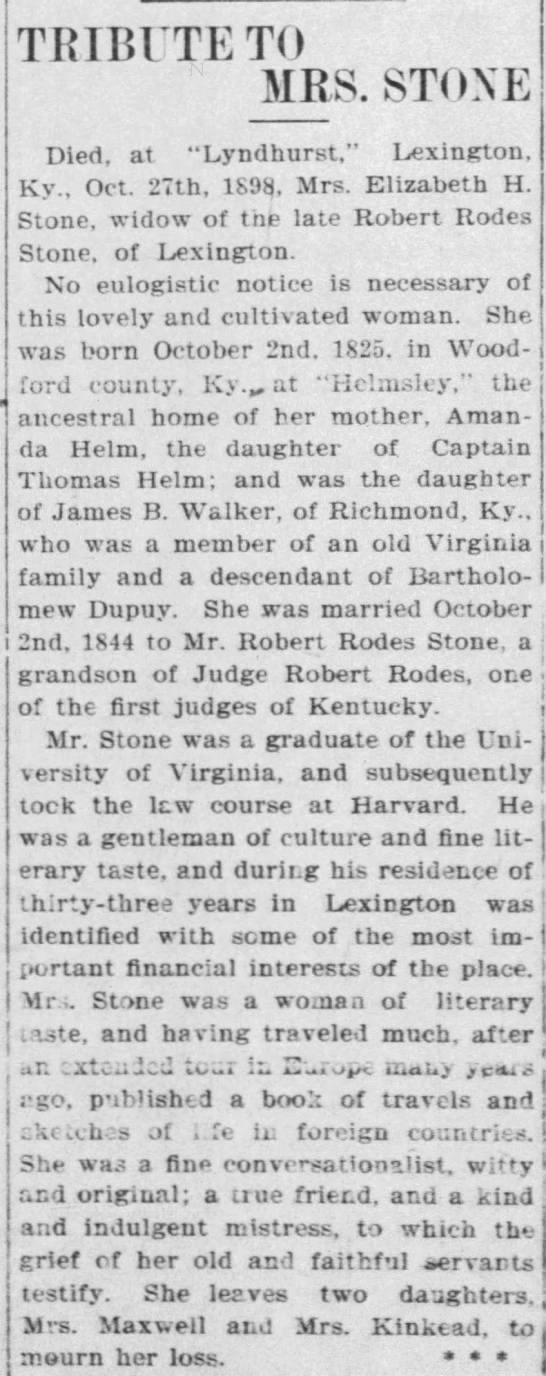
The Stones used their money to travel. "Mrs Stone was a woman of literary taste, and having traveled much, after an extended tour in Europe...published a book of travels and sketches of life in foreign countries. She was a fine conversationalist, witty and original," according to her obituary.


The quilt descended in daughter Laura Kinkead's family. Annie did not have children, and in fact was only married for several weeks late in life. In 1895 "A Romance in Life" circulated among U.S. newspapers telling the sad story of her marriage to Arthur Nithsdale Maxwell, British Royalty, who died two weeks later. Three months later another story was published wondering if the marriage ever existed. Returning to Lexington "Miss Stone, or Mrs. Maxwell, was suffering from the terrible shock....Her family thought it best to take her south, and about the middle of November she and her mother left for Florida."


Some newspaper articles:

Elizabeth's obituary 1898

The Mysterious Marriage
1895 & 1896


The easiest way to see this quilt at the Winterthur's web page is to go to the search page:
http://museumcollection.winterthur.org/
And do a search for Helm. Scroll down till you see the quilt. 2008.0023

See posts on quilts with related mottoes:
https://civilwarquilts.blogspot.com/2019/12/constitution-union-quilt.html