Wednesday, January 8, 2020

Yankee Notions #1: Open Book

Yankee Notions #1
Open Book by Denniele Bohannon
12"


We'll begin the Yankee Notions series with a block about the idea of literacy and the value New Englanders have placed on education since the first Puritans landed.

The Massachusetts Bay Colony passed a law requiring parents and masters to teach children to read as early as 1642. New England was home to the first colonial colleges and also to the 19th-century principle of common schools with the Yankee notions that education should be universal, non-sectarian and free.

Yankee schoolteachers spread these ideas in the South before, during and after the Civil War.

Yankee schoolteacher Laura Towne (1825-1901) with 
Dick, Maria and Amoretta in Union-occupied 
South Carolina sometime after 1862.


Graphic showing the proportion of illiteracy in the states in 1850, from an 1870 Report by the Commissioner of Education based on the censuses. Dots do not show numbers but rather proportions with New Hampshire and Connecticut having the fewest people who cannot read as a basis for comparison.
"Wherever the Yankee soldier has tramped the Yankee Schoolmarm will teach. Noble and chivalric gentlemen may throw stones at her windows, burn her schoolhouse, drive her from their neighborhood; but she reappears---she, or her cousin...." Atlantic Monthly 1869.


Southerners, of course, resented the often-heard criticism that they were ignorant and illiterate. Confederate diarist Mary Boykin Chesnut took delight in describing the spelling errors found in  letters scattered on battlefields among the dead soldiers.
"Free schools are not everything, as witness this spelling. Yankee epistles from camp show how illiterate they can be, with all their boasted schools. Fredericksburg is spelled 'Fredrexbirg,' medicine, 'metison'...."
Western Female Institute, Ohio

The concept of free public schools was a Yankee Notion that divided the country, as was the idea of public taxes to support those schools. Schools cost money; good schools cost lots of money. Who is willing to pay for it?

Virginia Governor William B. Giles (1762-1830) spoke for many when he criticized the Jeffersonian ideal of  public education. Schooling the boys of Virginia would make them unfit for farm and other manual labor that was their lot; hiring teachers would create a voting class with a special interest in the high taxes schools demanded and it was not fair to levy taxes on one taxpayer to benefit another's child.
The Block

Chocolate & Cinnamon traditions

BlockBase #2597 has been published with many names over the past century. Open Book is from a catalog identified as Needlecraft Supply in the 1930s.

The pattern is older. The block above is dated 1872.
Sorry about the Y seams.

Each month you'll get patterns for two sizes: 12" or 18" Blocks.

12" Block

A - Cut 4 parallelograms from a strip 3-1/2" wide at 45 degrees. The base should be 6-3/4" long.
B - Cut 1 square 7-1/4". Cut into four triangles with two diagonal cuts.

C - Cut 1 square 6-1/2".


18" Block
A - Cut 4 parallelograms from a strip 5" wide at 45 degrees. The base should be 9-3/4" long.
B - Cut 1 square 10-1/4". Cut into four triangles with two diagonal cuts.

C - Cut 1 square 9-1/2".


How-To


Open Book by Dorry Emmer
She's using some notions fabric in one set of blocks.

A Tangible Yankee Notion
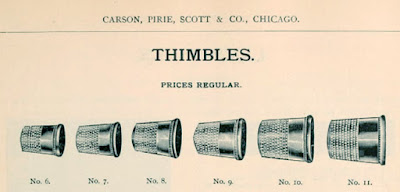
Thimble


Thimbles (the German word is Fingerhut which explains the concept nicely) have been around since humans invented needles. Made of various materials, particularly leather and metals, they can be hand made or manufactured. 


Manufactured metal thimbles were one of the sewing notions a Yankee Peddler would carry to housewife customers north and south.

The Peddler's Wagon by Charles Green Bush, Harper's Weekly, 1868

Thimbles commemorating Queen Victoria's
ascension to the throne and her 60th Jubilee.


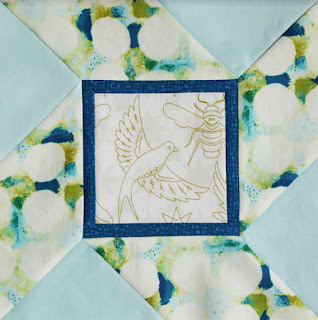
Open Book by Dorry Emmer
Dorry added a frame to spotlight her flying creatures fabric in
her second set of blocks.

Open Book by Becky Brown

And Becky added pieces in the center square to make it a 3-color block.

Denniele is doing two sets, one 12" and this one 18".
She says that 9" square in the center needed more pattern so she cut strips:
Cut 4 orange 1-1/2" x 9-1/2" strips
Cut 5 white 1-1/2" x 9-1/2" strips
Alternating colors, piece the nine strips together.
Sign at the German Fingerhut Museum

Saturday, January 4, 2020

Secession Album Quilt

Unquilted Album 
77 " x 61 "
From the collection of pottery collector
Robert Hunter of Williamsburg, Virginia

Jeffrey S Evans Auctions recently sold this album sampler.


One block with a Secession theme stood out:
"Block with 11 red stars above the South Carolina palmetto tree having an inscription from the French Revolution Marseilles hymn reading

To arms! To arms, ye brave
The avenging sword unsheath,
March on! March on! All hearts resolved
On victory or death."Signed Hattie Cameron / Oakgrove Aug 1st 1861."
"Catalogue Note: Hattie Cameron is probably identified as Savilla Harriet Cameron (b.1840-d.1867) of Fairfield, SC, daughter of Robert G. Cameron (1799-1873) and Savilla H. Feaster (1802-1886)."


The 20 blocks show a range of style, skill and fabric.
Many look to date from after Hattie's death.

Hattie died in 1867 at 27 years old shortly after the war she so heartily supported. She'd given birth to two children in her marriage to Leroy Mangum McAfee of the 49th North Carolina Infantry, whom she married in 1863.

Ruched florals in a woven basket 
Maryland influence?

Open wreath signed ? Robinson, more Maryland style

Her block and perhaps a couple of the others date to the 1860s but the Evanses noted:

"Blocks likely stitched together later with fugitive color border along each side, having later added backing. Blocks circa 1861, backing later."

The pink backing is an odd choice. Looks like silk lining fabric one could
buy already quilted, often used as coat lining. The wide binding was
probably once red or green.

Hattie's father Robert Gregg Cameron (1799-1873) was a slave owner and one young member of his plantation population was interviewed years later in the Slave Narrative project of the W.P.A. Nelson Cameron's father Vander worked in the tan yard tanning leather and shoes. He "belonged to one of the big bugs, old Marse Gregg," remembered Nelson who was probably about 10 when the war was over.


"All through the 'Carpet Bag' days my pappy stuck to the white folks, and went along with the Klu Kluxes. His young mistress, Miss Harriet Cameron, married the Grand Titan of all the Holy invisible Roman Empire...Pappy told me all about it....McAfee came down from North Carolina [to visit Feaster Cameron]....While on that visit he fell in love with Marse Feas's sister Harriett and married her....Sundays [my pappy] he'd take that long walk to Concord Church to put flowers on her grave."
Here's a link to the auction:

I brightened up the photos

One of the blocks is signed Gladney, a common name
in Fairfield County, South Carolina.

The wheel block with the scalloped edges here is
called a Sundew or Carolina Medallion today.

Read more about this pattern here:

A link to Nelson Cameron's memories of Harriet's family:

Wednesday, January 1, 2020

Applique Border for Cassandra's Circle

97” x 97” with 12-1/2” Finished Border. The general idea.
Cassandra's Circle BOM begins on the last Wednesday of January here.

The rose border, digitally sketched from an antique quilt, is simple but requires some skill in arranging the curves of the bias vine to fit gracefully and go around the corners. It's probably a good pattern for beginners who want to learn how to use bias strips and fit vines into borders. The leaves are a little confusing here. See the actual shape below. Each leaf is one piece although they look 2-color here.

Here's the inspiration. I changed the shapes.

Fabric for Applique
Red for flowers: 1 yard
Yellow for floral centers: 1/2 yard
Green for leaves:  1-3/4 yard
Bias Math
Green for vine & stems made into 1/2" bias strips (cut 1" wide): How many yards? (The math is too much for me.) But I'm guessing you’ll need about 10 yards (360 inches). That's about 2-3/4 yards of bias per side.  

Here's a formula I found at the Sewing Loft Blog.com.   

They say: For example with 4 inch bias:
 360″ of bias x 4 1/2″ wide = 1620  ÷ 42″ wide fabric = 38.57″ ÷ 36 = 1.07 yards of fabric.

For 1 inch bias:
360" of bias x 1" wide = 360 ÷ 42" wide fabric = 8.6  ÷ 36 = 1/4 yard of fabric. Is that enough?
I'd buy a yard of fabric. 

Stems. Cut 3” long strips, 28 of them.

Here's how to cut continuous strips of bias from APQ:

Background

If you are not going to piece your background strips you will need 5-1/2 yards. You can get 3 strips out of one 2-3/4 yard piece.
  • Cut strips 13” wide
  • Cut 2 strips 13” x 72 1/2” for the top & bottom.
  • Cut 2 strips 13” x 97 1/2” for the sides.
Scroll down for the pattern sheets.


Print out these patterns on 8-1/2" x 11" sheets of paper.
This rose in various sizes is the basis of many of the blocks in the quilt.
Applique the circles to the roses before appliqueing roses to the vine.

Saturday, December 28, 2019

Constitution & Union Quilt

Quilt dated 1859-1861
Ohio

Twenty-two years ago Linda Critchfield sent me snapshots of a quilt from her collection. We had hopes of including it in my book Quilts From the Civil War, but it did not happen. I'm sorting through my paper files, digitizing pictures and information as I organize the files to ship to the Quilt Research Center at the University of Nebraska Libraries in Lincoln.

92" x 92"

The flag is in the center of a pieced & appliqued sampler, typical of the 1850s & '60s. If I knew nothing about it I'd guess midwest: Ohio, Indiana, Illinois by the matter-of-fact set. Nothing fancy,
just the blocks and a lot of white leaving space for the quilting which was fancy.

But the blocks are signed with names, dates and places.

The flag block has this inked inscription in a scroll:
"Constitution & Union
One
And inseparable  Now
Forever
Miss. Clara D. Moore
Rural Retsed??
Ohio"

UPDATE:
Liz wonders if this doesn't say Rural Retreat, Ohio. Couldn't find a place name though there is a Rural Retreat, Virginia.

Below the flag is a shield with an inscription. I blew the photo up and drew over the letters,
laid it on my desk and everytime I walked by tried to read it. After a few
weeks I've come up with:
"A union of each a union of hope
A union we are x one very xxxx
A union of wxxxx union xxx
the Constitution forever"
I was hoping that was enough information to find a similar poem online, but came up with nothing.

Clara was one of eleven members of the Moore family to sign the blocks. There are 38 signed blocks with place names in Clermont and Belmont Counties, Ohio and Kentucky, Indiana and Tennessee. Dates range from August 10, 1859 to 1861.

Contrast this quilt with its political message to one made about the same time in South Carolina, the other side of the sectional divide. See a post here:

Linda wrote: "Included in the quilting are blocks illustrating the Capitol building, an anchor, telescope and a globe, a lyre, a pineapple, and a trapunto dog."

I mentioned Linda's quilt in the book but we didn't photograph it, which is too bad. It would be nice to have good photos of the blocks and more information about the names and places.

Clara's block refers to a motto that excited much discussion and sectional division in the decades before the Civil War. Massachusetts Senator Daniel Webster asserted in the Senate in 1830 that the U.S. was not an association of sovereign states able to choose which laws to obey, as many Southerners argued. Liberty to follow regional interests would destroy the constitutional idea of a union. Liberty yes, but "Liberty and Union, now and forever, one and inseparable."

Quilt attributed to Elizabeth Moffit Lyle, Kewanee, Illinois.
Collection of the Smoky Hill Museum, Salina, Kansas

Elizabeth changed the rallying cry to "The Constitution & Union Forever"


http://civilwarquilts.blogspot.com/2018/07/elizabeth-moffitt-lyles-union-quilt.html


Wednesday, December 25, 2019

Union Star Set for Yankee Notions

Denniele Bohannon designed this Union Star set for our Yankee Notions
pieced Block of the Month (starts in two weeks).

61" x 78"

A dozen 12" blocks fit like the white square shown.
Sashing finishes to 5" strips.
A single blue border finishes to 2-1/2".

Sashing Strips
You need 31 sets of pieced sashing finishing to 5".

  • Cut the blue strips 2-1/2" x 12-1/2" (need 2 per set) 
  • Cut the red strips 1-1/2" x 12-1/2" (need 1 per set
Cutting the 5" Stars for the Cornerstones

You need 6 of this color arrangement

Or Rotary Cutting Each Piece from EQ8


You'll see the Union Stars are variable stars in coloring.


You need 20 stars total in three colorways. The large triangle in the star changes from blue to red depending on where it intersects the red strips.
The Border
A single blue border finishing to 2-1/2" wide frames the quilt 
(below outlined in white).

Cutting the Border
For the sides cut 2 strips 3" x 73-1/2"
For the top and bottom cut 2 strips 3" x 61-1/2"

Saturday, December 21, 2019

Mark Twain Has to Leave Town

Banner Quilt 
by the Ladies' Social Circle 
Collection of the Clarke Museum in Eureka

Sam Clemens certainly must have irritated the women
of Eureka, California when he wrote satirically about their fund raising
fair with this quilt made for General U.S. Grant in 1864.

But not nearly as much as he irritated the women of Carson City, Nevada about the same time.

Samuel Clemens (1835-1910) (Mark Twain)
The red-headed Clemens was in his thirties during the war,
living in the far west with his brother to avoid the conflict
 in his home state of Missouri

Sam Clemens wrote for newspapers in Nevada during the war. His reporting was often imaginary.

Scrapbook of Twain's reporting in Nevada
Mark Twain Papers at the University of California Berkeley

The women of Carson City, Nevada held a small event to raise money for the U.S. Sanitary Commission in May, 1864.

Fancy dress ball

 The fancy dress ball featured a fundraising gimmick, a sack of flour that was continually auctioned off for high prices and then donated back to be sent to another Ladies' Aid Society.

Reuel Colt Gridley (1829-1870)

Gridley, Clemens's friend from Hannibal, Missouri, operated an Austin, Nevada grocery store. With his traveling sack of flour he raised thousands for the Sanitary Commission. This carte-de-visite was also a fundraiser, sold by the Sanitary Commission to the many CDV collectors.

Apparently the women in charge of the dance intended to send any money raised to the national Sanitary Commission but there was a misunderstanding and some thought the money would be going to the St. Louis aid society, a minor confusion until the reporter published a short piece attesting that the money "had been diverted from its legitimate course, and was to be sent to aid a Miscegenation Society somewhere in the East." This might be a reference to a donation to a Freedmen's charitable organization.

Clemens's use of the word miscegenation was an outrageous lie, implying that the Union-supporting women were also supporting marriage between the races (highly unlikely at the time.) The women were furious. See below for their letter to the editor, which he refused to publish. Rival newspaper The Territorial Enterprise was glad to print it for three days in a row.


Mary Eleanor Stotts Clemens (1834-1904)

The Carson City women expelled Twain's sister-in-law Mollie Clemens from the aid society. The husband of Ellen Cutler, president of the local group, challenged Twain to a duel.

Carson City, 1863

Five days later Twain took a stagecoach for San Francisco.

The letter:
"In your issue of yesterday, you state "that the reason the Flour Sack was not taken from Dayton to Carson, was because it was stated that the money raised at the Sanitary Fancy Dress Ball, recently held in Carson for the St. Louis Fair, had been diverted from its legitimate course, and was to be sent to aid a Miscegenation Society somewhere in the East; and it was feared the proceeds of the sack might be similarly disposed of." You apparently mollify the statement by saying "that it was a hoax, but not all a hoax, for an effort is being made to divert those funds from their proper course."
In behalf of the ladies who originated and assisted in carrying out the programme, let us say that the whole statement is a tissue of falsehoods, made for malicious purposes, and we demand the name of the author. The ball was gotten up in aid of the Sanitary Commission, and not for the St. Louis Fair. At a meeting of the ladies, held in this city last week, no decision was arrived at as to whether the proceeds of the ball should be sent to St. Louis or New York, but one thing was decided, that they should go to the aid of the sick and wounded soldiers, who are fighting the battles of our country, and for no other purpose . . . . .the ladies having the matter in charge, consider themselves capable of deciding as to what shall be done with the money, without the aid of outsiders, who are probably desirous of acquiring some glory by appropriating the efforts of the ladies to themselves.MRS. W. K. CUTLER, President. MRS. H. F. RICE, Vice President. MRS. S. D. KING, Treasurer. MRS. H. H. Ross, Sec'y. San. Ball."
A Wikipedia entry on this fundraising debacle seems quite accurate and detailed: