Saturday, July 9, 2016

Lincoln Memorial Quilt from the Massachusetts Project

"In Memory of Abraham Lincoln"

"President of the U. States"

"Assassinated at Washington
April 12th 1865"

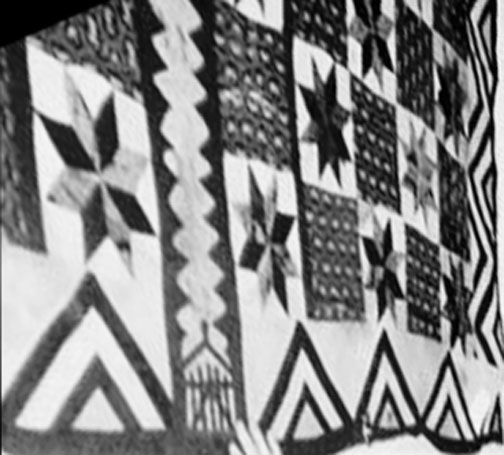
The Massachusetts project has included this photo of a Civil War memorial quilt at the Quilt Index.
Little seems to be known about it. It was in a private collection at the time it was documented, inherited from mother.

The central block has a dedication
"To G.A.N.
From His Friends"

Embroidered blocks include names and initials with places and regiment numbers.

The block is a traditional album variation, placed on point.
From the photos the fabrics look to be about 1870-1890.


See it at this link:

Wednesday, July 6, 2016

Gladi Wins a Prize!

Gladi won a ribbon at the Vermont Quilt Festival last week
for her Stars in a Time Warp quilt called Stella Nova.

Judge Gerald Roy chose hers for Viewer's Choice.


The hand quilting may have been the deciding factor.

See her post here:
https://gladiquilts.wordpress.com/2016/06/26/june-26-2016-judges-choice-award-at-vermont-quilt-festival-plus-pictures-of-some-of-my-favorites/

Saturday, July 2, 2016

Marin City Negro History Club's Portrait Quilts


During the early 1950s women in Marin County, California celebrated African-American history by making a pair of large quilts portraying Harriet Tubman and Frederick Douglass.

Harriet Tubman
Ben Irvin and the Negro History Club of Marin City and Sausalito, 1951
96" x 120"
Robert Woodruff Library Collection.

Ben Irvin, a San Francisco architect and later head of the Sausalito Arts Center, drew the designs. The first was Harriet Tubman. 

 1885 photograph of Tubman 


Members of the Negro History Club of Marin City and Sausalito stitched Irwin's ideas into a wall hanging that was 8 by 10 feet. Some of the artists: Birdie Smith, Martha Johnson, Essie McKee, Betty DePrado, Catherine Holland, Margaret and Billie Jo Fuslier, Bernice Vissman, Detia Wright, Florence Shandeling, and Claudia Beagerie.

Marin City was a relatively new place in 1950, a shipyard community that grew up in World War II just north of San Francisco. After the boom days people continued to live in government housing in an ethnically mixed community. 


Jet Magazine published a photo of the Tubman quilt in 1952, noting it was entered in the California State Fair.
"The bed cover is the handiwork of an interracial women's group....The first of a series of embroidered works showing prominent Negro leaders."

Frederick Douglass
Ben Irvin and the Negro History Club of Marin City and Sausalito, 1953
96" x 120"
Robert Woodruff Library Collection.

The group's second quilt, also drawn by Irvin, showed Frederick Douglass addressing an Anti-Slavery Society Convention in Nantuckett in 1841.


Anna Murray Douglass listens to her husband on the left and Abolitionist newspaper editor William Lloyd Garrison is at right.

Howard and Sue Bailey Thurman (1903-1996)

Sue Bailey Thurman from San Francisco showed the quilts around the country in the 1950s. They were exhibited in the 1970s in Marin County and postcards made of them. I can remember what an inspiration they were to textile artists using cloth to create pictorial images. 

Sue Bailey Thurman was an author, editor and teacher interested in Black history.  She wrote newspaper articles including  "Pioneers of Negro Origin in California" and married theologian Howard Thurman.

She donated both quilts to Emory University's Robert Woodruff Library in Atlanta. 
Read more about the quilts here:

Wednesday, June 29, 2016

Westering Women 6: Hill and Hollow

Block 6 
Hill and Hollow by Becky Brown
"July 27, 1857. Traveled the distance of about two and a half miles over sand hills the most terrible I ever beheld. Encamped on the banks of the Platt river for dinner.
August 2 1857.Our camping place for dinner was Ash hollow a splendid and romantic place."
Sarah Mousley

As we follow the Westering Women across the American continent we see the landscape change in Nebraska's panhandle. Ash Hollow Park is the red arrow on this N.P.R. map that shows
the dominant tribes along the trail.

After weeks of uneventful days following the Platte River, travelers came upon a series of landmarks. Windlass Hill, a formidable descent, was the first. Teams and wagons were unhitched and inched down the hill. 

Ruts and swales are still visible near Windlass Hill and 
California Hill on the Platte. 

Keturah Belknap wrote in 1848 that the men “were lifting the wheels to ease them down the steps for it was solid rock steps from six inches to two feet apart so it took all day but we all got thru without accident.”


"Bloomer Costume Put to a Severe Test"
Wadsworth's 1858 guide pictures a wagon careening downhill with
a woman holding on behind. 

Once the hill had been navigated immigrants rested in Ash Hollow, some staying a few days to enjoy the water, the best on the journey. After weeks of sifting the mud out of Missouri and Platte River water, spring water was a delight.

The hill and hollow are well marked in a Nebraska park near Highway 26 and Llewellyn. This is a great place to see ruts left by the wagons.

Hill and Hollow


The Nancy Cabot column in the Chicago Tribune published this classic block and named it Hill and Hollow in 1937 (BlockBase #1276), but it's divided by 10 so would make a poor 12" block.
I changed the proportions---leaving a lot of triangles in there---many hills and hollows still to cross from Ash Hollow to the Pacific.


Cutting a 12" Block
A - Cut 20 squares 2-7/8". Cut each in half with a diagonal line to make 2 triangles. You need 40 small triangles.


B - Cut 4 squares 4-7/8". Cut each in half with a diagonal line to make 2 triangles. You need 8 large triangles.


Bloomers on the Trails

The unfortunate woman pictured in Wadsworth's guide is wearing trousers under her skirt, but is it a long skirt or a more practical short skirt?

Kenneth L. Holmes, editor of the Covered Wagon Women series, noted in Volume 5 about trips in 1852 that he saw a pattern of women adopting the "Bloomer Costume," trousers. Seventeen-year-old Eliza Ann McAuley:
"My sister and I wear short dresses and bloomers..."

Eliza Ann McAuley [Egbert] (1835-1919) at the time of her 
California marriage, 1854

Dr. Mary E. Walker in bloomer costume soon
after the Civil War. One could borrow a 
pair of pants and trim off a ragged skirt...

making a more functional costume as worn by these female gold seekers.


Becky Wants to Know:
"Are we there yet? Well I guess we are half-way!"

Keturah Belknap about 1910,
over fifty years after her western journey.

See Keturah Belknap's journal in volume 1 of Covered Wagon Women and Sarah Mousley's in Volume 7.
Saturday, June 25, 2016

Graveyard Quilts for Mourning

Quilt by Elizabeth Roseberry Mitchell (1799-1857)
Collection of the Kentucky Historical Society,
Donated in 1959 by her granddaughter Nina Aura Mitchell Biggs (1866-1968), 
a local historian and writer.

I've been asked if the Kentucky Graveyard quilt would be an appropriate design for a Civil War reproduction quilt. I shall ramble on here.

47 pieced stars and 20 coffins in the Kentucky Historical Society's quilt.

http://kyhistory.pastperfectonline.com/webobject/90C9CB5A-6327-42F0-8085-383648601656

This famous mourning quilt is unusual but not unique. For years Elizabeth Roseberry Mitchell's medallion quilt picturing a cemetery and coffins in the center was described as one of a kind. But it isn't. There are two of a kind.

One of my theories is that people rarely make an amazing quilt like this out of the blue.There are sources and inspiration, possibly earlier and/or later quilts with related ideas.

In the case of Elizabeth Mitchell there are two related quilts:


'
The graveyard in the center of the second Mitchell family quilt
(thought to have been made earlier than the other)
with two coffins, 45 stars and the words
"Mitchell School Clothes"

Quilt historian Linda Otto Lipsett found another quilt in the collection of the Highlands Museum and Discovery Center in Ashland, Kentucky. Another Biggs descendant had donated that quilt in the 1980s, but the link had not been established by the museums.
\
A mural showing the diagram of the second Mitchell quilt, painted in 2008 by 
Denise Spaulding, Melanie Osborne, Gary Preston and 
ABC Quilt Alley on the flood wall in Ashland, Kentucky, .

The mural artists took some liberties, according to the Herald-Dispatch:
"That quilt is 172 years old and it's really fragile, almost crumbling. So now people can see what it would look like and it looks really good. They reproduced it like it would have looked if it was new. It was as close as we could get to being the real quilt."


The actual quilt top shows the border of V shapes and the cemetery path
of dog-tooth applique along the bottom border.


Family tradition is that Elizabeth Mitchell began the first quilt after she lost two-year-old John in 1836 and buried him in Monroe County, Ohio. Dissatisfied she began a second, similar version, perhaps when a second son died in 1843 at the age of 19. She made coffins for herself and other family members and basted them in the border. When they died she moved their coffins to the central graveyard. When she died in 1857 her daughter Elizabeth (1830-1867) moved Mother's coffin to the center.

The second version is quilted while the first is a top. 

The top on the left looks like it has a blue paisley fabric in the alternating squares, but this is just a glare in the photo. Both quilts seem to be set with the same brown print.


Kentucky Historical Society quilt.
The green calico binding seems in better shape than the rest of the quilt.

Linda Otto Lipsett with the Kentucky Historical Society's quilt.

Coffin labeled "Father" in a photo from the Quilt Index.

How old are the quilts? Much of the online history dating them to the 1830s seems to be adapted from a five-page typed paper that Nina Biggs donated with the quilt to the Kentucky Historical Society. That quilt is pictured on the Quilt Index where the Kentucky Quilt Project dated it as 1850-1875. If so, it is the right era for a Civil War mourning quilt,although there seems to be no Civil War symbolism in the original pair. Certainly it is an effective and authentic mid-19th-century mourning image.

Silk embroidered, framed memorial for a man who died in 1833.
from Stephen and Carol Huber's online shop


See Lipsett's 1995 book Elizabeth Roseberry Mitchell's 
Graveyard Quilt: An American Pioneer Saga, book here:

Detail of Polly Mello's interpretation of the 
Kentucky Historical Society's quilt.

Donna in SW Pennsylvania's interpretation.

Detail of a copy by Hollis Taylor.