Saturday, April 9, 2016

Seven Stars 1

Silk Star Quilt in the collection of the Museum of the Confederacy/American Civil War Museum, a gift for Jefferson Davis, attributed to the "stormiest part" of the Civil War, according to his wife Varina Davis.

You can look at the repeat pattern in several ways.
There are just two pieces, a diamond and a hexagon.


Read more about it at this post.

But you can also look at it like this as a hexagonal block.
and rotate it so it matches BlockBase #241.
We'd call it Seven Sisters


It's a hexagonal block of two pieces, a diamond and an irregular shaped, four-sided piece along the edges. The pattern was made by many quiltmakers North and South before and particularly after the Civil War.

The block was especially popular after about 1880.
Many surviving examples were pieced in
 fashionable colors from the
1880s and well into the 20th century.


Made by Mary Ellen and George James, Illinois, 1870-1900
Illinois State Museum. Union veteran George cut the pieces
for this after his return from the Civil War.

Detail of the James quilt

About the same time from the Michigan project
and the Quilt Index.

1880-1910
by the "Cheerful Workers of Concord" presented to their minister
W.R. McDowell,
Tennessee project and the Quilt Index

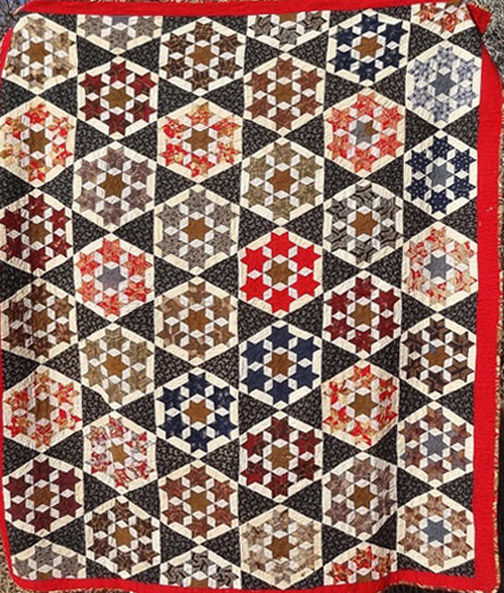
About 1890-1910 

About 1945 by Tomasita Ferro Bastardo,
Texas project and the Quilt Index

Detail of a silk quilt from about 1850 from
the collection of the Victorian and Albert Museum.
Related designs go back further in time

Quilt by Alice Bennett, date-inscribed 1873
Collection International Quilt Study Center and Museum
2003-003-0321

Alice Bennett's 1873 quilt is a variation. She pieced six stars instead of seven.

Unusual block from a 
Baltimore Album quilt in the collection of Colonial Williamsburg
with blocks dated 1844-1847
My first reaction to this pattern in the quilt donated by Varina Davis was that there is Confederate symbolism in the design. I've been working on this idea but I am not getting very far with it. More next week.


Wednesday, April 6, 2016

Block 2 as a Quilt

Indian Territory
I Photoshopped all the Block 2 (Indian) posts from the
Flickr page that were done in repro prints
and sketched a quilt.
A scrappy quilt.

Every other block is rotated 90 degrees.

8320-15 
I used this print (Lidian) from Old Cambridge Pike for the border.

Here are some of the blocks.


I like these blocks with triangles along the edges

Because they make Flying Geese when 
you set them side by side.


Saturday, April 2, 2016

Maggie Frentz's Flag Quilt

Lincoln Flag Commemorative Pieced Quilt
made by Margaret E. Frentz, 68" x 72",
date inscribed 1876.
Collection of the Indiana State Museum

This extravaganza is called the Lincoln Flag because the field of the flag is silk printed as campaign ribbons from the 1860 Lincoln/Hamlin campaign. 


Maggie Frentz, born in 1854, is thought to have begun the quilt when she was 13 years old during the Civil War.

Lincoln ribbons printed in black on various colors of silk are common
(relatively common---they aren't inexpensive.)
Maggie seems to have found some uncut silk leftover from the campaign.

She also included other ribbons in the stripes and the other patchwork

Bell and Everett ran against Lincoln in 1860.

In the center between the numbers 18 and 76 she featured a ribbon from the Pierce/King campaign of 1852.

Another example of that ribbon


Below it is a fuschia ribbon for O.H. Strattan for County Clerk
Oliver H. Strattan was from nearby Louisville, Kentucky.


The Museum knows a bit about Maggie. 
"The quilt was completed by Margaret E. (Maggie) Frentz in New Albany, Indiana, ca. 1876, when she was 22. She was born on March 7, 1854, and was the oldest daughter of Peter and Elizabeth Frentz. Elizabeth Frentz was from Louisville, Kentucky. This information was provided by the donor and also in a newspaper clipping in the donor file, though this information gave Maggie's age as 13 at the time she made the quilt.. This newspaper clipping says that Maggie pieced the quilt before and during the Civil War, which makes the age 13 fit."

Maggie died at 35 years old in 1889. She's
buried at St. Mary's Catholic Cemetery in New Albany
with her parents and baby sister Adelia.

Maggie may have attended St. Mary's of the Annunciation church
built a few years after her birth.

Her father Peter Frentz was listed in various city directories as a sign painter, a stencil cutter, a brand cutter and the operator of  a variety store. Perhaps he had a stock of old campaign ribbons that Maggie put to excellent use.

The 1859 city directory lists Peter Frentz as a stencil
plate cutter and proprietor of a "fancy store" at 336 and 342 Main. The
family lived in the same building.


He probably inherited this store from his father John B. Frentz who advertised in 1849 that he sold food and candy, toys, fireworks, musical instruments. John died in the 1850 cholera epidemic.

Peter and Maggie seem to have had a lot in common, both artists. They both took out patents. At 15 Maggie invented an improvement for corset fasteners.


"Maggie" on her tombstone

The Frentz family in 1860
Maggie is 6.

I bet Maggie's given name was not Margaret but some variation of Magdalene. The 1860 census is hard to read but her name at 6 is not Margaret. Her father was born in Germany; her mother in Hanover (Germany). Their Indiana-born girls were Matilda, Magdalene and May. The boy perhaps Benj.