Saturday, January 5, 2013

Dixie Diary 1: Her Flag Flying


Her Flag Flying
Block #1 at 8"

For the 2013 Civil War Block of the Month I'll be using prints from my Civil War reproduction collection Metropolitan Fair in pinks and browns.
My applique will be a variety of whites and very light prints from other lines.

Block 1 by Sandi Brothers
12" Block in a 1" finished frame.

Sandi did hers a few years ago in Civil War Homefront repros.
On the first Saturday of each month you'll find a block and a little history here.

Church Street in 1863.
Editor Charles East notes the
Morgan home is hidden by the trees behind the horses.

When the Civil War began in 1861 Sarah Fowler Morgan lived in Louisiana's capitol Baton Rouge. One of eight children from a wealthy family, almost twenty-years old, she lived on Church Street (now 4th Street) in luxury that would soon be a hazy memory.


Sarah started her daily diary in 1862, a year after the war began. She began with retrospective entries about her grief in the war's first year, describing the loss of her closest brother to a duel and her father to an asthma attack.

Sarah's father Judge Thomas Gibbes Morgan died
in the first year of the Civil War.

Her account of her family's Civil War experiences was published in 1913 as A Confederate Girl's Diary. This year we'll follow Sarah's years as a refugee, a girl growing up in extraordinary circumstances. Each month in 2013 you'll find a free pattern for a block of the month finishing to 12" or 8" squares.
The blocks, a combination of piecing and applique, are original designs based on basic patchwork, inspired by a 19th-century sampler. The first block recalls Sarah's homemade Confederate flag, stitched up as the Yankees entered the city in 1862.


Block 1: Her Flag Flying

Union Navy ships in Baton Rouge harbor, 1862
From the Library of Congress
May 10, 1862. Baton Rouge

In April, 1862, New Orleans was under Union control and in May Union ships were on the Mississippi River near Sarah's house preparing to take over the state capitol.

"We, too, have been having our fun. Early in the evening, four more gunboats sailed up here. We saw them from the corner….The American flag was flying from every peak. It was received in profound silence, by the hundreds gathered on the banks. I could hardly refrain from a groan. Much as I once loved that flag, I hate it now! I came back and made myself a Confederate flag about five inches long, slipped the staff in my belt, pinned the flag to my shoulder, and walked downtown, to the consternation of women and children, who expected something awful to follow. An old negro cried, 'My young missus got her flag flyin', anyhow!' Nettie made one and hid it in the folds of her dress. But we were the only two who ventured."


I wrote about Sarah's flag in 2010, illustrated by a picture from Harper's Weekly of a girl with a Confederate apron flaunting the seven stars of the first rebel flag. Since then I've found photos of similar surviving aprons from either side.

Mary Himes Fox's Union apron is on display at Gettysburg National Military Park. Mary (1841-1902) was just about the same age as Sarah Morgan.

Martha Booton was younger and a fellow rebel. Her apron is in the collection of the Museum of the Confederacy. See a photo here:
http://www.encyclopediavirginia.org/media_player?mets_filename=evm00001774mets.xml


 12" Block
All Sandi's 12" blocks are set inside a 1" finished frame---the better to fill out a full-sized quilt with blocks set on point. If you want to use the 12" set shown above you may want to add the frame as you make the blocks.
 Cutting a 12" Block
A – Cut 1 square 10-1/4" x 10-1/4". Cut into 4 triangles with 2 cuts.


B - Cut 2 rectangles 2-5/8" x 8-1/2". You will trim these later.
C - Cut 1 rectangle 2-5/8" x 18-1/2". You will trim this later.


Frame:
Cut 2 strips 1-1/2" x 12-1/2" for the top and bottom frame.
Cut 2 strips 1-1/2" x 14-1/2" for the side frames.

Cutting an 8" Block
Proportions on the smaller blocks are a bit different in some cases.

A – Cut 1 dark square 6-1/2" (6-9/16" if you want to use the 1/16th" default in EQ). Cut into 4 triangles with 2 cuts.
 

B -  Cut 2 rectangles 2-3/8" x 5-1/2". You will trim these later.
C -  Cut 1 rectangle 2-3/8" x 12". You will trim this later.


The Applique Shapes
  
The blocks each have either a star or a heart appliqued atop the finished piecing. 

Click on this JPG and print it out 8-1/2" x 11".

I was going to use the lightest piece in the
Metropolitan Fair collection for the applique
but it just didn't show up in real life.
So I am using a white background floral.
I found 6 scraps in my stash.

Choose the right sized applique for your block size.
Cut, using the template, adding a scant 1/4" seam allowance.
Prepare the star or heart for applique by turning under the edges and/or basting or gluing.
You might want to decide NOW if you want to set your blocks on point or on the straight to position the applique. This isn't so important for the star as it is for the heart. Stars work in any direction. You can always just baste the applique hearts down if you want to decide on the direction later.

Proposed Sets for the the Twelve Blocks

Here's a suggested set for the 8" finished blocks.
See the post here for more information on the sets.


And one for the 12" Blocks

Look for the next block on February 2 and next week I'll post about the inspiration quilt.

Friday, January 4, 2013

Dixie Diary Sets & Yardage

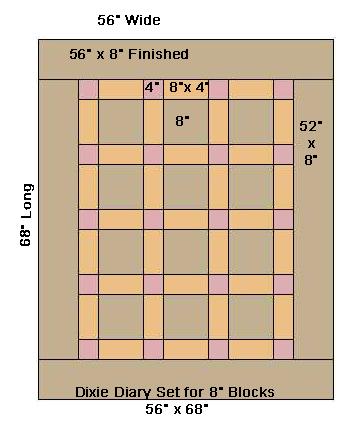
Set for 8" Blocks

Here is information about the Dixie Diary Civil War Block of the Month sets and yardage. I'm posting it here so we can refer back to it later. The first block has been posted on Saturday, January 5, 2013.

Each month you'll get a pattern for an 8" finished block and a 12" finished block.

Set for 8" Blocks

Quilt is 56" x 68". 12 Blocks.


Fabric Requirements
Blocks: 12 fat quarters or a Layer-Cake of 10" squares would do it with some leftovers from sashing & borders. You could probably get by with a Charm pack with other scraps for bigger pieces.
I am going to use pinks and browns from this Metropolitan Fair collection, but you may want to use the whole range.

Charm Pack of 5" Squares
Pieces will need to be cut larger than 5" so find some coordinating scraps.

Something quite light or quite dark for the applique pieces: 1/2 yard (I am using white background florals from my stash.)

Sashing & Borders: Sashing is 4" and Border is 8"
Electric Quilt says for yardage:
  • Pink cornerstones (20) = 1/2 yard
  • Brown Sash Strips( 31) = 1-1/8 yards
  • Border = 2  yards
Cut borders first and use extra in blocks.

Cutting
Pink Cornerstones: Cut 20 squares 4-1/2"
Brown Sashing Strips: Cut 31 rectangles  4-1/2" x 8-1/2"
Border:  Cut 2 strips 8-1/2" x 52-1/2" for the sides
               Cut 2 strips 8-1/2" x 56-1/2" for the top and bottom.

Set for 12" Blocks
Quilt is 67-1/2" x 87-1/4"
Blocks: You need 12 patchwork blocks set on point.
Setting:
Each 12" inch block is framed by 1" strips. Blocks are 14" finished (includes the strip.)
Patchwork blocks alternate with 14" unpieced blocks
Inner border finishes to 1".
Outer border finishes to 3".
Sandi used Civil War Homefront from a few years ago for her
12" Blocks
Fabric Requirements
Blocks: Maybe 8 different fabrics, 1/2 Yard pieces, or 16 fat quarters.
Buy a little extra of the setting &  borders and add to the blocks.
Something quite light or quite dark for the applique pieces: 1/2 yard
Setting:
Strips Framing the Blocks: 1 yard
Setting Triangles = EQ says 3 yards.
Borders
Inner Border: EQ says 1/2 yard (if you piece it together). Buy one yard and use for binding too. Or buy 2-3/4 yards--use for frames, inner border and binding.
Outer Border: 2-1/2 yards so it doesn't have to be pieced together. Cut the strips first and use the rest in the blocks.
Cutting
Frames for each 12" Block
  • Cut 2 strips 1-1/2" x 12-1/2" for the top and bottom frame.
  • Cut 2 strips 1-1/2" x 14-1/2" for the side frames.
Setting Blocks: Cut 6 setting blocks 14 1/2" square
Setting Triangles:  Cut 3 squares 21-1/2".
Cut each of these into 4 triangles with 2 diagonal cuts. You will need 10 of these edge triangles.
Cut 2 squares 10 7/8".

Cut each of these into 2 triangles with 1 cut. You will need 4 of these corner setting triangles.
Borders
Because the blocks are set on point the final measurements are a little iffy.  EQ says the quilt is about 67.4" wide---I've rounded it up to 67.5. It says 87.2" long. I've rounded it up to 87.25.
Border 1
  • Cut strips 1 1/2" x 79 7/8"  for side borders
  • Cut strips 1 1/2" x 62" for top and bottom borders
Border 2
  • Cut strips 3 1/2" x 81 3/4"  for side borders
  • Cut strips 3 1/2" x 68" for top and bottom borders

Saturday, December 29, 2012

January 1 2013: Civil War Jubilee


January 1 marks the 150th anniversary of the Emancipation Proclamation, which took effect on New Year's Day, 1863.

The event, one step towards freedom for American slaves, was celebrated all over the Union with Night Watches on New Year's Eve.


 The New York Times on New Year's Day, 1863 had headlines:
GRAND EMANCIPATION JUBILEE.
 A Night-watch of Freedom at Shiloh Church
 Great Excitement and Rejoicing Among the Colored People
Prayers, Speeches, Songs, Dirges and Shouts


The stroke of midnight was anticipated with speeches and at midnight a dispatch from Washington was read,

 "followed by three cheers for ABRAHAM LINCOLN, three cheers for freedom, &c., &c. Mr. GILBERT then resumed his speaking, and threw a damper on the enthusiasm of the audience by commencing to grumble and find fault because the Proclamation was to be 'issued as a military necessity, and not as an act of justice.' His audience did not appear to sympathize with his troubles in that line, and he soon dried up."

Mr. Gilbert, of course, had a point. The Emancipation Proclamation was a Union act freeing slaves in the Confederacy over which the Union had no jurisdiction in January, 1863. The end of the war was still years away.

But, as a gesture, it was an important gesture, indicating that Union goals had changed. The act also changed the status of  people in "Contraband Camps" who had been neither slave nor free.
 

 A few weeks later Harper's Weekly published a double page drawing by Thomas Nast on "the great event of the day---Emancipation."
The Past
 
On the left, the past under slavery; on the right, the future as free people.
 
The Future
Earning a living
 
The idea of a Jubilee, a celebration of freedom, is an echo of the Bibilical Book of Leviticus. In the Jewish calendar, a fifty year cycle was called a Jubilee in which slaves were to be freed: "Proclaim liberty throughout all the land to all its inhabitants."
 
Henry Louis Stephens,
Watercolor of a man reading the news,
1863

The National Archives in Washington is displaying a copy of the Emancipation Proclamation in the  East Rotunda Gallery for three days, beginning tomorrow: December 30, 2012, through January 1, 2013.
 
 
Many Night Watch anniversary parties are planned for New Year's Eve.

See more National Archives programming  by clicking here:
http://www.archives.gov/press/press-releases/2013/nr13-20.html

Saturday, December 22, 2012

The Book is Done!


Santa Claus at the Front
From Harper's Weekly 150 years ago next week
 
In time for Christmas, as promised, the Civil War Sampler book has been delivered.

I got a box of them two or three weeks ago and I mailed one off to everyone who has a block in the book.

Carol Sanderson
 
To illustrate the blocks I used pictures from our Flickr page, looking for a variety of colors and fabric ideas.

Melissa Devlin

I think I mailed out 35 books, so 35 different quiltmakers are represented in the book.

Donna at Quilting Bear Gal
 
Ann Champion


Amzingly enough, within ten days the books were in the hands of the most far-flung contributors. I see that Leisbeth Wessels in the Netherlands has received hers. Leisbeth's block is on the bottom on the page above. Country Log Cabin's at the top. See Leisbeth's blog here:
http://kleurrijkleven.blogspot.com/2012/12/een-verrassing-uit-amerika.html


And Patchie13 from France emailed that she has hers.

Leonie Weathersley (Just Cruising Mbk),
 
Kathie Coombs (Magpie Memories)
 
Leonie tells me that she (Just Cruising Mbk), Kathie Coombs (Magpie Memories) and Karen Matthews (Kookaburra Calling) are sisters. They all have blocks in the book.
 
Karen Matthews (Kookaburra Calling)
 
Here are some bloggers who have gotten their copies in the mail


Donna at Quilting Bear Gal has got her top together!


The bloggers photographed my inscription. Remind me next time to write neater.

The page at the C&T site says the book is ready although your quilt shop may not have it in quite yet.
http://www.ctpub.com/productdetails.cfm?sku=10874
You can also buy it as an eBook at the C&T site.

Thanks for all the help and inspiration. I couldn't have done all those blocks myself.


And thanks again for the quilt you made me, The Circle of Friends, which is right up there in the front of the book.

Saturday, December 15, 2012

2013 Block of the Month: Dixie Diary


Dixie Diary by Sandi Brothers
Quilted by Lisa Olinger
For a Quilt of Many Colors

A few years ago I did a limited edition block-of-the-month pattern titled Dixie Diary for my Moda Civil War reproduction collection Civil War Homefront. A few shops kitted it up in that line of fabric in 2010.

Sandi Brothers pieced it as a BOM for her Indiana shop A Quilt of Many Colors. I read that she and the members of her guild Sisters of the Cloth were invited to demonstrate quilting at last summer's Smithsonian Folk Life Festival in Washington D.C. She brought the Dixie Diary sampler with her.

Sisters of the Cloth
Sandi's on the right.
 
http://www.quiltofmanycolors.com/index.html

I thought I would rework this sampler in my current repro line Metropolitan Fair in pinks and browns---one of my favorite mid-19th-century color schemes.

Here are a few pink and brown antique quilts
for color inspiration.
 
 
They are all from about 1865-1885
This color scheme was quite popular
after the Civil War.
 
 
You better join. It's only 12 BLOCKS--- once a month---first Saturday of each month in 2013---right here. And the blocks are EASY. I really designed it for beginning quilters from 8 years old on up. The blocks will be in two sizes: 12" and 8"

Each block is an original combination of simple piecing and applique. The piecing is basic (One has Y seams---but even beginning quilters have to learn to do Y seams!) and each block has an optional appliqued star or heart in the center. You can opt out of the applique because it's stitched to a finished pieced block.


Each monthly block includes a story taken from one of the great Civil War documents---Sarah Morgan's Confederate Girl's Diary, first published 100 years ago in 1913.

Do check out the first block on January 5, 2013. It'll be right here at this blog address.

If you want to start thinking about fabric: I'm going to focus on pinks and browns so you can go through your Civil War reproduction stash and pull out the double pinks and the madder browns---


I'm going to do it in new Metropolitan Fair prints


But any of your Civil War repros will do. I'll show Sandi's and my blocks in the blues and reds of Civil War Homefront. As we've learned from looking at the finished Civil War samplers here you can use anything---batiks, solids, WHATEVER. Put your own stamp on it.

Look for the first block on the first Saturday of January.