Monday, January 17, 2011

3 Seven Sisters Posted


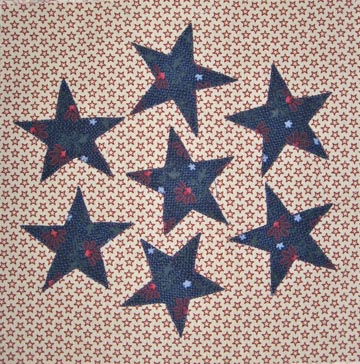
Stars upon stars by Donna

The reverse by Becky

Apparently I mentioned the A word, which can stand for Applique As Anathema.
But this is a relatively simple applique block.
See all the postings on the Flickr site (click on the photographer in the left hand column)
for different methods.
We did the one on the book cover by machine using freezer paper applique.
Last year Karla posted how-tos on her blog about machine applique techniques. This post on clipping inner curves could come in handy here.


Enquiring stitchers want to know:
Will there be more applique?
Yes!
Will there be more appliqued stars?
Maybe (I've only written this through March as of yet)

You'll want to find all your blue star fabric as there will be more flags.


This print is from my 2010 Moda collection Civil War Homefront

Here are a few others.


You can use the star prints to fussy cut if you don't want to applique.


Here are Seven Sisters cut from a star print.

Saturday, January 15, 2011

3 Seven Sisters

Seven Sisters

150 years ago this week Mississippi seceded from the Union, the second state to do so after South Carolina. Within weeks Florida, Alabama, Georgia, Louisiana and Texas followed. These seven rebellious states voted to form a Confederacy, selecting a flag in March, 1861 that symbolized the "Seven Sisters" in the field, a flag reflected on the cover of my book Civil War Women.

One version of the first flag
 
When the Civil War began in 1861 Sarah Morgan was a well-to-do 19-year-old living in Baton Rouge, the capitol of Louisiana. She had a lively family centered in a row of substantial houses on Church Street (now Fourth). Six slaves, recorded in the 1860 census, waited on the Morgan family. In her diary, Sarah recorded the events that ripped up her comfortable life.


A year after the War began New Orleans was under Union control and Union ships were on the Mississippi River near Sarah's house preparing to take over the state capitol. She wrote about the first day of Union occupation.

"Early in the evening, four more gunboats sailed up here. We saw them from the corner….The American flag was flying from every peak. It was received in profound silence, by the hundreds gathered on the banks. I could hardly refrain from a groan. Much as I once loved that flag, I hate it now! I came back and made myself a Confederate flag about five inches long, slipped the staff in my belt, pinned the flag to my shoulder, and walked downtown, to the consternation of women and children, who expected something awful to follow....Nettie made one and hid it in the folds of her dress. But we were the only two who ventured."

A rebel flaunting an apron based on the first
Confederate flag attracts attention from Union occupiers.
Use this photo for a pattern.
Print it so it's about 8" wide.

This week's block is based on the first Confederate flag, drawn from a quilt made in 1861 by Mrs. Green McPhearson of of Arkansas. Click on the link to see our inspiration, the Secession Quilt in the collection of the Historic Arkansas Museum. http://www.historicarkansas.org/collections/quilts.aspx?id=70

Click on the block picture above. Print it so it's about 8" wide to use for a pattern. Choose one star for a template, add a scant 1/4" seam allowance, cut seven and prepare the stars using your favorite applique method. Applique in a circular pattern to an 8-1/2" square background fabric.
Click here for a PDF version of the black and white photo. http://www.barbarabrackman.com/7sisters.pdf

NEW LINK (as of 9/1/2011)
https://acrobat.com/#d=eACZPlbfgh0Oi79wTQpr2Q

Late in the nineteenth century a pieced design called Seven Sisters, among other names, was popular.
If you'd rather do a pieced version---Sandy Klop at American Jane offers a pattern for the quilt above.
Scroll way down almost to the bottom of that page to her pattern Seven Sisters.

Read an online version of Sarah Morgan's diary, first published in 1913 as A Confederate Girl's Diary by Sarah Morgan Dawson, at either of these websites:

As more states seceded the Confederacy added stars
 to the flag, but soon redesigned it 
because it was hard to distinguish from the Union banner.

This week's story is drawn from a 2009 block-of-the-month I did called Dixie Diary. It's out of print. You can find a 19" pattern for the appliqued Seven Sisters in my book Civil War Women. Click here for a preview and ordering information for a bound copy (printed on demand) or a digital version.

Thursday, January 13, 2011

Flickr Group For Posting


Bettina in Spain

I have been getting lots of pictures and questions about where to post them.
Dustin started a Flickr Group called
Civil War Quilts 2011
Click here to see it and post:


Karen


From Lillian's Cupboard
Here's a how-to for the framed photograph:

Thanks to Dustin

Saturday, January 8, 2011

2 North Stars Finished Right Away


Tazzie's done with number 2

Rosemary Youngs sent two
See one of her books:

After I posted Number 2 I realized I should have done a web search for the inspiration quilt. I found it!
See the original from the Abolition Fair at Historic New England by clicking here:
http://www.historicnewengland.org/collections-archives-exhibitions/collections-access/collection-object/capobject?gusn=GUSN-10459&searchterm=None


And Mary's done
at Quilting in Oz

2 North Star


North Star by Barb Fife

Northern women opposed to slavery raised money for the cause through Anti-Slavery Fairs, much like our Christmas Crafts Bazaars. The antislavery newspaper, The Liberator, described the 1836 Boston fair:


See a digital version of the 1846 book The Anti-slavery Alphabet
by clicking here:
and browsing through the book.
“The Hall was filled with visitors at an early hour, and continued full until late in the evening. Very many of these were not abolitionists, but belonged to a large and increasing class of the community, who have been strongly abolitionized by Anti-Slavery efforts … The cake table was loaded with varieties of cake, made of sugar not manufactured by slaves, and near it was placed the motto, “Free Labor.” … There was a great variety in the articles, and many of them were very handsome and tasteful.”
Handmade items included pen wipers inscribed with “Wipe Out the Blot of Slavery” or “Plead the Cause With Thy Pen.” Needle holders proclaimed, “May the use of our needles stick the consciences of slaveholders.” Needle books shaped like shoes had written on the bottom, “Trample Not on the Oppressed.” Watch cases were inscribed with “The political economist counts time by years, the suffering slave reckons it by minutes.” Bunches of quill pens were bound with a label that read, “Twenty-five weapons for abolitionists.” Candy was wrapped in papers printed with poetry: “Come little ones! For the sweets you see, Were made by the labor of the FREE.”

Abolition Crib Quilt (Reproduction)
by Barbara Brackman & Terry Thompson
1996
Our inspiration was the quilt
in the collection of Historic New England.


A cradle quilt was made of patchwork in small stars. On the central star was written with indelible ink:
“Mother! When around your child
You clasp your arms in love,
And when with grateful joy you raise
Your eyes to God above—
Think of the negro mother,
When her child is torn away—
Sold for a little slave—Oh, then,
For that poor mother pray.”
Detail of our reproduction with the central inscription

Lydia Maria Child, one of the Boston Fair’s organizers, wrote in a letter: “You have doubtless learned the success of our Fair … My cradle-quilt sold for $5.” Her quilt has, amazingly enough, survived. The Society for the Preservation of New England Antiquities, now Historic New England, owns a small star quilt with the exact poem inscribed.


 Lydia Maria Child 1856
Quilts remained important to the era’s fairs. In 1846, The Liberator described a “North Star bed cover,” named, undoubtedly, for the escaping slave’s heavenly guidepost. The simple star here, one of the oldest patchwork patterns, represents the abolitionist’s needlework in our sampler. It’s been published by many pattern companies under many names, including Aunt Eliza’s Star or Variable Star, over the past 120 years or so. Today’s quilters often call it Sawtooth Star.
CUTTING INSTRUCTIONS
For a finished 8-inch block cut the following pieces:
A - 4 light squares 2-1/2" x 2-1/2"
B - 1 light square 5-1/4". Cut into 4 triangles with 2 cuts. You need 4.
C - 4 print squares 2-7/8" x 2-7/8". Cut each into 2 triangles with one cut. You need 8.
D - 1 print square 4-1/2" x 4-1/2"


This story is taken from my 2006 book Facts and Fabrications: Unraveling the History of Quilts and Slavery. See page 84 for a 15" pattern. Click here for more information about the book:
Sunday, January 2, 2011

1 Catch Me If You Can Blocks


People around the world have gotten right on this project. Barbara in Kuala Lumpur has finished the first block.

And so has Tazzie in Australia.

Susanne in Germany

And Karen


Rosemary

Mary

Saturday, January 1, 2011

1 Catch Me If You Can


Nearly 150 years after emancipation, we still delight in hearing tales of a slave's escape. This lively block stitched of only one triangular pattern piece captures the cleverness the adventure required. In her 1935 book The Romance of the Patchwork Quilt, Carrie Hall gave the name "Catch Me If You Can" to an old design with many other names including "Winding Blades", "Devil's Puzzle" and "Flyfoot."


Escape was often an impulse move. When opportunity knocked, a slave might slip through the door. Eliza Potter told the story of a young woman, a slave in Kentucky, who accompanied her mistress across the river to Cincinnati in the free state of Ohio:
"She was sent out one morning to make purchases and never returned, but found a happy home, I trust, on English soil."


Although we enjoy imagining good's triumph over evil, successful escapes were far too few. Most ended in failure for the simple reason stated by slaveholder William Dunbar in 1780:

"Ketty came home this morning of herself, finding it uncomfortable lodging in the woods."

Ketty must have weighed her options during the night and decided that hunger, cold and no real escape plan were worse than the expected whipping.


Don't make the mistake of thinking this first week's block was a code or form of communication on the Underground Railroad. The block was given the name in 1935 and Carrie Hall did not mention slavery or the Civil War at all in her description.

We are using a traditional block and a fanciful name to commemorate the Underground Railroad and escape from slavery. These symbolic patterns will have a label each week, as will reproduction patterns that actually existed during the Civil War.

Stitching the Block                              8" Finished Block

Rotary Cutting
Cut squares 2-7/8":  6 light, 6 medium and 4 dark
Cut each on the diagonal to make 12 light, 12 medium and 12 dark triangles [oops! that's 8 dark triangles]

Piece the triangles into squares, following the shading in the block photo


This story is taken from my 2006 book Facts and Fabrications: Unraveling the History of Quilts and Slavery. See page 68 for a 15" pattern. Click here for more information about the book:
http://www.ctpub.com/productdetails.cfm?PC=1049
You can buy it as a bound book or a digital book.

Read Eliza Potter's 1859 memoir of her life as a free black woman before the Civil War at Google Books.

A Hairdresser's Experience in High Life

Click here: