Saturday, February 11, 2017

Sheriff Jones Loses a Quilt in the Kansas Troubles

A "Kansas Troubles" pattern from the 1840s or '50s.
Collection of the Helen F. Spencer Museum of Art
Could that name for this pattern be as old as the mid 1850s when
the Kansas Territory was full of troubles.

Kansas Troubles: Name from the 
Nancy Page syndicated newspaper column in the 1930s

This may be a photo of Samuel Jones (1820-1885)

Samuel Jones was the Sheriff of Douglas County, Kansas, from mid-1855 to early 1857. He's one of our hometown villains in Lawrence, a Border Ruffian who lived in Missouri but established a bogus residence in the Kansas Territory to influence the question of whether we'd become a slave state or a free state. Jones, born in Virginia, was heavily invested in the concept of a slave state.

Samuel Jones established a pig farm in Douglas County and was appointed Sheriff by the pro-slavery territorial governor. While Sheriff he helped Missourians burn several businesses in the town of Lawrence, including the newspaper.

In the fall of 1855, while he was "on military duty in Lawrence," his livestock disappeared, "stolen, lost, and wholly destroyed to him by parties to him unknown." The thieves also stripped his cabin of household goods, his sacks of beans, a coffee mill and quilt "worth $5 or $6," according to neighbor Elizabeth Parks. Also missing: "one piece calico worth $1.25."

Four years later Sam Jones petitioned the territorial government to reimburse him for claims of $179.10 for his losses during what was called the Wakarusa War. By 1859 free-state men were in the ascendancy and Jones had resigned as Sheriff and moved to New Mexico where he'd been appointed collector of customs. He and his wife lived near Mesilla where he practiced law and land speculation. 


Samuel Jones signature on the right:
A Mesilla Mining Stock Certificate.

Jones was awarded $139.15, less than he'd requested. "The proof of the existence or loss of portions of the property claimed as lost is meagre and unsatisfactory."

Soon after Fort Sumter Jones was among a group of Confederate sympathizers who established a short-lived Confederate Territory of Arizona with Mesilla as it's capital. He was Marshall of the seceding area made up of parts of the New Mexico and Arizona territories. He died sometime after the 1880 census in Mesilla, probably about 1885.

How we view the Border Ruffians in Lawrence

It's hard for a resident of Larryville to sympathize with Sam Jones over the loss of his shoats or his quilt, but I bet his wife Mary C. Jones, living in Westport, Missouri during the Kansas Troubles, was not pleased when she heard about her Virginia keepsake.

Don't even get these guys at a GAR Union reunion in Lawrence
started about Sheriff Jones.

Many tales survive of quilts stolen by raiding soldiers during the Civil War. In Kansas we think of the Wakarusa War in which Jones lost a quilt as the first battle in the Civil War. Jones's claim for reimbursement is evidence of how wide spread the quilt-napping was.

Kansas Troubles variation from about 1890

Next time you see a quilt in the pattern Kansas Troubles, remember that period of civil unrest, which was national news in the 1850s but is now forgotten by most (except for us residents of Lawrence, Kansas.)

See more about the Kansas Troubles with a pattern here:
http://civilwarquilts.blogspot.com/2011/01/5-kansas-troubles.html

To see more of the Spencer Museum's quilt go to this link and search for the words Kansas Troubles.
https://www.spencerart.ku.edu/collection

Stella Rubin has a Pennsylvania antique for sale.

Wednesday, February 8, 2017

Finishes: Westering Women

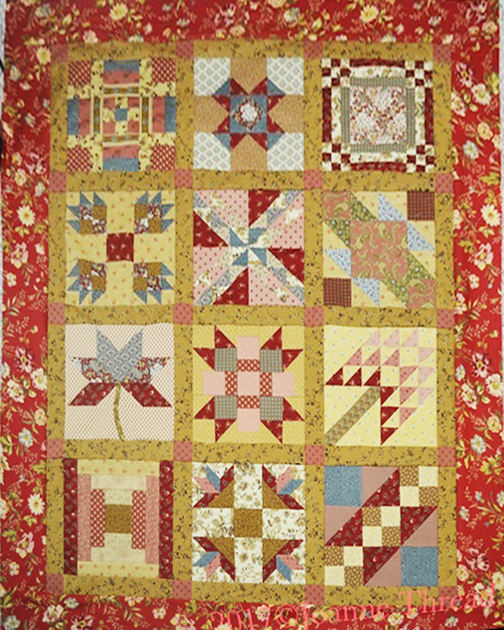
Stitch&Knit posted a picture of her finished Westering Women quilt
(she quilted it by the block each month)

She used many fabrics from a repro line Terry Thompson and I did years
ago called Lewis & Clark. Perfect for a Western trek.
(The color is better in the top picture.)

I've been lurking, copying photos of finished Westering Women tops.
I've done a litle Photoshopping, squaring things up, brightening, etc.

Big Lake Quilter

 They look great.

Lynette

Rebecca at Quilting Everyday

Joanne at Thread Head

What a variety.

Terry framed each block, which is a good way
to wrestle sampler blocks into a uniform size. Make some frames wider than others.
The blocks with their frames all finish to the same size.

Sandra at Patchwork Daydreams

Congratulations to the Finishers!

More finishes here:
http://civilwarquilts.blogspot.com/2017/01/traditional-sets-for-westering-women.html

Saturday, February 4, 2017

Pocahontas Virginia Gay's Confederate Memorial Quilt

Embroidered wool quilt by Pocahontas Virginia Gay, 
(1831-1922) Virginia. 
Estimated date after 1901-before 1922
Collection of the National Museum of American History, the Smithsonian

Last week I showed a Union Crazy Quilt. This week one with Southern sympathies. It's a little bit crazy but probably could better be defined as an embroidered and appliqued quilt.

Ms. Gay was descended from Pocahontas of Virginia's Powhattan tribe (1595?-1616) who famously married English colonist John Rolfe. "Aunt Poco" and her parents must have been proud of that Virginia heritage. She also left no doubt of her loyalty to the Lost Cause of the Confederacy with her portrait of Confederate President Jefferson Davis in her early-20th-century quilt..

At top left: PV Gay's signature, 
American Presidents Andrew Jackson
& George Washington plus Jefferson Davis.
Last week's Union crazy quilt also had a portrait of Washington.

From the Smithsonian's website:
"Pocahontas based her motifs on popular illustrations of sentimental vignettes and Southern heroes, as well as the Victor dog trademark adopted in 1901 by the Victor Talking Machine Company. Proud to be a seventh-generation descendant of Pocahontas and John Rolfe, she included a likeness of the Indian princess as she appears in a 17th-century engraving frequently reproduced in genealogies.Pocahontas Gay, or “Aunt Poca” as she was known to family, was born in Virginia on September 5, 1831. She was the daughter of Neil Buchanan Gay and his wife Martha Talley. She never married and lived at Mill Farm in Fluvanna County, Va. She died on October 14,1922."

A farm in Fluvanna County.

Pocahontas Gay left a little bit of a paper trail, indicating she did not spend all her life at the family farm. In 1897 a Richmond newspaper printed an article about a board meeting of the Virginia State Hospital for the Deaf and Blind at Staunton.


"Miss Pocahontas Gay, of Basic City, was made seamstress and monitor over the deaf girls."


 We can assume she was living in the Staunton area while she taught sewing at the school. She would have been in her late sixties then. The story indicates she resided in Basic City, part of Waynesboro/Staunton.


When she died in 1922 at the age of 92 her obituary said she'd been living in Richmond and was buried at the Gay Cemetery on the family's Mill Farm near Fork Union.

The Fork Union Bank in the early 20th century.

Another detail of the quilt shows a dog treeing a raccoon.
Political imagery or just local sport?

Wednesday, February 1, 2017

Westering Women: Links to BOM Quilt Patterns

Block 1 Independence Square
http://civilwarquilts.blogspot.com/2016/01/westering-women-block-1-independence.html

[THE LINKS WERE NOT WORKING BUT I THINK I'VE FIXED THEM ALL.]

Here are links to all 12 Westering Women blocks from last year.
All the blocks are from reader Star2Tia. A nice bunch of blocks, don't you think!

Block 2 Indiana Territory
http://civilwarquilts.blogspot.com/2016/02/westering-women-block-2-indian-territory.html

She used a good deal of my reproduction fabric, mostly from the Old Cambridge Pike line.

Block 3 Sweet Gum Leaf
http://civilwarquilts.blogspot.com/2016/03/westering-women-block-3-sweet-gum-leaf.html
Block 4 Lone Elm

http://civilwarquilts.blogspot.com/2016/04/westering-women-block-4-lone-elm.html

Block 5 Platte River

http://civilwarquilts.blogspot.com/2016/05/westering-women-5-platte-river.html

Block 6 Hill and Hollow

http://civilwarquilts.blogspot.com/2016/06/westering-women-6-hill-and-hollow.html

Block 7 Courthouse Rock

http://civilwarquilts.blogspot.com/2016/07/westering-women-7-courthouse-rock.html

Block 8 Chimney Rock

http://civilwarquilts.blogspot.com/2016/08/westering-women-8-chimney-rock.html
Block 9 Sage Bud

http://civilwarquilts.blogspot.com/2016/09/westering-women-9sage-bud-for-fort.html
Block 10 Rocky Mountain Chain

http://civilwarquilts.blogspot.com/2016/10/westering-women-10-rocky-mountain-chain.html
Block 11 Bear's Paw

http://civilwarquilts.blogspot.com/2016/11/westering-women-11-bears-paw.html


Block 12 Road to California

http://civilwarquilts.blogspot.com/2016/12/westering-women-12-road-to-california.html

I will leave those links with free patterns for 2017 but you may prefer to buy them in another format. If you would like to have the patterns as PDF's you can download and print the set of 12 blocks. I also can mail paper patterns to you (U.S. Postage included). Here are links to patterns in my Etsy Shop:

Instant Download PDF $15

Paper Patterns Through the Mail $22.50.

Below are posts for the introduction, fabric requirements and sets.
http://civilwarquilts.blogspot.com/2016/01/westering-women-block-of-month-2016.html

And a link to Star2Tia's Flickr posts
https://www.flickr.com/photos/35612903@N03/

Saturday, January 28, 2017

Emma Hurd's 1886 Union Crazy Quilt

I made a visit to our local Spencer Museum of Art at the University of Kansas and they had this lovely crazy quilt on display.


I'd seen it several times but I hadn't focused on the GAR patch before.
The initials stand for Grand Army of the Republic, the largest Union veterans' group.

The quilt is signed in paint 1886, Emma Hurd, Maquon, Illinois.
The painting on silk is impressive.

I remember when we accepted that quilt before the age of the internet. Perhaps I can find out more about Emma now and her connection to the GAR.

The catalog tells us quite a bit as it was her family who donated it.

Emma Housh Hurd 1858-1936
Born: Haw Creek, Illinois. Died: Peoria, Illinois.


Maquon is in Knox County, which is red in the above map. Peoria is in Peoria County in gray & Bureau County is in aqua.

Her middle initial was F. we know from her grave in the
Maquon Cemetery. She was born and buried in Knox County.

In 1886 Emma's husband  was Franklin Pierce Hurd  (1858 - 1928) who'd been born the year after President Pierce's four-year term. She had two young children under five, Jay Clinton & Addie, and had just given birth to a second daughter Caroline. One can imagine this quilt took a few years to finish.

Maquon's school about 1900
The building was opened in 1866 so Emma and her children may have attended.

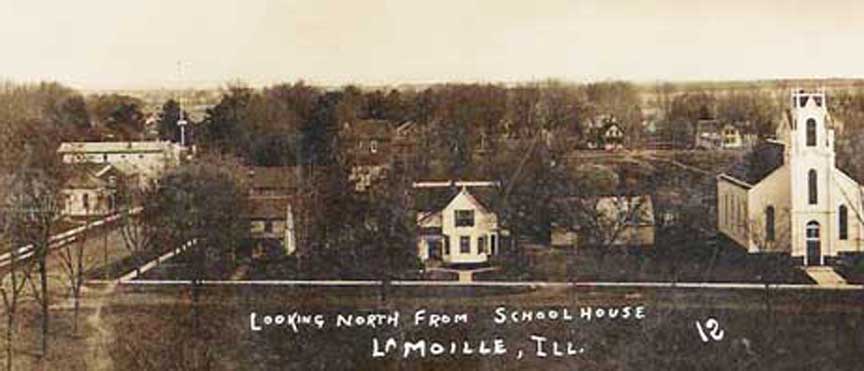
From her mother Addie Ouderkirk Housh's 1928 obituary in the Galesburg Register Mail, we learn that the family was originally from upstate New York and that the widowed Addie lived with daughter Emma in LaMoille, Illinois for the last five years of her life. Emma's mother Addie died about 8 years before Emma. Emma's father Andrew Clinton Housh died in 1923. He was born in Greencastle, Indiana in 1834. He and Emma's brother E. Lafayette Housh were  bankers in Mequon.


LaMoille is in Bureau County, Illinois near Ottawa. It seems this is where Emma lived in the 20th century.
See some old photos of LaMoille here (but couldn't find any of Emma's family):
http://www.jaysontuntland.com/Historical/Historical-Photographs/La-Moille-IL/


George Washington was a somewhat popular image on crazy quilts.
.
I haven't had much luck in figuring out Emma's connection to the GAR.
Her father and her husband (far too young) do not seem to have been soldiers.

86th Regiment Illinois Volunteer Infantry

This patch above might have been  important to Emma or perhaps one of her friends or family gave her the patch. An uncle maybe.


Colonel James D. Housh and Private Jacob Housh from Maquon attended the 1887 reunion
of that regiment in Peoria, as did Adam Housh & Thomas Housh. These men were Emma's uncles, her father's brothers.
Of Emma's three children Jay and Caroline lived into the 1960s. Addie died at about 11 years old in 1895. Perhaps while Emma was working on this quilt.

See Emma's quilt at the webpage of the Helen F. Spencer Museum of Art at the University of Kansas.

Wednesday, January 25, 2017

Yankee Diary Block 1:Tulip & Liberty

Block 1: Tulip & Liberty. 
Part 1 The Tulip by Becky Brown

Part 2: The Word Liberty

Caroline Cowles Richards

In April, 1854, while her husband was out of town, Abigail Beals sent granddaughters 12-year-old Caroline and younger Anna on a mission to Butcher Street in the African-American neighborhood. They were to invite Chloe Colbert* to dinner. "I think Chloe was surprised, but she said she would be ready tomorrow ... when the carriage came for her."

View of Canandaigua in 1858 by Carrie's friend Augustus Coleman.
Pictures are from the Ontario County Historical Society's collection.
http://www.ochs.org/photo-album/

Chloe once had been a slave in New York. The girls advised Grandmother she might, "rather invite white ladies, but she said Chloe was a poor old slave and as Grandfather had gone to Saratoga she thought it was a good time to have her. She said God made of one blood all the people on the face of the earth."

The two women were perhaps united by an old friendship or sense of obligation. Their guest "had a nice dinner, not in the kitchen either."

Block 1: Tulip & Liberty. Part 2 Liberty by Denniele Bohannon

We forget that New York, so far from the Mason-Dixon line, was a slave-holding state when Chloe Colbert and Abigail Beals were young. The laws emancipating enslaved people in New York were complex. Essentially, every enslaved person was to be freed in 1827, fifteen years before Carrie was born, but the 1830 the census still listed 75 slaves.

Purple counties listed enslaved people in the North
30 years before the Civil War. Chloe lived in Ontario County (blue).
From Armchair Atlas

The year before Carrie's birth her paternal grandfather Reverend James Richards Sr. acknowledged that he was still a slaveholder in 1841. "I can only say that there is a coloured woman in Newark N.J. who according to the laws of that state stands in the relation of a slave to me." The complexities of freeing enslaved people in the North dictated that this unnamed woman had been born too soon to ever be legally free. Although she may have lived as a free woman for much of the 19th century, she remained James Richards' legal property in New Jersey.

Austin Steward

Chloe lived on what is now Granger Street in Canandaigua with the town's other African-Americans---former slaves and free blacks. One neighbor was schoolteacher Austin Steward who published his autobiography Twenty-Two Years a Slave, and Forty Years a Freeman in 1857.

Poster announcing an August West Indies Emancipation celebration
in neighboring town, Geneva, New York. Geneva Historical Society

Steward recalled an annual celebration in the neighborhood, August First, the anniversary of emancipation in the West Indies. Soon after Carrie came to live with her grandparents, Canandaigua's black community invited Frederick Douglass to head the speakers' roster at the 1847 celebration. Celebrants gathered on the grounds of the village Academy to hear speeches and music and then "marched to the Canandaigua Hotel, partook of a sumptuous dinner, provided by the proprietor of that house." 

Antislavery convention in 1850 in Cazenovia, New York.
Frederick Douglass is seated at right.
Read more about this photo here:

After more speeches all "repaired to the ladies' fair, where they found everything in a condition which spoke well for the enterprise and industry of our colored sisters. Their articles for sale, were of a choice and considerate selection, and such as sold rapidly and at fair prices." Funds raised at the ladies' fair went to pay the speakers' fees. This fair may have been organized by the "Colored Ladies Anti-Slavery Sewing Circle of Canandaigua," whose name was recorded in 1843 when they sent $7 to aid Daniel Drayton, jailed for organizing a slave escape in Washington City.


Carrie's diary, edited as a sentimental view of small town American life, gives us only a glimpse of slavery's resonance in a Yankee state. Canandaigua, the nostalgic village of old-time harmony, was home to several radicals, abolitionists, and activists who helped slaves escape to nearby Canada. The courthouse was the site for landmark trials over Native American rights, escaped slave's rights, anti-Masonic hysteria and the trial of Susan B. Anthony in the 1870s for trying to vote.

Block #1 Tulip and Liberty

Block 1: Tulip & Liberty. 
Part 1 The Tulip by Denniele on a navy blue background.

The single stem floral design was popular with applique artists in the 1840s and '50s, although rarely noticed then and now. 

Four versions of the single stem tulip from New York quilts. There must have been
some meaning and importance to this recurring image.  See more about the floral at this post:

Tulip by me

Here's the pattern as a JPG.
Cut a rectangle of background fabric 9-1/2" x 12-1/2"

To Print:
  • Create a word file or a new empty JPG file.
  • Click on the image above. 
  • Right click on it and save it to your file. 
  • Check to be sure the size is correct and that it fits in a 12" wide rectangle. The red shape should measure just about 7" from top to bottom.
  • Print that file. 
  • Add seam allowances when you cut the fabric.

This month's pattern also includes a finished 12" x 3" strip with the word Liberty. The diagram shows their placement in the irregular set. The strip above Liberty could be adjusted to fit a larger word.
 You have to wait for months 4, 6 and 12 to set the first blocks.

Perseus Bradbury's wool table cover.

The word can remind us of Daniel Webster's 1830 speech, which became a rallying cry for Unionists before and during the Civil War: "Liberty and Union, now and forever, one and inseparable!" Liberty has many meanings, one thing to Daniel Webster, another to Chloe Colbert.

I appliqued my letters.

Cut a strip of background fabric 12-1/2" x 3-1/2".
Here's a pattern.
The word should print out 1-1/2" inches tall and 7-1/2" long.

Other options:
I like the free-form look of the appliqued letters---but you may not want to applique 1-1/2" letters. You can do them any size but they should fit inside a 3" x 12" finished strip.

Denniele has embroidered hers.
You could also ink yours.

Here are some alternate designs. Each  pattern JPG should print out 7" x 3". Center the word on your 12-1/2" strip, trace it and embroider or ink.


This prints out 11" x 3"

Becky has a treasure, something she found in her Great-Grandmother's trunk: a strip of fabric with the word printed on it. She has printed it onto pre-treated cotton and is incorporating it into her quilt. She thought you might want to print that too so she sent a photo.

What that little banner meant to her Great-Grandmother is a mystery. Perhaps someone wore it.

Cased photo from the early 1860s, sold at
Cowan's Auctions


And finally - you could piece those letters. Click on the link to see a pattern for larger letters (3") that you can buy as a PDF from FromBlankPages on Etsy. Piece them at 3" and adjust the space later.


You can buy a paper pattern for the first four months from me at my Etsy Store
https://www.etsy.com/listing/493172538/yankee-diary-bom-civil-war-quilts?ref=shop_home_active_1
Or a downloadable PDF
https://www.etsy.com/listing/506664289/yankee-diary-bom-civil-war-quilts?ref=shop_home_active_3
.
Links

Read about New York's most famous manumitted slave Sojourner Truth here:
http://quilt1812warandpiecing.blogspot.com/2012/03/7-isabella-baumfree-wool-slavery-in-new.html

*Carrie does not mention Chloe's last name but she is probably the wife of Lloyd Colbert. She was listed in the 1850, 1855 & 1860 censuses in the city. This Chloe Johnson Colbert was born in 1781 in New Jersey and probably died during the Civil War. She was just a few years older than Grandmother who was born in Madison, Connecticut.
http://web.co.wayne.ny.us/wp-content/uploads/2016/10/Genealogies_Part2.pdf