Saturday, April 15, 2023

Elizabeth Lindsay Lomax's Civil War


Woman at a Quilting Bee by Henry Mosler
A nostalgic view in the early 20th century
"I spent most of the day quilting. Occupation is absolutely necessary to keep one sane in these troubled times, but sewing materials, like everything else, have doubled in price --- due to the war."
Elizabeth Lindsay Lomax, Baltimore, September 12, 1861.
Elizabeth Lomax's published diary includes several references to quiltmaking. She quilted alone for the most part (we'd guess at her frame) and described quilting rather than piecing or other patchwork. This Civil War description was written while she was a refugee from her home in Washington D.C., spending time in Baltimore, Maryland, which was teetering between Union and Confederate loyalties. Maryland never seceded and Elizabeth took her Southern sympathies home to her Virginia birthplace.

Her granddaughter published selections from the diary of Elizabeth Virginia Lindsay Lomax (1796-1867), beginning with entries in the 1850s as increasingly divisive rhetoric echoed through the nation's capitol. Elizabeth was a widow with 6 grown children and a granddaughter when the Civil War commenced.

The 1860 Census
Son Lundsford Lindsay Lomax was at West Point when the diary began.
 After graduation he served in the U.S. Army on the Great Plains before the War.

In a long and forgotten war, US troops fought 
Indigenous Floridians between 1816 and 1868.

Her late husband Mann Page Lomax (1787-1842) had died of disease caught while fighting in the Seminole War in Florida. They'd married in 1820 and Elizabeth lived in Massachusetts and Rhode Island while Page, as she called him, was stationed in Florida. Left with many girls and a young son whom she adored, Elizabeth earned a living in several ways.
"Very warm today. Nevertheless I finished my work for the War Department and sent it in." July 20, 1854.

Once the Civil War expanded women's working roles, copyists
and other clerks went to the office every day, but in Elizabeth's
time she worked from home.

She was a copyist of government documents in Washington and spoke often of "writing" at home, a job, a political favor, for genteel women fallen on hard times. She was an excellent musician and in 1854 decided to give harp lessons, but not without some worry about trespassing outside "woman's sphere."
 "With my large family my expenses increase daily - After much consideration, I have decided to make use of the talent with which God has blessed me and give lessons on the harp and piano. Would my dear Page be displeased with me for deserting my woman's sphere - the home fireside? On the contrary, I believe that he would understand and approve. " September 19, 1854
She also received a government pension for her father's service in the Revolution and requested additional payments for her husband's death. Her "darling son" also sent her money. She managed to assemble these various incomes into enough capital to build a new house at G Street NW & 19th, a few blocks west of the White House, which they moved into during the Christmas season of 1859.
"Received one hundred dollars for copying today. My Christmas present from Uncle Sam. I am dreaming dreams these days - of building a home of our own - with a garden. If my Revolutionary claim goes through I shall certainly build a house - 'all the King's horses and all the King's men' could not stop me!" December, 1855.
The diary in those five years before the Civil War reveals a rather delightful home, full of pretty women in their 20s, many beaus and many boys, friends of son Lindsay like J.E.B. Stuart and Fitzhugh Lee. But once the war began Elizabeth's Virginia loyalties like the Lee's inspired her to choose the Confederacy. 

"Taking the Oath"

Living in federal Washington she was required to take the "oath," a pledge of loyalty to the Union. She refused. Her pension, her copying job and the carefree days were gone. Son Lindsay resigned from the U.S. Army and joined the Confederacy. She and the girls rented out the house, moved to Baltimore and then to Virginia.
"A frightfully exciting day. Riots here and in Baltimore, many persons shot, also a heartrending day for Lindsay and for me. …This evening Lindsay told me that he had sent in his resignation." April 21, 1861

Lindsay Lomax flanked by his Confederate friends Fitz Lee and J.E.B. Stuart.
Lindsay and Fitz survived the war; Jeb did not.

Elizabeth's diary ends in 1863. Her health in her sixties seemed to be failing although she lived for four more years. With all her attention to pedigree as a "First Family of Virginia" it is interesting that her latter years are rather undocumented. It took some digging to find her death date.

Godey's in 1859 showed a Tarleton dress,
made of a cotton stiffened with starch.

The Lomax daughters whose pre-war lives were full of ruffled Tarleton dresses and yellow roses followed their mother to Baltimore where their Confederate sentiments (and probably some smuggling, etc.) attracted the attention of the city's Union occupiers. 
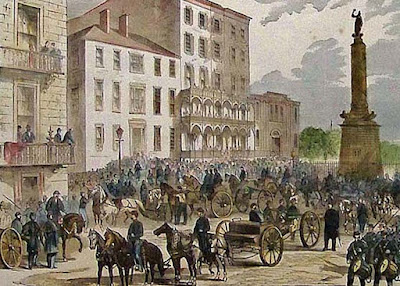
Baltimore's Monument Square under Union occupation

Daughter Virginia Sarah Lomax (1830-1915) and two of her sisters were ordered to leave Baltimore and warned that their return would be punished with treatment as spies. After Lincoln's murder in mid-April, 1865 Virginia ignored the order and found herself imprisoned with suspected conspirator Mary Surratt and other women in Washington's Old Capitol Prison.


Indignant at Yankee suspicions after the Southern plot to kill Union government officials, Virginia published a book full of typical Confederate astonishment that the enemy was lacking in chivalry and manners and prison food was miserable.


After the war, Virginia and her single sisters, twins Julia and Mary Noel, opened a girl's academy in Warrenton, Virginia. 


The family built a house large enough for boarders on Culpepper Street ,
 which they called Balcarres after an ancestral home in Scotland.

Four sisters are buried together in Warrentown.


Read Elizabeth's published diary, edited by her granddaughter, another Lindsay Lomax, in the 1940s.

1944 Review

Elizabeth's references to quilting

And consider that there is a lot more to that journal. The unpublished ten-volume diary from 1848-1863 is located in the Virginia Historical Society. What else did Elizabeth have to say? 

"Papers of Elizabeth Virginia (Lindsay) Lomax (1796-1867) consist of correspondence, 1820-1857; and a ten-volume diary, 1848-1863, kept in Chillicothe, Ohio, Norfolk, Va., Washington, D.C., and Baltimore, Md., concerning, in part, her life in Washington and Baltimore during the Civil War."

Wednesday, April 12, 2023

Atlanta Garden #4: Propeller


Atlanta Garden #4: Propeller for Auntie Healey by Becky Brown

Carrie Berry had several aunts. She often mentioned two in her 1864-5 diary. One was Aunt Amanda Berry Markham, her father's sister (See last month's block.) 

The other was Auntie Healey---Olive Markham Healey who really wasn't an aunt. Olive was sister to Auntie Markham's husband William, so Olive and Aunt Amanda were sisters-in-law who seemed to have been fond of Carrie. She was was often "up" at their homes during the Civil War.

Olive W. Markham Healey (1824-1913) in her later years
The name was spelled Healy or Healey.
"Georgia has the reputation of being the Yankee Land of the South, and it is well-deserved." Frederick Law Olmstead
Olive was in her early 40s during the war. She gave birth to eight children but only two outlived her. Olive and sister-in-law Amanda had much in common although Olive was born in Connecticut and Amanda in Mecklenburg, North Carolina. Most important to our story is that they were both secret Unionists in Atlanta. 
Presbyterian Church on Marietta Street, built 1852

Their husbands Thomas Healey and William Markham were among the most active of those working against the Confederacy, leaders of a group of  Union supporters belonging the the First Presbyterian Church. 
Thomas Goodfellow Healey (1818–1897) 

Atlanta Garden #4: Propeller for Auntie Healey by Denniele Bohannon

New Englanders Thomas and William came to Atlanta from McDonough, Georgia in the 1850s, both ambitious businessmen. When the war began Thomas was partner in brick-making firm Hayden & Healey with a boyhood friend from Connecticut. After the war he and Carrie's father Maxwell Berry were quite successful partners as building contractors.

City Hall is associated with Thomas Healey & Maxwell Berry 
as builders. Here during the occupation Union soldiers
 have erected dwellings on the lawn.

Carrie Berry's family of women may have joined other Atlanta volunteers like Sallie Richards whose husband Sam recorded her making bedding for the hospitals.

"City now full of sick and convalescent soldiers some 3 or 4 thousand….Sallie has been going to help make 'comforts’ to keep them warm in the absence of blankets."  Sam Richards, March 5 1862
Atlanta Garden #4: Propeller for Auntie Healey by Jeanne Arnieri

It is also recalled that the Berry's extended family broke laws to give assistance to the Union prisoners and patients housed in the city.


Fellow Unionist Cyrena Stone recorded a not so-much illegal as devious episode at one of the soldiers' hospitals in March, 1864. Union sympathizing friends brought a "basket...filled with good things." Enslaved Poppy who probably cooked the cakes, advised them to reserve the "nice cakes" for the poor Yankees" not the "Southern Confederacy Soldiers." The women divided the pastries between North and South but not equally.

Atlanta Garden #4: Propeller for Auntie Healey by Becky Collis

And machine-quilted in double fans

Cyrena also told of a very illegal event. A Unionist Confederate guard smuggled a Confederate uniform to a Yankee prisoner who donned the gray to escort a fellow Yankee out of the prison. They explored the city noting important defense positions and returned to the prison in the morning with plans to inform Union troops.


Atlanta Garden #4: Propeller for Auntie Healey by Addison

The Block

BlockBase #1934 was called Propeller by the Ladies Art Company.
Above the cutting instructions for 10" and 15" blocks.

Jeanne Arnieri is making two sets.

Mary Mashuta showed this mid-20th-century version
from Becky Keck's collection in her book Cotton-Candy Quilts.


We tend to think of a Propeller in terms of an airplane, but spinning blades propel many kinds of conveyances---like a Civil-War submarine. Pictured is the Hunley, on view in Charleston today. Men sat inside the tube and pedaled the propeller.

The Healy building on Peachtree Street

Post-war real estate investments made the Berrys, Healys & Markhams
among Atlanta's richest families.

Detail of a Tiffany window remembering Olive Markham Healey
 at Atlanta's First Presbyterian Church 
Auntie Healy's Findagrave file:
https://www.findagrave.com/memorial/88234477/olive-w-healey

Saturday, April 8, 2023

Zerelda Cole Samuel's Civil War

String star quilt that looks to be early 20th century,
 attributed to Zerelda Cole Samuel.

Curators at the National Portrait Gallery believe this to be a
 photograph of Zerelda Cole James and her two youngest children,
taken about 1850, the time when her first husband died.

Jesse James Farm Museum Collection

Zerelda, born in Kentucky, boarded at St. Catherine's Academy
in Lexington, Kentucky in the late 1830s before her her 1841 marriage at 16.

Zerelda Cole James Simms Samuel (1825-1911), perhaps about the time of the Civil War
She was a large woman at 6-feet tall and described as "leonine in nature"
in this husband's obituary.

Zerelda is pictured above with third husband Reuben Samuel (1828-1908). Her first Robert Sallee James (1818-1850) died of cholera during the California Gold Rush after about 9 years of marriage, leaving her with 2 boys and a girl, ages 7 to 1. She soon remarried Benjamin Simms in Clay County in 1852 who died after being thrown from a horse about 2 years later. 

Marriage record for Zerelda and Reuben Samuel, Clay County, Missouri
September 26, 1855,  Family Search 

1860 Census

When the Civil War began Zerelda and Reuben were in their mid-30s, farming in Washington Township, Clay County, Missouri and doing fairly well with $5,000 worth of real estate. At home were her three children by Robert James and their young daughter Sarah Louise Samuel. Her eldest Alexander Franklin James was 17 when war commenced, of an age to seek adventure, perhaps a worry for Zerelda, pregnant with John Thomas Samuel born the month after the war began.

The farm near Centreville, Clay County.


By the time the war was over Zerelda had given birth to another daughter Fanny. Youngest Archie was born in July, 1866 when Zerelda was 41. Archie was considered mentally handicapped and perhaps had Down Syndrome, associated with late maternal age.


Missouri during the Civil War was a miserable partisan patchwork with the Union Army in the cities overseeing a Union state. Rural people, many like Zerelda & Reuben from Kentucky, professed allegiance to the Confederacy. Their sons formed guerilla units dedicated to terrorizing the enemy. Zerelda's eldest Frank James joined these bushwhacker gangs during the war, while younger son Jesse remained at home. Zerelda's loyalties may be interpreted by looking at the names she gave her younger children. Fanny's middle name was Quantrill, named for the famous guerilla who burned Lawrence, Kansas in 1863. 

Archie Clements (1846-1866)
Archie Samuel was said to have been named for Archie Clements who'd headed a bank robbery in Liberty, Missouri six months before the boy was born. 

Photo said to depict Frank and Jesse James when 
Frank was about 28 and Jesse about 24 in 1872.
Dozens of dubious photos of the family circulate.

Zerelda's two eldest sons Frank & Jesse James may have joined Clements for that first daylight bank robbery or were inspired by his modus operandi to begin a fifteen year life of crime. Their mother's support for their enterprise was shown in her naming her baby for bank robber Clements who was killed in Liberty ten months after the initial robbery.

Dime Novels sang the James gang's praises for decades.

It seems obvious that Jesse was a psychopath, completely indifferent to the many people he murdered.

Revenge killings attributed to Jesse James

He enjoyed the notoriety in robbing banks and trains (an outlaw genre he pioneered in Iowa in 1873). He formed justifications for his behavior in Southern loyalties---claiming in a letter to the editor that  Missouri was "the land we fought for four years to save from northern tyranny." Victims included bank clerks and revenge against people who had caused him or his family harm. 


One outrageous robbery targeted the box office at Kansas City's Industrial Exposition in 1872.

Some who knew both Jesse and his mother declared he inherited his belligerent attitude from her. The family certainly seemed to be afflicted with many mentally unstable members. Bank robberies were one thing but robbing trains and their passengers (and business expositions) was a threat to community stability. Missouri's governors offered rewards of $1,000 or $5,000 for the gang's captures---to no avail. 


Hired to insure railroad security the Pinkerton Agency went too far.


Believing incorrectly that Frank and Jesse were at home on the family farm, Pinkerton agents attacked  during the night of January 26, 1875. They attempted to burn the house and then threw two incendiary devices through the windows. These crude grenades rolled along the floor and it looks like Zerelda with Archie at her side attempted to pick one up and throw it in the fire. The explosion shattered her right hand and Archie's abdomen. 

Eight-year-old Archie died a few hours later.
Zerelda's hand was amputated.

Zerelda after 1875

Things were obviously completely out of control in Missouri---on both sides.

Jesse James kills bank teller John Sheets in Gallatin, Missouri, 1869

Kentucky-born Thomas T. Crittenden (1832 –1909)
Brady Studios Portrait

In 1880 Missouri elected former Union soldier Thomas T. Crittenden as governor. He determined to be rid of the James gang and raised $10,000 from local business men on the theory that if offered enough reward money a gang member would betray them.

He was right. 

Photo said to be of gang member Bob Ford (1862-1892) and Jesse James. Ford shot
James in on April 3, 1882 and claimed the reward.

Jesse in his coffin, 1882

Rather than rejoicing Missourians were up in arms. What a cowardly thing for the Governor to do. Crittenden was vilified.

Oscar Wilde who happened to be lecturing in St. Joseph when Jesse was killed noted the local news and observed in a letter:
"Americans are certainly great hero worshippers and always take [their] heroes from the criminal classes."
John Newman Edwards (1839-1889)

Every legendary hero needs a troubadour; Jesse found his in two Missourians, newspaperman John Newman Edwards and his mother Zerelda. Edwards, who'd refused to surrender after Confederate defeat, went to Mexico to begin a new Confederate state but returned in a few years to publish the Kansas City Times, a platform for his view of the late War. By the time of Jesse's death he was working in St. Louis stirring up indignation, writing about "The Chivalry of Crime." 
'Those who conspired to murder (Jesse James)... have succeeded, but such a cry of horror and indignation at the infernal deed is even now thundering over the land… Others again among the murderers are sanctimonious devils who plead the honor of the State, the value of law and order, the splendid courage required to shoot an unarmed man in the back of the head...." John Newman Edwards's obituary of James.
Zerelda sold various postcards of the gravesite and herself

After Jesse's death his family switched from defending him to glorifying him, turning a legend they  created into a tourist attraction and source of income. The curious were encouraged to visit the James family farm and Jesse's grave; each view costing a few cents. Pebbles from the grave were also available for a small fee. 

Brother Frank at the tourist attraction about 1910
Note that Kodaks---cameras---were barred (sic). If you wanted 
a photo you could buy a postcard.

At one point Zerelda sold the house to an entrepreneur planning to dismantle it and set it up again at the 1893 Chicago World's Fair. That transaction was never completed.

Zerelda's husband Reuben Samuel suffered from a cognitive disorder in his latter years, probably a form of dementia, although legend claimed the cause was brain damage caused by Unionists hanging him (3 times in a row) during the War or perhaps lingering injury from the Pinkerton attack on the house. He died in 1908 at a mental hospital in St. Joseph after six years of residence. 

Now, you have to give it to Zerelda who without a competent husband to support her invented an occupation that she mentioned gave her a "good income" until her death in 1911 on a train trip to visit family in Oklahoma.

1983 postcard from the Jesse James Wax Museum
One could do an extended tour of Jesse James museums
and roadside attractions.

Shown at the Jesse James Farm Museum:

We can return to the pink quilt at the top of the page: Did Zerelda, who'd lost her right hand, piece and quilt that string-star in her '80s? She seems formidable enough to accomplish such a task---any task she set her mind to.