Saturday, February 11, 2023

United Daughters of America


Sewing for Union Soldiers, Harper's Weekly


In the first months of the Civil War C. M. Melville thanked the "Patriotic Daughters" of the United Daughters of America for their donations to a Washington hospital of "beautiful lint," shirts and bandages. The Franklin Council of the women's organization was located in Reading, Pennsylvania.

Directory of "Secret & Benefit Societies" in New York
lists three chapters of the United Daughters of America
the year before the war began.

National Heritage Museum Collection
Masonic lodge symbolism in the center of a quilt by
Jane Haight Webster  (1808-1877)

The United Daughters of America was one of the many lodges and secret societies that flourished in the America of the 1840s & 1850s. Sometimes classified as a Charitable Organization the United Daughters' principles were really not charitable in the wide sense of the word.

True, like other lodges and societies for men and women, they were a kind of insurance group dedicated to providing services such as funerals and cash to needy members. But membership was limited to native-born Americans. 

1852 Statement of Purpose describing the ladies' 
association's goals to stand as a "bulwark of their
country's freedom & greatness" in the face of the
"supineness of character among our people."
-----

Anti-Irish propaganda


June, 1846
Copied from a New Jersey paper

1851, a New York chapter gave a dance benefitting the poor (but not all the poor.)

1852 Album from Baltimore

1854
The United Daughters of America was essentially a Know Nothings lodge for women. Irish dancing partners might be jilted in favor of gentlemen whose grandparents were "born on the soil."

1854

In other words, they were an association of women with anti-immigrant political purpose.

1857 Baltimore Sun
Newspaper accounts indicate they were active in Baltimore, New York,
New Jersey and Pennsylvania between 1845 or so, into the Civil War 1860s, continuing to meet throughout the century.
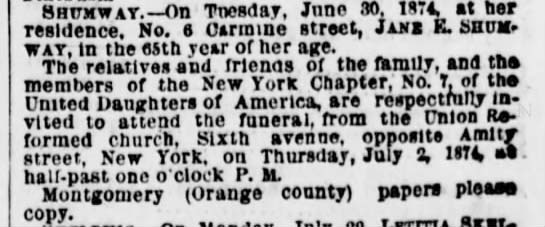
1874
Jane E. Shumway of New York was a member when she died.


The United Daughters of America thrived in the anti-immigrant politics of the 1840-60 years. Did members stitch album quilts so popular then for solidarity and fundraising?

Houston Museum of Fine Arts Collection
Album quilt from Baltimore

Wednesday, February 8, 2023

Atlanta Garden #2: Grandmother's Choice


Grandmother's Choice by Addison

Grandmother's Choice reminds us of Carrie Berry's mother Harriett Eliza Key (1830-1895), who was from McDonough, a small town southeast of Atlanta.

McDonough about 20 years after Harriet died.

Known as Hattie, she married Maxwell Berry October 4, 1853 just as his family was settling in Atlanta. Eldest daughter Carrie was born in Atlanta in early August, 1854. 


In a short autobiography Maxwell called Hattie the best woman alive, perhaps making up for being off by a year in their wedding date and undoubtedly embarrassing Carrie who was actually born at a decent interval, as they used to say.

Grandmother's Choice by Jeanne Arnieri
She's doing two sets.

Women tended to give birth about every two years until their early forties. Grandmother's Choice can remind us of how exhausting childbearing could be for our ancestors when choice was not available.

During 1864 the year of Carrie's diary and Atlanta's attack and occupation by Union armies Harriet Berry was raising five children under ten. As Atlanta was shelled and burned she was in the late stages of pregnancy, giving birth to her sixth child Maggie in December, 1864. 

Harriet's brood of five girls and one son was a little above 
average for her generation of mothers.
 She gave birth in 1854, '56, '57, '59, '62 and '64
and there may have been miscarriages and still births.
See more about the number of Harriet's children below.
"This has ben a election day for Mayor and council men but the election was broken up. I had a little sister this morning at eight o'clock and Mama gave her to me. I think its very pretty. I had to cook breakfast and dinner and supper." December 7, 1864, Carrie Berry


Grandmother's Choice by Denniele Bohannon

Carrie as the eldest wrote often of doing housework, which is what ten-year-old girls often wrote about, but in summer, 1864 as her mother needed increasing assistance there was an added burden. The Union Army was bombarding Atlanta with explosive shells.

General William T. Sherman (center facing left) and
one of the Union cannons outside Atlanta.

Diarist Cyrena Stone described the first shell she heard on July 21st, 1864:

"A horrid whizzing screaming thing came flying through the air."
Examples of Civil-War era shells. Some had fuses and exploded
while lying on the ground; others exploded on impact.

Grandmother's Choice by Dorry Emmer

"I got up early this morning and cleaned up the house for Mama. I nursed Sister [perhaps sister Mira, about two] while Mama got dinner....  Carrie, August 8, 1864.

The next day: "We have had to stay in the cellar all day the shells have ben falling so thick around the house. Two have fallen in the garden, but none of us were hurt...."

Library of Congress
Occupying Union troops destroying Atlanta's rails, 1864.
 George Barnard photo

Close to the railroad tracks that created Atlanta, a major Union target, the Berry home on Walton Street was often shelled during General William T. Sherman's Atlanta campaign. Cousin Henry "wanted us to move...but we will try it a little longer." One can imagine Harriet unwilling to leave the house until after her "confinement."

Harper's Weekly, 1864
Atlanta by the tracks, shelled & burned

Union cannons shelled the city for over a month beginning July 20, 1864. Estimates are that 25 civilians were killed, a number that would have been higher had not many (not quite so stubborn as the Berrys) left town. The Berrys moved several times during the siege of Atlanta. After the war Maxwell Berry's business successes in contracting, real estate and banking enabled them to build a showplace at the old location.

Their new house at Walton & Fairlie Streets is shown on
an 1871 map.


Grandmother's Choice by Jeanne Arnieri

Georgia Digital Library
 The Home for the Friendless, late 1890s

Harriet lived to be 65; she and her youngest daughter Maggie Berry McBurney were active workers in the children's charity asylum The Home for the Friendless who mourned her passing in 1895.

Memorial by the women of the Home for the Friendless, 1895

The Block
Mrs. Danner called it "Grandmother's Choice" so the block
can remind us of the options we choose to make
in planning our families---something Carrie's mother did not have.

Above the cutting instructions for 10" and 15" blocks.


Mid 20th-century
Here's a basic block with a garden path and four half-square triangles
in the corners. We'll use the construction for several other, more
complicated blocks later.


Carrie's Brother & Sisters

Lists of Harriet's children are confusing. Here is one list from the Key family genealogy.

And an edited version from Find-A-Grave


Harriet's daughter Fannie's obituary.

Grandmother's Choice by Becky Collis
She is using Civil War reproduction prints

And on the other hand...Becky Brown's Block 2
She explains:

When I thought about the devastation and burning of Atlanta I thought of ashes and that made me think about my big stash of black and white fabrics. My small quilt group makes quilts to give to veterans at the V.A. Hospital in Richmond, Virginia. (in 2022 we gave 115 quilts!) The quilts we give are about 48" x 60" so twelve 15" blocks make a perfect veteran quilt. I've also been wanting to make an Eye Spy quilt for a veteran and these blocks have a nice little spot in the center for doing just that. Each month I use a different bright fabric in the center to represent hope for rebuilding after the war. The block this month has a cheeseburger in the center - what veteran doesn't want a cheeseburger? AND if you have a cheeseburger on a quilt then you know Elvis wants one too! That's my story and I'm stickin' to it.

Saturday, February 4, 2023

Mary Emeline Marchbanks's Civil War


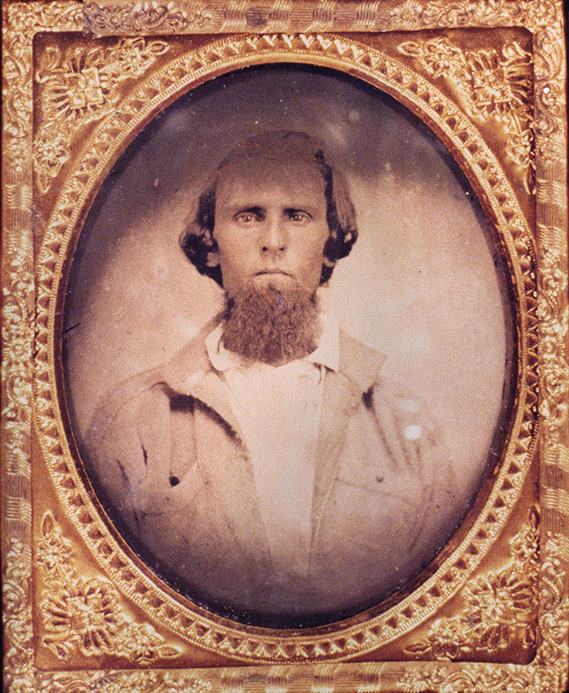
 Burton Newton Marchbanks (1830 -1864)

Mary Emeline Vance Marchbanks (1830-1924) born in Tennessee went west to Texas after marrying Tennessee-born Burton Newton Marchbanks in 1850 in Tennessee. His extended family including sister Ellenor Marchbanks Fowler emigrated that year to Texas.

 Ellenor Marchbanks Fowler (1811-1887),
Mary Emeline's sister-in-law
Her Findagrave file tells us: In 1850 she joined a group of 
Marchbanks family coming to Texas from Overton County, Tennessee.

The extended Sullivan/Marchbanks family and several of the people they held in slavery went to Texas in two groups in 1850 and 1851. Boling Feltz Marchbanks (1839-1922) wrote a manuscript recalling the 1851 trip when he was 11 and remembered Uncle Burton and his new wife Mary Caroline (sic) in that group.

Burton and Mary Emeline settled about thirty miles south of Fort Worth near what would became the Johnson County seat of Cleburne after the Civil War.

Johnson County, Texas

When the Civil War began Mary Emeline and Burton lived near the Nolan River. 


The 1860 census lists her husband as a stock herder (a cowboy?) They lived with their three young children Emily, Sarah and Josiah and an older man named Rukell(Rusell?) Marchbanks, a relative who was a Stock Raiser. They had assets of $540. Of those 3 children only one seems to have grown to adulthood. Sarah Marchbanks Shannon lived until 1903.

Burton enlisted in the 30th Cavalry Company E, also called the First Texas Partisan Rangers, in July, 1862. In the summer, 1863 his company was in the Indian Nations in what is now Checota, Oklahoma, battling the First Kansas Colored Infantry .

Kansas Museum of History
The First Kansas Colored Infantry's flag commemorates the victory
at Honey Springs in the top right.

Burton Marchbanks was injured there and captured, then paroled and mustered out a few weeks later in August, 1863 to go home to die the following year. The widowed Mary Emeline was left with Sarah, about six, and infant Mary Angeline born in April, 1863.

Collection of the Layland Museum in Cleburne, Texas

She saved her husband's clothing, which was handstitched, undoubtedly by her and possibly by others in that extended family. 

In 1861 Dallas merchants Haswell Brothers offered to pay
shipping for any clothing, quilts etc. for the use of the troops.
Industrious women made clothing for soldiers they did not know but Mary Emeline
had a hand in her husband's outfit and kept it as a memorial to him.


The garments he was wearing when he came home, most embroidered with an "M", were donated to the Layland Museum with the cased photograph of Burton in his woolen overshirt.


Poor Confederate widows rarely were able to thrive financially if they did not remarry. M. Marchbanks from Johnson County is listed in the Texas Indigent Families index, eligible for government commodities like cloth. Censuses from the postwar years show her living with daughter Sarah Marchbanks Shannon and then Mary Angeline Marchbanks Shannon.

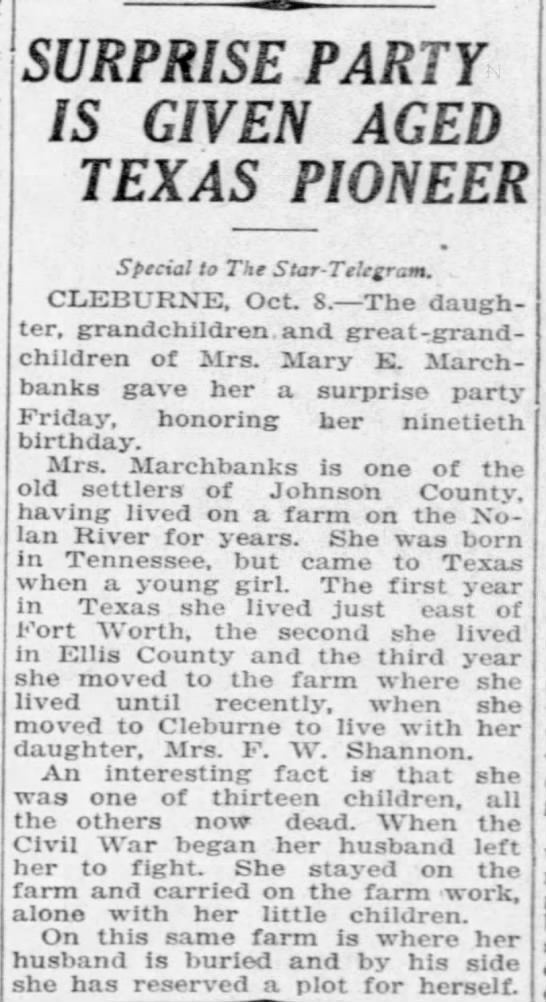
Fort Worth Star, 1921

Mary Emeline lived into her nineties in Cleburne. She had ten grandchildren and six great-grandchildren when she died of "old age" on July 23rd, 1924.

Her death certificate from Find-A-Grave: