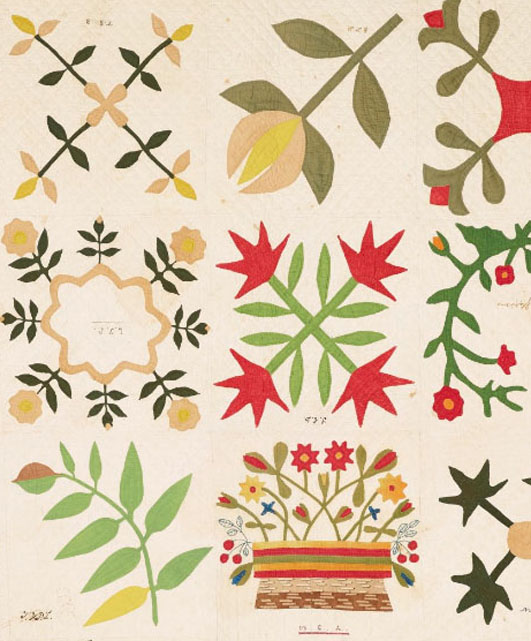
Many years ago Alabama collector Robert Cargo wrote me about this appliqued album sampler he'd found (I'm sure he wrote other quilt historians too). It's believed to have been stitched in 1857 or 1858 in a small Methodist community in Hebron, Alabama in Greene County.
90" x 104"
The quilt is with others in Robert's collection, now in the Birmingham
Museum of Art in Alabama.
What did I think? I was totally confused. Back in the mid-1980s I'd ever seen anything like some of those blocks.
Block with initials L.Y.L.
What was going on here, he wanted to know.
I do not believe I had a clue.
It is certainly organic.
UPDATE: Rose Marie is not the only one to tell me it looks like a peanut.
But then again a watermelon vine, suggests C.S.Spoon
And even I know what that looks like---
in fact any squash, gourd, melon vine sprawling all over the garden.
We are looking at Southern album samplers over at the QuiltHistorySouth Facebook group so I thought I'd give it another try. The Museum has a terrific photo of it here:
"The Sardis Methodist Church was the social center for members of this community in the mid-19th century, and this quilt may have been made for the minister of that church or to raise money for a church project. Of the forty-one signed blocks, twenty one are signed by men and twelve by women."
I found the Sardis Methodist Church with its community cemetery. The church history indicates the church was founded in 1830. Hebron, Alabama remains a rural area in western Alabama. Nearby towns are Clinton and Eutaw.
Robert wanted to confirm the date of 1857-8 he'd been given.
It's been called the Lanford Album because many Lanfords are linked to the blocks (10 or 11 Lanford names). Other names: Bibb, Powers & Rogers.
Again, I had no guess as to date at the time. The piece is not dated on it as far as I can tell.
Name from the Lanford family
But since then I've seen a lot more quilts and a lot more Southern quilts lately.
This is not from the 1850s.
Every piece of fabric in it except for this basket weave print
is a solid.
Many of them characteristic colors found in Southern quilts after 1880. The block on the left is the classic combination of oxblood brown and teal blue-green. The wreath on the right may have once been green and red but as in the majority of Southern solid color quilts the synthetic dyestuff was
quite fugitive. Many blocks show the typical tan faded shade now.
Looking closely, thanks to the museum's photo, we can see most do not feature a name, only initials. Somehow accompanying history has full names.
"Of the forty-one signed blocks, twenty one are signed by men and twelve by women." Birmingham Museum of Art.
Perhaps there was a separate list. Some blocks are familiar patterns going back to the 1840s & '50s, like the wreath and the triple floral. But that isn't how you stitched them in the 1850s---Album blocks started out more precise with more formal symmetries derived from eastern European folk arts.
Informal. Organic. Botany.
The block signed L.Y.L. might represent one of the Lanfords.
Lewis Y. Lanford (1849-1920)
Lewis Lanford may be the key to this quilt.
Lewis Yancy Lanford married Mamie Steele of Eutaw in 1908.
She was his second wife.
He married the first wife Hattie Childers on November 5, 1873. Here's Hattie's grave in the Mesopotamia Cemetery in Eutaw. Her life: 1851-1904.
Louis Y Lanford is buried there too and so is Mamie (1868-1953)
In 1985 Gail Andrews Trechsel discussed this quilt in the book Southern Folk Art.
"According to family history, this quilt was made by the ladies of Green and Hale counties and presented to Mr. Lewis Lanford in 1873 in appreciation of his untiring efforts in protecting them during the Reconstruction era."
A different story.
In 1873 Lewis was 24 years old, married at the end of the year. (It might be a wedding quilt---but 1873 is still early for the style.) The 1880 census finds him as a farmer in Pleasant Ridge, Greene County, married to Hattie with two young sons James 5 and Frank 3. But as he aged he became an important citizen of the town of Eutaw.
1899 Eutaw Whig & Observer
He owned a dry goods store in the 1890s.
And he was elected County Commissioner several times
in the 20th century.
The 1900 census finds Lewis's occupation as N.G.???
UPDATE: See in the comments, Peggy says it means No occupation Given.
He and Hattie are living with two young men James Lanford 25 and Harry Lanford 12. Harry is listed as Black and a servant.
Greene County Courthouse in Eutaw
by John V. Crossland in the 1930s
Library of Congress HABS photo.
The quilt in this context might have been made to honor a county commissioner
in the early 20th century.
Robert Cargo and G. Ward Hubbs wrote an article about the quilt for the journal Alabama Heritage (1986 #1) but it's hard to find. Hubbs also included information in his book Guarding Greensboro: A Confederate Company in the Making of a Southern Community.
Here's a link to a Google preview:
See page 35.
Wish Robert Cargo were around to discuss this with.
He'd certainly enjoy the talk of Southern quilts: