Wednesday, March 8, 2023

Atlanta Garden #3: Auntie's Signal


Atlanta Garden
Block # 3 Signal Design by Jeanne Arnieri

Ellis Street. Peachtree Street is on the ridge with the large houses
"I have ben up to Aunties' nearly all day getting quilt scraps and doll scraps. I am right sorry Auntie is going away. I don't know what I will do for some place to run to."      Carrie's diary October 6, 1864

Carrie Berry was fortunate in having close family who lived nearby---aunts, uncles and cousins. She wrote often of her "Auntie," Amanda Dorcas Berry Markham (1819-1890), her father's older sister who'd come to Atlanta from McDonough, Georgia in 1853.


The Southern-born Berrys had formed connections with a few other Henry County families of very different backgrounds. Amanda Berry married William Markham when she was about 20 in 1839. He was an industrious and mechanically-inclined Connecticut Yankee whose early enterprise in Georgia was clock sales, a typical Yankee occupation. Uncle Markham, who came to McDonough in 1835, imported Connecticut clocks and peddled them door to door. Amanda's brother Maxwell Rufus Berry was a business associate who tired of the road, married a McDonough girl and moved to Atlanta soon before daughter Carrie was born in 1854.

The Clock Peddler by C.W. Jeffreys,
a comic icon in early 19th-century.

McDonough held promise for New Englanders looking to prosper in the South but once the railroads bypassed the town several in the family saw more opportunity in new Atlanta, the railroad location. 

William Markham (1811-1890)
They lived at Peachtree & Baker

Signal Design by Addie

From Gullicks and Allied Families, 1653-1948

And up to then Aunt Amanda and Uncle William were doing well. Soon after arriving in Atlanta he served a three-month term as mayor and then went into the real estate and construction business with brothers-in-law Thomas Healey (married to his sister Olive) and Maxwell Berry (Carrie's father). In the late 1850s he invested in an iron rolling mill company.


Scholfield & Markham's Atlanta Rolling Mill produced rails, boilers and spikes for the city's transportation system.

Adolph Menze, The Iron Rolling Mill (Modern Cyclopes), 1870-2, detail

Signal Design by Denniele Bohannon

The 1860 census shows Amanda born in North Carolina,
 William, manufacturer, from Connecticut and their two Georgia-born children.

August, 1864

Auntie's home was a refuge from Carrie's own small house full of younger children and a harried mother. But things up there were not as they appeared to the ten-year-old. When hysteria for Southern independence began about 1860 New-England-born Uncle William had "courageously advised against secession and warned people against the appeal to arms," according to an 1889 city history.

What's more, when the shooting war began the Markhams continued their Union loyalties. William was acknowledged as leader among "The Unionists," suspected quite rightly of not only sympathy but also actions to aid the North. Among the Atlanta Unionists: His brothers-in-law Maxwell Berry and Thomas Healey. 

Union prisoners starved and abused

Auntie conspired with other Unionist women to smuggle food and money into the city prison where captured Yankees were fed starvation diets. Carrie's aunts and uncles met secretly throughout the Civil War to plan anti-Confederate actions and so did her father. None of the men in the immediate family joined Confederate troops. William Markham went to great lengths to protect son Marcellus, 20 years old in 1861, from conscription. Marcellus finally escaped the draft by going north in the war's last year.

Southern Unionists saluting the Union flag in a secret meeting
Harper's Weekly

Atlanta's Confederate rulers knew Markham's sympathies but did little to stop or punish him, although a vigilante tried to stab him on the streets one night. One official action seems to be the 1862 seizure of Markham's 155-acre farm for a hospital dedicated to smallpox victims during the epidemic of 1862-3 when soldiers and infected civilians were held under guard there outside the city. 

Dr. Edward Jenner discovered the smallpox vaccine.

Smallpox at the time was preventable with the first effective vaccine administered in the 18th century but Atlantan Sarah Huff recalled all-too familiar events:
"The people, as a usual thing, disapproved of vaccination, and also they believed in visiting the sick. For the latter reason one family between us and the city went visiting once too often, and caught the disease and spread it over the whole neighborhood. Three members of that family died." 
Signal Design by Dorry Emmer 

Scholfield & Markham's iron mill was the South's second largest such industry, an exception to the anti-industrialism promoted by those favoring an agricultural economy. 

"The Confederacy embarked on its quest for independence lacking virtually everything---save, perhaps, arrogance." Mary A. DeCredrico, Patriotism for Profit: Georgia's Entrepreneurs  & the Confederate War Effort

 As war demanded more iron plates for ships, more rails for trains and more cannons the mill might have ramped up production but the Unionist owners deliberately sabotaged efficiency. Confederates confiscated the mill in 1863 and blew it up in 1864 before abandoning the town.

Remains of the iron mill when Sherman's Army rode into Atlanta

Editor John H Steele in the Daily Intelligencer was aware of the Unionists, listing 47 people in a "city cursed with the presence of men and women …spies in its midst." "We predicted if ever the enemy made his appearance in Atlanta he would find among its citizens a number of them ready to bid him welcome."

When Sherman banished Atlanta residents the Markhams went north, leaving Carrie alone with her immediate family to piece quilts and doll clothes from Auntie's scraps. But after the Union victory, all returned to prosper in post-war Atlanta. No one forgot that they were Union sympathizers. The 1902 Pioneer Citizen's History of Atlanta had this to say:


Uncle William's Markham House Hotel, part of the family's postwar real estate empire.

The Block
Signal Design by Becky Collis

Signal Design was given the name in Woman's World
magazine about 1930.

Above the cutting instructions for 10" and 15" blocks.

The pattern is an old favorite with several published names.
Tulip Wreath can refer to Auntie's garden in her Atlanta
home where nothing was exactly what it seemed.


Block about 1900

The alternate name Signal Design can recall the Atlanta Unionists who met at night in Uncle William's office. What kind of signals did these people use to plan meetings? Thomas G. Dyer whose book Secret Yankees details the activities of the Markhams and their associates doesn't tell us---

Kerosene railroad signal

Signal Design by Becky Brown

See a link to a preview of Secret Yankees: The Union Circle in Confederate Atlanta
below. Unfortunately the author has Carrie's father Maxwell Berry's name wrong, referring to  him as Madison Berry throughout, repeating an error editor Louis L Parnham made in the Pioneer Citizens History of Atlanta published in 1902. 


Signal Design by Jeanne Arnieri


Saturday, March 4, 2023

Matilda Hamilton Fee's Civil War

"Teach all Nations Freedom" 1854

When Matilda Hamilton Fee moved to Kentucky in 1854 several women
from West Union, Ohio made an album quilt to present to her.


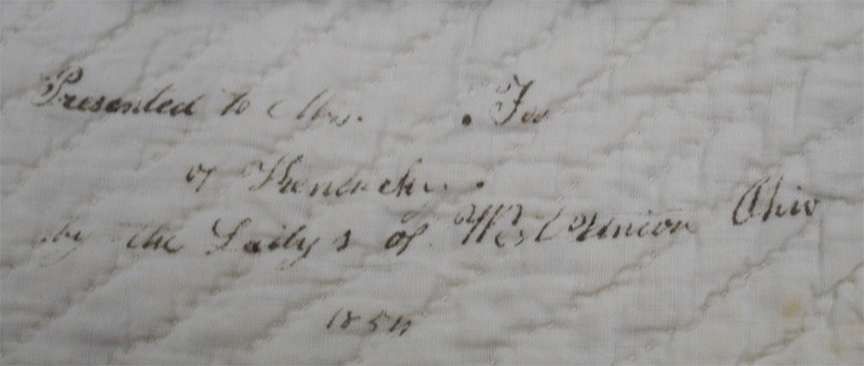
Presented to Mrs    .Fee
of Kentucky.
by the Ladys of West Union Ohio
1854

The library has transcribed the names on the blocks
and one could go through the list and find the signers, for example...

Sarah Ellen Kirker (1846-1900), a child at the time the quilt was made.
Sallie was a member of an important family in Liberty
Township in West Union. Her grandfather Thomas Kirker was Ohio's
second governor.
Two other Kirkers's names are on the quilt.

West Union-ites before the fire of 1876 destroyed the old stone courthouse
It looks like the gift givers were residents of rural Liberty Township
rather than the county seat town of West Union with a population of about 500 
in the 1850s. 

More information on the names might 
explain who was from the town of West Union
and who from Liberty Township west of town.


Matilda Hamilton Fee (1824-1895)
probably in her fifties.

John Gregg Fee (1816-1901 ) 


The quilt went off to Kentucky, about 100 miles across the Ohio River with Matilda Hamilton Fee, whose husband John had taken up a challenge from Kentucky abolitionist politician Cassius M. Clay to found an anti-slavery church in a slave state.

Cassius Marcellus Clay (1810-1903)

Fee soon decided a college open to Black & white students was the next step and Berea College (a Biblical name) was opened in 1855.

John Gregg Fee & Matilda in the 1860s
They married September 26, 1844.

The Fee's house in Berea.
The Fees, both Kentucky born, knew their chosen path would be difficult. Their slave-holding
neighbors threatened Berea throughout the last years of the 1850s until the Harpers Ferry insurrection ignited more hostile actions in December, 1859.


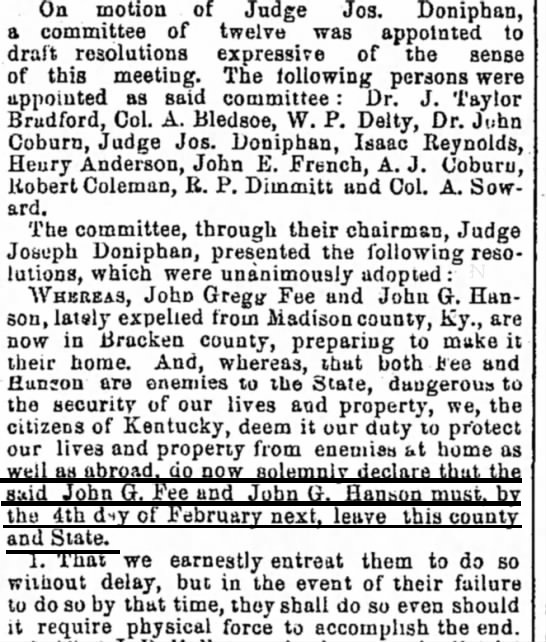
January, 1860 article from the proslavery Louisville Courier
announcing the expulsions of the Berea leaders.

The Fees and their co-educators sought refuge in Cincinnati
across the Ohio River. 

With her husband traveling elsewhere, Matilda rode north in a carriage with her four children. Her youngest boy 4-year-old Tappan Fee (undoubtedly named for a New York abolitionist family) died a few months later of diphtheria. Believing that a cold chill caused most diseases they blamed the trip and the Kentuckians for his death.


The 1860 census taken in the summer shows them living in Storrs Township, 
west of the city with their three remaining children. 
They resided with the family of J.D. Reed, another minister.

Once the Civil War began Kentucky remained in the Union although the residents continued deeply divided in sympathies. Matilda ventured back to Berea in 1862 riding with with Laura and Burritt, 16 and 12, in a buggy and a wagon painted with a Union flag.

In his autobiography John recalled: 
 "The country at that time was full of soldiers, Union and Rebel....after securing a small supply of groceries for a destitute home in a destitute region...coming through Richmond, our county seat, the people, men and women, expressed surprise at seeing a woman driving along the highway. She had not proceeded more than three miles when she was halted by Union pickets, who at first suspected she might be a rebel spy, conveying news to Kirby Smith's men, who were already near to her home. Her frank manner...her story of who she was and where she was going, together with the Union flag painted on her carriage... all these considerations constrained the officer to say, 'Let her go; she is all right.' She came to her humble home, constructed a bedstead, filled a tick with straw, borrowed a blanket to sleep under, lay down with her two children and slept."


Morgan's Confederate raiders in Ohio

Rebel soldiers soon raided the house, taking:
"her borrowed blanket, her coarse and fine comb, her better shoes and Burritt's hat, and the carriage harness. The horse and carriage were hid in the woods. My daughter Laura had a very nice Union flag which her mother had made, and with this a set of silver spoons her grandfather had given to her; these she had hid up in the eaves-trough."
Finding Berea in a turmoil with "scenes of privation, anxiety and toil," Matilda gave up her home after ten weeks. "My wife's mother came, informing her where I was, and helped her and the children back to the border of the State." The women probably settled in Clermont County, Ohio just north of the Ohio River where son Ed Sumner Fee was born in March, 1863. 

Camp Nelson, Jessamine County, Kentucky

John heard of Camp Nelson, home to a training center for United States Colored Troops. Typically considering his impulsive ideas as communication with the Deity, he decided they needed religious instruction. "Without counsel from, or commission from any board, I immediately prepared to go; took my eldest son, my dear Burritt...and on the next Saturday started for Camp Nelson, thirty-five miles distant."


He told the Quartermaster he wanted "a place for religious service and regular preaching," and was given it on the condition that he also teach the recruits to read and write.

 University of Kentucky Special Collections Research Center.
Refugees living at Camp Nelson in 1864. Families often joined the soldiers there.


Matilda seems to have remained in Ohio but returned to Berea where daughter Bessie Hamilton Fee was born just as the war ended in April, 1865. After the war the Fees continued in leadership roles at Berea, Matilda in charge of the Ladies' Board of Care through the 1880s. 

Students in the late 1880s


Matilda died in 1895 a few months after her 50th wedding anniversary.

More information:

https://libraryguides.berea.edu/feequilt/home

https://www.berea.edu/president/blog/matilda-fee-and-elizabeth-rogers-heroines-of-the-berea-story/

https://www.findagrave.com/memorial/8317127/matilda-fee

Wednesday, March 1, 2023

Herbarium Block-of-the-Month 2023-4 Introduction


Time to think about the next applique BOM here at CivilWarQuilts.
Herbarium


The quilt on the poster here is one of 8 samplers I've found with similar patterns. This mid-19th-century
example in the collection of the Shelburne Museum has plant names on many of the blocks.


Our applique sampler Herbarium  for the next 12 months draws from a group of quilts with similar blocks based on plants' natural appearance rather than the stylized roses in formal repeats that we usually see.

New York Project & the Quilt Index

Not as graceful as the Shelburne's botanical sampler,
this quilt attributed to Florence Strutz of New York
has both botanical imagery and formal wreaths.
We'll do some of both over the year.

Our history lessons will be about the importance of "botanizing" and herbariums in the science education of the mid-19th century American schoolgirl. Each block recalls a teacher, a botanist or a collector who organized her specimens into a book, a Herbarium (an Herbarium---if you don't pronounce the H.)


Children ready for a day of nature studies. He 
has a net for catching insects and over his shoulder a
vasculum, a container for carrying specimens, flora & fauna. 
She has a basket to hold her botanical finds.

Botanist Rachel Littler Bodley with her herbariums,
collection boxes and her published book on plants.

See more about Rachel's unusual patchwork skirt at this post:


Blocks will finish to 15"

Fabric requirements:
You may want to do this in traditional reds and greens on white.


Becky Brown is using hand-dyed cottons from Vicki Welsh's  Colorways


Denniele Bohannon---red & green prints on a background of black & white text

Becky Collis's choices---
Solids and a print with many possibilities.

Me, the red & green scrap box for the applique on four-patch
backgrounds of black and white geometrics.

Although Phoebe likes a mess she is concerned that my sampler will be too busy. 
I assure her I am going to pull it together.

How much fabric?
For 12 blocks (and borders or extra blocks) the applique---
Minimum of 4 fabrics: 2 reds/2 greens 1 yard each.

Background.
Varied backgrounds
15" blocks will fit nicely in a fat quarter.

A single, unified background
3 yards for the blocks---2 squares across the width. You'll have a leftover strip along the side.
No matter how much yardage of one fabric I buy it is NEVER enough.
Five yards should do it for borders and setting!


That's one reason I use the pieced, variegated backgrounds of 4 patches or 9 patches.
One can always run out to get another half a yard.

First block on the last Wednesday of March, March 29, 2023.

If you would like to buy the pattern package for $12 to print yourself see it here at my Etsy shop:

And do check in at our Facebook group HerbariumQuilt. It's public so you don't have to join. Post your pictures.
https://www.facebook.com/groups/1956642391352208

See a discussion of the antique Herbarium samplers here---back when I'd found only 6 examples.