Threads of Memory
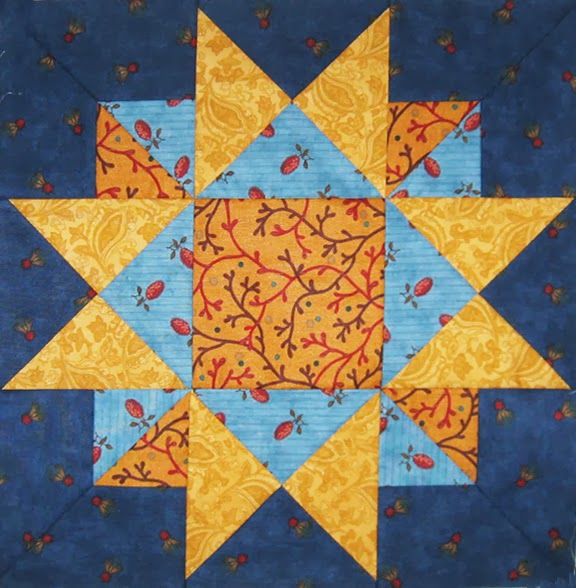
Block 1: Portsmouth Star
by Becky Brown
The first block in the 2104 block-of-the-month here at Civil War quilts is Portsmouth Star, a new block with an old-fashioned look, named for Portsmouth, New Hampshire. The coastal town was a place of refuge for Ona Judge Staines and uncounted other African-Americans looking for liberty. The townspeople, as John Whipple informed George Washington in 1796, were “in favor of universal freedom.”
Threads of Memory
Block 1: Portsmouth Star
by Jean Stanclift
The patterns were free online for two years but now I am offering them for sale in two formats
at my Etsy shop. Buy a PDF or a Paper Pattern through the mail here:
On June 1st, 1796, a ship named the Nancy
sailed into Portsmouth harbor near what is now the New Hampshire/Maine border.
An African-American girl named Ona Marie Judge made her way from the ship to
the town. Just fifteen, the runaway slave hoped to pass as a free black in
Portsmouth's small African-American community.
Ona's new life collapsed one day that summer when she passed
an old acquaintance on the street. Elizabeth Langdon, eighteen-year-old daughter of New Hampshire's
Senator, recognized the fugitive from visits to Ona's mistress's parlor.
Elizabeth tried to say hello but Ona brushed by without a word, hoping the
wealthy white girl would believe she'd been mistaken.
Elizabeth was confident she knew Ona and word soon reached
the Virginia slave owners that their property resided in New Hampshire. Ona's master
and mistress wanted her back and knew they had constitutional rights to recover
the runaway. Under the 1793 Fugitive Slave Act, Portsmouth's officials were
obliged to arrest Ona and hold her.
"Absconded from the household of the President
of the United States, ONEY JUDGE, a light
mulatto girl, much freckled, with very black
eyes and bushy black hair..."
Ona's master was quite familiar with the Fugitive Slave Act.
As President, George Washington had signed the law. Washington pressured
federal appointees to return the girl he called Oney. His correspondence,
visible online at the Library of Congress, tells some of the story.
When Ona
was in her seventies she talked to two newspaper correspondents about her
escape. Their articles tell the other side.
When they moved to the new capital of Philadelphia the first family brought eight slaves from their Virginia
plantation. At the age of ten Ona became
Martha Washington's personal maid. Oney "was handy and useful…being
perfect Mistress of her needle," wrote Washington.
The President's House in
Philadelphia. Ona came to work here
in 1790.
She recalled that her
life in the President's household posed no hardships but she wanted freedom,
particularly after she learned the Washingtons planned to will her to
granddaughter Elizabeth Parke Custis. Ona apparently did not care for Eliza Custis, a few years her junior. She was determined "never to be her slave."
Gilbert Stuart painted this picture of Eliza Custis the year
Ona ran away. Between Ona's opinion
and the portrait, we get an idea of Eliza's personality.
Realizing Washington's presidency would soon be over, Ona made the most of her last weeks in Philadelphia.
"Whilst they were
packing up to go to Virginia, I was packing to go, I didn't know where; for I
knew that if I went back to Virginia, I should never get my liberty. I had
friends among the colored people of Philadelphia, had my things carried there
beforehand, and left Washington's house while they were eating dinner."
Ona's escape by ship took her from Philadelphia
north to Portsmouth, New Hampshire.
Captain John Bolles or Bowles
Somehow she booked passage on the Nancy
commanded by Captain John Bolles. "I never told his name till after he
died, a few years since, lest they should punish him for bringing me
away."
Martha Washington with a slave
By Edward Savage
Like many slave holders, the Washingtons believed outsiders
stirred up discontent. Martha was of the opinion that a deranged Frenchman had
seduced Ona. Joseph Whipple, the New Hampshire official charged with returning
Ona, explained that the escape was Ona's idea---her "thirst for compleat
freedom…had been her only motive for absconding." An angry George Washington fussed, "I am sorry
to give you, or any one else trouble on such a trifling occasion, but the
ingratitude of the girl, who was brought up and treated more like a child than
a Servant…."
Letter from Whipple
"I have ascertained the fact that the person mentioned is in this town."
Whipple warned the Ex-President it would be difficult to
persuade Ona and just as hard to kidnap her, despite the fact that New
Hampshire still sanctioned slavery. "I am informed that many Slaves from
the southern states have come to Massachusetts & some to New Hampshire,
either of which States they consider as an asylum; the popular opinion here in
favor of universal freedom has rendered it difficult to get them back to their
masters."
Washington instructed Whipple to use charm. "If she
will return to her former service without obliging me to use compulsory means
to effect it, her late conduct will be forgiven." Whipple should avoid
violence, any measures that "would excite a mob or riot." Whipple's
last letter on the topic, mailed right before Christmas 1796, announced the banns
for Ona's marriage to Joseph Staines had been published. He was pessimistic he
could act without causing the riot Washington hoped to avoid.
Portsmouth Star by Becky Brown
from my Ladies's Album reproduction collection for Moda---
in shops in March.
Ona married sailor John Staines. A year passed in which she gave birth to daughter Eliza before she heard
from the Washingtons again. Frustrated with Whipple's inaction, Washington sent
nephew Burwell Bassett to retrieve her. Bassett tried persuasive lies,
promising Ona that on her return the Washingtons would free her, something George Washington had actually dismissed as a bad example to the other slaves. Ona
recalled her response to Bassett: "I am free now and choose to remain so."
The Langdon's house, still standing,
was a decade old at the time of the plot to kidnap Ona.
Bassett returned to Portsmouth while John Staines was at
sea, planning to take Ona and the baby by force. He sketched his plot to
Elizabeth Langdon's father at whose home he was lodging. Senator John Langdon
sent a messenger warning Ona to run.
Senator John Langdon warned Ona of
the Washingtons' kidnap plans.
Portsmouth Star
by Dustin Cecil
in my Civil War Jubilee collection plus white.
The story's end appeared in the newspaper
account fifty years later: "She went to the stable and hired a boy with a
horse and carriage to carry her to [the Jack's house] in Greenland [New Hampshire] where she
now resides, a distance of eight miles, and remained there until her husband
returned from sea."
Washington Mourning Picture
Published by Pember & Luzarder, 1800,
from the Library of Congress
Ona was unlikely to have mourned Washington's passing.
Washington died late in 1799. "They never troubled me
any more after he was gone." Ona and her husband raised two or three
children in Portsmouth. After being widowed she returned to the house of her
Greenland friends, the free black family of John Jacks. In the 1840s,
newspapermen found her there, poor and ill but glad to tell her tale.
Ona Judge Staines's story tells us of a network of help in
the nation's early years, an Underground Railroad decades before that name or
railroads of any kind appeared. Ona absconded on her own but she remained free due
to the kindness of many people, among them friends in Philadelphia, ship
captain John Bolles, Joseph Whipple who stubbornly refused to act in
Washington's behalf, Senator Langdon who alerted her to flee and the Jacks
family who took her in when she needed refuge.
What We Can Learn About the Underground Railroad from Ona Judge's Story
Officials often refused to enforce the slavery laws.
Refugees like Ona could live out in the open because
authorities did not enforce the laws. New Hampshire was a slave state in the 1790s and her
owner had all the clout one could wish for, but officials like Whipple chose
not to act. Others like Langdon surreptitiously assisted her. We can only guess
their motives, but Whipple suggested that "popular opinion" in the
town threatened civil disorder if Ona was arrested.
You can find much more about Ona Judge Staines’s life by reading several primary documents online.
Read two interviews by clicking on this link to a site about the President’s House in Philadelphia.
Read correspondence between George Washington and Joseph Whipple concerning Ona by clicking on this link to the website of the Weeks Public Library in Greenland, New Hampshire.
See three of Whipple’s letters by going to the Library of Congress website American Memory.
Type Joseph Whipple in the search box at the top right. When the results appear, click on the three letters in the George Washington Papers collection near the top of the first page (letters 2, 3 and 4).
Read more about Ona Judge Staines at these sites:
Portsmouth Star
Dustin's All-Ticking Version
This is real ticking---not a printed quilt-weight fabric.
Options
Make A Quilt A Month
Set nine Portsmouth Star blocks together with a 3" border to create a 42" quilt.
Alternate 5 blocks with one background and 4 with another for variety.
Another Option
You could rotate those smaller half-square triangles
to create a layered look but it would require set-in seams (Y seams) in each corner.
Calm down; you can do it.


.jpg)