Saturday, July 15, 2023

Amelia Kayser Stein's Civil War


Baltimore Album Quilt top (detail)
Berger/Miller Family/Jane Katcher Collection

Amelia Kayser (Keyser), called Millie, was born in Baltimore, Maryland in 1843,
daughter of Betty Preiss and Moses Keyser, German immigrants.


The 1850 Baltimore census shows Millie at 7 living on Pratt Street with a brother and three sisters (Betty had nine children.) Moses is a fairly prosperous merchant, the typical occupation for this immigrant generation of Jews and their children. His dry goods store was at 72 Hanover Street.

Baltimore Street in Baltimore, 1860 W.H. Bell, photographer.
A sign advertising the Maryland Institute Exhibition hangs over the street.
Their building is the tallest one on the right.


Maryland never seceded from the Union but many citizens of Baltimore disagreed, rebelling five days after Fort Sumter as the Union's Sixth Massachusetts Infantry arrived in town and were transported down Pratt Street. A mob threw stones; the soldiers shot into the crowd. The Pratt Street Riot left soldiers, mob members and bystanders dead.

The Pratt Street Riot by Currier & Ives

Eighteen-year-old Millie was a witness and told her daughter about those first days of the Civil War.

"My mother used to tell stories of Baltimore and the Northern soldiers being stoned as they passed from one station to the other you had to change in Baltimore."


Baltimore Sun, 1855

When the Civil War began in that second battle in Baltimore Millie was probably being courted by Daniel Stein (1832-1891), a young merchant dealing in dry goods, a partner in Stein Brothers Tailors on Baltimore near the corner of Liberty Street. Daniel arrived with the family from Weigergruben, Germany about 1840 joining the eldest brother Meyer Stein in Maryland. 

Lloyd Street Synagogue

Millie and Daniel were members of the same synagogue and their marriage may have been arranged, as European marriages often were, by the men of the families.

Daniel arrived here as an 8-year-old.

Meyer (Mayer) Stein (1822-1911)

Meyer Stein became head of the family when their father died soon after arrival. Meyer married Maryland-born Rosa (Rose) Rosenstock (1836-1875) on November 10, 1851.
10 Nov 1851


Millie Keyser married Daniel Stein on March 23, 1864, becoming part of the large Stein family. It may be that her sister-in-law Rosa Rosenstock Stein was step-daughter to Sarah G. Rosenstock (1835-1907) who has left us a quilt done in the classic Baltimore Album style.

Charleston Museum
Donated by Mrs. Luke Vincent Rockwood.
Quilt dated 1857, attributed to Sarah G Rosenstock whose name is on it.

Rosenstock quilt
Baltimore's Jewish community developed their own style of
 appliqued albums, not so much friendship quilts, but perhaps sets of
  blocks purchased from a seamstress or two.

The Steins tended towards argumentativeness (Daniel was irascible all his life according to his two youngest children.) When the war began most Steins expressed the Baltimorean loyalty to the Confederacy although none enlisted. 

Daniel and younger brother Solomon were Union sympathizers. Daniel's son told the family story that Daniel "was Northern in sentiment, though all the rest of the family were Southern, and was exceedingly disputatious." He and Solomon left Baltimore for Pennsylvania, opening a branch of Stein Brothers in Pittsburgh at Fourth & Wood Streets.

850 Beech Street in the Allegheny West neighborhood
of Pittsburgh. Millie's 5 children were born here between 1865 and 1874.

He returned to marry Amelia Kayser and took her to Pittsburgh where they set up housekeeping with Solomon and his wife Pauline Bernard Stein. Millie's opinions on Pittsburgh are not recalled but she apparently didn't care for her sister-in-law Pauline. After ten years in Pennsylvania the partnership dissolved;  Solomon and Pauline moved on to New York; Millie and Daniel took the children to Europe, returning in 1880 to settle on ten-acres in Oakland, California.

Milly's youngest Gertrude at 3 in 1877

https://www.findagrave.com/memorial/127714469/amelia-stein

Milly died of cancer at the age of 45 when Gertrude was 14, leaving two girls and three boys, young adults to be raised by an unstable father who became "more of a bother than he had been," according to Gertrude. Daniel died three years after his wife. The children were not unhappy to be on their own.

Leo Stein on the left next to Gertrude with oldest brother Michael at right

Three grew up to become the art collectors Michael, Leo and Gertrude Stein. Following the Stein family's combative tradition few in Millie's family were speaking to each other by the time of their deaths in the mid-20th-century.

Millie's Family

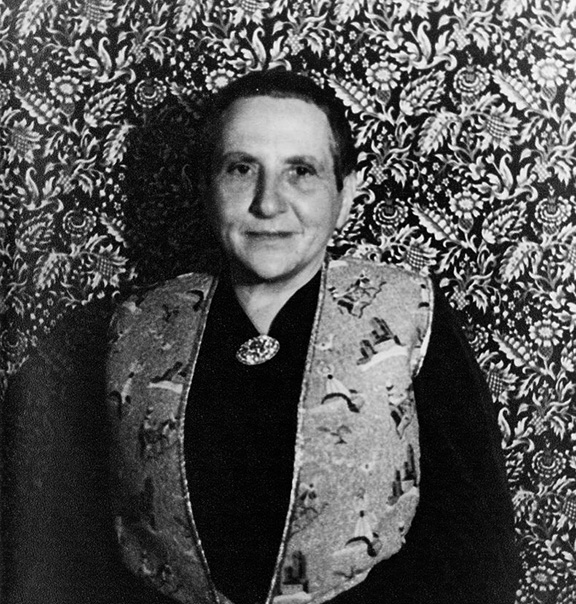
Gertrude Stein (1874 - 1946) by Carl Van Vechten.
She is 60 or so here.

Detail of Sarah Rosenstock's quilt

Read about Millie's children, the exceptional Steins:

Brenda Wineapple, Sister Brother. Gertrude and Leo Stein.
Linda Wagner-Martin, Favored Strangers: Gertrude Stein and Her Family 

And read about the Jewish applique quilts of Baltimore in Ronda McAllen's AQSG paper:

Beinecke Rare Book and Manuscript Library

Pauline Stein's niece Gertrude Stein, Alice Toklas and the obstreperous Ford
truck they named after Aunt Pauline Bernard Stein. "Auntie," both human
 and vehicular, "always behaved admirably in emergencies 
and behaved fairly well most times if she was flattered."

Wednesday, July 12, 2023

Atlanta Garden #7: Grandma's Favorite

Atlanta Garden #7 by Addie
Grandma's Favorite for the Flipper children:
Did Isabella Buckwalter Flipper have favorites?

Photo by George Barnhard, 1864, Library of Congress
Barnhard documented the destruction for Sherman's Corps of Engineers

This showplace house at Atlanta's outskirts on Marietta Street was shelled repeatedly in the summer of 1864. Well constructed of plaster-faced stone the house had been commissioned by slave trader Ephraim G. Ponder in 1857. On the roof an open-air observatory where one could enjoy the vista or shoot at incoming Yankees.

Marriage record 1853

Ponder and his wife Ellen B. Gregory had moved to Atlanta from Thomasville, down by the Florida line. Ellen, fourteen years his junior, is said to have been beautiful, lively, erratic and wealthy in her own right. 

Sketch by Lewis Miller 

Their 25-acre estate was known for its fine gardens kept by a talented, enslaved gardener. Over 60 slaves were reported to live on the property before the siege of Atlanta.

Local historian Wilbur Kurtz plotted the house on the Marietta Road
in 1930.

The estate had residences and workshops for the many slaves who made Ephraim Ponder a business success. More shrewd than enlightened he believed in educating his bondspeople---if not in literacy---in skills and trades, education creating a demand for the wheelwrights, blacksmiths and his best shoemaker Festus Flipper, all of whom he could rent out for a nice sum. 

The slaves' ownership was perhaps a contentious financial matter in the marriage and certainly later in the Ponder divorce. By the time the war began the Ponders' marriage was over. Ephraim sued Ellen for divorce in 1861 accusing her of promiscuity, drinking and a habit of aiming a pistol at him. 

Atlanta Constitution, June 30, 1930

Decades later Wilbur Kurtz interviewed Sarah Huff a child during the war,
 who remembered Ellen Ponder as a widow rather than
a divorcee. (Children needn't know everything.)

The Ponder home still stands at 324 North Dawson in Thomasville.

Grandma's Favorite by Becky Brown

Ephraim returned to Thomasville and the house he'd built there leaving Ellen in Atlanta to run the estate and manage the bondspeople. Her haphazard supervision was a form of benign neglect that benefitted the Black residents, most of who'd come with the Ponders from Thomasville. 

1862
Ellen Ponder seemed to have no trouble mixing in society despite the scandals. Here she used her own name as a Vice President of the charity supporting the Confederate hospitals.

1862
Her personal fortune must have helped maintain her status.

Another of Lewis Miller's Virginia sketches

Grandma's Favorite by Denniele Bohannon
Among the African-Americans living at the Ponder estate were Festus Flipper and his wife Isabella Buckwalter Flipper (1837-1887). 

Festus Flipper 
This may be the senior Festus (1837-1887)
or son Festus (1868-1943).

The couple met while bound to different slaveholders. Isabella's was Methodist minister Reuben H. Lucky (Luckey) (1801-1875.)  Festus earned enough money to buy his wife and their son Henry born in 1856.   

Photos of the Ponder house were taken by George Bernard
during the Union occupation in fall, 1864. 

By the time the shelling began in the summer of 1864 Ellen Ponder had left town, taking the Flippers and their small boys with her. 


Eldest son Henry, about 8, remembered moving to Macon. 

As Sherman's troops marched south from Tennessee the "dissolute mistress's" Atlanta house became an armed camp, filigreed with defense structures, its boxwoods and fruit trees scarred by shells. Ellen never returned to the house, which stood empty and damaged for many years after the war.


Diarist Carrie Berry noted Atlanta's chaos during Union occupation. Black Atlantans who welcomed the Union army bringing hoped-for freedom worried that Hood's Confederate troops might return, kidnap them and send them south. The Berry's enslaved servant Mary left right after Union troops took over. 


Another Atlanta girl Lucy Harvie Hull (1857-1923) remembered swinging on the gate watching soldiers pass. "We saw the neighbors moving out...our servants all ran away except Uncle Dick and Mammy."

Grandma's Favorite by Becky Collis

After nine months in Macon the Flippers returned to Atlanta as the war ended. Isabella cooked for the occupying armies and Festus repaired their boots. Their home, a restaurant, also became a school as the Flippers set about educating their boys who, due to Ellen Ponder's neglect, had been illegally taught to read.

After the war Henry and his brothers attended the Storrs School for Freedman
on Houston Street, near their home.

Students and teachers at the Storrs School,
perhaps a Flipper boy or two among them.

Their eldest went on to Atlanta University and West Point's Military Academy.

U.S. Military Academy Collection
Henry Ossian Flipper (1856-1940) as a West Point Cadet. 
Isabella's five boys were ambitious and successful.


Bishop Joseph Simeon Flipper (1859-1944)
& Professor Carl Flipper (1876-1961)

Isabella had many grandchildren who lived into the 20th century. Each a favorite, I am sure.

Grandma's Favorite by Jeanne Arnieri

The Block

Nine patch with four pinwheels, blocks from about 1910.


Above the cutting instructions for 10" and 15" blocks.

Further Reading:

Henry O. Flipper wrote an autobiography: The Colored Cadet at West Point. Read it online here:
https://www.google.com/books/edition/The_Colored_Cadet_at_West_Point/qmbrAgAAQBAJ?hl=en&gbpv=1

See more of Lewis Miller's paintings of enslaved Virginians.

Saturday, July 8, 2023

Not a Civil War Era Quilt


Saw this on line advertised as an Antique Civil War Quilt.
It is indeed a cool quilt but there are so many clues in the fabric
that it's from about 1890-1925, decades after the war was over.


Best clues to date in the claret red, a dark wine-colored red you just don't see until about 1890,
and the black/gray prints---same time period.

From the time when these people who'd lived through the war
as young adults were in their 60s ---photo from 1913.