Wednesday, February 21, 2024

Ellen Tucker Emerson's Civil War


Lidian (Lydia) Jackson Emerson enjoying breakfast in bed with
her cats. Sketch by her daughter.

Ellen Tucker Emerson (1839-1909) in 1860

At 17 Ellen returned from school in western Massachusetts to the family home to live the rest of her life. She never seemed interested in marriage but enjoyed her position managing the Sage of Concord's home. 

Edward, father Waldo (as he was called) and Ellen in the 1850s

Ellen's father Ralph Waldo Emerson (1803-1882) was one of the foremost writers, philosophers and personalities of his time. Ellen's mother was a perfect example of a Victorian invalid, depressed and prescribed debilitating drugs. Calomel causing mercury poisoning probably contributed to her lethargy, digestive problems and moodiness. She was often considered too delicate by female constitution to venture from her bedroom. She had to be coaxed to eat; her low weight was often remarked upon. Nevertheless, she lived to be 90 years old, delighted for her daughter to fill her role for the last 35 years of her life.

Lydia Jackson Emerson (1802-1892)
Lydia Jackson was Ralph Waldo Emerson's second wife, married in 1835.
 His first named Ellen Tucker Emerson had died of tuberculosis
 after a short marriage. Lidian (husband Waldo changed her name) 
 suggested the first wife's name for her eldest daughter.

From her last year at school in Lenox daughter Ellen wrote:
"The next year will probably be an apprentice-ship in house-keeping and that I hope to have begun my career as superintendent of the house.”
When the Civil War began Ellen had been housekeeper and father's secretary for several years. In the introduction to Ellen's biography of Lidian Emerson, Delores Bird Carpenter tells us she at first "thought news of every new recruit...a great thing," regretting that the only family member who joined was a second cousin. Lidian was thrilled at news of civil war. She was sure it meant the end of slavery.

Timothy O'Sullivan's photo of a few of the hundreds of freedpeople
who became Union responsibility in 1861

Although Ellen was focused on her family during the war, she joined other Concord women in sewing for soldiers and for Port Royal Islanders freed by Union victories on the Carolina coast in the first year of the war. Her mother also went to Soldiers' Aid Society meetings but she held sewing in "low esteem," recalled Ellen. 


Lidian's contribution was buying expensive English pins to fasten the handmade bandages. Ellen heard from a wounded Concord soldier that his doctor was glad to see his bandage stamped "Concord, Mass" as those had "a pin in them that would work."
"When every old sheet in Concord had been made up and sent, people began to sacrifice their good ones, and Mother, greatly elated, saw to it that the supply of pins never failed."
Library of Congress
Women visiting patients from the 36th New York
 at the Portsmouth Grove Hospital, drawing by Private William Thompson Peters, Jr.
On a summer, 1862 vacation to Rhode Island with the Henry James family, Ellen spent a morning at Portsmouth Grove Hospital for wounded soldiers near Newport, Rhode Island. "I returned utterly unable to send anyone to the war with cheerfulness."

Good friends John Murray Forbes and Waldo Emerson shared
grandfather duties to Ralph Emerson Forbes, Ellen's sister Edith's oldest.

Ellen often accompanied her father to Boston's Athenaeum library where a librarian recalled them, Ellen carrying his papers and books in her satchel. "I remember that she would sometimes try to induce him to accompany her on a round of social calls. He usually seemed rather averse to doing so.....In a thousand little ways, here among the books, I have observed her provide for his comfort and anticipate his every want."

Concord Museum Collection
Ellen & a needlework project (?) 1899

In her biography of her mother Ellen mentions a good deal of fabric and bedding but the quilts (there must have been some!) are not recorded among words like blankets and downs, which might mean eiderdown coverlets.

Metropolitan Museum of Art
Adeline Harris Sears, Rhode Island, Silk celebrity quilt

Famous people were often asked to sign a scrap of fabric and return it by mail. Adeline Harris was quite successful in her quest for donations from celebrity "lions." Underneath Emerson's signature at top, those of Samuel F.B. Morse, Oliver Wendell Holmes, Henry W. Longfellow and William Cullen Bryant who dates his to 1858.

The Concord Museum is showing needlework produced by young women in New England, particularly samplers, a show up through February 25th.
https://concordmuseum.org/


And see a 2014 exhibit there with a marvelous album quilt:

The Emerson home "Bush" in 1905. Ellen continued to live here until her death.

Ellen wrote a rather charming biography of her mother, which seems to reflect the personalities of both women. The manuscript is with the Emerson papers in Harvard's Houghton Library. https://hollisarchives.lib.harvard.edu/repositories/24/archival_objects/336565

Delores Bird Carpenter has edited and published it but unfortunately without the fabric swatches attached to the manuscript.

Ellen Tucker Emerson, Life of Lidian Jackson Emerson, Edited with an Introduction by Delores Bird Carpenter, 1992.
A preview:

Wednesday, February 14, 2024

Washington Whirlwind #2: Boy's Playmate


Washington Whirlwind #2: Boy's Playmate by Becky Collis

Mary Todd Lincoln 
Photo by William Mumler, 1865

During the social whirlwind of a new presidential administration in the spring of 1861 Mary Cook Taft, wife of the Patent Office's chief examiner, was introduced to First Lady Mary Lincoln. Once Mary Lincoln heard that the Tafts had two boys about the same age as her own sons she invited them over to play at the White House.

Halsey Cook Taft "Holly" & Horatio Nelson Taft Jr. "Bud" 

The Lincolns had four boys. During the first years of the war Robert was at Harvard.
Eddie had died of a disease at the age of 3 in 1850.

The White House in the 1840s

Boy's Playmate by Jeanne Arnieri

Mary's impulsive move worked out well, at least in the beginning, although advisors might have told Mrs. Lincoln the Tafts, despite being New Yorkers, were appointees of the Democrat Buchanan with a reputation for Southern sympathies. The Tafts were "doughfaces" in the slang of the day. Once Lincoln was elected, however, and Southern states began seceding Taft became a strong Union man.
"There has been no startling News today, but the right of Secession is contested by all northern men who with the president consider it Revolution. I have not hesitated to call it Treason." Horatio Taft's diary January 17, 1861


Horatio Nelson Taft (1806-1888)

Horatio Taft and Mary Malvina Cook Taft had three boys and an older girl Julia together. Through his first marriage, Horatio had two sons Charles and Frank, grown by the time of the Lincoln White House. Mary Taft's youngest son Willie was too small and shy to keep up with his older brothers and the Lincoln boys but he was invited over occasionally.

The Patent Office
During the war as patent applications dwindled, the building was taken over for a hospital and Horatio was laid off in late 1861.

Halls and storage rooms at the Patent Building were filled
with bunk beds for wounded and sick soldiers, but Horatio
visited the old office often, according to his diary.

Horatio was bored, puttering around their rented house, discussing war news at the Willard Hotel and thinking up inventions to patent when there wouldn't be a conflict of interest. Mary Taft didn't like living in Washington and neither did he so in the fall of 1861 he decided to move back to New York and perhaps resume his career as a lawyer. 

The view in war-time Washington was dominated by the unfinished Capitol
 building where work continued on a new dome.
"This has been a delightful day and our sale of furniture has passed off. It mostly sold at a low rate, but it was mostly purchased at Auction two or three years since. We sold nothing but the bulkey articles amounting to only $140.00." September 24, 1861

Vintage Boy's Playmate block, about 1900 

After selling their furniture, the Tafts crated up possessions to ship home and bade the Lincolns farewell.
"My wife went today to pay her respects to Mrs Lincoln before leaving the City. Was very graciously received by Mrs L. and assured that if she could do anything to keep our Family here she would do it as she was anxious to have our boys come there as companions & playmates for hers." September 25, 1861
We then get a glimpse of Mary Lincoln's typical manipulations. She did not want to lose the Taft boys. 
Horatio went to see a Major Watt who told him: "Mrs L. always succeeds, and is enlisted in my behalf."

Before a week was out the Tafts had been persuaded to rent a house about 5 blocks east of the White House: "On 9th St No. 346, having 9 rooms and back buildings, rent $200.00 pr year. House in tolerable repair and convenient, shall move in tomorrow." 
"I called upon Mrs Lincoln this evening with Julia and had quite a long conversation with her. She was quite indignant that I had not been restored to office." October 10, 1861


Boy's Playmate by Denniele Bohannon

 October and November passed with no new occupation for Horatio but Mary Lincoln was at work.

"Wife went up to the Presidents to see Mrs Lincoln, did not see her. She however got a strong letter from the President to the Sec'y of the Interior in my favor." November 21, 1861
The next day his old boss at the Patent Office reluctantly offered him "a 2nd Class Clerkship in the Land Office for the present if I would accept of it. It is $1400 pr year. That is certainly better than no business in this extravagant City and I shall take it till I can do better."

Julia Taft: "It was an outstanding characteristic of 
Mary Todd Lincoln that she wanted what she wanted when she wanted it."

Mary Lincoln earned a reputation for shady manipulations of government appointments for her friends, patrons and creditors. An elegant carriage given to the First Lady might insure an appointment as an agent in the New York custom house, a potentially profitable job if one wasn't too strict about ethics. Here we see her at work on a smaller scale, engineering playmates for her boys.  

The idealized Lincoln family was the subject of many lithographs,
this one by a rather untalented portrait artist.

Julia's book goes into pleasant detail about the Tafts and the Lincolns. She often escorted her younger brothers on visits and was happy to chat with Mary Lincoln who treated her with a leniency and familiarity her own mother could not. Julia read novels in the White House library, novels being forbidden by Mary Malvina Taft.

In his diary, Horatio is pleased to mention the boys' visiting their home, which took place often in the winter of 1861-1862.
"The Lincoln Boys have been here twice today after our boys to go there. (December 12) ...Both the Lincoln boys were here this afternoon looking over the pictures with Bud & Holly. They are evidently not kept on Sundays with puritan Strictness. They like to come here and feel quite 'free and easy' with our boys." (December 15, 1861)

"This has been 'Christmas day'... I have spent the day at home fixing up things....It has been quite a noisey day about the house. Our three boys and the Two Lincoln boys have been very busy fireing off Crackers & Pistols. Willie & Thomas Lincoln staid to Dinner at 4 o'clock."
Boy's Playmate by Becky Brown with a black & white sashing.

Tad Lincoln was the leader of the pack. When he and Holly disappeared into the many basements of the Capitol building, causing a crisis, sister Julia recalled Holly telling her: "Tad dared me to explore around and we did and got lost." 

The Block

The block has several names, all relating to the mischievous children in the Lincoln White House's first year.


Cutting a 12" Pattern

Model Maker Becky Brown is a precision piecer and she advises me:


Horatio Taft's Washington diary was donated to the Library of Congress
in 1970, a gift from Mrs. Willoughby Davis, a family member.

Read the transcript of his diary entries here:
https://www.loc.gov/resource/mtaft.mtaft1/?st=text

https://www.loc.gov/collections/diary-of-horatio-taft/articles-and-essays/the-washington-diary-of-horatio-taft/

 See the transcription here here:

https://www.loc.gov/resource/mtaft.mtaft1/?number=149?sp=4

And one more Taft link:

The Metropolitan Museum of Art in New York City owns
this chintz applique quilt attributed to Mary Malvina Cook Taft.
See a post on this quilt---unlikely to be by her hand:

Did she obtain it during her wartime residence in Washington?
Perhaps a stolen Southern quilt?

Wednesday, February 7, 2024

Mary Tirzah Barnes's Civil War


Double Irish Chain, 1850
Quilt in the collection of the National Museum of American History at the Smithsonian.

One inked block in a corner is said to read Mary T. Barnes, 1850.

A second quilt from the same family. The black and white photo
shows the block-by-block quilting designs in this white-work quilt.

The caption for this quilt is similar to the Irish Chain
"An inked inscription, 'Mary T. Barnes 1850' is near one corner."
In this case we have a clear photo of the inscription.

And that is really not what it says. 
"M.T. Barnes
1852."
is my interpretation.

These quilts were donated in 1933 by Mary's youngest children Mildred and Isabella Erwin,
single women who lived together in Washington D.C. with their brother John B. Erwin II.

The museum's annual report mentioned the gift.


In 1850 Isabelle & Mildred's mother Mary Tirzah Barnes was 9 or 10 years old, living with her
father Dixon Barnes on a plantation in Lancaster County, South Carolina.
Mother Charlotte Rebecca Brown had died a few years earlier when Mary was 6.

Mary's daughters thought the quilts might have been made for Mary's dower chest. But no one indicated by whom.

Did Mary, abut 10  years old, piece together all those squares, under the direction
of a relative or servant?

The pieced quilt speaks of 1850 with its newly fashionable red & green geometric
patterns and an old-fashioned chintz striped border (a strange stripe with
an animal print) combining two styles as chintz quilts became "chintzy."

But does it tell us anything about the young Mary Barnes?

Dixon Barnes (1816-1862)
from a painting at his Find A Grave site.

As the Civil War began Mary Tirzah Barnes (1840-1893) was perhaps at school as she is not listed in the 1860 census with her father, who looks to be living alone. He was actually living with dozens, perhaps hundreds of enslaved people, invisible to the census takers but counted in a separate slave schedule. Mary herself is listed there as owner of 33 bondspeople, perhaps a legacy from her mother. Her father in his own estate and in trust for others is listed with many more.

Lancaster County, South Carolina

Dixon Barnes had served in the South Carolina Legislature and Senate. In 1855 he married a second time to a Mary Cunningham who lived only a few months after the marriage---so here we have a second Mary Barnes. She was the widow of John S. Cunningham and apparently had two girls and a boy when she married Dixon Barnes. The reference to this short marriage is from a legal case. 


South Carolina court case mentioning Dixon's
second marriage, to another Mary Barnes.
Did someone write her name on the quilts at a later date?

Robert A.R. Cunningham was Mary Cunningham Barne's young son who seems to
have inherited much human property. He died in 1865.
Were Mildred & Isabella Barnes even aware that their grandfather has been married
for a few months in 1855 to another Mary Barnes?

When the war began Dixon Barnes raised local regiments, becoming Colonel of the 12th South Carolina, soldiers he led into battle at Sharpsburg, Maryland in September, 1862 where he was shot in the leg. He died at in Charleston, Virginia a few days after the battle, also called Antietam, one of about 23,000 fatalities there.

Alexander Gardner photographed the Antietam disaster.

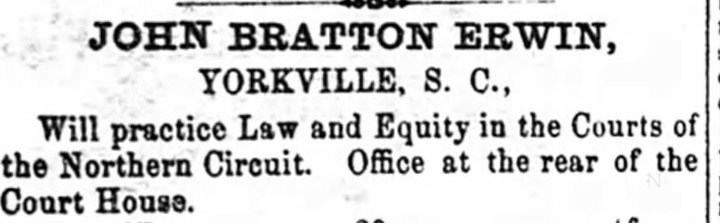
Ad for John Erwin's practice in the fall and winter of 1860-61.

Mary's grief over her father's death may have been tempered by the safe return of a Private
John Bratton Erwin (1834-1916), attorney from York County. 

January 18, 1866

They married a few months after war's end.

Lancaster's Court House by architect Robert Mills

John had been managing a railroad but "upon marrying Mary Barnes he gave up his profession and undertook the management of her large estates," according to a biography. Children immediately followed and by 1871 she had three boys and became pregnant with the fourth. A horrible event happened in the fall. All three of her boys Dixon 4, George 3 and William 1 died of disease in a few weeks, leaving the parents with nothing but the promise of another child.


Fortunately five more arrived with four outliving their mother who died in 1892 of tuberculosis.


Obituary for Mary, June, 1892.

Husband John then moved to Washington D.C. to clerk in the War Department, bringing his children with him. When Republicans gained control of those clerkships and fired him he turned to real estate. He married a younger woman from Washington, Miss Louisa Nourse Forrest, listed here in the 1900 census with Mildred at 16 still living at home.


A minor mystery about the quilts. Now I think the best way to phrase something like this would be:
"Attributed to the household of Mary T. Barnes."