Wednesday, December 20, 2023

Barbara Freitchie's Civil War


Star pattern called Star Puzzle or Pieced Star in the early 20th century

In May, 1931 Needlecraft Magazine published an article by Helen Rockwell Adams who'd visited the recreation of Barbara Frietchie's house in Maryland. On the bed she saw a sawtooth star, which "tradition assures us that Barbara made...with her own hands." Adams pictured a block, naming it Barbara Frietchie's Design.

This recreation of the Frietchie house was once a museum in
Frederick but doubts as to the accuracy of the story presented there
created concerns about local "history."
 It's now a bed and breakfast.

Found by the Iowa project. Blocks are on point.

The simple star Adams pictured had several earlier names, although none as romantic as a design linked to America's female Civil War hero.

My generation was brought up on the stirring tale of a 95-year-old woman
defying Confederate hero Stonewall Jackson by flying a Union flag as his
troops passed her house in Frederick in September, 1862.

Poetry was powerful propaganda. During the Civil War Massachustts poet John Greenleaf Whittier often described current events in rhyme. From novelist Mrs. E.D.E.N. Southworth he heard the story, converted it to verse, which was published in the Atlantic Monthly in October, 1863.

Emma D.E.N. Southworth (1819-1899)

The stirring lines inspired patriotic fervor during the war and into the late 20th century despite the fact that historians have pointed out that Stonewall Jackson, who died in battle soon after the poem's events, marched nowhere near Frietchie's house. True or not, her tale was a Union answer to the Confederate myth of the martyr Stonewall. Here was a woman who'd won a small victory over the legendary General.

Barbara Hauer Fritchie (1766-1862)

When the Civil War began Pennsylvania-born Barbara was in her mid-90s. Scraps of her life have been determined. In 1806, at 40 years old, she married John Casper Frietsche who was 14 years younger than she. His father had been hung for a loyalist traitor during the Revolution. Her husband died in 1849; they had no children. She did indeed live in a house on the site when the Confederate troops occupied the city in September, 1862. Her health and mobility have been controversial subjects. Was she able to hang out a window and wave a Union flag? She died 3 months later, months before Whittier's poem appeared. The original house washed away in a flood in the early 19th century.

Frederick, Maryland, 1862

Frederick mayor (and busybody) Jacob Engelbrecht kept a dairy in which he noted much in Frederick society. 
Jacob Engelbrecht (1797-1898)

In 1942 Dorothy Mackay Quynn and William Rogers Quynn summarized their in-depth investigation into the accuracy of the story told in Whittier's poem, concluding there was no evidence it ever occurred.


The whole tale has inspired some historical absurdities: One being a 1924 movie with the flag event 
a point of drama between two young lovers in Civil War Maryland, each loyal to a different side.

Florence Vidor as a much younger Barbara Frietchie.

Another tale was told in which George Washington visited some Frederick women at a quilting party in 1791, giving Barbara a china bowl he'd been carrying in his bag.


Read Dorothy Mackay Quynn and William Rogers Quynn's  article "Barbara Frietschie" in the Maryland Historical Magazine (1942, Volume 37 Issue #4) at this link:

1900 Play

Quilt recorded by the Wyoming Quilt Project, mid-20th-century

Wednesday, December 13, 2023

Atlanta Garden #12: Union Circle


Atlanta Garden #12: Union Circle by Denniele Bohannon

Our last block Union Circle remembers the Union patriots in Atlanta, the Berrys, Markhams, Healeys and others.


Right after Christmas, 1864 Carrie's father was punished for his pro-Union activities when the Confederates in control again arrested and imprisoned him for three weeks in Macon. But once he returned home unharmed and undrafted, the drama in the Berry household decreased and Carrie's journal came to an end.

Carrie's last diary entries in January, 1865 reflect a return to a normal school girl's life. 
(Did she ever learn to spell?)

William Markham 1811-1890

After war's end Uncle William Markham became a trusted Union source for information about who'd been a Unionist and who a persecutor of Union sympathizers. In Secret Yankees Thomas G. Dyer quotes an Intelligencer article during Sherman's occupation in which Uncle Markham is described as a "mean, vindictive man...well-known in Atlanta to be traitorous to the cause of the South," and, as Dyer notes, the editor implied "that Markham should be murdered." Yet, Markham's money and perhaps his judicious approach to post-war political discussion made him a respected member of Atlanta's elite. 

Atlanta in 1895, revived after Civil War destruction, progress that
made wealthy citizens of the Berry/Markham/Healeys.

Union Circle by Becky Brown

William Macon Crumley (1847-1921)
Ten years after the war Carrie married Confederate veteran William Crumley who had joined the Confederate Cobb's Legion when he was 14.


William's father, a Methodist minister, married them in 1875. Crumley was an active member of the United Confederate Veterans group in the post war years and wealthy in his own right.

Maxwell Rufus Berry (1823-1909)
Carrie's father at his death was estimated to be worth over $700,000, mostly in Atlanta real estate.


From M.R. Berry's 1909 obituary

Jacob's Pharmacy  stills stands in a building Carrie inherited on Peachtree Street, a historic
site due to its association with Coca-Cola.


March, 1921
 This business news published just a few weeks before Carrie died.

Union Circle by Becky Collis

The 1900 census finds Carrie married to Crumley, a prosperous hardware merchant with three boys and a girl ages 23 to 8. Lena Banks, a 21-year-old Black servant, also resided with them at 40 Forrest Avenue. Note the columns with numbers 6 and 4. That census asked how many children a woman had given birth to and how many were living at the time. Carrie and William had lost two.


Robbie, their eldest, lived until 1953.
This house at 18 Inman Circle was their last home
where they lived with him.


Fortunately Carrie and her husband did not live to see the death of son Dr. William
Gregg Crumley in 1924 six years after returning from serving in World War I. 

Carrie died at 66 in May, 1921 from what her doctor diagnosed as
cancer of the gall bladder. Her husband died less than six months later.

 October 5, 1921, Atlanta Constitution

Union Circle by Jeanne Arnieri

We certainly wish we knew more about Carrie Berry Crumley as an adult. How did father Maxwell, a Unionist, get along with her husband, the boy Confederate soldier? What stories did she tell her children about her childhood in a battlefield?

Atlanta's Whitehall Street in the early 20th century

Carrie would have been in her sixties in the teens. Did she dress in the conservative wear thought appropriate for "the elderly?" When one sees a photo like this portraying a determined woman (carrying her own package for heaven's sake!) one wishes one could grab her arm and demand in polite fashion: "Tell me about the war."

The Block

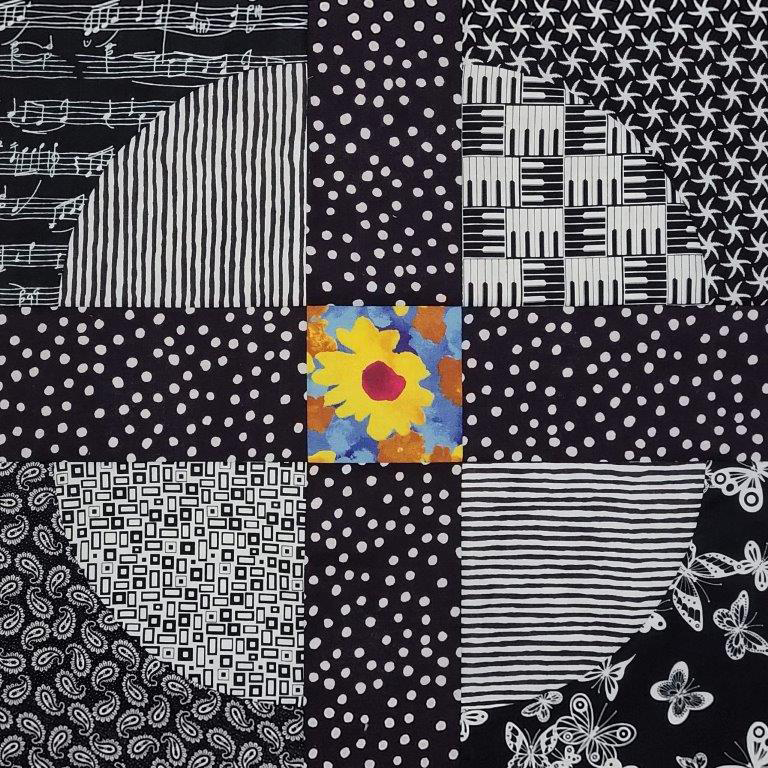
Our only block with curved piecing, this last block is based on a common fan design, using the pattern structure of BlockBase #2001. As it's a new pattern we can give it a new name Union Circle


Louise Vaughn of Hopkins, Missouri sent the fan design to the Kansas City Star 


Print the sheet below 8-/2" x 11"
See the inch square for scale.


Above the cutting instructions for 10" and 15" blocks.

And we are finished!

Wendy Coffin, "To the Boys Who Never Came Home"


See the Berry & Crumley family papers as the Atlanta History Center:

Atlanta Garden by Jeanne Arnieri
She made two!

Do post your pictures of finished Atlanta Garden quilts on our Facebook group page AtlantaGardenQuiltBOM:

Next month we start the 2014 pieced BOM Washington Whirlwind. Here's the Facebook group:
WashingtonWhirlwindQuilt

Wednesday, December 6, 2023

2024 Pieced BOM: Washington Whirlwind


Next year's pieced Block of the Month series here at the Civil War Quilts blog is scheduled to start on January 10, 2024 with twelve blocks published as free patterns on the second Wednesday of each month. The theme is Washington Whirlwind and the stories are from the Lincoln White House.

Willie on the left and Tad at right with the First Lady

We'll begin on a light note with some boisterous boys, the White House children during the Lincoln years. Willie and Tad were at the center of the whirlwind with accomplices in a pair of neighbors, the Tafts. Their older sister Julia Taft remembered the White House days; her memories were collected in a 1931 book Tad Lincoln's Father. 

Julia Taft's little brothers Holly & Bud

The monthly stories for Washington Whirlwind are drawn from hers and other White House memoirs, letters and diaries.

We'll show some different settings---the horizontal grid 3x4 for the 12 blocks and this version for 9 or 13 with blocks on point.

The nine purplish blocks here would be pieced.
The turquoise plain. 


Why purple? It was the fashionable color in the 1860s
and you know Mary Todd Lincoln was nothing if not fashionable.

First Lady's dress by Elizabeth Keckly
Smithsonian Collection

And quite a difficult character unfortunately.
But therein lies the family tale.

Becky Brown's solids---purples from Magenta to Solferino (period names)
with some complementary yellows, etc.
Jeanne Arnieri is using reproduction prints, a butternut
& blue palette.

Twelve blocks in a 3x4 grid = 48" x 63"
With a 6" finished border 
50" x 75"

In 2001, Tad Lincoln's Father was reprinted by the University of Nebraska Press's Bison Books.


You can buy a pattern packet for Washington Whirlwind ---14 pages to print yourself for $12. 

And we have a public Facebook group.
You don't have to join. Just check in regularly.
Post your blocks.

You have a couple of weeks to get your fabric together or you can wait to see what we are up to.
January 10th.