Saturday, November 14, 2020

Harriet Alexander Caperton's Sampler #2: Pre-Civil-War Years


Unusual block, probably made from a paper-cut pattern,
in an appliqued sampler attributed to Harriet Alexander Caperton (1820-1899)
Union, Monroe County, Virginia, 1850s, perhaps.

Last week we began examining this sampler attributed to Harriet


Did Harriet's five-pointed stars indicate a sentiment for the Union? After all she lived
in the town of Union, Virginia all her life (Well, without her actually packing a thing she relocated to West Virginia in 1863---whether she liked it or not.)

Chrome orange areas are revealed through reverse applique.

 (See more at this post last week )
https://civilwarquilts.blogspot.com/2020/11/harriet-alexander-capertons-sampler-1.html

To examine Harriet's quilt and her life we have to begin with West Virginia's political history. When she was about 40 years old the Civil War broke out and the state of Virginia seceded to become a Confederate state.


Virginia had once been much larger extending from the Atlantic on the east into the western Appalachian mountains, but generations of ceding territory to form other states had created this strange 1860 shape, home to many different cultures. The purple counties in the northwest were far more loyal to the Union than the eastern and southern counties in pink. And then there was the mixed strip in red in the center. Harriet lived in the blue county on the line between some strong opinions. In 1863 western Virginia split off from the "Old Dominion" to become the 35th state, a Union state.

Cliches about pre-Civil-War Virginia, neatly categorizing eastern areas
as planters supported by slavery; the western people as mountaineers
in log cabins.


We do not know Harriet's opinions but my first reading of her album sampler was probably wrong. I looked at all these five-pointed stars, her town named Union and it's location in the break-away county as evidence of Union sympathies. I've changed my mind. First of all: Harriet's immediate family was anything but the stereotype of  "Mountaineer," although her grandfather James Alexander (1750-1814) could be viewed as a pioneer of the Revolutionary War era.

About the time of Harriet's applique she is listed
as owning 13 slaves in the 1860 census. Twenty percent of
the people in Monroe County were listed as enslaved that year.
 It's doubtful Harriet had any Union sympathies.

A 1911 regional history tells us that James and wife Isabella Erskine Alexander's families intermarried with "other leading families of Monroe [County], the Alexander connection has been very prominent in local annals [Descendants became Senators, U.S. Representatives, Governors, etc and some quite wealthy.] Mother Isabella (1748-1834) was from Cecil County, Maryland; James from eastern Virginia, perhaps near Roanoke.

James Alexander and Isabella, in their twenties, were the first [non-Native people] to settle in Monroe County, created in 1799 from Greenbrier County. They'd been in Greenbrier prior to the Revolution's end and built that proverbial "first house" on a hill east of Union, a cabin soon burned in a battle with the native people. They rebuilt on what would become the town's main street and apparently James and Isabella ran a tavern and mapped a town.

Militia musters were important social events.

The name Union was chosen six decades before the Civil War to honor a mustering place of the neighborhood militias, The Union Militia. 

Son Henry, Harriet's father, was the sixth of their 7 children. Harriet's mother Elizabeth Carthrae Alexander (1782-1829) was remembered in a local history as a gardener, raising the first geraniums and fuchsias ever seen in Union.


Harriet was born in 1820. Her mother died when she was nine. Perhaps she grew into one of the girls who shocked neighbor Anne Royall. Royall left observations about Monroe County in her 1826 book. She was unimpressed by Union: "This is a poor little village, remarkable for nothing but a very elegant brick court-house."

The brick courthouse in Union today is the third, built in the 1880s.

Royall noticed the wildness of the females who thought nothing of riding for miles around the country "sometimes attended only by another of their own age and sex! So much for the ladies of Monroe."

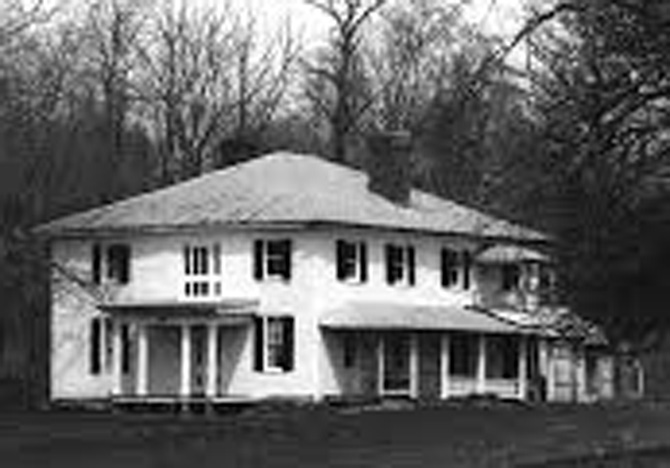
Elmwood Plantation survives in Union, on the National Register
of Historic Places

Early property owners thrived in the years before the Civil War, among them the Alexanders, who built increasingly grander homes that have not survived. Neighbor Hugh Caperton (1781-1847) is recalled as a Union resident who "became wealthy in land and the mercantile business [and] figured prominently in political affairs...."Elmwood. the Caperton family mansion, was built in Union in 1835.

Anne Royall thought Hugh Caperton remarkable although she did not mention him by name. "C___Esq. [has] amassed great wealth" as a merchant and speculator.
 "An American, a Kentuckian (I think.)  He is descended from a respectable family...he is one of your finest looking men, of elegant address, and very handsome....Those who are so unfortunate as to fall in their debt, receive no mercy....The taste those people have for foreign finery, and foreign luxuries, roused them to industry....Meanwhile their children are springing up, already practice the arts of cunning and speculation."

 A few years later Harriette married one of Caperton's children, William Gaston Caperton, middle child of ten.


Their wedding certificate

William Gaston Caperton (1815- 1852)
Gaston graduated from Yale in 1837,
married Harriette at 28. He was named
for Judge William Gaston of New Bern,
North Carolina.

Harriet was in her early 20s when she married in 1843. Her husband was probably called Gaston as were many of his descendant named for him. After perhaps a year spent practicing law in Staunton, Virginia the family returned to Union, due to his "failing health."


The 1850 census is hard to read. Harriette 29 is living with William G., three children and a 30 year-old Irish woman named Mary Cullan, perhaps in charge of the children. Gaston is worth $12,000 in land. By then Gaston was indeed in bad health. He dropped dead in front of Harriette at 37, leaving her with four surviving children aged 8 down to six-month old Isabelle.

Yale Obituary


We have little more information about Gaston; he doesn't seem to have accomplished much in his 37 years. His prominent brothers are pictured here without him. Allen Taylor Caperton on the right was a post-Civil-War U.S. Senator. Gaston at this point may already have died but he always seems just out of the picture. "Failing health" and dropping dead are often indications of alcoholism, rarely acknowledged. 


When Hugh Caperton died in 1847 he  left an elaborate will bequeathing much money, real estate and many enslaved people to his children. Harriette's husband did not receive what the others did: The enslaved Tuckwiller family and three other slaves listed by name, two horses and a cow. Gaston, married four years to Harriette, seems to have been much in debt to this father who enumerated, "advancements heretofore made to him, in all making about twenty thousand dollars." 

Washington newspaper the Daily Republic printed an obituary,
not too accurate but heartfelt.

And that seems to be the end of Harriette's husband.


The 1860 census shows Harriet at 40 as head of her own household with her four children each worth more than she was (wealth probably measured in human beings).  Right before the Civil War eldest son John was 16.

Harriet's blocks (on the left) have much in common with other antebellum applique quilts. On the right
blocks from a quilt dated 1848 made by the Robinson and Cather families, near Winchester, Virginia, 
Collection of the Museum of the Shenandoah Valley. Harriet's on the left are similar but a little more high-spirited.

Next week the Caperton family during the war.

See Anne Royall's biting observations about her neighbors in Monroe County:  Sketches of History, Life and Manners in the United States.


Wednesday, November 11, 2020

Yankee Notions #11: Modern Broken Dish

Yankee Notions #11, Modern Broken Dish by Becky Brown
The block can contrast nostalgia and modernism as North and South
remained distinct cultures after the Civil War.

The classic story of Southern nostalgia is about an end-of-the-century visitor from out of town on  Charleston's battery admiring the moon over the harbor. "Ah," sighs the native, "You should have seen it before the War."


The tale has been attributed to wits Mark Twain, Oscar Wilde and many others. There was New England nostalgia aplenty (see last's month's post on thrifty quilting) but the South had the reputation for living in the past.

Historian James E. Davis summarized postwar differences:
“In significant ways Southerners were romantics, Yankees more pragmatic and formalistic. Southerners leaned toward idealized medieval visions offered by Sir Walter Scott, but Yankees plunged ahead with increasingly rampant capitalism.“ 
The educated woman was a threat

Attitudes towards industry delineated differences as did the role of women. Post-War New England was full of New Women.

Ridiculed and reduced to an emasculating stock character.

Arthur Schlesinger, Jr. used the cliche to describe his mother-in-law Cornelia James Cannon, novelist and women's rights essayist: She was a "bustling woman...brusquely disdainful of frocks and frills....her hair and dress in shapeless, no-nonsense Boston bluestocking style."

Modern Broken Dish by Dorry Emmer

The Modern Woman

The Perpetual Southern Belle
Virginia Clay Clopton (1825 - 1915)
Frocks & Frills all her life

Virginia in her seventies
Collection of the American Civil War Museum

The Block

Modern Broken Dish by Denniele Bohannon


BlockBase #2415 was given the name Modern Broken Dish
by the Kansas City Star in 1937


Cutting a 12-Inch Block

A - Cut 2 squares 5-3/8. Cut in each in half diagonally. You need 4 triangles

B - Cut 4 strips 1-1/2" wide by about 14". You'll trim these when the block is finished.
C - Cut 9 squares 3-3/8".

Cutting an 18-Inch Block

A - Cut 2 squares 7-5/8. Cut in each in half diagonally. You need 4 triangles

B - Cut 4 strips 2-1/8" wide by about 20". You'll trim these when the block is finished.
C - Cut 9 squares 4-3/4".

Modern Broken Dish by Denniele Bohannon

This Month's Tangible Yankee Notion:
Decorative Sewing Tape Measures

Modern Broken Dish by Dorry Emmer
The perfect fabrics!


Decorative tape measure

One must have a tape to fit clothing. This tailor may be working
on attaching some soutache to the customer's pants or measuring the seam.


A better, modern tape measure would be retractable.
Modern in 1858

And even better if it were pretty.

Footstool?


I have a small collection of these advertising and celluloid plastic tapes.


One more block next month.

Yankee Notions by Becky Brown,
11/12 Blocks


Saturday, November 7, 2020

Harriet Alexander Caperton's Sampler 1


Block from a quilt top made by Harriet
Alexander Caperton (1811-1899)


It looks like a friendship applique sampler but there are no names on it, and many of the blocks
look like the design ideas of one person rather than a group of friends. Documentors for the West Virginia project believed: "All except one appear to be from the same hand."

Fabrics all look to be solid color fabrics, no help in
dating this quilt other than "After 1840."

Intricacy of the applique designs indicate a pre-Civil-War date.

Examining this quilt is confounded by a restoration/reconstruction from the late-20th-century. The caption in the West Virginia book tells us the top was found with 24 blocks stitched together but 
"with a block missing from the upper left corner...a new block was made, and the top lined and bound by employees of  [quilt dealer] Shelly Zegart in Kentucky."
Twentieth-century addition in top left corner.

We assume this to be the top left corner; tulips, heart and dark fabric ---not Harriet's style.
The top was bound in the 1970s; sold to another dealer
who sold it to the woman who brought it to the
West Virginia documentation day in Franklin County, West Virginia in 1995.

She had the information that the top first surfaced in 1970 at the estate sale of  Harriet's granddaughter Rose Caperton (1880-1969) who, according to the National Register application for the family house Wyndridge, lived there "eschewing such modern conveniences as electric lighting." She was the last Caperton to live in the home and is buried in an unmarked grave near the barn.

Harriet's son William built Wyndridge about 1870,
enclosing two older two-story log houses. Rose was born and died there,
keeping family treasures and memories.


Harriet lived until Rose was almost grown so they must have known each other rather well.


Harriet spent her life in Monroe County, beginning as a Virginian and
ending as a West Virginian. She lived near the town of Union, which might
give us some insight into her Civil War experiences (if we did not examine our assumptions.)

"A Quilting Party in Western Virginia"
Regional humor published in Boston's periodical Gleason's Illustrated,
October, 1854, about the time the quilt was made.

Next Week: More on Harriet and her family.

Several of the blocks are rather conventional in design such as this lyre---"Yet they exhibit a curious touch that sets them apart from mainstream renditions, while the shapes fill space in an exuberant manner. "
I bet Fawn Valentine wrote that lovely description in the West Virginia Quilts & Quiltmakers Book.

Wednesday, November 4, 2020

Forgotten Angels: The Lives of African American Women Who Served as Nurses

Here's a beautiful book cover
for a new book by Kalinda Page & Jack McElroy

A father-daughter team

Kalinda and Jack's Forgotten Angels: The Lives of African American Women Who Served as Nurses in the Civil War is easy-to-read, written for the middle-grade school audience with extensive research about Black women during the Civil War.


See a book preview at Amazon

At about $8 it would make a great stocking stuffer for anyone interested in Civil War women---anyone ages 10-100.

The cover features a portrait of Susie King Taylor by Samuel Bridgham Jr. in the collection of Steve Restelli. I am pleased to say I connected the authors with the photo that I came across when looking for information about the Bridgham family who once owned a Civil War quilt in my collection.

We are working on a  Moda fabric collection
based on the Bridgham quilt. Ladies'
Legacy should be in shops in March.

Read more about the older Samuel Bridgham and this quilt here:

Photo of a woman thought to be Susie King Taylor (1848-1912),
attributed to Samuel W. Bridgham, Jr, about 1889

Steve Restelli: 
I have collected antique photographs for more than 40 years, and this image is just amazing. I purchased this in a group large format of glass plate negatives that came from the Bridgham estate in Seekonk, Massachusetts, only 40 miles south from where Susie lived. There is so much feeling, detail and wonderment that surrounds this image....Samuel W. Bridgham was the photographer. I do not know much about him either, except that he was once the president of the New York Camera Club, and he was very wealthy.
See Restelli's facebook page:
https://www.facebook.com/groups/230905310740264/

And here's what I know about Susie King Taylor and a quilt she made:

http://civilwarquilts.blogspot.com/2020/01/susie-king-taylor-her-gar-quilt.html