Wednesday, December 18, 2019

Cassandra's Circle: Fabrics & Sets

Cassandra in the center with a few women of her circle

Cassandra's Circle Block of the Month begins here on Wednesday January 29, 2020. Look for a free applique pattern on the last Wednesday of every month through January 2021---there are thirteen blocks.

We'll keep the same Facebook page. I'm changing the name to CivilWarApplique but it's the same URL. Post pictures of either 2019's Hospital Sketches or 2020's Cassandra's Circle. We have almost a thousand members.
https://www.facebook.com/groups/2152934498369880/

Official Set

72" square without a border

The 13 blocks.
The large center block will be pattern #1 in January.
See a post about this set here:
https://civilwarquilts.blogspot.com/2019/10/2020-boms-at-civil-war-quilts.html

97" Square with Border

And this year you'll get a pattern for an appliqued border finishing to 12-1/2". Border pattern in early January so you can start appliqueing flowers and leaves.

Fabrics

Janet Olmstead's traditional applique colors for Hospital Sketches

The patterns will finish to 18", the same size as the applique in last year's BOM Hospital Sketches. I imagine a few of you haven't gotten all 12 blocks finished yet so you could continue with the same colors and fabrics, combining blocks and sets from both years.

A couple of stitchers used a monochrome blue color scheme that worked great. Above: Karen Doerr Martin's block atop Angie's from Quilting on the Crescent.


Becky Brown is using William-Morris-inspired prints on a single textured background. Her palette of primary colors, red, yellow, green and blue, is pushed to sophisticated, muted shades.


 You can bet she chooses her prints with an eye to fussy cutting.

Pat Styring is also using a primary palette but intense shades and her backgrounds are black. She's thinking dots and words.

Backgrounds

Barb Rowland Roberts

Last year some of us appliqued to a scrappy four patch and you may want to continue that idea.

Lorraine Hoffman

Linda Pyke shaded the four patches---dark in the corners,
light in the center, a nice way to unify the design.

And then there's Matt Macomber's!
I cannot wait to see him finish this.

 If you are thinking pieced backgrounds here's an idea and a different set for Cassandra's Circle: Twelve 18" blocks in an alternate dark and light shaded set. The applique goes over the frame, sort of a layered look.


Light on dark, dark on light

54" x 72" without a border

I'm doing a small version with unpieced backgrounds, reducing the patterns by half to 9-inch finished blocks. My color scheme is taken from teens & twenties magazine illustration like this cover by Miriam Story Hurford.

Bright colors across the spectrum

Pastels and darker...
A lot of peach

With a checkerboard sash?

Saturday, December 14, 2019

Maria Harper's Confederate Memorial Quilt

By Maria Preston Harper (about 1823 - ?) South Carolina, 1861
Collection: American Museum of the Civil War
38"  x 56"

The cliche is that every quilt has a story. This crib quilt tells a tale that isn't pretty.


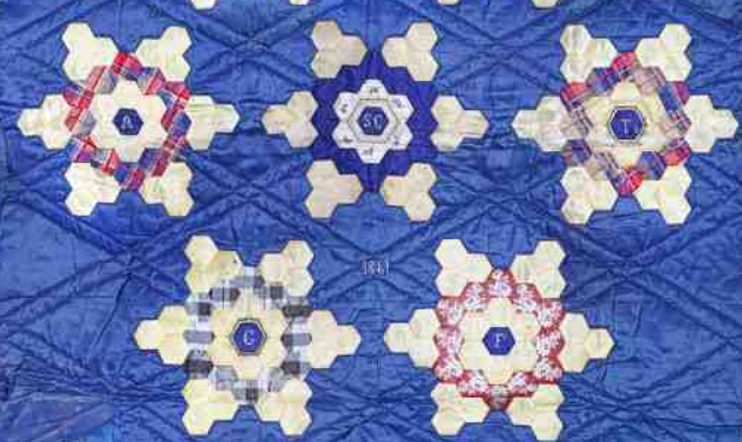
The silk quilt features the new Confederate flag at the top and South Carolina's palmetto flag at the bottom. Eleven hexagon stars each have a letter or two embroidered in the center, standing for the 11 states of the Confederacy symbolized on the flag.


F for Florida
Tennessee was the last state to secede in June, 1861, so Maria Preston Harper may have finished it after that date in the summer of 1861.

The little Secessionist commemorative, stitched to indoctrinate a baby in Southern principles, was donated to the Museum of the Confederacy, now the American Museum of the Civil War, by Catherine Dickson who told the museum that Maria Preston Harper made it to warm James Augustus Dickson. Born in 1861, he was the first son of Henry Dickson and Catherine McPheeters Dickson and perhaps Maria's grand nephew.


James Augustus Dickson was born May 26, 1861 in the midst of the secession crisis.

Maria probably made the quilt celebrating the brave new world of the Confederacy in either Lancaster or Fairfield County, South Carolina where her family seems to have had homes. She never married so left no descendants to keep track of her but here she is in the 1860 census living with her mother and widowed sister, McPheeter nieces and nephews and other assorted people in the Fairfield District of South Carolina. Her name is spelled Mariah and she is 37, born about 1823.


Maria had sisters Nettie and Ann Harper McPheeters and brother Wesley. She was undoubtedly a comfortable member of the aristocratic class of the Carolinas. Her mother seems to be worth $110,440.

Jesse Davis, a freed slave living in Winnsboro, South Carolina, was interviewed in the W.P.A. Slave Narrative project in the 1930s. He remembered his own master as rich but "not big rich like the Davises, the Means, and the Harpers." Jesse was about 20 during the Civil War so would have a reliable memory of the hierarchy among local plantation owners.

Yorkville's Court House (now York) designed by
the prolific architect Robert Mills who did much
to create classical Southern style.

Maria's father William Joseph Harper (1790-1847) had died over a decade earlier. Her mother Anne Catherine Coalter Harper died soon after the baby Dickson was born, as her tombstone tells us---on the "dawn of the 45th anniversary of her wedding day." Anne and William are both buried in a small cemetery at Salem Crossroads.

Maria may well be buried in the Salem Crossroads Cemetery
but no one has transcribed a stone for her.

And that would be all we know about Maria Harper with all discussion of her motives pure speculation if not for the fact that her father was quite an important politician, a U.S. Senator, a Carolina Senator and a Judge. William Harper was born on the Caribbean island of Antigua to Irish Methodist missionary John Harper and Antigua native Henrietta Hawes Harper. John Harper was reported to be an abolitionist and certainly a strong Methodist (another son was named John Wesley Harper.)
Maria's father U.S. Senator William Joseph Harper (1790-1847)

When William was about three the Harpers moved to Boston for his mother's health (she died soon after.) Reverend Harper's politics may have been welcome there, but five years later he took the family to Charleston and then to Columbia, South Carolina where he founded the Washington Street
Methodist Church.

Son William became a Carolinian, well known for his radical politics, described as second only to Senator John Calhoun as advocate for South Carolina's perceived rights from the nullification crisis of the 1830s to his death in 1847.

Anti-Calhoun cartoon from 1832. Is Harper depicted on the right?

Despite his father's abolition ideas William Harper was a chief apologist for slavery. In his arguments slavery, rather than being a necessary evil, was a positive good creating civilizing benefits and preventing evils such as degeneracy, barbarism and political radicalism.


Understanding Maria Harper's fathers' politics gives us a glimpse as to how she came to make the silk quilt for her young relative. Trying to grasp her motivations at a deeper level in the context of her peer group is more difficult. Understanding her generation's virulent advocacy of secession and the Confederacy and their seemingly inherent hatred of the North presents deeper problems.

Southern Woman demanding a divorce from the North over
the rights to "larrup" her slave. From the English magazine Punch

Reading about South Carolina's women in biographies, diaries, letters and essays explains some of the antipathy. Out of that reading grew the stories behind our Block of the Month quilt patterns for 2020. I found the hostility, particularly in South Carolina, was endemic, reinforced by politicians, ministers, newspapers, teachers and family.

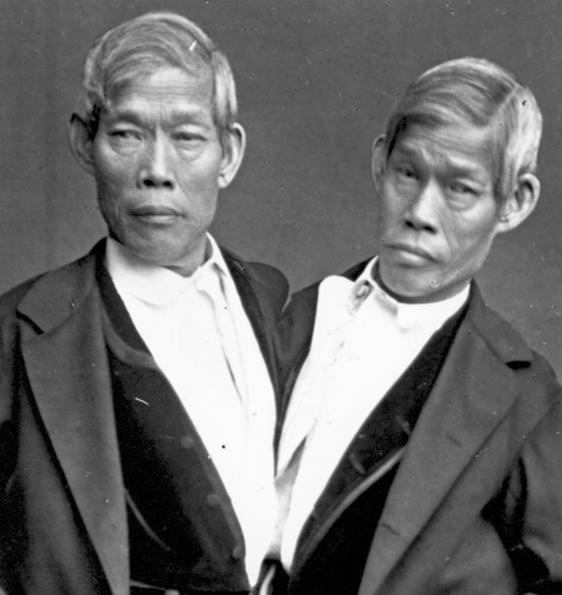
Louisa Cheves McCord, whom we will revisit in the applique quilt Cassandra's Circle, was spokeswoman for the Southern female. Never one to avoid a dramatic turn of phrase, she characterized the antebellum Union of North and South as wretched twins, "linked in incongenial brotherhood" using the analogy of Cheng & Eng Bunker, the famous Siamese conjoined twins.

The Bunker Twins
(1811 - 1874)
Outlandish rhetoric was a characteristic of Southern argument

The South was unhappy victim of Northern legislation favoring an industrial economy. "Blind as they seem to the fact, our Northern States prosper by us and through us," was the way McCord saw it. The agricultural South's resentment of the industrial North will be explored in the pieced BOM, Yankee Notions.

John C. Calhoun and his compatriots believed a state could
nullify any law the federal government made, particularly
any trade laws that benefited Yankee industry and taxed
Southern consumers---hence the Nullification Crisis. 
(It's unconstitutional.)

Miss Columbia with her Constitution and a switch,
 trying to keep order among unruly boys.

Look for both patterns to start in January, 2020.
Wednesday, December 11, 2019

Yankee Notions: Fabrics


Yankee Notion of the tangible kind

Our 2020 pieced block of the month begins here on January 8, 2020.


Every month you'll find a free pattern for a traditional block on the second Wednesday throughout the year. Yankee Notions will include instructions for 18-inch blocks and 12-inch blocks. You might want to consider a two-color sampler.

Like this mid-19th century album.

Red & white?

Late-19th-century sampler

Blue & White?
Orange & Turquoise?

66" x 87"
18" blocks set with 3" sashing
Add a 4" border to make a quilt 74" x 95"

For just the blocks for a Two-Color 12" Block Quilt you'd need 2-1/2 yards each of dark and light. Probably a minimum of 3 yards of each for the 18" Blocks

As the theme is American history, model makers Becky Brown & Denniele Bohannon are using a limited selection of red, white an blue fabrics.

Denniele's solids

Becky's using three prints.

For a Three-Color Quilt of 12" Blocks
You'll need 3 shades:
  • 1/2 Yards
  • 1-1/2 Yards
  • 1-3/4 Yards
You might want to go with a traditional selection of 
reproduction prints. Here are a few collections available now.

Hat Box from Andover

Each month will show a plan for a traditional block in pinks and browns---
sort of a chocolate & cinnamon version.

Yarra Valley from Max & Louise

Twelve blocks of 12". I'd guess you'd need 12 fat quarters.

Mary Koval's Rhapsody in Blue


And then there is Tula Pink's PomPoms:


I started a Facebook group YankeeNotionsBOM so we can post pictures and fabric ideas.
Click here: Ask to join.

Dachshund pincushion
A Yankee notion probably imported from Germany

See more about the historical theme here:
https://civilwarquilts.blogspot.com/2019/11/yankee-notions.html

Saturday, December 7, 2019

Battle Trophy

19" square
Here's a sorry old applique block found at a Philadelphia estate sale.
Sold again online recently.

It has an inked label on the reverse
and a couple of paper labels on the front.

"Taken at the
Battle of
Bristow [Bristoe?] Station
Aug 27. 1862"

Bristoe Station is in Prince William County, Virginia

The heavyweight paper label pinned to the front is in good shape.

But this paper label is in tatters.

The seller thought it might be a memorial quilt block made to honor
a soldier "Taken at the Battle of Bristow Station,
Aug 27 1862"

Another story for the inscription:
The block was stolen at the Battle of Bristoe Station

The National Park Service runs Bristoe Station Battlefield Heritage Park 
 southwest of the Manassas battlefield. This photo is from their page.


Bristoe Station was a small railroad junction with Confederate supply
trains passing through. Union troops aimed to destroy the tracks and
the equipment.

It was a train wreck, one of many in the area.

How did one small quilt block survive it all?

Library of Congress

Alfred Waud sketched the events of the battle now called of Bristoe Station, which actually took place October 13th. Historians call the August 27th encounter the Battle of Kettle Run or Union Mills. Battle names were niceties local civilians cared little about. Waud's drawing here is of a house taken over by troops who built a look-out tower on the roof.  Residents are camping in a tent.

"A.R.W. Oct 1862"

Waud was great at capturing the scene in a few strokes.
The figures look like woeful women staring at their occupied home.

It's one thing to steal a quilt for bedding, but awfully mean to steal a woman's unfinished quilt block. Yet, this was total war meant to terrorize civilians. My guess is that a Union soldier pocketed that quilt block and a year and as half later it was displayed at the Philadelphia Sanitary Commission Fair as a trophy of war.

Captured flags, armaments and other souvenirs were common displays.
The block may have been sold to raise money for the Sanitary Commission,
or just shown for smug inspiration.


What was planned for the end of those stems?