Wednesday, March 11, 2015

Stars in a Time Warp 9: Chrome Yellow

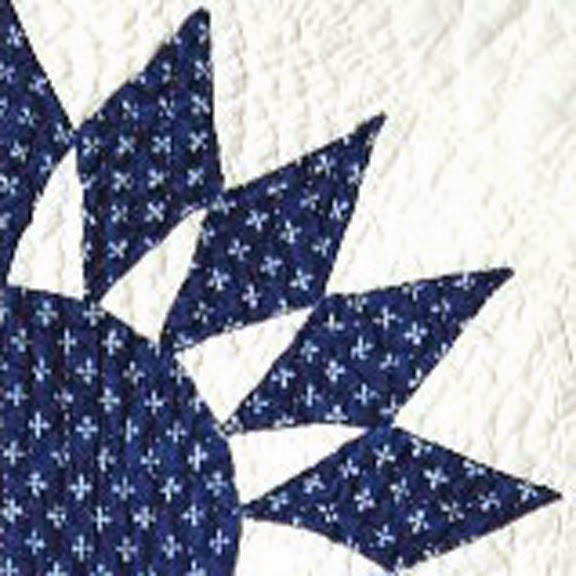
Reproduction star block by Becky Brown

Reproduction star block by Becky Brown

Chrome yellow is lemon-colored, an intense yellow with a slight greenish cast.

Vintage block, mid 19th century

Here's a copy of that block that I made. I even had the same chrome yellow print in a reproduction.

Vintage applique, mid-19th-century
That must have been one popular print.

Vintage quilt 1880-1910 detail


Vintage top 1830-1860

You can find the color in early 19th century quilts. The mineral dye process dates back to the 1810s.

The chemistry for chrome orange and chrome yellow
is quite similar. Above, a New York quilt dated
1859-60 includes both colors.


Vintage quilt 1840-1870

Vintage quilt 1840-1870

Chrome yellow became quite popular with quilters about 1840, when the colors of German folkloric arts were adopted for quilts.

Vintage quilt 1870-1910

The shade continued popular  through the end of the 19th century.


Vintage quilt 1870-1900

Vintage  top 1890-1920

A swatch from William Crooke’s 1882 manual on prints and dyes showing
chrome or canary yellow stripes.

Vintage chrome yellow prints
Chrome yellow prints---often the same print over and over--- became known as oil-boiled calicoes after 1880 or so. (Oil-boiled refers to an obsolete step in the printing process.)

We might consider these 1880-1930 prints
a reproduction of the 1840-1880 style.

Quilters in southeastern Pennsylvania bought many yards.

Block by Carrie Hall, probably made about 1930, in Spencer Museum of Art collection.
Hall used nostalgic reproduction prints to get the traditional color scheme.

Ann Hermes has this end-of-the-19th century
quilt for sale in her Etsy shop.


Reproductions

Reproduction block by Becky Brown in
chrome orange plain and chrome yellow print

A reproduction of a reproduction from my collection 
Old Fashioned Calicoes

Dawn Cook Ronigan's reproduction
miniquilt, donated to the AQSG auction last year.
She emphasized bright chrome yellows and chrome oranges in her reproduction palette.

Reader Valerie's green and red blocks backed by reproduction
prints from her chrome yellow stash.

S.F. used chrome orange and chrome yellow.

Reproduction chrome yellows

Judie Rothermel from Party of 12

Chrome yellows don't sell as well as reproduction blues and madder browns so good repros are sometimes hard to find. You need a collection of prints and solids in your stash.
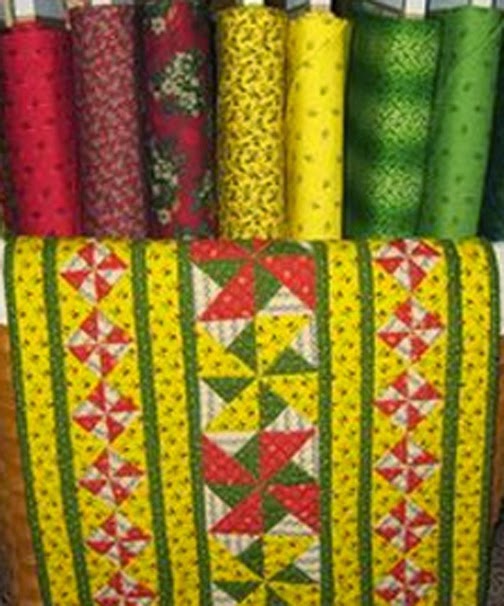
Recent line: Touch of Baltimore from Little Quilts.
Display at the Thistle Bee Quilt Shoppe.

Reproduction Star by Bettina Havig

You see a lot of chrome yellow solids in antique applique.

Vintage applique quilt dated 1858

 
Moda's Bella Solid 9900-131, Lemon, is a good match
if you are looking for a canary solid.

What to do with Your Stack of Star Blocks
More Ideas for Alternate Applique
 Buy these patterns. Adapt them for 6" blocks.

Here's an excellent idea for alternate applique from 
friends Alma Allen, Jan Patek and Sue Spargo who
included "Cottage Flower" in their 2000 book Simple Pleasures

A Cottage Flower block by Karen at Log Cabin Quilts,
who did a lovely job with classic prints pushed to low values.


Froncie Quinn at Hoopla reproduced a 
quilt by Florence Peto from the 1940s in which 
simple applique alternates with nine-patches.
Why not stars instead of nine-patches?
See the Calico Garden here:

Peto's original used some Chrome Yellow reproduction
prints.


Lisa Bongean at Primitive Gatherings designed her own version of Peto's quilt:
 Lisa's Flower Garden
with her ideas for simple applique and color.

 Lisa's Flower Garden

One More Thing About Chrome Yellow


Chrome yellow cottons were produced in England but mainly for export. Chrome dyed fabrics, especially the solids and the brightest prints, seem to have been sold in the United States primarily for quilts. 

In her research for the Ohio Quilt Project, fashion historian Virginia Gunn found an 1849 advertisement for dressmaking drygoods, such as printed lawns and ginghams, with a separate category: “Green and Yellow Prints for Quilts.” Yellow and gold solids are not found in American clothing---gowns, shirts or baby outfits. Gunn wrote that any “solid-colored cotton was little used as dress fabric.” 

In 1842 a Baton Rouge merchant offered
"French, English and American calicos, a variety of patterns, red, blue and green,"
probably aiming at that same quilt customer.

Drygoods store in Minnesota, about 1900

See another post about chrome yellow here:

Saturday, March 7, 2015

Symbolism in an Abolition Quilt


Detail of a British wool quilt, perhaps made
by a recovering soldier in the 1850s.
How many stitches per square?

Historians caution that we often read symbolism in old artifacts that was not intended by the maker. Another error is in interpreting that symbolism in the context of our era. We tend to ignore or be ignorant of the culture of the past.

In quilt history people make many assumptions in the areas of slavery and Civil War quilts. So few quiltmakers left any written record of symbolic meaning in their quilts, but so many meanings have been attached to them.

For example, story tellers like to attach tales 
of mid-19th-century runaway slaves to this sailboat pattern, even though
the pattern is a definite mid-20th-century design.


Broadside for an Anti-Slavery Fair in western New York, 1849

Letter from Margaret Brachen published in the Liberty Bell

One example of actual written evidence for symbolism is in a letter from a woman named Margaret Brachen of Halifax, England, in West Yorkshire. She wrote to Maria Weston Chapman, the power behind the Boston area abolition fairs that raised funds for the antislavery cause. Chapman published the letter in the Report of the 24th National Anti-Slavery Festival in 1858. 

I first saw the letter published in
the New Lisbon Ohio Anti-Slavery
Bugle, March 13, 1858

Bracken or Brachen wrote the letter on October 13, 1857 describing a "patched bed-quilt," she'd shipped for the Christmas, 1857 fair.
"Whilst sitting at my work, I thought there must be as many stitches in my quilt as you have slaves in America, and I counted the stitches in one row, and found them to be on an average twenty-five, and each square having four sides, made one hundred ; there are three squares in a box, and thirty-five boxes in width, and forty-two in length, so that it was a simple question in multiplication, the simple result of which is, that there are about twenty times as many slaves in America as there are stitches in my quilt...."
After a reflection on recent uprisings in the British colony of India she went on:
"One other thought suggested by my quilt I had almost forgotten. You will see that the lights and the darks and the blacks are all arranged so as to act, or rather harmonize, in concert; and so M'ould the races..."
Bracken then made suggestions about ending slavery by writing kind letters to slave-owners asking exactly how much money each would require to release their bondspeople.
"When an old woman has patched a quilt, she longs to tell some of the thoughts which occupied her mind during the progress of the work."
Maria Weston Chapman (1806-1885)
Collection of the Boston Public Library

Chapman added a footnote:
"This wonderfully beautiful proof of patient industry and profound sympathy for suffering humanity is henceforth an heirloom in the family of Mrs. Bracken's American correspondent..."
They bought the quilt for Bracken's value of 6 guinea (about $350-$400 today.)


Box but no squares

We have no idea what Margaret Bracken's quilt looked like or where it is today, but we can imagine it was pieced of squares into a box pattern, perhaps like some the quilt at the top of the page or below. 

Squares in a box?
Oops---I am imagining too much from the descriptions. I should be content with not knowing.

We may need to imagine the pattern but we needn't imagine the symbolism because Margaret Bracken's thoughts have survived in print.

See a scan of the Report of the 24th National Anti-Slavery Festival at Internet Archive: 

Wednesday, March 4, 2015

Stars in a Time Warp 8: Indigo Blue

Becky Brown reproduction block


Vintage indigo print from early 19th century
The figure is slightly blue in this print with a background we might call navy blue.

Detail of a quilt date-inscribed 1833 by Elizabeth Kimbrough Neal Brockinton's mother.
Collection of the Briscoe Center.

Perhaps three indigo prints or one navy indigo and two lighter Prussian blues. There were other blues too.
See more here:

Indigo prints featuring white or pale blue figures on navy blue grounds are seen in our earliest 
quilts.

Date-inscribed 1795, Jones, Art Institute of Chicago

The indigo figures in these early prints tend to be spotty and rather minimal in design.

An early-19th-century pocket  
 with an indigo blue on blue print in the star.
You wore a pocket under a slit in your skirts to
stash your hankie and your keys.

Stars in the Sashing, mid-19th century? from Stella Rubin

The classic two color quilt: It looks like a solid indigo here,
which is a possibility, but a detail photo probably would
reveal a minimal white on blue print.

Detail of a worn nine-patch quilt from about 1820-1850.

The scraps of indigo are more colorfast and the fabric is more durable than many of the other prints.
Indigo blues are often the best survivors in these early 19th-century scrap quilts.

I did not find many indigo prints featured in mid-century scrap quilts. More complex Prussian
blue prints were so popular in the 1840s and '50s that indigo must have looked hopelessly old-fashioned and primitive. Of course it was old-fashioned and primitive---part of the charm.

Date-inscribed 1843, from the Historic New England collection

The navy blue here could be a solid indigo but it is more likely a small print. Note the damage on the left lower corner---possibly an encounter with a strong bleaching agent. Indigo is usually colorfast.


Mid-19th century indigo staple print
Small x's for a figure, set in a half-drop repeat.

The figure has a touch of blue indicating the cloth may have been dyed light blue with indigo before the resist paste was printed. The cloth was then dyed to a darker blue and when the resist chemical was removed the pale blue remained.

Vintage quilt, date-inscribed 1843, Elanor A. Robinson
Double dots set in a half drop repeat.

We are beginning our time travel in the mid-19th century so we will begin with the simple indigo prints used then.

For William Dudley Blodget, date-inscribed 1867

Single dots set in a half drop repeat---this repeat results in a diagonal grid, a design idea quite fashionable during the 1840-1870 era.

Knitter about 1860
A half-drop repeat was THE look during
the sixties.


Date-inscribed 1845, M. Lasher
A dot: You get the picture about the repeat.

A dot repro

Here's a recent picture from eBay. How old?
Indigo stars---not much of a clue.
But it looks like the blue print is a single print throughout the quilt, and it's simple. I'm guessing
before 1880. 
The corded, stuffed quilting in the border is a better clue---probably before 1860.


Vintage indigo star print
The simple figure here is a five-pointed star, a flag print.

Vintage block from 1875-1900

These little stars in white on indigo blue were fashionable after the Civil War but you also
see them earlier. I saw them referred to as "flag prints" in an 1875 catalog from Montgomery Ward.

Vintage quilt date-inscribed 1846 A.B. Ruby

Vintage block from 1875-1900

Two reproduction star prints from Moda,
Left: Old Glory Gatherings from Primitive Gatherings:
 Right Lexington by Minick & Simpson

Cathy's vintage top pictured on Cyndi's blog

The stars are set with sashing of a flag print barely visible here at the bottom.
Hard top to date because the prints are such classics.

Vintage block about 1880-1900
Orange madder-style prints and complex indigos.
This woman loved pattern.

We'll return to indigo when we go towards the end of the 19th century, the heyday of indigo prints. The dating rule is: The more variety in the indigo prints the closer to 1900.

Reproduction star by Becky Brown with 
3 indigo prints and 1 shirting

Another style change towards the end of the century: quiltmakers liked to combine indigo ground prints with prints in other colors.

Vintage block about 1890-1920

These later indigos with a variety of figures are more fun to make so you might copy them now.

Vintage stars about 1890-1920

Gretchen's Reproduction Cheddar Block
The indigo  and chrome repros really capture the late-19th-century look.


Vintage block about 1890-1920

Older block, a single, simple print

Reproductions

Reproduction quilt by Julie Hendrickson, Blue and Brown quilt 
from History Repeated I.
The triple dot is the perfect mid-century indigo.

Two simple figures in half-drop, diagonal repeats by
Nancy Gere. Good for early indigo reproductions.

Indigo Revival from Minick and Simpson
who often do indigo reproduction prints.

Spinning Stars by Minick and Simpson using their Lexington line

Setting idea for your stack of star blocks: 
A Border of Stars Set on Point

Vintage Quilt dated 1822 by Fanny Hurlbutt.
Documented in the Connecticut Quilt Project. Photo from the Quilt Index. 
See the full strip quilt here:


Kathie Ratcliffe, detail of Leesburg, one of her miniature quilts
 in the Star of Bethlehem design.

Kathie Ratcliffe, Star of Bethlehem

Bettina Havig, Peace Haven
Match the setting triangles to the star backgrounds and
the stars float.

Connie Chunn, Mary's Harvest, 2006
A great finish to a tiny medallion.

Sue Garman, Ancient Stars

One More Thing About Indigo Blue

Indigo prints have been popular around the world because the dye process, while complicated, is reliable and produces beautiful, durable results. Indigo dyers created pattern on cotton in two primary ways. 

Samples from the IQSC's exhibit Indigo Gives America the Blues Timeline.

One method is to use a resist to produce a figure, what we might call a batik. A thick substance (wax or paste) is printed on the fabric which is then dyed in an indigo bath. When the paste is removed:  a blue ground with a white or pale blue figure. Resist Printing above.

The other is to dye the cloth blue and then apply a discharging chemical that bleaches out the figure. Discharge Printing above.

I am relieved to know most experts say it is very hard to see the difference between these two processes, especially with the industrial printing in the second half of the 19th-century. Sometimes it's obvious, but don't worry that you can't tell which is which in an old print. (If it's a new print it's screen printed---unless it's a true batik.)

See a great online exhibition on indigo dyeing at the International Quilt Study Center and Museum's website at Indigo Gives America the Blues.