Saturday, September 13, 2014

Period Quilting Frames Part 2


Last week I showed pictures of traditional quilt frames and how they were propped up parallel to the ground. The four boards that support the quilt were not permanently joined together.

The simplest way to hold the boards together may
be C Clamps as in the above photo from Canada about 1900.

C Clamps are adjustable hardware that looks like the letter C.
They can be manufactured as the metal antique above

or handmade as in these wooden clamps.

In this more recent picture manufactured metal clamps
seem to be holding the boards together. We can see by the
borders that the quilt is extended out as far as it goes.

The frame can be propped up in the back of the church
basement when not in use. Here the Methodist quilters
in Wheatland Texas pose with a Trip Around the World
quilt in a C clamped frame.


Cheyenne women using a frame supported by
sawhorses and C clamps in 1961. The frame
is clamped so a smaller area of the quilt
shows. Quilters usually begin in the center and work
out to the edges.

Here's a frame positioned to take up
the least amount of space. If working alone
or with one or two others, this is a good
solution to the space problem, a smaller footprint as we'd say today.

C-clamp upside down in
Saginaw, Michigan, perhaps about 1950. 
Does anybody quilt standing up? 
These women need
ladder-back chairs so they can lower the frame.
I wonder about the authenticity of this staged photo.

The history of manufactured C-clamps is as vague to me as the history of sawhorses. You might want to do a little hardware study to see what the typical C-clamp looked like in 1863.

The frame in Kimmel's 1813 painting is lashed together
with the same string or strips that fix the quilt to the frame.
This might be a good solution if you don't have 4 period C-clamps.

I also see regularly spaced holes in the boards above.


Similar to what's depicted in this quilting scene from Harper's Weekly
in 1863.


I have an old frame like this with holes down the middle of the boards.

LRStitched blogged about a pierced board she inherited
from her great-grandmother.

Those holes could serve several uses. One could thread the quilt to the frame using them, or hang the
frame from the ceiling with rope through the holes. The holes might intended for pegs. You'd line up the holes and peg them together as you rolled the quilt up.

H W. Pierce's "A Quilting Bee in the Olden Time," a nostalgic
print from 1876,  shows "colonial ladies" at a frame held together with pegs
and holes. He probably knew little about how 18th-century quilters
constructed frames, but this seems like an accurate representation
of a 19th-century frame.

The frame is held together perhaps with
pegs through the holes, resting on a middle
rung in a ladder back chair. Is that a reticule
(purse) hanging from the chair?

In this 1990 photograph from Florida Memory
Alma Bailey is quilting on a frame with what look to be home-made
wooden pegs holding the frame together. The holes in the frame are also used
to attach the sides of the quilt to the frame. The left-over string hanging down
will be laced to the frame and the quilt as the frame is extended and re-pegged.
See the photo here:

Again in Florida, women peg a frame together.
The Florida Memory site has dozens of
pictures from about 1990 showing quilting groups using
a variety of traditional quilting frames. Search for "Quilt" on their site.


Another way to roll the quilt up on the frame
is the cogwheel. See a discussion here:


The other board that LRStitched inherited is also full
of holes, but they don't pierce through the board and
the holes are very irregular.

Library of Congress
These smaller holes are probably made by tacks that
held the fabric that held the quilt to the frame.

You wouldn't want to tack the actual quilt or backing to the frame, but you'd tack a sturdy piece of fabric like the ticking in the above mid-20th century of quilters in Lititz, Pennsylvania. The quilt is pinned or basted to the striped ticking.

The Canadian women have wound strips to the frame
to support the quilt, rather than tacking the sturdy cloth to the frame.

These early 20th-century women have tied the
sides of the quilt to the frame with string. It doesn't look too stable,
but they are tying or tacking the piece rather than quilting it.


If I were looking for Civil-War-era accuracy, I'd stick with
home-made solutions rather than factory-built hardware
and frames.

Woman in White Springs, Florida
State Archives of Florida, Florida Memory,

And don't even think about a hoop. It's a 20th-century idea.

Saturday, September 6, 2014

Accurate Quilting Frames for Civil War Re-enactors


A vignette from American Home Scenes in 
Harper's Weekly April 13, 1861

A reader wrote that she was interested in quilting on a frame at Civil War re-enactments. What kind of quilt frame would be authentic?
"I have looked at pictures but it is hard to see how the frame itself is made. I want to be 'period' correct for the Civil War but I am not getting anywhere as to how the frame itself should be."
Luckily for the historically-minded, quilt frames have not changed much in about 200 years. The typical frame is four boards fastened together.

The earliest depiction of a quilt frame I've found is this 1813 painting The Quilting Frolic by John Lewis Krimmel.

See more about the painting and the painter here at my 1812 blog from 2012:
http://quilt1812warandpiecing.blogspot.com/2012/07/a-sashing-pattern.html


The young woman in the background is unfastening
a patchwork quilt from the frame. It's time for the post-work dancing to start.
There seems to be a strip of fabric attached
to the wooden frame. The quilt is pinned or basted to the fabric.

These wooden frames have to be propped up at a level so a group of quilters seated in chairs can work together to quilt the layers. The four boards are not permanently fixed together. They are moved in and out as the quilt is rolled up.

The women at this quilting party about 1910 have propped their 
frame up on the middle rungs of the chair. They have rolled up
the quilt so only one quilter can work at each end.

Women at the Dorcas Society in Buxton,Maine. 
Their hair is dressed in the style of about
1900. Apparently you can face the ladder-back support chairs in or out

or at an angle.


From Gleason's Pictorial Drawing-Room Companion, Oct. 21, 1854

In this 1854 cartoon of a Quilting Party in Western Virginia people are sitting in the ladder back chairs and the frame is held up by four posts. Any clever carpenter could have figured out a system of special posts.

 A similar frame in Alvin, Wisconsin about 1940,
photo from the Library of Congress.

If you do a web search for old quilting frame you find
some interesting solutions to the problem of elevating
the frame.

If you don't have a carpenter around you can
drive 4 forked-sticks in the ground, but I wouldn't
advise this.

Posts also hold up the frame in this photo from perhaps the
last quarter of the 20th century. Note the frame handily holds
canes and purses. This quilting group may have a factory-
made frame, an item I'm guessing wasn't available until
the 20th century.

The Quilting Party
Edgar Melville Ward
Collection of the International Quilt Study Center & Museum

Ward's 1892 painting shows a set of legs
with the wooden boards fitting into them, something
that looks like a commercial quilting frame.


You find photos of frames held up by sawhorses. I
know nothing about the history of sawhorses so I
would be dubious about using this rather stable prop
as a Civil-War-era solution.

World War II Red Cross workers with a frame
propped up by sawhorses.

Another option you see in 20th-century photos, particularly
of Southern quilters, is the frame strung from the rafters.
This Oklahoma-born woman living in Kern County, California
 quilted on a frame in a small migrant cabin about 1940. The frame
can be pulled up to the ceiling when the space is needed
for cooking, sleeping etc.

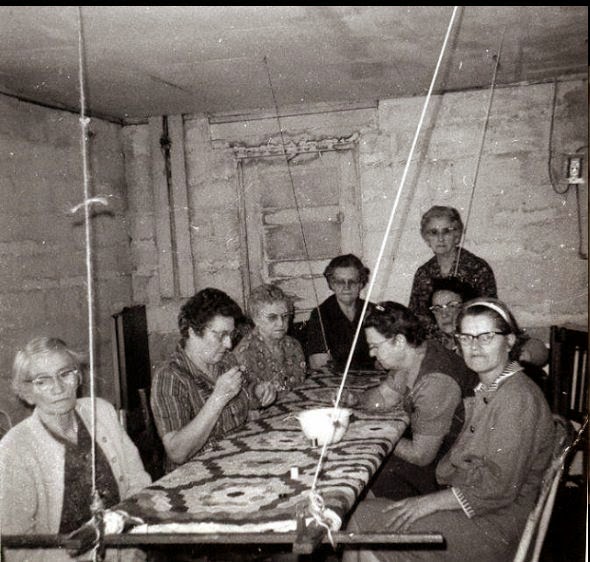
Women quilting, perhaps in a basement, about the
same time, using a hanging frame that is
fastened with hooks or hardware
attached to the ceiling.
It looks damp down there.

Another Library of Congress photo showing
a resourceful woman quilting in a smokehouse.


North Dakota State Historical Society

The earliest photo I've yet found of a suspended frame. 
The women photographed in 1888 are from the Pendroy settlement in North Dakota.
I looked for Southern roots but found only the Pendroys last lived in Iowa.

Read more about the family and the neighborhood here:


I wish I could find some earlier photos of frames hung from the ceilings, but until we do, we should probably not consider this an authentic mid-19th century type of frame. Besides, it's not really practical for a Re-enactment site.

Next week. More on period frames.

Saturday, August 30, 2014

Threads of Memory 8: Jacksonville Star for Emily Logan


Block # 8 in Threads of Memory:
 Jacksonville Star for Emily Logan by Jean Stanclift

In 1838 a girl living in Jacksonville, Illinois gradually realized she'd been duped. Although she lived in a free state, Emily Logan and her brother Robert were treated as slaves by Elizabeth and Porter Clay. The Kentucky-born children were ignorant of their murky legal status.

Freed children during the Civil War.
Photo sold at Cowan's Auctions, 2008.

Illinois had been platted from the Northwest Territories where slavery was banned, but the state's many southern immigrants established two exceptions to the concept of a free state. One was that slave owners like the Clays could continue to enslave people as long as they returned them to a slave state for a short period each year. With an annual return visit to Kentucky the Logans were technically residents of a slave state and thus slaves.

Abraham Lincoln
Illinois lawyers like Abraham Lincoln might argue (and Lincoln did argue in an 1847 case) that according to the law such Illinois blacks were slaves in transit rather than free Illinois residents. The other technicality created a system of indentured servitude---in essence slavery.  Once registered as a servant, a girl like Emily could be indentured for twenty-eight years.

Jacksonville is the yellow star, west of Springfield, Illinois
with Kentucky in the lower right

Elizabeth Logan Hardin Clay and her second husband brought the Logan children with them to the western Illinois town of Jacksonville, which attracted a "considerable admixture of people," remembered an early settler. "A very large and influential part of the population was made up of Kentuckyens having a strong proslavery bias." Many of those Kentuckians were kin to Elizabeth Clay's first husband Martin Davis Hardin, a third cousin to Mary Todd Lincoln's family.

Martin Davis Hardin
 Elizabeth's second husband Porter Clay was politician Henry Clay's youngest brother.

Jacksonville Star by Becky Brown in Ladies' Album prints


The Porter/Clay house, drawn in 1935,
from the Library of Congress

Jacksonville also had a share of New England settlers whose cultural center was Illinois College, a western mission of New England ideas created by Yale's antislavery graduates. Southerners regarded the college as an "engine of abolitionism."
Illinois College still stands

Abraham Lincoln’s future law partner and biographer William Herndon attended Illinois College for a short time before his father demanded he come home. “My father was thoroughly pro-slavery in his ideas, believing the college was too strongly permeated with the virus of Abolitionism….” Although New Englanders made up less than ten percent of Jacksonville’s population, their antislavery notions gave the town a reputation as a radical outpost.

Mid-19th-century view of the Opera House
from the collection of the New York Public Library

In a county history published fifty years later, several of the "Old-Time Abolitionists" recalled the town's early years. Although they might be remembered as heroes at the end of the century, in the 1830s and '40s antislavery activists were  "the most hated and despised of men….Once when…a noted preacher was addressing us at the Congregational Church, some malicious person threw a black rag baby straight at his head."


Charlie King, redeemed from slavery
about 1862. Images of Charlie and his
sister Alice were sold to fund the anti-slavery cause.

After two years in Illinois Emily and Robert had talked to enough abolitionists to believe they could walk away from the Clay household.

The Porter/Clay house photographed in 1935
from the Library of Congress

When the Clays realized their intentions they made plans to ship them to Kentucky. The children escaped into "Africa"---the local name for Jacksonville's free black community.

Alice King

One of the New Englanders remembered the fury of the three angry men who knocked at the door of a neighbor "demanding to know the whereabouts of Bob and Emily Logan." Despite the threats, "courage…suddenly possessed the mind of the man who was not afraid to do right, and the early callers had to go elsewhere." But the men soon found Robert and shuttled him to a boat on the Mississippi River heading south. He disappeared into the slave state of Missouri. A Clay relative named Marcus Chinn and another man were indicted for kidnapping Robert, but the courts of Morgan County refused to convict them.


Elihu Wolcott (1784 - 1858) as a young man.
He was in his fifties when he helped the Logans

Emily sought shelter with several of the town's abolitionists, among them Connecticut-born Elihu Wolcott who sued for her freedom in her name. The Clays transferred her ownership to Chinn and the case of Emily Logan, a woman of color, vs. Marcus A. Chinn languished in the Morgan County justice system. After two years the trial was moved to Sangamon County where a jury declared that Emily was indeed free and awarded her damages of one dollar.

The dollar damages were a token and so, unfortunately, was the case. African-Americans in Illinois remained in legal limbo under the state's  "Black Laws" until the end of the Civil War.

Today Emily Logan is remembered primarily as a case name. Re-enactors in Jacksonville tell her story in Underground Railroad tours of the town's historic houses, but we know little about her life after 1840. She represents an important---if neglected---chapter in the story of freedom's fight. African-Americans sued their owners and the state for relief from slavery. Although most lost their legal fights and those who did win rarely established positive precedents, their ambition to use the law was a step in developing methods of peaceful resistance.


Jacksonville Star by Jean Stanclift

Jacksonville Star is a new block featuring a traditional nine-patch star with elongated points. The square inside a square inside a square can recall the layers of different cultures in a town with so diverse a population.

The patterns were free online for two years but now I am offering them for sale in two formats
at my Etsy shop. Buy a PDF or a Paper Pattern through the mail here:

Jacksonville Star by Becky Brown

Becky added seams and fussy-cut her center square A.


What We Can Learn About the Underground Railroad from Emily Logan's Story
Today we tend to recall the pre-Civil War United States as two regions: free states and slave states. This neat dichotomy of good and evil allows us to forget the gray areas where "Black Laws" demeaned African-Americans. The Underground Railroad had to operate within a free state like Illinois because Southern immigrants brazenly brought their slaves with them. 

Jacksonville Star

Make a Quilt a Month

Piece 13 blocks to create a dazzling fireworks display. Make 9 blocks with one background (here blue) and 4 identical except for a different background (here red.) The border is 6 inches for a 63" x 63" quilt. You will need 8 large triangles for the edge and 4 smaller ones for the corners.

For the side triangles cut 2 squares 18-1/4". Cut each into 4 triangles with 2 diagonal cuts.
For the corner triangles cut 2 squares 9-3/8". Cut each into 2 triangles with a diagonal cut.


Read more about slavery in Jacksonville in Mark Steiner's Abolitionists and Escaped Slaves in Jacksonville:

Saturday, August 23, 2014

Saco, Maine Quilt 1862


In my list of quilt dated during the Civil War I missed this quilt dated 1862 in the collection of Pam Weeks. The red, white and blue quilt was made in Saco, Maine, perhaps to be sent to a soldier's aid society. It's constructed block-by-block, or "Pot-holder Style" in which each block is pieced, quilted and bound and then joined to the other blocks. Pam has studied this New England style of Civil War quilt extensively.

A pattern for the Crosses and Losses quilt was published in American Quilter in 2012. See a free pattern here.

http://www.americanquilter.com/publications/pattern_view.php?id=236

See my post on other quilts dated 1862 here:
http://civilwarquilts.blogspot.com/2014/01/quilting-party-like-its-1862.html