Showing posts sorted by date for query 1837. Sort by relevance Show all posts

Wednesday, March 5, 2025

Bathsheba Phillips Crane's Civil War


In my files of silk quilts I have one attributed to Bathsheba Howard Crane. Notes say 
it's in the Vermont Historical Society but I don't see it in their catalog.
An image search was of no help either.

In 1861 when the Civil War began 50-year-old Bathsheba Howard Crane was living in Boston, Massachusetts, married to Baptist minister Denzel Mansfield Crane (1812-1879) since 1837.

Bathsheba Howard Phillips Crane (1811-1895)
Frontispiece from her 1880 book
 Life, Letters, and Wayside Gleanings, for the Folks at Home

The Cranes had three living children, Helen A. in her early twenties and two sons Herbert Webster about 20 and her youngest George Merle about 8 (Charles had died as an infant.)


The 1855 census found them in Worthington with a resident maid Lucy M. Foster.

Bathsheba published an obituary of her husband:
"At the age of 18, he was impressed with the importance of the gospel ministry. He commenced study ... at Franklin and Pierce academies and Brown University, preaching and teaching to meet his expenses." 
A year after their marriage at her home in Newfane, Vermont he was ordained and began a series of Baptist pastorates in Vermont and Massachusetts, where local religious tradition disdained the Baptist faith.

Allison Lockwood (1920-2021) wrote several articles about the Cranes in Northampton for the Daily Hampshire Gazette.

Allison Lockwood
Cannot find that journal.


In 1858 they left Northampton for Boston where he was well-known for his speaking style and conversions. His wife recalled that in the six years they spent in Boston he claimed 189 converts. Crane adapted Baptist ideology to New England mores, campaigning against alcohol and slavery. It is said he joined the free soil antislavery party in the mid 1850s. His church was called the Union Baptist Church because they supported the Union. Separating themselves from Southern Baptists the Union Baptists Missionary Magazine in 1862 resolved:
"That we believe the institution of slavery to have been the principal cause and origin of this attempt to destroy the government, and that a safe, solid and lasting peace cannot be expected short of its complete overthrow."
1863 was not a good year for the family. Nine-year-old George Merle died of diphtheria on January 2nd and the Union Baptist Church burned that year, requiring Rev. Crane to conduct services in City Hall.

The following year the Cranes left Boston for another pastorate and daughter Helen married John R. Haskins in May, 1864. Bathsheba began collecting her letters and writings with an eye to producing a book published in 1880.


 Son Herbert, living in New York City died there on May 14, 1869 of pneumonia at 28.


I doubt Bathsheba Crane made this quilt, which as a pieced, quilted
silk piece looks to be a Quaker quilt from the first half of the 19th century.

Bathsheba is associated with another textile, a woven
coverlet in the collection of the Vermont Historical Society.

The woven coverlet was given to the museum in 1955, where it was displayed in a textile exhibit the following year. It is doubtful Bathsheba wove the coverlet either. She was 14 in 1825 and coverlets were more an item of commerce than home needlework for teenagers. She may have owned this coverlet, woven by a professional weaver.

And perhaps a Quaker friend gave her this lovely quilt.


Wednesday, August 21, 2024

Sarah Atwater's Civil War: The Wide Awakes


Banner made for a Lincoln political club in 1860
by the Ladies of Clarence, New York


In the fall of 1860 as the four-way Presidential election approached, a surge of support for Abraham Lincoln appeared in odd fashion. Women like Sarah Kirtland Atwater, a 16- year-old from Wallingford, Connecticut participated by designing and stitching marching banners for the boys in the Wide Awake
army. Sarah, daughter of a local politician who died when she was about 5 was probably chosen to honor her father.

She may have had several male friends in the local group, which was made up of young men. The grassroots organization included unusual and compelling imagery, most noticeably the eye quite "Wide Awake."
Hake Auctions


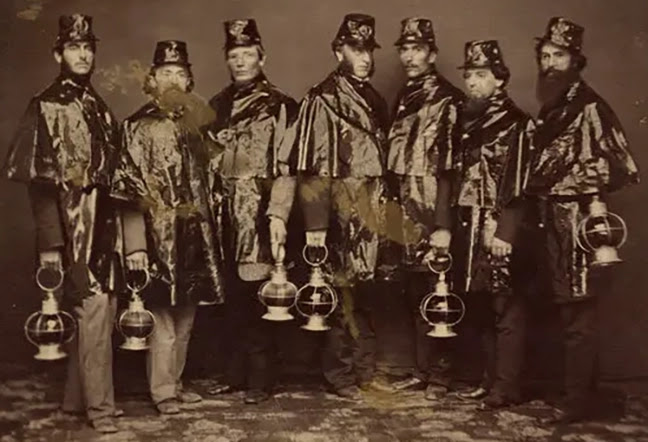
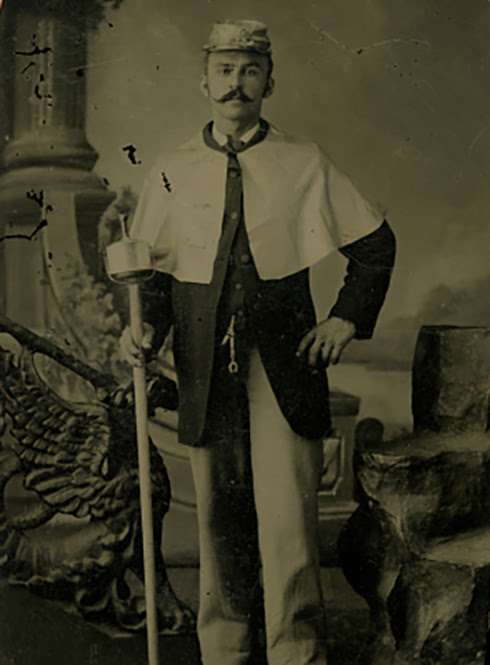
Wide-Awakes wore uniforms of shiny black capes and carried lanterns often attached to poles. A paramilitary organization, their purpose was promoting Lincoln's candidacy, establishing order while "Plug-Uglies" and other less peaceful gangs caused chaos at election rallies. And it gave the young men an identity, a fresh identity defined by their clothing.

Online auction photo of a man with a Lincoln/Hamlin badge
and the distinctive shiny black cape that Wide-Awakes wore.

In contrast to destructive gangs disrupting political events the Wide Awakes marched in orderly, well-drilled formation, offering protection for campaigners like Lincoln, William Seward and Cassius Clay.

Hartford parade in the home of the Wide Awakes.
Fireworks and lady spectators waving handkerchiefs.

Jon Grinspan, Curator of Political History at the Smithsonian Institution
has recently published Wide Awake: The Forgotten Force
 That Elected Lincoln and Spurred the Civil War...

Edgar Smith Yergason (1840-1920)
Company B 22nd Connecticut Volunteers

Telling us about this 19-year-old (in soldier's uniform above he's about 21), a clerk in Talcott & Post's dry goods store in Hartford, Connecticut. In winter, 1860, although too young to vote for Lincoln, he had an idea for a political club. Being a lifelong designer he considered the visuals, realizing that a memorable outfit defined a man. He created a uniform, practical but odd, out of the shiny black cotton cambric in Talcott's stock. (Cambric is often used on the underside of chairs to keep the dust out.)
Talcott & Post specialized in interior fabrics.

Oil Cloth was one of their featured items.

Grinspan dates Edgar's idea for a Lincoln club to February, 1860.

Connecticut Wide Awakes, Connecticut Magazine, 1895.
James Chalker in the center with the taller cap was a tailor who sold uniforms.


By November 4th's election day tens of thousands of "Wide-Awakes" across the Northern states had fashioned capes out of shiny black cloth, undoubtedly with the support of female seamstresses, professional and amateur.

August, 1860

Collection of the Library of Congress
George Beza Woodward (1837-1927) Derry, New Hampshire
The lanterns dripped fuel, a practical
reason for a protective cape.

Keene, New Hampshire

While uniforms had much in common the banners seem quite varied, design up to the
local club---and the women who stitched them.  

For all the banners carried in parades very few survive. The above
article from Bangor, Maine lists a few.


A pageant from the ladies of Akron, Ohio

Belfast, Maine

The Wide-Awake idea spread from Connecticut and New England into Lincoln's Illinois and north to Wisconsin and Minnesota where orderly and enthusiastic drills were the major activities.

Three days before the election in Cleveland.

Election Eve, Worcester, Massachusetts

It would seem the role of women in the organization is the time-honored place of "Ladies ' Auxiliary."

Charlotte, Michigan

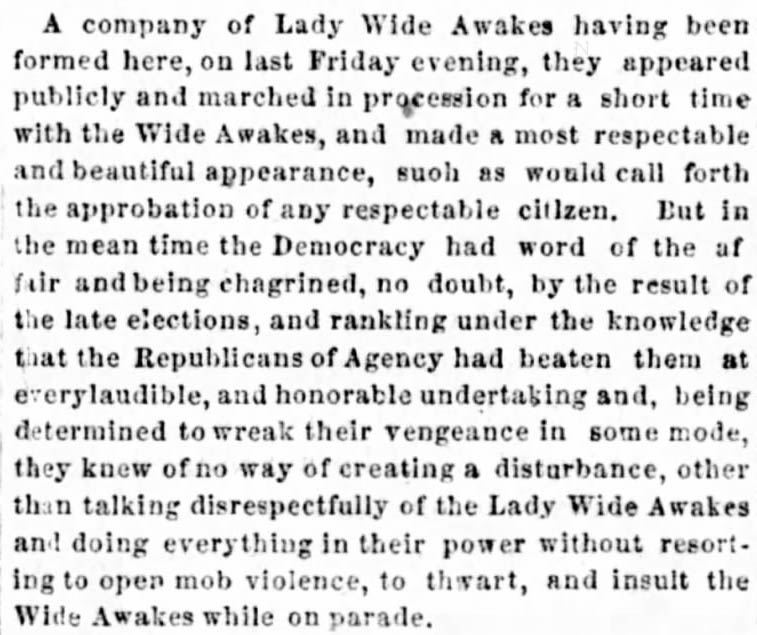
But newspaper articles tell a bit about women's Wide-Awake groups who paraded on horseback. Just a bit.


Agency, Iowa

Women crossing boundaries were considered fair game for hooligans who had their own uniformed clubs.

Urbana, Illinois, October 1, 1860

Lincoln's November victory was celebrated by the students' Wide-Awake club at the women's academy Mount Holyoke.

St. Louis Globe, November 20, 1860
250 Wide-Awake Lincoln fans versus 30 Douglas grievers

 
Sarah's presentation and speech right before the war began may have been the high point of her
war experience, mostly spent in her teenage years in Wallingford in New Haven County about 30 miles south of Hartford.


She had no brothers or father in the fight as her father died soon after the 1850 census recorded him, his wife, three young daughters and a pair of servants.

Sarah married Frederick Royal Manning (1827-1898) becoming his second wife in 1868. She moved to Brooklyn, New York where he ran a dry goods store and they raised his children and their daughter and son.

A relative founded the Choate school on Atwater property in Wallingford. 


1921 Obituary Meriden Journal

After Frederick's death Sarah returned to Connecticut where she lived into the 1920s.

Edgar Yergason also moved to New York after many years at Talcott & Post where he became a partner with a reputation for his interior designs. He opened his own firm on Fifth Avenue, winning commissions from the Harrison & McKinley administrations to decorate White House rooms.


He's remembered for his interior design but Grinspan explores
his clever move to outfit some young men for political action.

Unknown Wide Awake
Collection Pamplin Historical Park


Men looking for a place in society do like to fraternize.

Smithsonian Institution Collection

In his introduction Grinspan writing in recent months compares the defining mood of 1860 to the current divisions some of the nostalgic see as the end of democracy, imagining a past of united Americans. See a preview here: