Saturday, January 18, 2020

GAR Encampment Quilts

Collection of Historic Huntington

Tent camping at a 1900 Huntington Beach veteran's reunion in California

with a quilt on the bed. Is the girl holding a kitten?

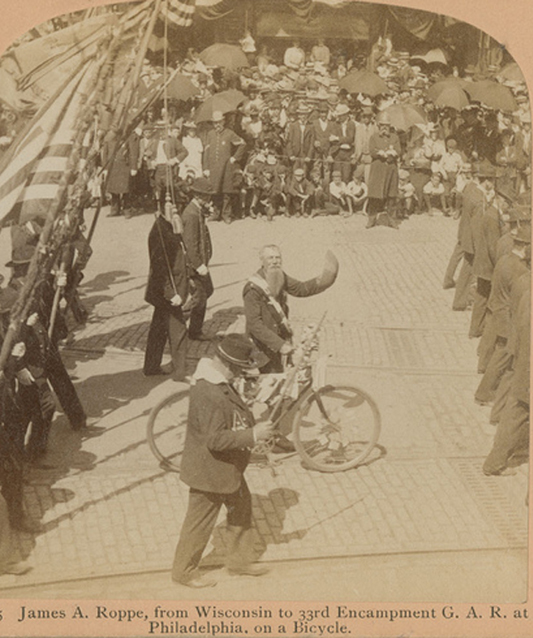
Union Civil War veterans and their families attended reunions called Encampments from 1866 to 1949.  The encampments might be local or the annual national reunion in the fall. Veterans loved to remember tent camping days during the war with rustic yet much more civilized accommodations.

Embroidered, tied bedcover offered at Cowan's Auctions, embroidered with names organized by Tents. Each triangle may literally represent a tent.


The quilt came with a souvenir booklet

Names embroidered are women's names and various locations from Poughkeepsie to Florida, so the assumption is that it was record of a W.R.C. or other women's auxiliary group at the veteran's reunion in Des Moines in 1926.


Silk flag souvenir of a Chicago reunion in 1900

From The 100 Years Ago today column in our local newspaper 
September 6, 1919
"What is expected to be the last great national encampment of the Grand Army of the Republic will open [in Columbus, Ohio] tomorrow and continue during the week. The fact that the ranks of the old veterans have dwindled to approximately 135,000 and that the American Legion, veterans of the European war, stands ready to take up the work which the G.A.R. has been doing for the last 53 years, leads members to predict that within a few years, the organization of Civil War veterans will be superseded by an organization of their sons and grand-sons."
Attendees in Columbus in 1919

1919 badge

Despite the reporter's pessimism the 1919 reunion was not the last. Veterans met until 1949. The last GAR member died in 1956.

Parading under an arch in Buffalo, 1897

One can certainly track declining numbers. Thirty years after the war in 1895 Louisville hosted 357,639. Thirty years later in 1925 Grand Rapids saw only 55,817 veterans (Do these numbers reflect the families and the women's groups or just the soldiers?)

The parades, the campground, the liquor sold....
Some of these were elaborate events.
One can imagine how they boosted the local economy.

Baxter Springs, Missouri

One of the last, again in Columbus, had only 163 attendees in 1945.

1939 Encampment, Pittsburgh
He'd been to a few.

Western Illinois Museum collection

This silk contained crazy quilt is from the Peck Family of Illinois
with ribbons from at least two reunions.

1892 reunion in Maccomb, Illinois

1889, Quincy

Quilts were important in the veterans' organizations as fundraisers, social links and gifts. A list of encampments and locations from the Library of Congress may be useful in identifying a few:


And see more about the last of the veterans:


More on GAR quilts here:

Wednesday, January 15, 2020

Saturday, January 11, 2020

Susie King Taylor & her GAR Quilt

Susie Baker King Taylor (1848-1912)
Photo from her autobiography
Reminiscences of My Life in Camp with the 33rd US Colored Troops.

In 1898 Susie Taylor, who had been a slave in Georgia and as a free teenager a laundress and teacher  during the Civil War, made a "large quilt of red, white, and blue ribbon" for the second annual fair to benefit the Massachusetts Woman's Relief Corps at Christmas time in Boston. She was an active member of the Robert A. Bell Corps (Post #67), vice-president that year of the women's auxiliary to the African-American G.A.R. veteran's group. She and her fellow volunteers ran a table, the traditional women's fair booth. Theirs sold miscellaneous items and her quilt was probably offered at the table.


The quilt did not sell but on December 18, 1897, the fair's last evening, prizes were awarded and Taylor's "Old Glory" quilt was chosen to be given to the Fair's President Emilie Jewett Waterman. Taylor wrote in her autobiography a few years later that the quilt "made quite a sensation."  She must have been pleased with it and we'd love to see what her Old Glory Quilt looked like, but no traces are found beyond the last night of the fair.

(1846-1933)
Emilie L. W. Waterman's photo from the account of the 1898 Fair.
 Her full name: Emilie Louisa Wild Jewett Waterman

Taylor had moved from Savannah to Boston in the 1870s. She was widowed, raising her only child,  a son, as a domestic worker. In her memoir she recalls working for relatives of Boston mayor Harrison Gray Otis.


In the 1880 census she is recorded as living with Harriet Webb Gray and Gorham Gray on Beacon Street, perhaps in this house at 433 Beacon Street.  She married her second husband Russell L. Taylor in 1879 at the Midway Church in Liberty County, Georgia. 

The Taylors may have been married here.

Perhaps Russell belonged to the Robert A. Bell Corps of the G.A.R., a segregated Union veterans' group. A history of the corps:
"Several ladies interested in Robert A. Bell Post united in forming a Relief Corps which was instituted Feb. 25, 1886, with sixteen charter members.... Membership, fifty-two. PRESIDENTS. Mary L. Hammond, Sarah E. Johnson, Mary L. Hammond, Addie H. Jewell,. Susie A. Taylor."
In her memoir Taylor recalled some of the work:
"In 1886 I helped to organize Corps 67, Women's Relief Corps, auxiliary to the G. A. R., and it is a very flourishing corps to-day. I have been Guard, Secretary, Treasurer for three years, and in 1893 I was made President of this corps." 
The  W.R.C. groups purchased furnishings for G.A.R. meeting rooms, provided charity for veterans and their families and supported veterans' homes and memorial day ceremonies. They raised money through fairs, theatricals and musical events.

By the time Susie Taylor King died in 1912 African-American 
women had many clubs and organizations competing for
membership. The GAR and its women's auxiliary disappeared in the 1950s.


Two years before her death Susan A.K. Taylor was President of Post 67,
The address: 21 Holyoke in Boston. WRC meetings were every other Wednesday evening.

21 Holyoke today

Was this Taylor's home or just the group's meeting place?

GAR posts were generally named after soldiers who'd died in the Civil War. Robert A. Bell had been a sailor killed at the Battle of Fort Fisher in North Carolina. His mother was said to be a member of Taylor's group.

The 1900 census found Susie A  and Russell Taylor running a boarding house with 10 lodgers and a 19-year-old niece living with them, possibly at 34 Buckingham Street, where Russell died the following year.

Russell Taylor's death certificate, October, 1901

Vincent Memorial Hospital about 1900

The 1910 census listed Taylor as a resident employee of the Vincent Memorial Hospital on Cunningham Avenue. Vincent Memorial was a woman's hospital created for working women with an obstetrics department that became part of Massachusetts General Hospital. As the oldest woman living there she was described as a servant rather than a nurse. The nurses were unmarried white women, generally in their 30s.


Susie Taylor's quilt hasn't been heard of since she wrote her book.
We'd love to see what it looked like.

Wednesday, January 8, 2020

Yankee Notions #1: Open Book

Yankee Notions #1
Open Book by Denniele Bohannon
12"


We'll begin the Yankee Notions series with a block about the idea of literacy and the value New Englanders have placed on education since the first Puritans landed.

The Massachusetts Bay Colony passed a law requiring parents and masters to teach children to read as early as 1642. New England was home to the first colonial colleges and also to the 19th-century principle of common schools with the Yankee notions that education should be universal, non-sectarian and free.

Yankee schoolteachers spread these ideas in the South before, during and after the Civil War.

Yankee schoolteacher Laura Towne (1825-1901) with 
Dick, Maria and Amoretta in Union-occupied 
South Carolina sometime after 1862.


Graphic showing the proportion of illiteracy in the states in 1850, from an 1870 Report by the Commissioner of Education based on the censuses. Dots do not show numbers but rather proportions with New Hampshire and Connecticut having the fewest people who cannot read as a basis for comparison.
"Wherever the Yankee soldier has tramped the Yankee Schoolmarm will teach. Noble and chivalric gentlemen may throw stones at her windows, burn her schoolhouse, drive her from their neighborhood; but she reappears---she, or her cousin...." Atlantic Monthly 1869.


Southerners, of course, resented the often-heard criticism that they were ignorant and illiterate. Confederate diarist Mary Boykin Chesnut took delight in describing the spelling errors found in  letters scattered on battlefields among the dead soldiers.
"Free schools are not everything, as witness this spelling. Yankee epistles from camp show how illiterate they can be, with all their boasted schools. Fredericksburg is spelled 'Fredrexbirg,' medicine, 'metison'...."
Western Female Institute, Ohio

The concept of free public schools was a Yankee Notion that divided the country, as was the idea of public taxes to support those schools. Schools cost money; good schools cost lots of money. Who is willing to pay for it?

Virginia Governor William B. Giles (1762-1830) spoke for many when he criticized the Jeffersonian ideal of  public education. Schooling the boys of Virginia would make them unfit for farm and other manual labor that was their lot; hiring teachers would create a voting class with a special interest in the high taxes schools demanded and it was not fair to levy taxes on one taxpayer to benefit another's child.
The Block

Chocolate & Cinnamon traditions

BlockBase #2597 has been published with many names over the past century. Open Book is from a catalog identified as Needlecraft Supply in the 1930s.

The pattern is older. The block above is dated 1872.
Sorry about the Y seams.

Each month you'll get patterns for two sizes: 12" or 18" Blocks.

12" Block

A - Cut 4 parallelograms from a strip 3-1/2" wide at 45 degrees. The base should be 6-3/4" long.
B - Cut 1 square 7-1/4". Cut into four triangles with two diagonal cuts.

C - Cut 1 square 6-1/2".


18" Block
A - Cut 4 parallelograms from a strip 5" wide at 45 degrees. The base should be 9-3/4" long.
B - Cut 1 square 10-1/4". Cut into four triangles with two diagonal cuts.

C - Cut 1 square 9-1/2".


How-To


Open Book by Dorry Emmer
She's using some notions fabric in one set of blocks.

A Tangible Yankee Notion
Thimble


Thimbles (the German word is Fingerhut which explains the concept nicely) have been around since humans invented needles. Made of various materials, particularly leather and metals, they can be hand made or manufactured. 


Manufactured metal thimbles were one of the sewing notions a Yankee Peddler would carry to housewife customers north and south.

The Peddler's Wagon by Charles Green Bush, Harper's Weekly, 1868

Thimbles commemorating Queen Victoria's
ascension to the throne and her 60th Jubilee.


Open Book by Dorry Emmer
Dorry added a frame to spotlight her flying creatures fabric in
her second set of blocks.

Open Book by Becky Brown

And Becky added pieces in the center square to make it a 3-color block.

Denniele is doing two sets, one 12" and this one 18".
She says that 9" square in the center needed more pattern so she cut strips:
Cut 4 orange 1-1/2" x 9-1/2" strips
Cut 5 white 1-1/2" x 9-1/2" strips
Alternating colors, piece the nine strips together.
Sign at the German Fingerhut Museum