Confederate Rose
By Becky Brown
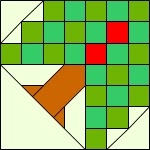
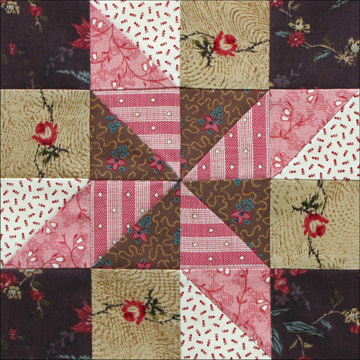
Nancy Cabot, quilt columnist at the Chicago Tribune in the 1930s, named several of the Civil War commemorative patterns in this series, most of which she designed herself. She gave us the Confederate Rose below, a complicated pieced design, which I have simplified here, giving the pattern for the center square. You may want to make it in shades of white, pink and rose, the colors of the Confederate Rose plant.
The original Cabot block is BlockBase #2651
if you want to make it just like Nancy's.
The Confederate Rose is a variety of hibiscus, unusual in that it puts out multicolored flowers. At the end of the 19th century people thought it might be a rose which began the morning with white flowers that turned red at night. Horticulturalists discussed it in their journals after a news story was published in 1884.
"The 'Confederate rose' is the name of a new flower which is white in the morning and red at night. Four of them have been planted around the grave of Gen. Albert Sidney Johnson in the State cemetery at Austin."
Confederate General
Albert Sidney Johnson was killed at Shiloh in 1862.
A skeptical editor at the
Gardeners' Monthly and Horticulturist wrote:
"We do not know of any rose under this name. There are flowers which open white, and become pinkish when they fade, but we do not know of any rose which does this. It is barely possible that this is an exaggeration of some such fact, though still more possible that it is one of those silly paragraphs of a 'smart' reporter, which do no credit to the newspaper press."
Ten years later a botanist identified it in Garden & Forest
"Hibiscus mutabilis, Cotton Rose, or Confederate Rose, is a small tree of rather open habit. I first noticed it in the gardens of New Orleans, and later at Mobile, Pensacola and Jacksonville. It is a fine plant when in bloom, bearing at the same time white and red flowers, and thus presenting a very striking appearance. The showy double flowers are white in the morning, changing to pink at noon, and to deep red at night. As the flowers last almost to the middle of the next day, the contrast of the white and red blossoms is very impressive. This plant is also known as the Mexican Rose; it is, however, a native of China and India, and thrives well on high Pine-land, but grows to perfection in rich hummock soil."
General Johnson's grave is a Victorian showpiece at the Texas State Cemetery.
He was originally buried in New Orleans; reburied in Austin in 1867.
Cutting an 8" Finished Block
A- Cut 2 dark squares 2-7/8". Cut each in half diagonally. You need 4 dark triangles.
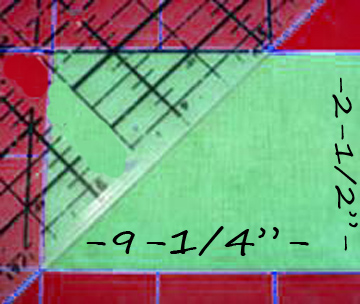
B - Cut 4 light strips 6-7/8" x 1-7/8". Trim the corners at 45 degree angles or use the templates in the PDF file.
Read more about the Confederate Rose, a once-popular hibiscus at this site:
http://aggie-horticulture.tamu.edu/southerngarden/hibiscus.html
UPDATE MONDAY 9-12-11 for those having trouble printing the templates:
WARNING: Reading below this line may cause eyes to glaze over.
Here is a JPG with the template. Click on it. Print it so it comes out 8-1/2 x 11. We'll see if this works
Later--I tried it and it did not print out the right size. Piece B should have printed out so the top dark line measured 2-7/8" (to match the long side of triangle A) but it printed out 2-1/8".
I need to enlarge it as it prints. By how much?
Well I have a tool, a proportion wheel, that I used to use in the old days of cut and paste layout. It tells me that if I have a line that is 2-1/8" and I want it to be 2-7/8" I have to enlarge my print by 135%.
There has to be a digital proportion wheel. So I did a websearch for those words and found one
I typed in the numbers-
first the current number 2.125.
Below that what I want it to be 2.875.
And then had it calculate. It says 133%. Close enough.
I then printed the JPG above by going to PRINT PREVIEW. At the top it says SHRINK TO FIT. I pulled down the menu to CUSTOM and typed in 133%. I see I cropped out some pattern pieces so I messed around on the sheet by going to full page view and adjusting the margins (little arrows) till I got it right in the frame. And I printed it. It's close.
It's probably easier to photocopy it at 133%
In any case, you might want to cut these shapes a little larger. Work out from the center and trim, is all I can say.
And I wonder why I never get any sewing done anymore. Computers are now my hobby. To put a happy face on it we can say we are learning math skills and printing skills. I'm bookmarking that digital proportion tool. It could be useful.