Showing posts with label Reproduction Patterns. Show all posts

Saturday, December 3, 2011

49 Yankee Puzzle

Yankee Puzzle by Becky Brown

Yankee Puzzle can recall the basic problem in Lincoln's war philosophy. Liberty and Union. Was it possible to have both?


President Lincoln from the Library of Congress collection


On December 3, 1861 Lincoln gave his first State of the Union address to Congress. He discussed a variety of administrative details but danced around a major policy decision---how to end slavery. 

"Under and by virtue of the act of Congress entitled 'An act to confiscate
property used for insurrectionary purposes,' approved August 6, 1861, the
legal claims of certain persons to the labor and service of certain other
persons have become forfeited, and numbers of the latter thus liberated are
already dependent on the United States and must be provided for in some
way."


Freed people working in a Union camp in Yorktown, Virginia, 1862
Photo by James Gibson. Library of Congress.

In other words: General Butler's policy of declaring slaves as contraband of war was now law. What of the thousands of Contraband camping on the edges of the free/slave map that was being rewritten every day? How to care for them? Where to care for them?


 Harper's Weekly, December 21, 1861.
This sketch of the refugee community in Beaufort, South Carolina,  is full of stereotyped imagery,
particularly in that it is titled "Work's Over."  You may notice this detail shows the women still working.
Nothing new. Is that a quilt or bedspread they are washing?

 Lincoln's tentative solution in 1861: colonization---

" at some place or places in a climate congenial to them. It might be well to consider, too, whether the free colored people already in the United States could not, so far as individuals may desire, be included in such colonization."

The federal government might budget funds to acquire a new territory:

"If it be said that the only legitimate object of acquiring territory is to furnish homes for white men, this measure effects that object, for the emigration of colored men leaves additional room for white men remaining or coming [to the new territory]."

This speech with its idea of a separate home for free blacks and freed blacks was just one small step in a solving a confounding puzzle: How to untangle the complex knot of slavery and save the Union at the same time.

Block from about 1900

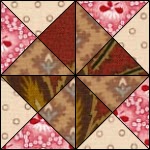
Recall the State of the Union in 1861 with an old block called Yankee Puzzle by Ruth Finley in her 1929 quilt book. Other names for the design are Big Dipper, Electric Fan, Hour Glass and Pork and Beans.
(BlockBase #1195b)


Cutting an 8" Finished Block

There's only one piece, triangle A.

A - Cut  1 square 5-1/4" each of light pink, dark pink, tan and brown Cut each into 4 triangles with 2 diagonal lines.




Saturday, October 15, 2011

42 H is for Hospital

Log Fence by Becky Brown

The H signifies a field hospital.


A faded Civil War hospital flag
from Gettysburg National Military Park Collection. 
The background color was probably a stronger yellow 150 years ago.


Flags were used to communicate on the battle field. We're all familiar with the white flag as a signal of surrender. Yellow flags meant the no-fire zone of a hospital for either side. Confederate nurse Kate Cumming explained their use in her first day of nursing in Corinth, Mississippi.

We are at the Tishomingo Hotel, which, like every other large building, has been taken for a hospital. The yellow flag is flying from the top of each. Mrs. Ogden tried to prepare me for the scenes which I should witness upon entering the wards. But alas! nothing that I had ever heard or read had given me the faintest idea of the horrors witnessed here. I do not think that words are in our vocabulary expressive enough to present to the mind the realities of that sad scene. Certainly, none of the glories of the war were presented here."

Hand-colored photo of a field hospital
after the Battle of Savage's Station, Virginia.

Late in the War the Union Army adopted a clearer signal, a yellow flag with a green H. The graphic design alerted friend and foe that patients were sheltered in that camp. 

Above the Michigan State Relief Association nursing at a field hospital in Virginia.
Is that a quilt airing out on the tent?


The quilt block is drawn from a child's quilt that is pictured in my book Civil War Women, made by a member of the Burkhart family in Illinois about the time of the Civil War. Terry Thompson and I called it Log Fence for that book. The H's just jumped out at me recently.

I want to emphasize: I am NOT saying this mid-century quilt was intended to represent the H or a hospital. We can, however, use the block to symbolize the brave doctors and nurses who worked in the field hospitals.


Cutting an 8" Finished Block

Use a background that captures the faded yellow in the Gettysburg flag above or a brighter yellow to indicate the flag as it once was.
A Cut 1 green square 1-5/8"
B Cut 2 background yellow prints into rectangles 3-7/8" x 1-5/8"
C Cut 2 green and 2 background yellow prints into strips 8-1/2" x 1-5/8"
D Cut 2 slightly darker yellow strips 8-1/2" x 2" (This will give you extra to center and trim the block when done.)


See more about nurses on this post from April.
http://civilwarquilts.blogspot.com/2011/04/17-comfort-quilt.html


Read Kate Cumming's 1866 book
A Journal of Hospital Life in the Confederate Army of Tennessee

http://books.google.com/books?id=jXwKAQAAIAAJ&pg=PA9&lpg=PA9&dq=journal+of+hospital+life&source=bl&ots=IVggqdzGVP&sig=Ck227H-si_hGK1C_P93R8jvIJTQ&hl=en&ei=pgQrTt7MHJDVgAfJ4PWaCw&sa=X&oi=book_result&ct=result&resnum=6&ved=0CEUQ6AEwBQ#v=onepage&q&f=false

It's also available in a newer print edition as Kate: The Journal of a Confederate Nurse.

Here's a version of Log Fence by
Francine Pons of San Antonio, Texas.

Below three photos of nurses at Union Hospitals in Washington D.C. from the Library of Congress


Saturday, October 8, 2011

41 Red, White & Blue Quilt

Red, White & Blue by Becky Brown

Every Civil War sampler needs a pieced star block. This week's pattern was published as Red, White and Blue quilt in the agricultural magazine The Orange Judd Farmer in 1898. (An odd name for a magazine but Orange Judd was the publisher's name---also an odd name for a man.)

Several patriotic quilts with pieced and appliqued stars survive from the 1861-1865 years.


Quilt by Cornelia Dow and others, Portland, Maine, 1864

This quilt (the stars are appliqued) was first published in the groundbreaking book about women's history called Hearts and Hands by Pat Ferrero, Elaine Hedges and Julie Silber. The star blocks are covered with inked sentiments about the Union cause, many patriotic, many amusing. The book pictured a block with the pun: "While our fingers guide the needle, Our thoughts are intense (tents)."


Maria Cornelia Durant Maynard Dow
About 1830
A collage made of a badly scanned portrait
 in her husband's autobiography


The authors attributed the quilt's organization to Cornelia Dow (1808-1883), wife of a Union General who had been released from Libby Prison in 1864. Her husband Neal Dow wrote an autobiography in which he described his wife.


"When not quite twenty-six years of age, having secured sufficient means to justify the establishment of a home for myself, I married Maria Cornelia Durant Maynard, on the 20th of January, 1830. My wife's father, John Maynard, was born in Framingham, Mass....went to St. Croix when a youth, and there met, and in 1789 married, her mother, Mary Durant, born in the island of St. Croix in 1771....Returning to this country with his wife and several children, Mr. Maynard, who had in the meantime accumulated a fortune, took up his residence in Bulfinch street, Boston, where his youngest child, Maria Cornelia Durant, was born June 18, 1808.....My wife's father, having met with financial reverses, was obliged to break up his home in Boston, and came with his family to reside on a farm...in Scarboro, Me. Maria Cornelia went to live with an aunt, for whom she was named, and [at sixteen] to Portland to pursue her studies in a private school for young women...."

The Neal Dow Memorial on Congress Street in Portland

In 1829 Neal Dow had this house built in anticipation of his marriage.Today it's the home of the Women's Christian Temperance Union, a monument to Dow and his temperance work. (He was mentioned as originator of the Maine Law on Ken Burn's documentary Prohibition on PBS this week.)
Maria Cornelia was 56
 when the quilt was made. 
Undated photo from her husband's autobiography


Cutting an 8" Finished Block


The block this week is BlockBase #3677. It requires template piecing.
See the templates in the PDF by clicking here:
https://acrobat.com/app.html#d=UmrlEGwbeyz5kyW2Q*mSmA
Or click on this picture and print it so it measures 8" along the top line.


Becky, an excellent seamstress, shows us how she put this together. EQ draws patterns like this with a  separate pattern piece for each shape. Because she is so good she fussy cut each piece and then lined up the stripes and the flowers. "I loved the challenge of piecing this block, " she writes. This is a challenge you do not need to tackle---unless you want to. Small over-all floral calicoes would be easier to work with.

Becky: "At first glance it may appear that all 5 star points use the same template, but there are 3 templates for the star. I cut all the pieces and lightly marked the pattern letter on the back of the star pieces."
She stitched the star together first and then added the set-in pieces one by one.
"You will notice I basted a white thread in F, (to mark it as the top) and added the pieces clockwise. F to H, H to J, etc. "
You can always applique it.

Two other Maine Civil War quilts were on display this summer.


This flag quilt was made by the Ladies Aid Society of the First Church in Belfast, Maine in 1864 and sent to the Armory Square Hospital in Washington, D.C., where it was displayed for sick and wounded soldiers. In 2011 the quilt was donated to the Belfast Historical Society and Museum.


This Civil War patriotic quilt was made by the Ladies Aid Society of Portland about 1864
Collection of the Brick Store Museum, Kennebunk, Maine.

Among the verses inked on it:

Ye have fought our battles for us, Showing how the brave can die.
We are waiting to receive you, When ye lay your armor by.
               
We’ll stitch with the needle. A
nd fight with the tongue
‘Till every old rebel Is conquered or hung.


Read more about this quilt, which was on display at the New England Quilt Museum during the summer
http://www.brickstoremuseum.org/Feature64_CivilWarQuilt.shtml


We have 12 weeks to go (there are 53 Saturdays in 2011) but don't think the patterns are going to get progressively more difficult. There are still some four-patches on the horizon.

Saturday, October 1, 2011

40 Order Number Eleven

Order Number Eleven
By Becky Brown

Order Number Eleven was named for a Union order forcing Southern sympathizers to leave their homes.


The quilt design Order Number 11 was published in the Kansas City Star in 1929 by Ruby Short McKim, a pattern designer from Independence, Missouri. She told the story of Fannie Kreeger Haller who as a ten-year-old, "saw her mother's choice new quilt snatched from their bed by marauders back in 18[63]when Order No. 11 was the issue. She carried the treasured design in her mind and years after reproduced the quilt, christening it 'Order No. 11'."

Detail of George Caleb Bingham's painting Martial Law or Order #11.
Is that a quilt being stolen on the balcony?

This dramatic painting by Mattie Bingham's husband is one reason the story of Order #11 lives on. See Mattie's story in Block#19.

Even sixty-five years later, McKim's readers would have been quite familiar with the issue of Order Number 11. In 1863 Missouri Bushwhackers under the control of William Quantrill burned the pro-Union town of Lawrence, Kansas, the home of the Jayhawkers. Quantrill's raiders murdered every man and boy they could find, killing nearly 200. Four days later the Federal Army issued the order evacuating four counties in western Missouri in what could be seen as either a wise precaution or a vicious act of revenge.

Union soldiers and guerillas terrorized families into leaving by burning their homes and stealing their possessions. Unionist Missourians were permitted to move to designated military outposts or to Kansas. Those without certificates of loyalty had to leave. The roads south of Kansas City were filled with frightened and angry refugees, among them Bursheba Younger. (See her story in Block #30: http://civilwarquilts.blogspot.com/2011/07/28-next-door-neighbor.html)

Fannie's mother's quilt, which was jayhawked right off the bed, was of the design also known as Hickory Leaf or the Reel, a pattern that dates back to the 1840s. 


The early versions were sometimes pieced but most are applique.

Nancy Harris McCorkle and Charity McCorkle Kerr
Sisters-in-law Nannie and Charity were Confederate sympathizers who aided Missouri guerilla Bushwhackers and were imprisoned in Kansas City. The jail fell down killing Charity and three other women, one in a series of heartbreaking events that led to Order Number 11.

Cutting an 8" Finished Block

Cut a square 8-1/2" of background fabric.
See the templates here: https://acrobat.com/#d=dGRUH6p5yJW6uM7Rne8YHw
Use the templates in the PDF file to cut the applique pieces. Add a scant 1/4" seam allowance to the pieces.
You need 1 of the large piece A and 4 of the crescent B.

Prepare and applique in your favorite manner.

Remember if the PDF prints out the wrong size you can adjust the size when you are giving your printer instructions. If it's too big--- try printing it at 50% and see how it looks in the preview. Adjust the percentage until the block fits within the margins of an 8-1/2 x 11" piece of paper. It should then fit fine in your 8" block.

Another way to do this pattern is to applique the whole figure as one piece. See Jo Morton's popular pattern "Rachel's Reel" for a similar design with a single applique patch that fits into an 8" square.

The Reel design is one of the classic patchwork patterns from before the Civil War.

Here it's been modified with a white signature strip across each block. The quilt (probably about 1850) was advertised as a New Jersey quilt in an online auction.

In 1904 Caroline Abbot Stanley wrote a novel called Order Number Eleven: A Tale of the Border, as partisan and romantic as Bingham's painting. Read it here at Google Books

Saturday, September 3, 2011

36 Kentucky Crossroads

Kentucky Crossroads
By Becky Brown

Kentucky Crossroads can remind us of the importance of the rivers to winning the War. Western Kentucky, where the Ohio River joins the Mississippi, was an important crossroads of waterways. Many of the skirmishes in late summer, 1861, were fought  by gunboats in the area.
Kentucky (in orange in the middle of this map)
 was a border state
 that remained in the Union

Kentucky began the War as officially neutral but it was a slave state with split loyalties. Neutrality was often impossible to maintain. As Union sympathizers gained political strength during the summer of 1861, Confederate troops went  in to secure the Mississippi River for the South, taking over the town of Columbus and the river below that. On September 6, 1861 General Ulysses S. Grant's Union Army occupied the town of Paducah at the junction of the Ohio and Tennessee Rivers, ensuring that the North controlled the Ohio River.

Western Kentucky
Paducah remained under Union occupation for the duration and Kentucky remained a Union state, although the Confederacy held on to Columbus and the lower Mississippi for several years. 

Mr. F. Beard sketched the town for Harper's Weekly six weeks after Grant's takeover. He described occupied Paducah as a


"beautiful little city, full of respectable and often elegant residences. It now wears, however, a deserted and melancholy appearance. Whole streets of tenantless buildings stretch from the landing to the intrenchments; and the few inhabitants who remain, although entirely unmolested and secure, look guilty and sullen. Some of our boys left the steamer Sunday, and, wandering about the town, took possession of the deserted choir of a secesh church, and one of our number being a good organist, and most of us having assisted before on such occasions, we did our best to convince those within hearing that, although belonging to the 'Northern rabble,' we were not altogether heathen and benighted."
The pattern Kentucky Crossroads was given the name in an early 20th century magazine. My source is just a clipping in a scrapbook; it may have been Comfort or Hearth & Home magazine. We know the pattern best as an album block. (BlockBase #2881).
Cutting an 8" Finished Block

A - Cut 4 light strips 2-3/8" x 5-1/2". You'll trim these at the end.


B - Cut 1 dark square 6-5/8". Cut into 4 triangles with 2 diagonal cuts. You need 4 triangles.
C - Cut 1 medium square 2-3/8"


Sew the corner strips to the center strips.
Trim the corners.


This album block (or Kentucky Crossroads) is an authentic pre-Civil-War pattern.
The detail below contains blocks dated 1847.


Album by Bettina Havig and Friends
Columbia, Missouri
2009
Album by Mary Wilk Madden
and Barbara Brackman
1996