Wednesday, June 17, 2020

Hospital Sketches: Spring Finishes


Charlotte Schmidt-Brodalski's Hospital Sketches quilt
is finished.

This former art teacher/blogger is pleased to see how creative
stitchers have been in choosing colors, fabrics and borders
to make each version unique.

Charlotte seems to have taken a tip from chintz quiltmakers of
the early 19th century in scattering butterflies.

Her use of a medium gray patterned background offered a challenge in finding fabric to contrast, I'm sure. I tend to use very dark or very light backgrounds because it's easier to get the florals (particularly the greenery) to show. Charlotte did a great job.

Linda Pyke's anniversary quilt also shows clever planning in the backgrounds. The color's off in this photo but you get an idea. She used a four-patch behind the applique, but rather than random
light squares she arranged them to create a lighter glow in the center. She also filled up some of the pattern's empty spaces with hearts, dots & birds.

She writes that she, "Once used a cheetah fabric for a background. As long as you have contrast between the background and the applique or pieced block you're good."

Sue sent Mark Lauer a picture of his beauty in the classic colors on white in the machine.

And here it is finished and on the bed. Beautiful!

Lois Griffith's has the same traditional look as Mark's. She added shapes
and altered blocks and quilted it on her regular machine.

More dots!

 Randi Merlau's, also with a pieced border is quilted, bound and labeled.

Peggy Sandfort's with it's four-patch background is back from the longarmer.

Check our Facebook page as people finish this project.

Saturday, June 13, 2020

"The Union Forever"

"The Uni-on for ever" 1850
Quilt by Elizabeth Helm Walker Stone (1828-1898), Kentucky
Wintherthur Museum
Gift of Martha Walton Coonley in honor of great-great grandmother, 
Elizabeth Helm Walker Stone, her grandmother, Laura Kinkead Walton
and great-aunt, Robert Rodes Stone Kinkead.

The Winterthur Museum's online catalog has several photos of this beautiful silk hexagon quilt. See a link below.
In the center an eagle is embroidered with the words
"The Uni-on for ever"

Elizabeth Helm Walker Stone was about 22 when she dated this quilt in 1850. The quilt and genealogical records tell us she was from a privileged family in Madison County, Kentucky.
The 1860 census's slave schedule lists 28 people living under her husband Robert Rodes Stone.

Despite being a slaveholder Elizabeth seems to have had strong Union sentiments as did Robert Rodes Stone (1817-1893) who attended Harvard Law School and became a Colonel in the Union Army. They married in 1844 and the year the quilt was dated had one child Anne Rodes Stone, about five.

Corner embroidery

His obituary tells us that his father had "a large landed property...he preferred the simple, independent life of a country gentleman, which he never abandoned until the war and emancipation made it no longer pleasant or desirable....He married Elizabeth Helm Walker, one of two daughters of a prominent citizen of Madison County."

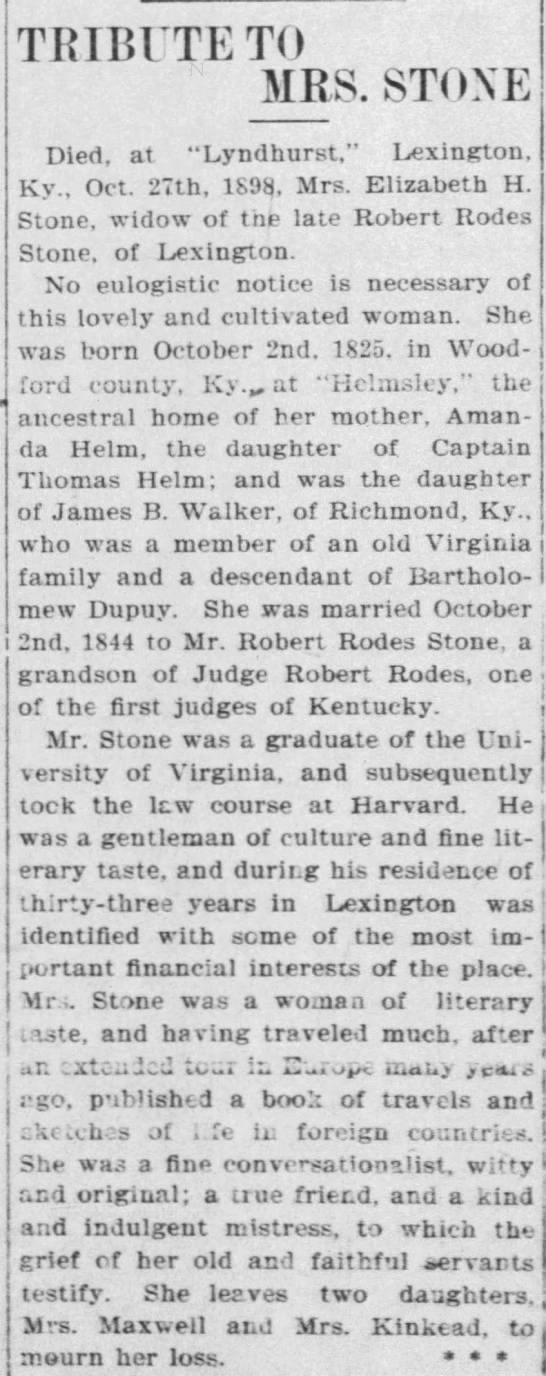
Elizabeth's obituary records she was born in Woodford County at "Helmsley, the ancestral home of her mother" near Versailles, Kentucky. The Helmses, originally from Virginia, remained a prominent Kentucky family.

Lexington Historical Society

After the Civil War Robert and Elizabeth moved with the times, relocating to Lexington where Robert became a banker, described as "a wealthy capitalist" after his death. Their two daughters Laura, born in 1854, and Annie eventually shared "the magnificent estate" left by Robert becoming two of the "the wealthiest women in Kentucky," according to Annie's marriage notice.

The Stones used their money to travel. "Mrs Stone was a woman of literary taste, and having traveled much, after an extended tour in Europe...published a book of travels and sketches of life in foreign countries. She was a fine conversationalist, witty and original," according to her obituary.


The quilt descended in daughter Laura Kinkead's family. Annie did not have children, and in fact was only married for several weeks late in life. In 1895 "A Romance in Life" circulated among U.S. newspapers telling the sad story of her marriage to Arthur Nithsdale Maxwell, British Royalty, who died two weeks later. Three months later another story was published wondering if the marriage ever existed. Returning to Lexington "Miss Stone, or Mrs. Maxwell, was suffering from the terrible shock....Her family thought it best to take her south, and about the middle of November she and her mother left for Florida."


Some newspaper articles:

Elizabeth's obituary 1898

The Mysterious Marriage
1895 & 1896


The easiest way to see this quilt at the Winterthur's web page is to go to the search page:
http://museumcollection.winterthur.org/
And do a search for Helm. Scroll down till you see the quilt. 2008.0023

See posts on quilts with related mottoes:
https://civilwarquilts.blogspot.com/2019/12/constitution-union-quilt.html

Wednesday, June 10, 2020

Yankee Notions #6: Improved Nine Patch

Yankee Notions #6, Improved Nine Patch
by Denniele Bohannon, 18" version.

Yankee Notion #6 is the idea of improving things --- from Transcendental spiritual ideas of trying to become a perfect human being to Yankee mechanics. 


Nile's Weekly Register, 1831

We could discuss Ralph Waldo Emerson and philosophical/religious ideas about working on our personal perfection but let's begin at a more concrete level with one of America's most famous inventors and engineers Eli Whitney, born in Massachusetts, died in Connecticut---a Yankee through and through.

Eli Whitney
1765-1825

Most American children of the 19th and 20th centuries memorized Eli Whitney's accomplishment---"inventing the cotton gin." When we were young the engine/machine was lauded as a platform of America's economy; today it's decried as the foundation of slavery. Both concepts are true but the important point here is that Whitney did not invent a machine. He improved a machine.

Catherine Littlefield Greene (1755-1814)
 in her 50s

The story: Whitney went to Georgia as a young man to tutor the children of a plantation family but digressed into his favored activity, Yankee tinkering. His cotton-farming neighbor Catherine Greene was impressed and their collaboration in the early 1790s resulted in Whitney's coming up with a way to mechanically comb the seeds out of the upland cotton she was growing.

The improved gin, a small model.
Whitney never made much money off this machine. His other
inventions and improvements made him rich, however.

Southerners were making an agricultural transition to upland cotton rather than the easier-to-clean but harder-to-grow Sea Island cotton. Mechanics of cleaning the seeds with an engine---a gin--- required a different mechanism. Whitney and Catherine Greene may have discussed a mechanism (she was born in Rhode Island and was perhaps a Yankee tinkerer herself) or she may have just encouraged him with enthusiasm and financial support.

Later cotton gin on the left.
Note the belts connecting it to a power source, probably a water wheel.

The basic Yankee notion was that handwork was inefficient. How to
mechanize it?

Library of Congress
Photograph by George N. Barnard of cotton production at 
Mount Pleasant in South Carolina. 

The above view of labor in the 1870s illustrates the contrast between Yankee concepts of time use and lingering Southern attitudes about employing people to do tasks machines might do more efficiently. But then again---machines put people out of work. The transition to new forms of labor is always difficult.

A Lummus cotton gin (they still manufacture gins) from a company
founded by a New Yorker in 1863.

The Block

Improved Nine Patch by Becky Brown

We know who improved the cotton gin, but who improved the Nine-Patch? Perhaps someone writing about quilts for the farmer's magazine The Rural New Yorker in 1930, so far the earliest reference to the pattern in print.

BlockBase #306


Most Improved Nine Patch quilts are constructed
like a Wedding Ring pattern with squeezed squares and ellipse shapes,
no square blocks.

But we are doing it as a block.

It may be the most difficult pattern in the series as it's made up mostly of curves. You could design your own block---improve a nine-patch in your own fashion (No Y seams, no Curves) but the 1930s version is a cool pattern, and Eli Whitney did not flinch from a challenge.

Improved Nine Patch by Dorry Emmer
You can rotary cut piece A but the others are cut
with templates.
For a 12" Block- Cut 1 A 3-1/8"
For an 18" Block - Cut 1 A 4-3/8"


Tangible Yankee Notion
The Safety Pin


New Yorker Walter Hunt obtained a patent in 1849 for his safety pin. He twisted a piece of wire to form a clasp at one end, a point at the other and a coil in between. The coil pressured the sharp end to stay in the clasp.
Improved safety pin


Walter Hunt 1797-1859

Walter Hunt invented many items including the lock-stitch sewing machine. He was not much of a business man, however. Others improved the sewing machine and made fortunes.


And that's why there is a sewing machine in Dorry's block.


Denniele's sketch, Blocks 1-6.


Becky Collis sends photos of her machine quilting on Denniele's.

See a post about the Improved Nine Patch here:
http://encyclopediaquiltpatterns.blogspot.com/2018/01/improved-nine-patch.html


Saturday, June 6, 2020

Sylvester Read's Quilt Business

Quilt in an unknown pattern, About 1900,
 70" x 80"

The Arizona project recorded this quilt with many triangles.


Blocks are a little over 5-1/2".

The tans probably were once red:
a red, white and blue patriotic piece.
Quilt Index
http://www.quiltindex.org/fulldisplay.php?kid=67-EC-1430

Sylvester H. Read was born in Massachusetts, eldest son of a shoemaker with the wonderful name of Resolved Reed. He grew up in New York, lived a good deal of his life in Knox County, Ohio but continued moving west, settling in Illinois, Iowa and finally in Custer County, Nebraska where the quilt was made.

During the Civil War he enlisted in the 15th Regiment of Ohio Volunteers in August of 1861 and was taken prisoner at the Battle of Chickamaugua in September, 1863. His wife Mary S. Davis Read (1836-1923) was raising their three small children at the time. He survived the prison and the war.

His grave is marked with a G.A.R. veteran's star. He received a pension
and was a charter member of
Custer County's Samuel Rice G.A.R. post.


After the war, the Reads went west. The 1870 census finds the family with five children in Troy, Iowa where Sylvester is working as a carpenter. The children were born in Ohio and Illinois. S.H. Read is recorded as one of the early settlers of Custer County, Nebraska, arriving in Merna from Clarke County, Iowa in the early 1880s. Several if not all of his children also settled near Merna (which is about 60 miles northeast of North Platte. Undoubtedly they were homesteaders looking to prosper as farmers .

Custer County is right in the middle of Nebraska. The 100th Meridian 
runs through the county. On the east side of that line---rain enough to farm with 
19th century technology; on the other.....


Merna in 1886
Solomon Butcher photograph

The quilt descended in the family through their daughter Leila Thomas (1857 - 1932) with the story that it was made in Nebraska by Sylvester as one of a pair. The other was sent as an inauguration gift to President William McKinley in 1897. The family noted that he began to make quilts for income when he could no longer work on the farm.

We'd like to know more about Sylvester Read's quiltmaking business but information is scarce. Information about Custer County, however, is abundant mainly because one of Sylvester's neighbors was Solomon Butcher, a fellow homesteader who decided to become a photographer instead of a farmer.

Solomon Butcher in later life

Photography didn't pay either so Butcher spent his time recording his neighbors. His iconic photographs of Custer County and its sod houses are in the Nebraska Historical Society, familiar to everyone with an interest in the American West.


Butcher shot several photos of Sylvester's daughter Leila & her husband Frank Thomas. This negative is damaged but a detail reveals her plants outside the door, their dog with perhaps their son and his Uncle.


Second shot on the same day.

This shot is later, more children. Better roof.


And still later
"Frank Thomas's New House"
The family did prosper.
Merna, Nebraska

While many quilts were made for and in memory of William
McKinley, I could find no record of Sylvester Read's.


See more of Butcher's Nebraska photos here:
http://www.nebraskastudies.org/1875-1899/solomon-butcher-sod-photos/