Wednesday, October 11, 2017

All Block Twos


Yankee Diary
Block 2: Susan B.'s Star 
by Denniele Bohannon

What if you made a dozen of block 2 
and alternated dark and light shading?


Here are your blocks and a couple of dark
Photoshopped block 2s. They are 18" so the virtual quilt would be 54" x 72".

66" x 84" with a 6" border.
Well, it would keep you busy
and you'd wind up with a patriotic extravaganza.

Saturday, October 7, 2017

Picture Rocks Ladies' Aid Society


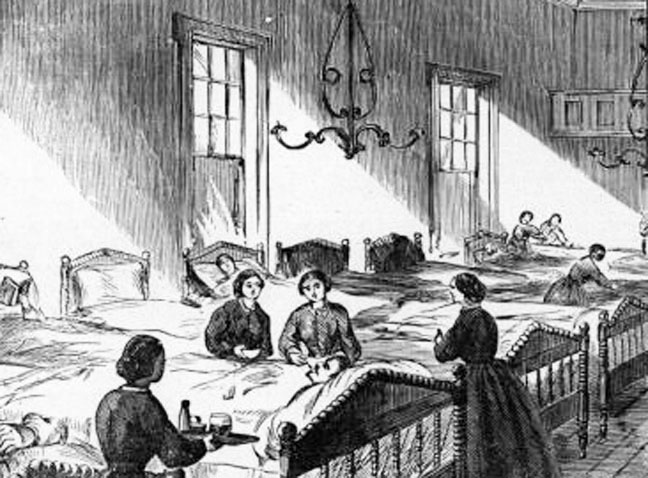
Winslow Homer's drawing of a Ladies' Aid Society in Harper's Weekly, 1862

During the Civil War women all over the Union formed Ladies' Aid Societies that were branches of the U.S. Sanitary Commission. The women of Picture Rocks, Pennsylvania, left a record of their activities in Lycoming County.


Picture Rocks in the Muncy Valley is named for some long-gone
Native American pictographs in the hills

The women were tentative about organizing and doubtful as to the good they were able to do.

1864 Letter to the Secretary of the Woman’s Branch of the U.S. Sanitary Commission:
“ I am happy to inform you that, at length, after two or three failures from stormy weather, we have a ‘ Soldiers' Aid Society’ at Picture Rocks. There seems quite a general desire to engage in so noble a work, although, with a few, I have found a feeling of distrust as to the good the ‘Sanitary' is doing, and the necessity of its work. More light is needed on the subject. I do not expect that our contributions will be anyways large, for, with few exceptions, our people number their wealth by hundreds instead of thousands. But we can be one of the little rills that, drop by drop, make the vast ocean.

A portion of the 1864 minutes were published in the 1873 Lycoming County Atlas.
"Voted to meet Thursday afternoons, and to each bring material for quilts, etc., until we could gain sufficient funds to purchase flannel. " [We conducted]  a few fundraising activities to buy flannel for the quilts and calico to make hospital wrappers." 
March 17, at house of Mrs. J. B. Drake...Voted to bring together contributions ready for a box. Put together blocks that members had pieced and quilted. 
 At meeting, April 10, we packed in barrels the following articles: Dried fruits..., eight pairs of socks, one quilt, six shirts, one pair of drawers, one undershirt, two sheets, two dozen of pocket handkerchiefs,... etc.


The flannel was perhaps cotton flannel. The quilt could be pieced of household scraps but they may have used brushed cotton yardage for the backing or filling. The women in the town of a few hundred people finished one quilt for one soldier in a hospital in 1864. One welcome quilt, we'd guess from an account in Kentucky at this post:


Below is the full account of the society from the Atlas.

"SANITARY COMMISSION.
The fact has been painfully realized that our history would be incomplete without some account of the doings of the women of Lycoming during the War of the Rebellion. A strong effort was made to secure full data of the Ladies' Aid Societies throughout the County, but only in part have these efforts been attended with success. Through the kindness of one of the active workers, in the lower part of the County, a report has been received for that section, which is published in full.

RECORD OF THE PICTURE ROCK’B AID SOCIETY, AUXILIARY TO THE UNITED STATES SANITARY COMMISSION, WOMEN'S PENNSYLVANIA BRANCH.

In the summer of 1861, many of the loyal sons of the Muncy Valley responded to their country’s call. The daughters of the valley could not do battle for their country's honor and life, but they could speak words of encouragement and cheer, and they could see that every soldier in the ranks was equipped with all the comforts that busy fingers and loving hearts could devise. And from the time the first company “ took up its line of march," they were watchful and alert to anticipate the needs of those who were risking their lives in their country's service. Many barrels and boxes, filled with dried fruits, jars of apple-butter and pickles, socks and mittens, reading-matter,——in fact, everything that motherly love could suggest, were sent forward from time to time, reaching them in good condition when in winter-quarters, at other times lost by the way, from a sudden removal of camp. This was discouraging, and convinced us of the necessity of united, systematic effort, before we could be really helpful to the sick and wounded.

But we were so few in number. Was it really worth while for us to organize? Not until March, 1864, in response to an earnest appeal for help from the W. B. S. C. of Philadelphia, did we effect an organization at Picture Rocks. Our first meeting convened March 10, at the home of Mrs. Eben Sprout. Present, Mrs. A. Burrows, Mrs. J. B. Drake, Mrs. J. Little, Mrs. E. T. Sprout, Mrs. L. B. Sprout, Mrs. A. R. Sprout, Miss Rosa Little, Miss Martha Little, Miss Jane Whipple. The following oficers were elected: Mrs. Ellis Bryan, President; Mrs. Jesse Blaker and Miss Ann Rymarson, Vice-Presidents; Mrs. A. R. Sprout, Secretary and Treasurer. Appointed committee to solicit funds, Misses Mary Bryan, Rosa Little, and Jane Whipple. Voted to meet Thursday afternoons, and to each bring material for quilts, etc., until we could gain sufficient funds to purchase flannel. From a rough draft in the Secretary’s book, I copy the following letter:

SECRETARY of Woman’s BRANCH or UNITED STATES SANITARY COMMISSION :—

“ I am happy to inform you that, at length, after two or three failures from. stormy weather, we have a ‘ Soldiers' Aid Society’ at Picture Rocks. There seems quite a general desire to engage in so noble a work, although, with a few, I have found a feeling of distrust as to the good the ‘Sanitary' is doing, and the necessity of its work. More light is needed on the subject. I do not expect that our contributions will be anyways large, for, with few exceptions, our people number their wealth by hundreds instead of thousands. But we can be one of the little rills that, drop by drop, make the vast ocean.”

Next meeting, March 17, at house of Mrs. J. B. Drake. Present, Mrs. A. Burrows, Mrs. Eben Sprout, E. T. Sprout, A. R. Sprout, Miss Ann Rynearson, Mary Rogers, Jane Whipple, Rosa Little, Martha Little, Minerva Little, Martha Krause, Jane Saunders. Heard reports of Soliciting Committee. Appointed Jane Saunders on committee, in place of R. Little, resigned. Instructed the, committee to continue their labors for another week. Voted to bring together contributions ready for a box. Put together blocks that members had pieced and quilted.

At meeting, April 10, we packed in barrels the following articles: Dried fruits, eleven pounds of huckleberries, nine pounds of cherries, six and one-half pounds of blackberries, three pounds of raspberries, one pound of currants, five pounds of ‘ apples, eight pairs of socks, one quilt, six shirts, one pair of drawers, one undershirt, two sheets, two dozen of pocket handkerchiefs, four towels, one linen coat, two pillows, two bags of hops, several bundles of old linen, cotton, and lawn, etc. includes minutes of the meetings, accounts of a few fundraising activities to buy flannel for the quilts and calico to make hospital wrappers."

https://books.google.com/books?id=7X1BAQAAMAAJ&pg=RA1-PA100&lpg=RA1-PA100&dq=1841+quilt+pennsylvania&source=bl&ots=dUR565nEaK&sig=if4EkN0pGK9OGlxzGNayzd8JmqU&hl=en&sa=X&ved=0ahUKEwjSs53rqMXSAhWD6iYKHXQ8C3A4HhDoAQg9MAY#v=onepage&q=1841%20quilt%20pennsylvania&f=false
Wednesday, October 4, 2017

Northern Lily & Southern Rose

Got these photos recently of some beautiful hand quilting
by Candice Greco, a friend of a friend.

The pattern for her quilt is from my book Quilts From the Civil War

"Northern Lily & Southern Rose."

Northern Lily & Southern Rose by Terry Clothier Thompson. 
Pp 70-79

Terry and I certainly had fun working on that book, the first thing we wrote on quilts and the Civil War. We looked at a lot of vintage quilts and read first-person-accounts from the era. Terry updated several designs with her own flair.

Our inspiration:
When the Kansas Troubles inspired partisans to move to the Kansas Territory in 1855 as antislavery or proslavery advocates, Lucy Larcom won a contest with a poem to inspire western migration and UNION.
"Sisters true, Join us too
Where the Kansas flows
Let the Northern Lily bloom
With the Southern Rose."

It's one of the nine projects with full instructions in the book. I still have a lot of these books---I'm so glad I bought a bunch. You can buy one here:
https://www.etsy.com/listing/220263069/quilts-from-the-civil-war-9-projects?ref=shop_home_active_5

Saturday, September 30, 2017

Two Antislavery Quilts

Signature Quilt with an antislavery message, about 1848,
in the collection of the Royall House.
From the Massachusetts Project & the Quilt Index.


The Royall House & Slave Quarters is a Massachusetts museum with restored colonial era buildings including the only surviving slave quarters in the northern states (I'm always doubtful about words like "only" and "first".) 

Isaac Royall was a Maine merchant with plantations in the West Indies (the Caribbean) who built a mansion in what is now Medford, Massachusetts, in the mid-18th century, described as "one of the grandest in North America.” 

The two-story brick dormitory for slaves who were
brought from the Caribbean.

At least 27 enslaved people worked on the estate. After his father's death Isaac II, a British loyalist, abandoned the colonies and the home when the Revolutionary war began. The slaves became free people by default.

The museum is open to visitors in the summer.

Isaac Royal II and his wife Elizabeth Mackintosh Royall (in blue)

Like many historic houses the museum has a rather random collection of old quilts that have been donated over the past century. Small museums rarely kept detailed acquisition notes and a collecting focus was unusual until recent decades. Whether any of the quilts have a connection to anyone who lived in the house is unknown.

The notes in the Quilt Index indicate this 
quilt has an antislavery message.

But at least two quilts have a connection to the mid-19th-century's antislavery movement, indicating someone saw a focus in the connection to the house's history as a large slave-holding estate.

Mid-19th-century silk quilt. 
Notes in the Quilt Index indicate a poem in
the center.


In the corners a detail photo reveals a printed silk:
"Plead for the Slave."

See the records for the antislavery quilts here:
http://www.quiltindex.org/fulldisplay.php?kid=1D-FC-E5A
http://www.quiltindex.org/fulldisplay.php?kid=1D-FC-E5F

You can view all the quilts in a museum collection if they are in the Quilt Index by searching by museum name. Here's a link to the quilts recorded at the Royall House.
http://www.quiltindex.org/search_results.php?page=1&page10=0&keywords=royall&search=go

Wednesday, September 27, 2017

Yankee Diary 9: Our Thoughts Are Intense

Yankee Diary #9
Our Thoughts Are Intense by Barbara Brackman

Carrie's sweetheart Lieut. E. C. Clark
 led recruiting in Ontario County in spring, 1863

From Carrie's Diary. May, 1863.
"A number of the teachers and pupils of the Academy have enlisted for the war. Among them E. C. Clarke.... They have a tent on the square and are enlisting men in Canandaigua and vicinity for the 4th N. Y. Heavy Artillery. I received a letter from Mr Noah T. Clarke's mother in Naples [a nearby village]. She had already sent three sons, Bela, William and Joseph, to the war and she is very sad because her youngest [Carrie's Edmund] has now enlisted.... I have heard that she is a beautiful singer but she says she cannot sing any more until this cruel war is over. I wish that I could write something to comfort her but I feel as Mrs [Elizabeth Barrett] Browning puts it: 'If you want a song for your Italy free, let none look at me*.' "
I found a letter from Ed Clarke to his brother at Spared & Shared blog.

At first Edmund's major problem in the Union Army was trying to not look foolish during drills.
In a letter to a friend:
"I find enough to give me good exercise both of body and mind. Sometimes I even get quite tired out. I enjoy my rest all the better. I have had command of the company for the last 3 days, drilling them and taking them out on dress parade which for a novice dealing with old soldiers is rather embarrassing and of course I have had to study tactics diligently."
A New York Heavy Artillery unit
Edmund was in M Company of the Fourth New York Heavy Artillery

A year later Carrie wrote:
"May 4, 1864. The 4th New York Heavy Artillery is having hard times in the Virginia mud and rain. They are near Culpepper."
In September she alludes to his injuries:
"My war letters come from Georgetown Hospital now. Mr Noah T. Clarke is very anxious and sends telegrams to Andrew Chesebr every day to go and see his brother."
 Georgetown, Virginia hospital where 
Edmund Clarke spent September, 1864. 

Nurses at the Georgetown Hospital.

Edmund survived and was brought home by a local doctor. The usual cool detachment of her diary drops when she sees him.
September 30. " I ... found him just a shadow of his former self. However, 'hope springs eternal in the human breast' and he says he knows he will soon be well again. This is his thirtieth birthday and it is glorious that he can spend it at home. "

This unnamed man looks like E.C. Clarke in the
History of the Fourth NY Heavy Artillery.

And here's Denniele's.
Nice fussy cut stripe in the pole!
 The Army Camp Block

The pun "Our thoughts are intense" comes from an inscription on a Maine Civil War quilt by Cornelia Dow and others: "While our fingers guide the needle, Our thoughts are intense (tents)."

Block 9 by Becky Brown

This month's block is drawn from a sampler by Dorothea Lemley, which seems to picture an army camp with its conical tents. 


Dorothea's quilt is pictured in my book
Civil War Women. Her flag inspired Block #4.

I simplified Dorothea's eagle, inspired by one in an 1863 sampler from Bedford, New York.


Cutting a 9 x 15" Finished Block

BACKGROUND
Cut a rectangle 9-1/2” x 15-1/2”.
Fold it in half to find the center vertical line and press. Place the tree trunk a little to the right of this line. You are leaving room at the bottom left for a flag to be sewn over the seam later.

APPLIQUE
Cut one of each piece on the pattern sheets. Add seams when you cut the fabric.
For the tree trunk and the branch cut bias strips.
The trunk finishes to 1/2” wide by 8-1/2” long. Cut a strip 2” x 9”
The branch finishes to 3/8” by 3”. Cut a strip 7/8” x 3-1/2”.


To Print:
  • Create a word file or a new empty JPG file for each.
  • Click on each of the images above and below. The leaf is on a separate sheet.
  • Right click on each and save it to your file. 
  • Print that file on an 8-1/2" x 11" sheet. The eagle's wings should measure 8-1/2" across.
  • Add seam allowances when you cut the fabric.


One of the last things you are going to do as you set the blocks together is add the fourth flag you made for block 2. It goes over the seam line between another block and the camp.
But don't add it yet.

Here are Becky's blocks 1-9
Three more patterns to go = 5 more blocks.


In camp, 1862. 
Union Soldiers and a woman (perhaps a laundress) before a 
Sibley tent with a central tent pole.

Another Sibley tent on a quilt---this one with a Zouave soldier at rest---
from the 1863 album from Bedford.

I found a letter from Edward (sic) Clarke and recognized Edmund at the blog Spared & Shared:

Read the history of the Fourth New York Heavy Artillery:

See Cornelia Dow's Maine quilt at this post:

 *Carrie's quote about war is from Elizabeth Barrett Browning "Mother & Poet, 1861"


If you'd rather have the patterns in a different format I've listed all the Yankee Diary patterns for sale in my Etsy shop. Here are links to the last four blocks and the set and border:

PATTERNS 9-12 as paper patterns through the mail. $10.

Saturday, September 23, 2017

A Maryland Civil War Quilt?

Eagle medallion quilt with dogtooth appliqued border.

Pictures float around the internet. Pinterest posts lose credits
and copyright---captions are completely gone. 
Where did this picture come from?

It certainly looks like a Civil War quilt made in the 1860s.
The applique floral and grape vines.
The dogtooth border in Turkey red.
The color scheme.
The craftswomanship.
The canons and trumpets indicate an enthusiasm for war, something you
wouldn't see in the 1850s.

The federal shield was important in the 1860s.

Looks like some kind of a Union quilt

Here's what the actual picture looks like. It's hung against an
aluminum-sided wall (?)

Coincidentally, Debbie Cooney and I have been emailing each other lately about those bluebell-like flowers (morning glories?). Here are a few other quilts with similar applique.

Chiswell family quilt, 1848-1855, Montgomery County, Maryland
from the Baltimore Museum of Art's collection


Marylou McDonald took the above photos. I Photoshopped them to
correct the color.


Snapshot of a block from another Maryland album.


From a 1992 auction catalog from Pook & Pook.
Older blocks set together later?


Mathematical Star with applique in the center by 
Rachel K. Trundle Dawson, 
Mt. Auburn, Frederick County, Maryland.
 IQSCM #2009.039. 0042

See more about this unusual star design in a post:

Block signed Emily A. Dawson from Montgomery Co, MD.
Polly Mello's collection.

These applique designs are distinctive not only in the use of the morning-glory-like bloom
but in the free-flowing organization of the flowers and vines. Much American applique is based on more formal and less naturalistic arrangements.

Typical floral applique with roots in Germanic folk
art traditions

Debbie writes: "The Dawsons were major quiltmakers in the area of SW Montgomery Co. right on the Frederick Co. line. So we think the Frederick appliques came from the same source. The BMA quilt has signers from the same area."

Emily was a cousin of Rachel Trundle Dawson's husband. See also three impressive quilts by Rachel's sister-in-law "Big Susan" Dawson (1823-1880) in your copy of the Maryland Project book A Maryland Album.

My guess: The eagle quilt is a Frederick County or Montgomery County, Maryland quilt made in the 1860s. Any ideas on where the picture's from?
UPDATE: While perusing my Encyclopedia of Applique I came across this wreath pattern. #4.55 on page 63, published as Morning Glory in The Family Magazine in 1913. I see when I turn to the back of the book that I knew nothing about The Family---just had a couple of clippings (gave them to IQSCM so I can't check them but I am sure I had no clues as to place or I'd have included it.)

ANOTHER UPDATE: Found the source for the picture. In my files I have a copy that says Laura Fisher Antiques. See Laura showing Martha Stewart some patriotic quilts but not this one:
http://www.marthastewart.com/913106/patriotic-quilts