Wednesday, June 5, 2024

Anna McNeill Whistler's Civil War


Anna Matilda McNeill Whistler (1804-1881)

When the Civil War began Anna was a widow. Husband George, a railroad engineer working for Russia's Tsar, had died of cholera there in 1849.

George Washington Whistler (1800-1849)

Anna returned to the United States with her two surviving sons. In 1853 she was living in Scarsdale, New York. Born in North Carolina, she had sons attending New York schools. James was an ill-suited cadet at West Point, following in his father's career path; William was considering a medical career at Columbia. Anna was pious enough to wish they'd become clergymen but she seemed happy with their eventual career choices.

She wrote about quilting for charity with the Scarsdale quilting circle there in the early 1850s, meeting in the parlors at Jane O'Neil Hill Popham's home.

Scarsdale Public Library Collection
Jane O'Neil Hill Popham (1784-1882) with granddaughters
at her home The Locusts, still standing.

The Pophams' parlors in the 1930s

By 1856 son Jemie who'd been dismissed from West Point decided to study art in Paris. Willie was studying in Philadelphia and Anna moved there to be with her well-loved youngest.

Philadelphia's Arch Street where Anna spent the late 1850s.

Willie graduated from the Pennsylvania Medical School in 1860 and married second cousin Florida "Ida" Bayard King (1840-1863) born in Georgia. Mother Anna then traveled to Europe to visit James and stepchildren Deborah Whistler Haden and George Whistler. Both James and Deborah's husband Francis Seymour Haden were artists experimenting with printmaking forms, particularly etchings.

Deborah Delano Whistler Haden (1825-1908),
Anna's stepdaughter with whom she maintained
family relations despite son James's hatred of his half-sister's husband.
 
When the Civil War commenced in 1861 Anna and her sons' allegiance followed her Carolina heritage and that of Ida's. William and Ida went to Richmond, Virginia where he found a post in the Confederate medical troops becoming an Assistant Surgeon. 

"Ida has made Willie a thorough secessionist," wrote Anna when she visited. In her early 20s Ida fell victim to smallpox and died in March, 1863 despite her mother-in-law's care. Anna found herself alone in Richmond behind the blockade. Willie was serving in the field and her other children were in Europe.

William McNeill Whistler (1836-1900)

Determined to get to England Anna booked passage on the Confederate
blockade runner Advance, which sailed from the Cape Fear River to the
West Indies and then to England nearly 20 times before being 
captured by the Union. Anna arrived in 1863.

A few months before the Civil War ended an exhausted Dr. William Whistler scheduled a voyage to England, anxious to see his family. Traveling from Charleston up to Wilmington and then to New York before he could find passage William carried dispatches from the Confederacy to contacts in England, but delivered them only weeks before Appomattox.

Flamboyant artist James Abbott McNeill Whistler (1834- 1903)
by William Merrit Chase

Doting mother Anna always indulged both sons. One might guess she'd spoiled James who was the art world's pugnacious, self-centered Prima Donna in his time but James seems to have had such a difficult personality we can only classify him today as some kind of sociopath (a narcissist who could really paint.) He needed to be the center of attention and saw any interference as betrayal, picking huge fights with art critics and fellow artists such as sister Deborah's husband. With someone as self-absorbed as James the family could only stand back and hope for periods of peace.

Anna Whistler in her life-long mourning
with a required widow's cap. The variety
in this type of necessary head gear is
fascinating. 

The Whistlers, James, William, Deborah and Anna remained in England, seeing no home in America after Confederate defeat.

"My Brother," 1896, lithograph by James Whistler.
William practiced medicine in England and remarried a Greek heiress.
Helen "Nellie" Euphrosyne Ionides (1849-1917)

Many Confederates sought European refuge with plans to continue the war or turn a profit on what they'd learned and earned during it. The Whistler brothers were hired by torpedo specialist Henry Doty, to sell arms to South American countries warring against Spain. Willie's request for a passport was rejected but James sailed for Chile and Peru as a sort of secret agent. After failing in their arms deals the South American plot was over with James (not suitable for any secret work) getting into fist fights with several people including Doty. James returned to his art work and William spent his post-war years as a noted laryngologist.

William's Obituary in 1900
Anna must have often wondered how her parenting had resulted in two
such different sons.

In 1872 James painted his mother, wearing a
widow's cap in his characteristic monochrome palette.
The portrait, rather controversial at first due to color & composition
 (note the cropped picture frame at right), 
became an American icon in the pantheon of mother worship.

Read Anna's letters in the Atlantic Monthly, Volume 136.
She also left a diary of their exciting years in Russia.


Wednesday, May 29, 2024

Kentucky Classic #3: Kentucky Carnation for Eliza Hoskins Farris

Kentucky Classic #3: Kentucky Carnation by
Elsie Ridgley. Elsie is doing the block-by-block set
rather than the medallion. Many of her fabrics are William
Morris reproductions.

Kentucky Classic #3: Kentucky Carnation
A wild carnation recalls Elizabeth Chaney Vass Hoskins Farris (1822-1912.)


Collection of the Kentucky Historical Society

Eliza Hoskins Farris was a skilled seamstress, famous for her quilts in her home state of Kentucky. During the Civil War she lived with her parents who farmed a large acreage near Bryantsville in Garrard County. Her single blessedness and the family's 19 enslaved farm workers and house servants gave her leisure time to make elaborate show quilts, which received a good deal of press attention from the time she was in her thirties, press attention she was skillful at managing.

See a post on her show quilts here:

Becky Collis's Kentucky Carnation
She is arranging the design elements into a medallion format.


Across the road from Eliza's family farm was Richard Robinson's place with a large house commandeered for a Union post at the Civil War's beginning. "Camp Dick Robinson" was a post that recruited, trained and temporarily lodged Union troops, the first Union recruiting post in Kentucky, which never joined the Confederacy.

Despite the fact that the recruiting post was not a hospital Eliza enjoyed a post-Civil-War reputation as a nurse, the "Angel of the Camp," a "Lady Remembered Kindly by Many East Tennessee Union Soldiers."  In the first months of the war young soldiers caught the measles (many sent back home to recover) but when they were staying at the post they were nursed by Eliza and probably her sisters and sisters-in-law.

Post-Civil-War histories revered the unofficial hospital nurse
 corps primarily organized by the Union's Sanitary Commision.

Eliza's image as a compassionate farm girl, the "Angel of the Hospital," continues into the 21st century despite the fact that she wasn't a girl but a 39-year-old woman at the beginning of the war who had little to do with the recruits moving through the neighborhood after the initial measles epidemic.


Her reputation as an important Civil War nurse might have been polished to support her 1909 pension application, citing her nursing activities. Congress thought little of her application, rejecting her request despite a good deal of gushing publicity about her service as the "Florence Nightingale of Camp Dick Robinson." Senator William O'Connell Bradley, born in Garrard County, was her enthusiastic sponsor. After Congress declined her request (probably due to little evidence of any such service) Bradley established a fund from his fellow senators, raising a gift of $1,050 for her. The woman knew the value of public relations.

https://kyhistory.pastperfectonline.com/webobject/E44C4D70-6A97-49B2-85FC-612780314716


Every other month here we are giving you two sets with
Becky Brown's design for a medallion set. Rather elaborate carnation
blocks go over the seams in the 25" square corner blocks here.

Becky Collis's blocks 1 & 3.

The Block


This floral is common in the group of Kentucky Classic appliques. This pink flower with a pinked edge certainly looks like a carnation, perhaps a Dianthus Armeria that grows wild in Kentucky.


Almira Lincoln Phelps's 1833 description of Dianthus wild and exotic

Since we appliqued an herbarium last year we learned a little about botany---but not as much as a mid-19th-century schoolgirl who'd probably recognize the floral as a Dianthus. The pink bloom with a pinked edge is quite small---about the size of a thumbnail.


Pinked edge. 
Pink gave its name to Dianthus and then to a color.

Our design is drawn from a masterpiece by Sarah E. Nelson Edwards and has five petals. Some Kentucky versions have six.

Becky Brown's basted parts

Sallie's quilt was on the cover of the Spring, 1983
issue of Lady's Circle Patchwork Quilts.
More about her in Block #9

Carnations were common in these Kentucky classics, but Sallie's is a step above.

Quilt with carnations in the rotating center block 
and scattered along the edges.


For the medallion that Becky Brown is making you will need to enlarge the pattern 180% or so and stitch 4 corners with the outer rose and leaf waiting to be stitched over the finished seams. She's added more petals to the pink.

Art Institute of Chicago
More pinks in a quilt about which nothing is known.

But I'd bet on Kentucky.

Wednesday, May 22, 2024

Harriet Sage Doyle's Civil War

Quilt attributed to Harriet Sage Doyle as it has
a label on the reverse "WBD, AD 1861." WBD is Ohioan William B. Doyle,
who had four wives. Harriet Sage was his wife in 1861,
 his second wife. A descendant of William's
brought the quilt for documentation at the Arizona Quilt Project.

Harriet Sage Doyle (1835-1862)
Descendants have a lengthy digital file on the Doyle family,
which includes this photo and letters from Harriet.

William Barnabus Doyle (1825-1890), an 
Akron, Ohio lumber dealer

When the Civil War began in 1861 Harriet was 25, married for about five years with two small boys. She seems to have been quite ill with a chronic disease, probably tuberculosis. In the first months of the war she and her boys Dayton and Willie were staying with family members in New York while her husband traveled for his business. Harriet was seven months pregnant when she wrote this letter to William. She was worried about his being drafted although he was 36 or so at the time.


August, 1862

In September 6-year-old Dayton came down with diphtheria, a dangerous disease. He survived. 


That month she gave birth to Charlie who lived only a few weeks. And then in February, 1862 Willie died at three. Harriet did not outlive him by long, succumbing the following November in her mid 20s.

The family quilt is a Princess Feather four-block, drawn to give a secondary pattern in the center.

The border shapes are rather unusual---a coxcomb?

Was the unfortunate Harriet well enough to make a quilt in 1861?

 Harriet Sage Doyle (1835-1862) - Find a Grave Memorial


Wednesday, May 15, 2024

Eunice Bullard Beecher's Civil War


A silk quilt dated 1850 by Helen M. Wilkes of Brooklyn, New York,
 a gift to Eunice Bullard Beecher, wife of Brooklyn Minister 
Henry Ward Beecher. The pattern is a variation of the Full Blown Tulip
 or Caesar's Crown design rather popular in the 1840s & '50s.

See more about the pattern at this post:

Miss Helen Matilda Wilkes joined Beecher's church in 1850,
the year she presented this quilt.

Silk quilts did not last long as bedcoverings. About 20 years ago the Beecher Stowe House published a postcard of the fragment that remained then in their collection. The quilt had been divided into four
pieces so four family members could each have a share. 

With current internet access we find
 Helen Matilda Wilkes (1826-1872) buried in Brooklyn.

1872 obituary of the quiltmaker, perhaps

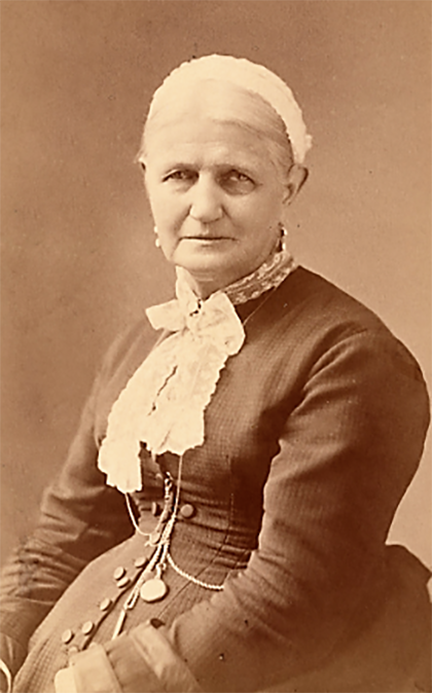
The recipient, Eunice White Bullard (1812-1897) about the time
she married newly ordained minister Henry Ward Beecher in 1837.

Their first posting was to Lawrenceburgh, Indiana. Then to Indianapolis where she caught malaria that afflicted her all her life. Ten years on Indiana's frontier were hard duty. Eunice gave birth to four children but two had died by 1847 when the couple was thrilled to get a call from founders of a new church in Brooklyn, New York who were impressed by Henry's preaching style and philosophy of religion as love rather than brimstone. Henry thrived at the Plymouth Church where he was minister from 1847 until his death in 1887. 

Eunice & her first set of twins

Six more children arrived in Brooklyn but by the time the Civil War began in 1861 the Beechers had only four living children, having lost the pair of twins above to mumps on the same day---July 4th, 1853---and others to malaria.

FindaGrave
Herbert was also a twin but it appears his brother was stillborn in 1854.


Brooklyn's Plymouth Church
rebuilt large to accommodate the Sunday audience after a fire

We can hope Eunice's religion (or Henry's) was some solace in the loss of the young children. Henry may have been some comfort (he grieved as deeply as she did) but he was a difficult husband. Always self-absorbed and needing adulation he enjoyed lecture and preaching road trips and the attention of star-struck congregants.

Henry Barton Beecher (1842-1916)

Weeks after the war began their eldest son Henry defied his mother and enlisted at 19 with his father's approval. In her biography of his father Debby Applegate tells us that the boy "was caught in a serious moral infraction and dismissed from his regiment in disgrace. His 'crime' was hushed up, but judging by his mother's reaction, it likely took place in one of Washington's notorious bawdy houses." 


Post-war gossip about Henry Jr.'s service in
the Springfield Republican and New York Times

His father's assistant Theodore Tilton somehow obtained a new posting for the junior Henry in the Army of the Potomac after an interview with Secretary of War Simon Cameron. Eunice was not pleased with any of these events.

Daughter Harriet married a minister at the beginning of the war. Eunice spent much of her war at a cottage she and Henry had bought in Peekskill, north of New York City in Westchester County. She wrote her husband many letters, which he failed to answer. Was she aware of Henry's extramarital affairs with young church members? 

After the war scandalous revelations about Henry's many affairs
enraptured the nation. 

Although she wouldn't have been able to describe it as such, Eunice was surely aware of his clinical depression, illustrated every Sunday in gloomy sermons. During the war concerned church leaders decided he needed a rest and sent him to Europe for four months at their expense.

New York Times, April 1863

Eunice did not accompany him.

Later spin on the 1863 rest cure was that Abraham Lincoln commissioned Beecher to influence public opinion in favor of the Union. Henry did make speeches in England to that effect---were they well-received?

Punch, the English humor paper, published some doggerel and a cartoon of "The Reverend Mr. Treacle" selling "Beecher's American Soothing Syrup" to a country that was not interested.
Mr. Beecher
Yankee preacher
Is, just now, a London feature.
Sent, we're thinking
By Abe Lincoln
To become Brittania's teacher.

Fort Sumter, April, 1865

Perhaps Henry's greatest Civil War honor was Lincoln's choosing him to give a speech at a notable ceremony as the war ended. Henry, Eunice with a host of friends and Plymouth Church members arrived at Fort Sumter in a chartered ship, where Henry gave a speech on April 14, 1865 celebrating the return of the Union flag over the war's first battleground. The next day they heard that Lincoln had been murdered the day of the ceremony.

Their post-war lives drowned in a huge scandal about her husband's hypocrisy regarding affairs with female church members that played out in the newspapers, resulting in a sensational trial in 1875.
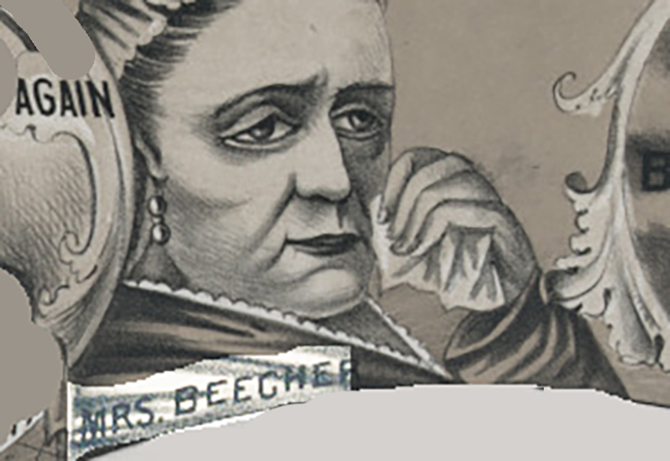
"Eunice, a formidable woman with commanding features and snow-white hair, attended regularly. Day in and day out, Mrs. Beecher, wearing a black dress and looking like a raven, sat impassively in a wooden armchair in the spectators’ section of the courtroom." Robert Shaplin, "The Beecher–Tilton Affair," The New Yorker, June 4, 1954.
 Do a search for "Beecher Tilton Scandal" to read MUCH more.


During that period Eunice must have found comfort in writing; she authored several books in her lifetime. Her 1873 book of household hints and recipes gathered from periodical columns advises mothers on how to teach girls to sew with a doll quilt. If this is indeed the way she approached dialog with children her four surviving children were very lucky.

But she was not considered a gentle woman. Her famed sisters-in-law, Henry's sisters Harriett Beecher Stowe, Catharine Beecher and Isabella Hooker found her querulous, hostile and complaining. The best Catharine could say for the public was that Eunice had "always been civil to the family." (An exaggeration.)

Henry Ward Beecher died in 1887---the adultery scandals somewhat forgotten. Eunice lived exactly another ten years with daughter Harriet Beecher Scoville and her family.

An Obituary in 1897
Another obituary with Eunice represented the steadfast wife---the Victorian woman steeped in denial clinging to the ideal of a life-long insoluble marriage.

The Cambrian, 1897

How much of this hypocrisy Eunice actually believed is open to question but she was a stubborn woman making the most of a marriage to a very famous and wealthy man whom diarist George Templeton Strong described as having "a screw loose somewhere." She coped.