Wednesday, January 3, 2024

Finishes: Atlanta Garden


Nocturne Atlanta Garden
Martha Claassen   

Elsie Ridgley

Shawn Priggel


Teresa Wood got the border on this week.

Post your finishes on our Facebook group page:
AtlantaGardenQuiltBOM


Wednesday, December 27, 2023

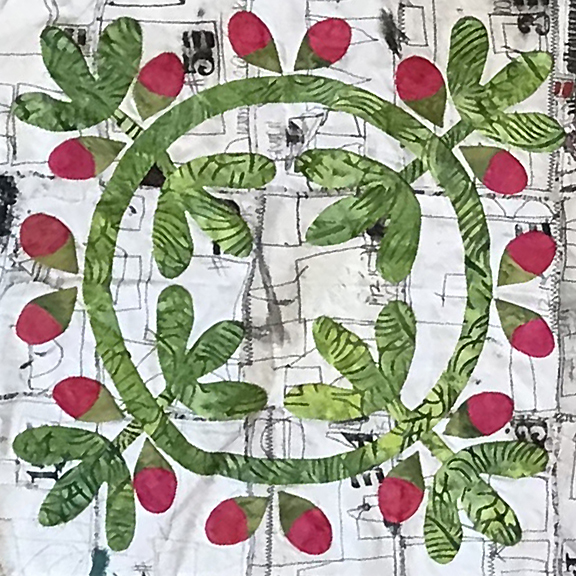
Herbarium # 10: Strawberry Wreath for Mrs. Robinson


Herbarium # 10: Strawberry Wreath for Mrs. Robinson by Becky Brown

After months of looking for the design source---a pattern or teacher who designed the eight Herbarium quilts---we have to give up. We are looking for someone like Mrs. J.A. Robinson who taught both botany and ornamental needlework at the Sharon Female Academy in the 1840s and '50s. 


But she taught in Mississippi far away from the known information about the eight samplers.


The Teacher, Godey's, 1840s

She was surely one of many similar teachers, wife of the principal and governess to the boarders, teaching the lady-like arts so valued in Southern families with botany an appropriate science.

Strawberry Wreath by Kathy Suprenant

An 1845 ad in the Jackson paper tells us that students will be
"surrounded by a virtuous and pious people." No dissipation or idleness.

All that remains of the Robinsons' Sharon Female Academy, which closed after
the war in the early 1870s, is this small classical outbuilding moved
 to the larger town of Canton.

 Strawberry Wreath by Becky Collis


1854

Mrs. Lincoln Phelps, textbook author, assured her audience the science was beautiful and delicate.


Although incipient scientists could be accused of being "a bit of a blue" as Jemima's mother did in a Godey's story.


A "Blue" was an intellectual, a woman often considered unmarriageable, one reason Southern parents were cautious about the curriculum. But surely, exploring the neighboring meadows for wild strawberry plants was a ladylike thing to do.

Botaniste by George Spratt


Southerners would not be sending their girls north to Oberlin, Ohio, a hot bed of radical antislavery ideas and romance apparently while collecting specimens at an interracial and coeducational college.

Oberlin Students 1855

The Block


"Strawberries Wreath"
Six of the eight samplers show a strawberry wreath with spade-like leaves.
A rather mysterious detail as strawberries, wild and cultivated, have a triple leaf. 
1812 botanical print of strawberries, rounder than ours


If it wasn't labeled on the Shelburne's sampler I'd think it was another fruit.

Quilt dated 1846 by Martha Wickham

Wild strawberry gathered in Carmel, California, 1945

Revised strawberry wreath.
The pattern

I am not going to sew the Strawberry Wreath as I only need 12 blocks for a side-by-side
horizontal set and the series offers 13 blocks. Number 11 & 12 will have
fewer pieces than # 10---You might want to wait and check them out before you start cutting strawberries.

The model makers are using the diagonal set with extra
half-wreaths on the sides


There is a bit of a mystery connected to the Sharon Female Academy. In the Methodist Cemetery a gravestone for Sarah N. Burns has a lengthy inscription for a student who died in 1847 when she was about 15, a "child of affliction."

Who were those "pretended friends?"

"Her career on earth was short. She was the child of affliction. The protracted illness of which she died was caused by mismanagement and the officious interference of pretended friends. But she passed triumphantly away and her last words were 'Come Lord Jesus and take me home / the greatness of the leaf is done / the beauty of the flower is risen / the birds to other climes have flown / and there's an angel more in heaven.' "  What kind of affliction???

https://www.findagrave.com/memorial/145122480/sarah-n-burns


 Strawberry Wreath redrawn to fit a pentagram by Robyn Gragg.


Wednesday, December 20, 2023

Barbara Freitchie's Civil War


Star pattern called Star Puzzle or Pieced Star in the early 20th century

In May, 1931 Needlecraft Magazine published an article by Helen Rockwell Adams who'd visited the recreation of Barbara Frietchie's house in Maryland. On the bed she saw a sawtooth star, which "tradition assures us that Barbara made...with her own hands." Adams pictured a block, naming it Barbara Frietchie's Design.

This recreation of the Frietchie house was once a museum in
Frederick but doubts as to the accuracy of the story presented there
created concerns about local "history."
 It's now a bed and breakfast.

Found by the Iowa project. Blocks are on point.

The simple star Adams pictured had several earlier names, although none as romantic as a design linked to America's female Civil War hero.

My generation was brought up on the stirring tale of a 95-year-old woman
defying Confederate hero Stonewall Jackson by flying a Union flag as his
troops passed her house in Frederick in September, 1862.

Poetry was powerful propaganda. During the Civil War Massachustts poet John Greenleaf Whittier often described current events in rhyme. From novelist Mrs. E.D.E.N. Southworth he heard the story, converted it to verse, which was published in the Atlantic Monthly in October, 1863.

Emma D.E.N. Southworth (1819-1899)

The stirring lines inspired patriotic fervor during the war and into the late 20th century despite the fact that historians have pointed out that Stonewall Jackson, who died in battle soon after the poem's events, marched nowhere near Frietchie's house. True or not, her tale was a Union answer to the Confederate myth of the martyr Stonewall. Here was a woman who'd won a small victory over the legendary General.

Barbara Hauer Fritchie (1766-1862)

When the Civil War began Pennsylvania-born Barbara was in her mid-90s. Scraps of her life have been determined. In 1806, at 40 years old, she married John Casper Frietsche who was 14 years younger than she. His father had been hung for a loyalist traitor during the Revolution. Her husband died in 1849; they had no children. She did indeed live in a house on the site when the Confederate troops occupied the city in September, 1862. Her health and mobility have been controversial subjects. Was she able to hang out a window and wave a Union flag? She died 3 months later, months before Whittier's poem appeared. The original house washed away in a flood in the early 19th century.

Frederick, Maryland, 1862

Frederick mayor (and busybody) Jacob Engelbrecht kept a dairy in which he noted much in Frederick society. 
Jacob Engelbrecht (1797-1898)

In 1942 Dorothy Mackay Quynn and William Rogers Quynn summarized their in-depth investigation into the accuracy of the story told in Whittier's poem, concluding there was no evidence it ever occurred.


The whole tale has inspired some historical absurdities: One being a 1924 movie with the flag event 
a point of drama between two young lovers in Civil War Maryland, each loyal to a different side.

Florence Vidor as a much younger Barbara Frietchie.

Another tale was told in which George Washington visited some Frederick women at a quilting party in 1791, giving Barbara a china bowl he'd been carrying in his bag.


Read Dorothy Mackay Quynn and William Rogers Quynn's  article "Barbara Frietschie" in the Maryland Historical Magazine (1942, Volume 37 Issue #4) at this link:

1900 Play

Quilt recorded by the Wyoming Quilt Project, mid-20th-century