Saturday, March 19, 2022

Fanny Fawcett Hopkins's Civil War #1


Fawcett Family Quilt

When the Civil War began Frances Alexes Fawcett Smith Hopkins was about 30 years old and newly married to her second husband Dr. Benjamin Franklin Hopkins. Frances brought a daughter Josephine Smith from her first marriage to Joseph Smith and the Hopkinses soon had Nannette in 1860. The first years of the Hopkins' life together were full of anxiety and grief---the lot in life for women of her generation.

Benjamin Franklin Hopkins  (1828-1916)

Once the shooting war commenced Dr. Hopkins left his wife and two daughters to join the Confederate Fifth Virginia Regiment, soon becoming surgeon of the Seventh Georgia Regiment.

Nancy's death record, collaged to be somewhat legible.

 In September, 1861 Frances's sister Nancy L. Fawcett died of consumption (tuberculosis) at the age of 29. Fortunately, Benjamin, who signed her death certificate, survived the War. Records inform us  "badly afflicted with rheumatism" he was mustered out. 

Battle of Upperville, Harper's Weekly

William H. Hopkins, Benjamin's brother, also enlisted in the Confederate Army. In June, 1863 he was wounded at the Battle of Upperville in Loudon County. His obituary 30 years later said he "was shot through the lungs and carried the ball in his body to the day of his death."

A more joyful event was the war-time birth of boy Dilworth in 1863, followed after the War by three more girls Irene (b 1866) Chertsey (b 1868) and Orra (b. 1874) and the youngest Frank (b. 1871)

The 1870 census finds them in Cedar Creek Township in Bath County. Also living with them was Jane Crawford Fawcett, Frances & Nancy's mother. Frances and Jane were from nearby Rockingham County.

Virginia before West Virginia seceded from the state during the Civil War.
Bath & Rockingham Counties are in the Shenandoah Valley.

Warm Springs in Bath County

The family lived in Bath County because Dr. Hopkins was a physician
at the hot springs sanitariums in the area, which is full of geothermal springs
that treated everything from his rheumatism to nervousness and depression.

The Ladies' Bath at one of the springs in 1881


90" x 98" 
Perhaps also in the house with the extended Hopkins, Smith and Fawcett family
was this extraordinary quilt, which has been passed down
by people who keep good records of their history.


The quilt was rather recently recorded in an event at the Wisconsin Museum of Quilt and Fiber Arts, which continues the work of documenting family quilts. The Wisconsin woman who owns the quilt knew quite a bit about it and her family. She believed that three of her ancestors worked on the quilt, which she thought dated to 1840 or so. She's the a g-g grand daughter of one of them and the g-g-g-g grand daughter of another.

The oldest woman, Nancy Smith Crawford (about 1790-about 1860) cut the fabric and her granddaughters pieced the blocks. Frances was about nine years old in 1840; sister Nancy was maybe a year younger. Their mother was Jane Crawford Fawcett who lived at one time in Harrisonburg, Virginia.

The girls pieced 72 pieced and appliqued blocks
 in a pattern popular at the time, often called Peony,
the Fawcett family name. Each block finishes to 6-1/2".

Harrisonburg, Virginia about 1900

Mother Jane Crawford had married Abner Fawcett (1802-1835) son of a store keeper in Harrisonburg in November, 1829 but the girls' father did not live long. His father Joseph Fawcett (1770-1844) lost his store and his fortune and went west to Missouri in 1834, settling in New Franklin in central Missouri on the Missouri River. A year later Joseph moved to St. Charles where the Missouri meets Mississippi. Joseph's branch of the Fawcetts (The Gausses married a Missouri Fawcett) also kept good records and many of their papers are available on line. Joseph told his sons of Abner's death on a visit to Missouri:
"In Sorrow I announce to you the death of your poor brother and my unfortunate son Abner. he died on board the steam boat Magestik opposite to a Town called Bambridge on the Mississippi on the 10th Inst [of this month] and was buried on the say [same?] day a short distance above the Grand Tower on the Missouri side of the river. how oft have the errors of this son pained and grieved me yet how awful was the intelligence of his death.... some times he was wayword but at other times he performed acts of genuine kindness poor dear fellow." March 14th 1835
A few weeks later the Majestic's boiler exploded and
Abner is sometimes described as a victim of that disaster
 near Memphis but he apparently died earlier of cholera, 
epidemic in the river towns in the early 1830s.

His father's description of Abner as "wayword" may explain why he is barely mentioned in the female family records. On her own after he left, Jane Crawford Fawcett took her girls back to her mother Nancy Smith Crawford's farm, where we can guess they were raised in a house of women.

1887: A terrible year for the Hopkins family

Jane Crawford Faucett herself died of "cholera morbus" in the summer of 1887 when she was 77 attended by her son-in-law Dr. Hopkins. That fall daughter Frances, 57, also died. Her husband listed "remittent fever," perhaps malaria, as the cause of death. Frances is listed as Fana, a variation of her nickname remembered as Fanny. Her grandmother Nancy Smith Crawford is said to have died in 1860.

A quilt made by lost family members might have been set aside for generations, one reason it was in such excellent condition 4 or 5 years ago.
Why extraordinary?
1) Age + condition
2) Visual appeal
3) Fabrics
4) Early example of a style & pattern
5) Much provenance or history that can be corroborated in records

Their father's father, Joseph Fawcett, then living in St. Charles, Missouri, visited them in 1840 and brought them fabric to make a quilt.

Dr. Chertsey Hopkins DeJarnette (1868-1947) 
(Perhaps named after a place in England)

Frances & Benjamin Hopkins's children turned out to be consequential people in their own right. Chertsey and Frank (1871-1959) became physicians. 

Dr. Nannette Hopkins (1860-1938)

Nannette Hopkins became an educator with a couple of honorary Doctorates as Dean of Georgia's Agnes Scott College. Orra became a Minister's wife. Exceptions were Dilworth who died at 17 in 1880 and Josephine Smith who remained a single woman without much of a paper trail, dying in her 70s in 1928. Most of the family is buried in the Warm Springs Cemetery in Bath County.

Next week more about the Fawcett quilt.


Saturday, March 12, 2022

Celestine Bacheller Remembers Her Civil War Home


Gathering water lilies

Celestine Bacheller (1839-1922?) is associated with this silk pictorial quilt
in the collection of Boston's Museum of Fine Arts.
56" x 74"

It has much in common with crazy quilts in the velvets and other weaves and the embroidery style. The accompanying story tells us Celestine in her 50s or so stitched memories of her childhood home in Wyoma, now part of Lynn, Massachusetts.

Wyoma's ponds feature in her landscapes.


Those waterways made Wyoma a good place for textile manufacture.
Celestine's family was in the silk dyeing and manufacturing business.


The 1850 census shows her father Alfred Bacheller as a Silk Dyer.
Hannah Roles Bacheller at 33 has 6 children from Celestine the eldest at 11
to baby Charles.

The family home at 395 Broadway on the Flax Pond

1860 Census
Hannah had two more girls in the 1850s. Alfred prospered according to this census and
teenagers Hartshorn and Lindley were also working in the silk business.

Port Hudson near Baton Rouge, Library of Congress

When the Civil War began Alfred joined the 38th Massachusetts Infantry,
which took part in the Siege of Port Hudson, Louisiana in the summer of
 1863. In August he was killed and buried in Louisiana.

1880 Census

Hannah took Celestine and younger girls Adeline and Lillian to live in Boston, where they remained. Her sons may have contributed to their female family members' upkeep but the Bacheller women earned a living as seamstresses.


Boston Public Library
View of Chambers Street about 1910

An 1869 directory listed Celestine, brother Eugene and Hannah living at 51 Chambers.


Dating the quilt by style and its relationship to the crazy quilts that became the rage after 1883, we'd date this then from sometime in the early 1880s until Celestine's death about 1922. Perhaps her seamstress sisters helped. The abundance of silks of various kinds might have been left over from professional sewing jobs or perhaps they bought the many packages of clothing factory cutaways available about 1900. The M.F.A. label tells us she was the forelady in a Boston tailor's shop in the 1880s and may have taken home scraps for the project.

Celestine is not listed in 1886 but George may be a brother, and Sarah a sister in law.


The quilt was probably made in Boston when the waterside home was just a family memory.


When Hannah died in 1891 they were still in Boston, boarding at 1098 Washington Street. Celestine never wed but Adeline married someone named Handrew (?) and Lillian married an O'Malley. By 1920 the three sisters were living together in Roxbury on West Cottage Street with the only man in the house Lillian's son Charles O'Malley then 29.

1920 Census


Charles or his wife may have inherited the quilt as it was donated by Mr. and Mrs. Edward J. Healy in memory of Mrs. Charles O'Malley.


Wednesday, March 9, 2022

American Stars #3: The Gratzes


American Stars #3 Double Pinwheels by Becky Brown
Double Pinwheels recalls the Gratz family, North and South, and their double heritage.

Rebecca Gratz (1781-1869)
Miniature on ivory by Edward Greene Malbone
American Jewish Archive

In her long life Rebecca Gratz wrote many letters, giving us much information about her distinguished Philadelphia family whom, we are happy to say, saved their papers.

Sully family portraits of Miriam Simon (1750-1808)
 & Michael Gratz (1740-1811), Rebecca's parents.

Her father Michael Gratz was a Philadelphia merchant, born in Silesia and educated in London, who emigrated with his brothers to the colonies in the 1750s. He and Miriam had eight children, four girls and four boys. Three of the children married but Rebecca, Sarah and three brothers remained single, spending their lives together in the family home, moving as economic circumstances changed.


The Gratzes apparently lived in this building at 7th & Market Streets in the early 19th century. The house was torn down but has been reconstructed because Thomas Jefferson boarded here while he wrote the Declaration of Independence.

Rachel Gratz Moses by Gilbert Stuart
The Rosenbach Library has a collection of Gratz portraits.

When sister Rachel Gratz Moses died in 1823 leaving young children their aunts and uncles took over much of their care. 

See a post on one niece Miriam Moses Cohen's quilt here:https://civilwarquilts.blogspot.com/2022/02/miriam-moses-cohens-civil-war.html

The brothers, rich men all, have left no mysteries about their bachelorhood but Rebecca Gratz has too often been defined by her chosen spinsterhood. As wealthy heirs she and sister Sarah did not need husbands to support them.

The story that has been perpetuated since 1820 (when Rebecca was in her forties): This Jewish woman  was in love with a Gentile but believing strongly that Jews should not marry outside their faith she rejected her true love. The tale really has little basis. Beautiful and wealthy she had many suitors but chose to live an independent life in the company of her brothers and her "children"---her nieces and nephews.
Rebecca has long been linked to the the Rebecca in Walter Scott's
romance Ivanhoe, the Jewish woman who refused to marry Ivanhoe
because of her religion.

1932 article in the Kansas City Star. The myth continues today.

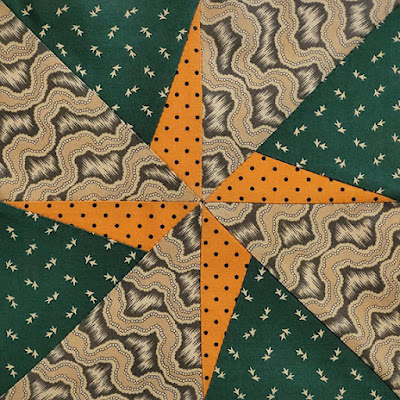
#3 Double Pinwheels by Denniele Bohannon

Benjamin Gratz ( 1792-1894) by Thomas Sully

Brother Benjamin did marry outside the faith. The youngest of Michael and Miriam's children was sent west after the War of 1812 to manage family enterprises in Kentucky. Settling in Lexington he created a southern branch of the family, becoming a Southerner in many ways. He made his own fortune, first in manufacturing rope, then in railroads. Creating rope from hemp was tough manual labor. At one point Benjamin had 75 slaves working in this profitable enterprise.

The census's 1850 slave schedule lists 61 unnamed people on this page
and probably more on the next for Benj. Gratz.

Maria Gist Gratz (1795-1841) by Lexington artist Matthew Harris Jewett.
Maria, a native Kentuckian and an Episcopalian, 
was Benjamin's first wife, married in 1819.

With skills at creating relationships and a tight family web, Rebecca befriended her new sister-in-law. Her letters to Maria detailing events in the Philadelphia household have been published. The extended family mourned when Maria died in her mid forties. Benjamin married his late wife's niece Anna Maria Boswell Shelby in a year or two. She was a rich widow; owner of 28 slaves according to a family account. Benjamin brought four adolescent boys to the marriage; Ann had one, Joseph Orville Shelby in his mid teens. 

The Block

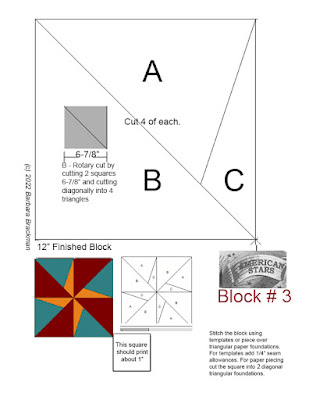
The block Double Pinwheel Whirls was published in Quilters' Newsletter a few decades ago,
a rather modern looking star. It's #1267 in BlockBase+.

Print the pattern on an 8-1/2 x11" sheet of paper.
Note the inch square for scale.

#3 Double Pinwheels by Jeanne Arnieri
Jeanne added an extra strip.

The Next Generation

Mount Hope, the family home, still stands at 
Mill & New Streets in Lexington's Gratz Park

The Lexington Gratzes welcomed family and neighbors at Mount Hope. Among the young students who lived at their home close to Transylvania University were cousins Frank Blair and Benjamin Gratz Brown. When the boys visited the Philadelphia Gratzes Rebecca wrote sister-in law-Ann complimenting her son: "Jo seems to have the spirit of mirth inborn in him." 

A tight family but civil war created divisions.

Rebecca in her seventies in the 1850s

At graduation the Lexington cousins headed for St. Louis about 1850, some to practice law and later politics. Henry Gratz and half-brother Jo Shelby were in search of their own fortune in the rope business and perhaps a western life free of parental supervision. Rebecca, fond of her nephew Jo, was optimistic. 
"So amiable affectionate & clever....he has gone to such a thriving place and where he has so many friends!"
Henry eventually returned to Kentucky in 1856 where he became a post-Civil-War newspaper editor, but Jo took to the Missouri frontier, settling in Waverly on the Missouri River about 75 miles from the state's western border with the new Kansas Territory. Their Waverly Steam Rope company required slave labor (reportedly 50 slave workers) and he became committed to the proslavery cause as Missourians defined it.

State Historical Society of Missouri
Joseph O. Shelby (1830-1897) in 1857
Shelby's Missouri career is romanticized by nostalgic Southerners

In his mid-20s, he came under the influence of Claiborne Jackson and David Rice Atchison, proslavery politicians advocating fraudulent voting in elections determining whether Kansas would be a free or slave state. Law-breaking escalated into terrorism and guerilla attacks on free-state settlers across the state border.

Missourians attack Lawrence, Kansas, 1856

Years later Shelby told Kansas historian William Elsey Connelly who quoted him in his book Quantrill & the Border Wars:
"I was in Kansas at the head of an armed force [in 1863]....I went there to kill Free State men. I did kill them. I am now ashamed...but then times were different....Those were the days when slavery was in the balance and the violence engendered made men irresponsible." 

So it was circumstances that drove him to murder. 

After Fort Sumter in 1861 Rebecca in Philadelphia worried about Ann's son: "What is the position of Jo Shelby in this terrible struggle? Missouri seem to be most turbulent." His position: A continuing commitment to slavery and violence to protect it. He organized a Confederate brigade in Union Missouri.

General Joseph O. Shelby
University of Kentucky Library
"I have seen [Jo's] name mentioned in the Southern Army...We may pray for Jos personal safety-tho' we cannot for the success of his arms." Aunt Rebecca.
The rest of the Gratz family remained Union loyalists, including Benjamin's son Cary Gratz who was killed early in the war in a Missouri battle with him and his step-brother on opposite sides. Lexington neighbor John Hunt Morgan also chose the Confederacy. He married Rebecca Gratz Bruce,
a family namesake if not a relative.

Rebecca Gratz Bruce Morgan ( 1830-1861) died of
complications from childbirth.

John Hunt Morgan (1825-1864) 
Boyhood friends Morgan and Shelby developed Confederate swagger
that created a long romantic reputation.

Jo Shelby must have been a charismatic charmer (glorified today despite his traitorous behavior.) His Union family continued to speak well of him and help him out. When Missouri became a nightmare of guerilla war in 1863, Benjamin Gratz traveled to Waverly to escort Jo's wife and children back to the safety of Lexington, Kentucky. After Confederate defeat Jo Shelby refused to accept reality and took his family to Mexico, although that plan did not live up to his expectations either.

Among the Lexington cousins who'd moved to Missouri in 1849 were Frank Blair and Benjamin Gratz Brown, lukewarm free-state supporters who became Union leaders during the war. Brown, who went by the name Gratz Brown, ran for American vice-president after the war as Horace Greeley's unsuccessful running mate.

Anna Maria Boswell Shelby Gratz (1808-1892) at Mount Hope

Family solidarity deteriorated as younger family members grew up. When Ann Shelby Gratz died in 1892 her will left most of her ($40,000-$100,000?) estate to her surviving Lexington daughter Anna Gratz Clay and $4,000 to each of her four grandchildren. Joseph Shelby received only a small bequest. 


He sued to overturn the will, supported by his  nieces and nephew, accusing his sister Ann Gratz Clay of undue influence on their mother. 

Cincinnati Enquirer, March 1, 1895

If you want to read more "spicy testimony" or spiteful testimony do a newspaper search in February & March, 1895 for family names like Annie Gratz Clay and Jo Shelby.

It turns out (if you believe Shelby's lawyer) that no one in the family liked sister Ann Gratz Clay (Mrs. Thomas Hart Clay, Jr.)  Dubious documents were introduced and rejected. The lawyers came close to fisticuffs; the family's feud was spread over the newspapers. Shelby lost.


It was those bigoted Union veterans on the jury, Jo told the pro-Confederate
Kansas City Times, one of the Kansas City papers
 that did a great deal to make his legend.

Denniele's block as an all-over repeat.

Further Reading: