Wednesday, February 16, 2022

Freedom's Friends: New Applique Series for 2022


Time to start thinking out next year's Applique Block of the Month.
We are wrapping up the Ladies's Aid Album on the last Wednesday of
February.

Look for a free pattern for Freedom's Friends on the last Wednesday of each month starting on March  30th, 2022---and a true story about the Underground Railroad as it operated out of Philadelphia.

The history comes from William Still's book about fugitives on
 their way from slavery to freedom.

William dedicated the book to "The Friends of Freedom," the "Heroic Fugitives" and their descendants.


The Underground Rail Road,
published in 1872 provides many historical vignettes with absolutely nothing to do with codes and secret messages incorporated in quilts---that once-fictional tale frozen now as historical bunk by those who know little about quilts, runaways or antislavery activism.


Pook & Pook Auction

William Still provides the historical inspiration and we'll certainly never run out of applique inspiration.
The blocks will be relatively simple, drawn mostly from Delaware River Valley samplers of Pennsylvania and New Jersey made in the 1840-1860 period.

Attributed to Mary Higgins (1811-1860) New Jersey, 1850
Garth's Auction

We have a Facebook page. It's public so you don't have to ask to join. Post blocks, questions and comments over the year. Freedom'sFriendsQuiltBOM - all one word.

And if you'd like to buy all the patterns now for $12 in a PDF to print yourself here's a link to my Etsy shop:
https://www.etsy.com/listing/1155035028/freedoms-friends-applique-quilt-bom

We model makers the Killer B's have picked our fabrics and finished a few blocks.

B for Bohannon
Denniele begins with a rather conservative color scheme for Denniele:
Traditional reds and greens.
We shall see what she makes of it.

B for Brown
Becky's using a bright palette of hand-dyed almost solids with
a dark blue background

B for Brackman
I am using a winter landscape look with various
grayed light backgrounds and muted reds and greens from the
box of "Pieces too small to save."

The blocks will be appliqued to squares cut anywhere from 18-1/2" to 17-1/2" (so you can square up a fat quarter if you like.)
You'll need the usual range of lights to darks for applique shapes.
If you are buying fabric you can plan on about 6-1/2 yards for a single background (and borders)
and 8 fat quarters for applique.


Reproduction print ideas
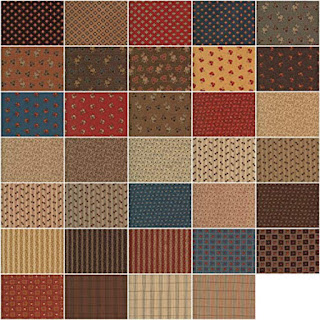
Yesterday by Jo Morton

Di Ford's Oak Alley

This line from Edyta Sitar is intriguing.

And there is plenty of Ladies' Legacy in shops.

William Still's hand-written records
Collection Temple University

His book---the link won't work but do a web search for William Still Underground Railroad to see the digitized book.
 

https://www.google.com/books/edition/Still_s_Underground_Rail_Road_Records/KD9LAAAAYAAJ?hl=en&gbpv=1&dq=william+still+underground+railroad&printsec=frontcover

Saturday, February 12, 2022

Honest Abe: Quilter


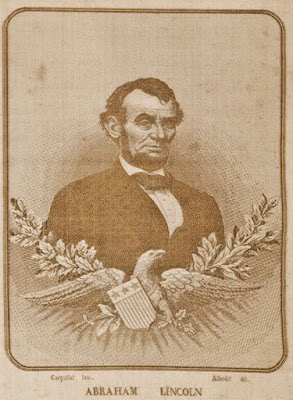
Woven silk portrait of Lincoln

Today is Lincoln's actual birthday. Honest Abe was born February 12, 1809. As one of the top three best-ranked Presidents by historians and an American tragedy in his assassination he has many tales connected to him. Among them a few quilts.


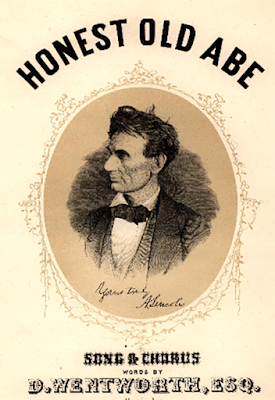
Campaign sheet music, Library of Congress

Harney County Museum, Burns Oregon
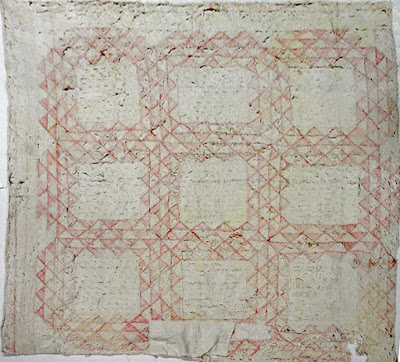
The Oregon project recorded this Ocean Waves quilt with a Lincoln story.

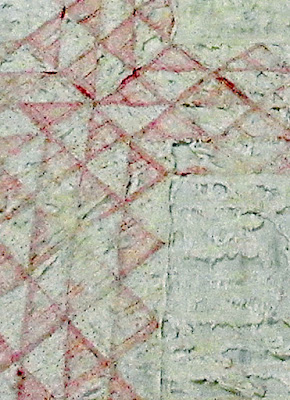
Honestly, the quilt is in terrible shape --- it has the kind of damage one sees after time between the mattress and the bed springs, an idea entirely too popular in the early 20th century.

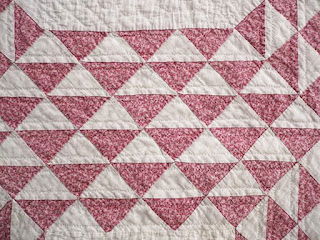
It seems to have been pieced of a plain white and a double
pink floral print.

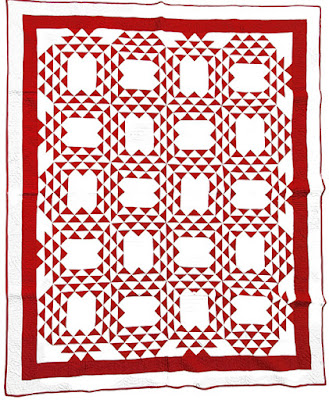
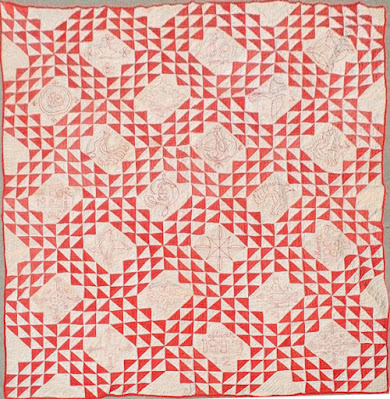
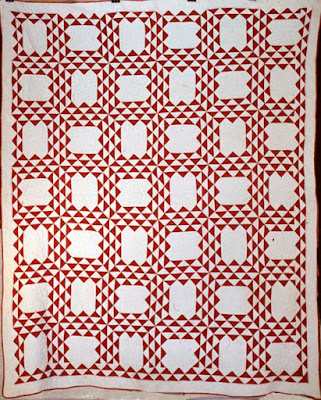
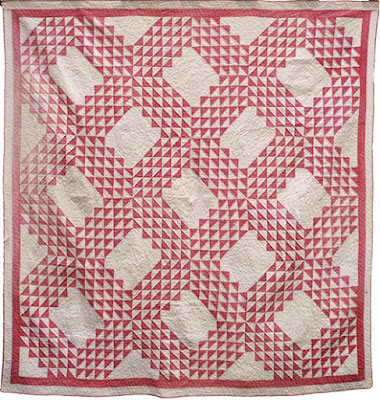
It must have once looked like this version in Turkey red and white.

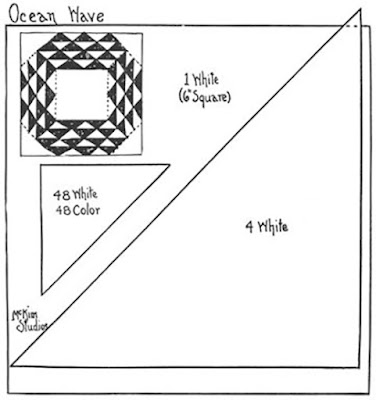
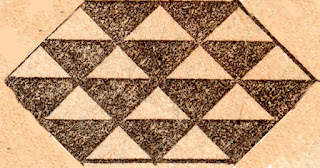
The pattern is commonly called Ocean Wave, based on blocks shaped like
long hexagons full of triangles.


From the Quilt Index file:
"Story associated with the quilt says that Abraham Lincoln assisted with quilting when he stopped by the family farm for a visit. The cotton was raised by Amanda's father, Jacob Cowels, and used in the padding. When William M. Ray was 18 years old, the quilt was given to him by his mother, Amanda (Cowels) Ray. In 1926, William gave the quilt to his daughter, Mrs. Elmo (Ila) King....

"This Oceans Wave quilt is known as the Lincoln Quilt because Abraham Lincoln assisted in the quilting while visiting the quilt maker's family. The Harney County Historical Society dates this quilt to 1854 because Abraham Lincoln was living in Illinois in 1854 while running for Congress....

"The original of this copy was signed by Mrs. King at Otis, Oregon in 1928. The quilt was then given to her brother Eben Ray, by her family on her death in 1980."
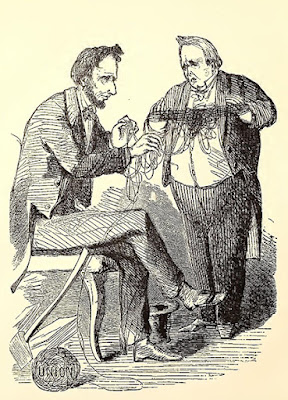
Lincoln and William Seward (?) with a ball of yarn
labeled Union.

 I think the "copy" referred to above is a paper copy of the family tale.


Ila Esther Ray King 1909-1982 apparently wrote and signed the story. Here she is in the 1930 census living in Tillamook. She was born in Oregon as was her mother. Her father was born in Ohio.

Based on the physical evidence of the quilt (and a lack of documentary evidence) this quilt had nothing to do with Abraham Lincoln,  probably made long after his death in 1865. Abe did not put a stitch in it.

The Ocean Wave design was quite the fashion from about 1880 to 1925. 
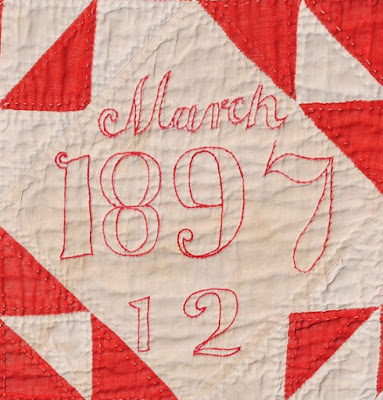
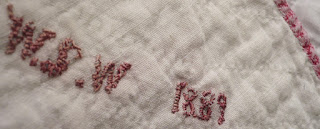
The example above has redwork embroidery in the plain white squares.

And a date of 1897


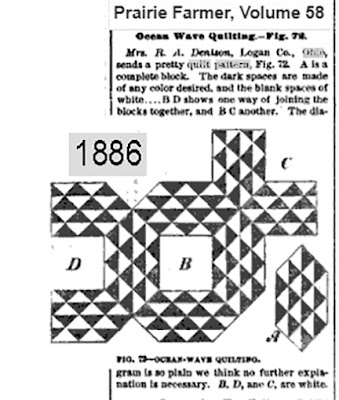
Probably the earliest published version of the pattern---
1886 from the Prairie Farmer magazine.

1892, attributed to Mona Miller, West Virginia Project

Above: the earliest Ocean Wave in this pattern arrangement
 in my file of date-inscribed quilts.

A double-pink Ocean Wave dated 1889 from an online auction.

Block on the diagonal.

Museum holdings like the "Lincoln Quilt" present many problems. Should such a worn-out object be taking up storage space? Could it be de-accessioned as having a completely dubious family history? Would the family be angry that their cherished "brush with greatness" was dismissed as untrue?

Or could the object be re-interpreted with an honest label (in honor of Honest Abe) saying something to the effect that in the past much material culture was valued only for its association with famous men. We know from examining this quilt that it could not have been made during Lincoln's lifetime but probably after 1880. Current thinking about material culture values the object itself. We can wonder who made it and where and why it was so undervalued that it became so worn. And then again why it became so overvalued that it was donated to a museum?

Wednesday, February 9, 2022

American Stars #2: The Keys


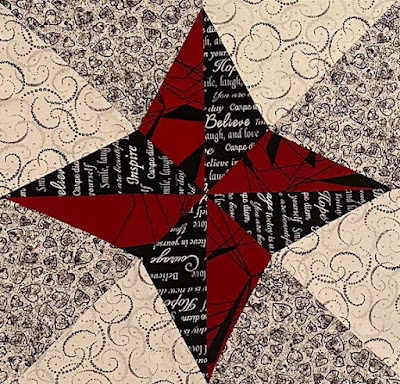
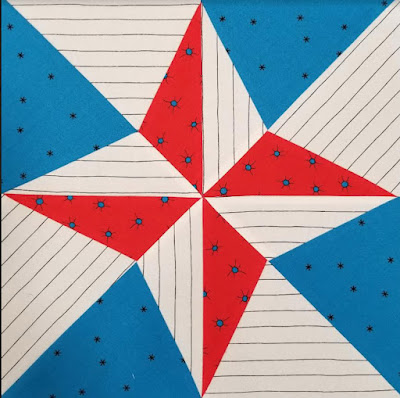
American Stars #2: Star-Spangled Four Patch by Becky Brown

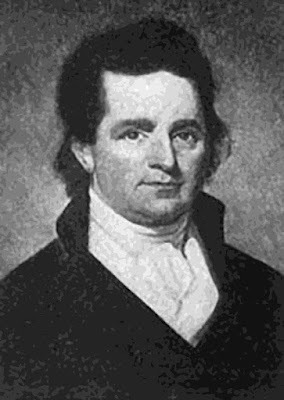
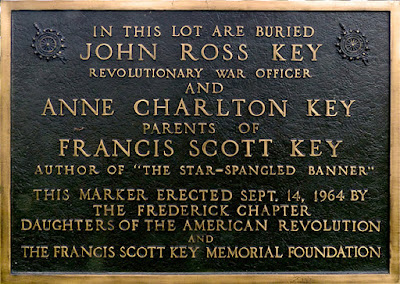
Star-Spangled Four Patch recalls the Key family whose notoriety goes back to the Revolution when Phillip Barton Key, son of English immigrants, chose the British army. Brother John Ross Key (1754-1821) fought on the opposing side.

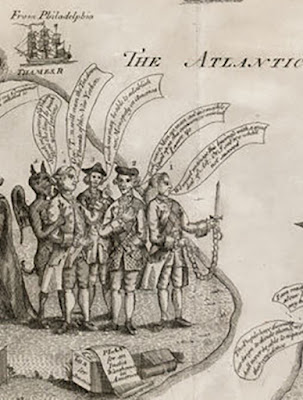
Loyalist soldiers fighting for the crown listening to satanic advice

Phillip Barton Key, the elder, 1757-1815

Phillip fought the Yankees for 4 years until the Spanish captured him in Florida shortly before
the war was won. Like many Loyalists he sailed for England after the colonial victory at Yorktown.

John merits a D.A.R. plaque; Phillip not.

But Phillip returned to Maryland where he and his brother resumed family affections and he restored his reputation with the people of Maryland who elected him to Congress in 1807. The Key men often studied law over the generations. Phillip took his nephew Francis Scott Key into his law practice.

National Portrait Gallery
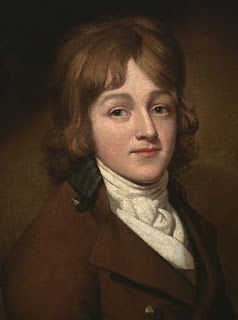
Francis Scott Key (1779-1843) in his teens.
Portrait by Rembrandt Peale, about 1796

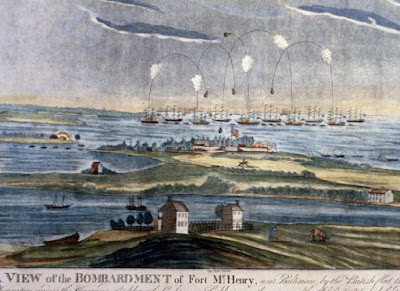
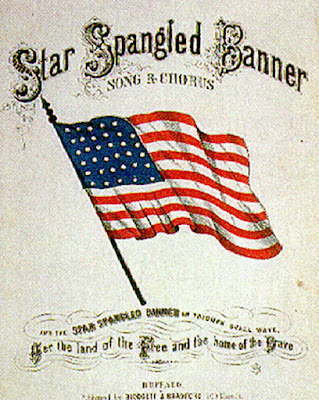
Francis, of course, is remembered as the author of "The Star Spangled Banner," a poem written while he was witness to Maryland's Battle of Fort McHenry in 1814.


The poem was set to music and is now the U.S. national anthem.

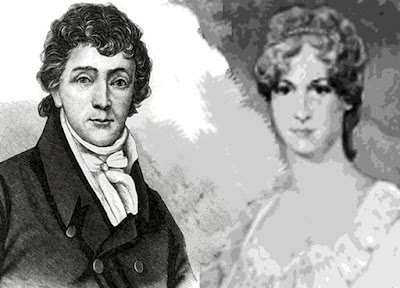
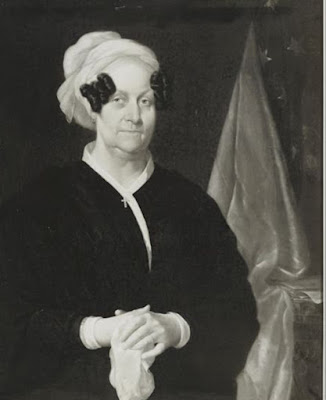
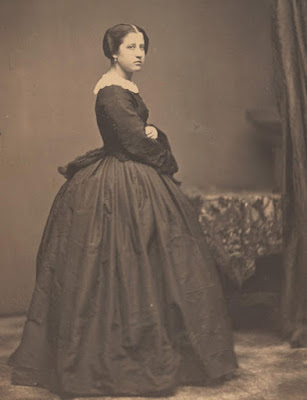
Francis (Frank) Key and Mary (Polly) Tayloe Lloyd Key (1784-1859),
 married in 1802, lived in Georgetown. 
Friend Rosalie Calvert: "I must tell you of an event of Annapolis society, 
Polly Lloyd is to be married next month to Frank Key who has nothing..."

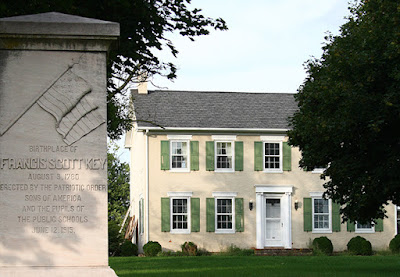
John Ross Key's family home Terra Rubra in Carroll County, Maryland.
The house has been rebuilt since Key owned it.

American Stars #2: Star-Spangled Four Patch by Jeanne Arnieri

John Ross Key's only daughter Ann Charlton Key (1780-1855) married lawyer Roger Brooke Taney here in 1806. Her husband, brother Frank's school friend, became Chief Justice of the Supreme Court, forever blamed for the Dred Scott decision of 1857 stating that no Black person could be a citizen of the United States.

Uncle Roger Brooke Taney (1777-1864) died on the day Maryland abolished slavery
October 12, 1864. Ann and their daughter had died in an 1855
yellow fever epidemic.

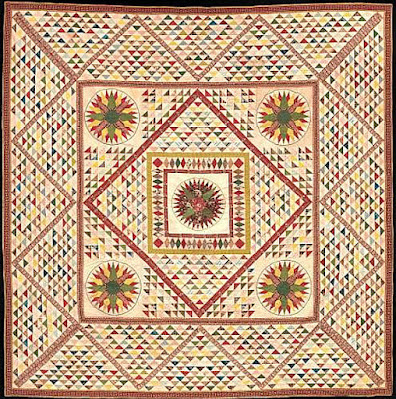
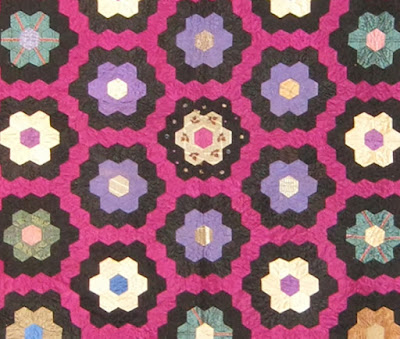
Bedcover attributed to Mary Tayloe Lloyd Key
D.A.R. Museum Collection
Mary's unquilted spread, pieced over quite a period of time in the 
years of her widowhood. Frank died in his mid 60s in 1843.
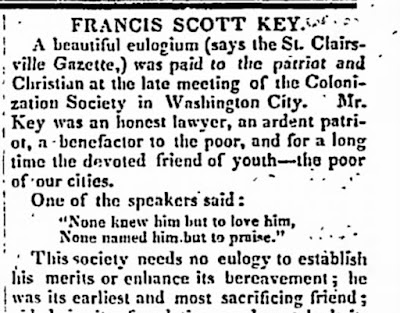
Obituary, March, 1843

The Block

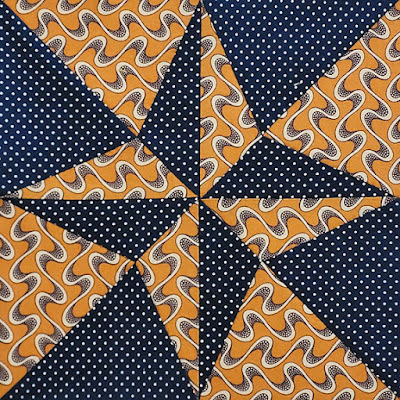
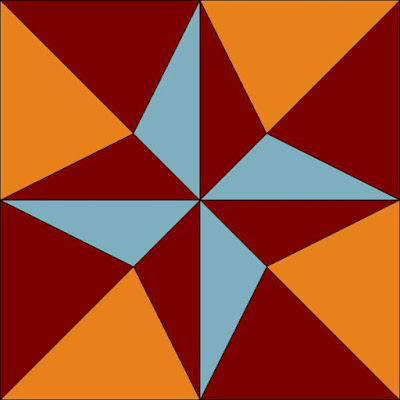
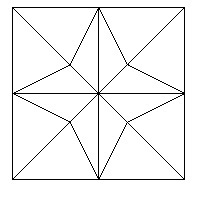
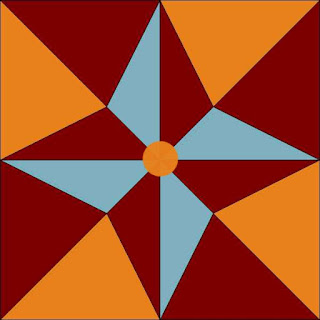
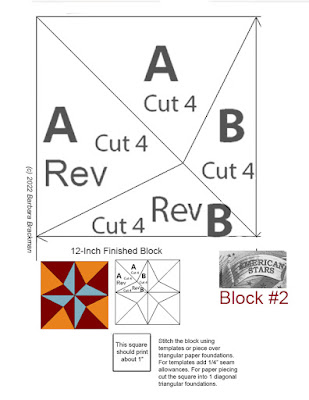
BlockBase #1235 was published as Star & Dot in Comfort magazine about 1900.
Where's the dot? Put one in the center if the intersection of 8 seams frustrates you.


Print the pattern on an 8-1/2 x11" sheet of paper. Note the
inch-square block for scale.

Star-Spangled Four Patch by Denniele Bohannon

The Next Generation

Polly and Frank had six sons and five daughters. The daughters married well to lawyers, naval officers and politicians, but there was a streak of violence and a dark side to some in the family. Son Daniel Murray Key (1816-1836) joined the Navy and began a lifelong fatal hatred of shipmate John Sherburne.

1836. Daniel died at 20.

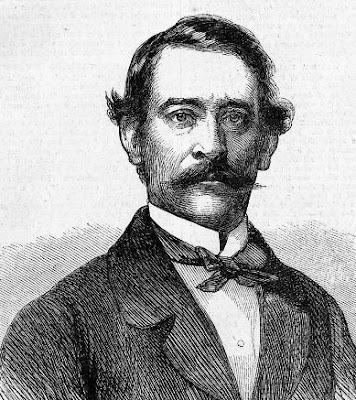
Phillip Barton Key (1818-1859), named for his great-uncle, was two years 
younger than Daniel. While he was Washington's District Attorney 
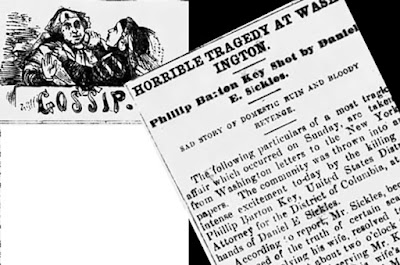
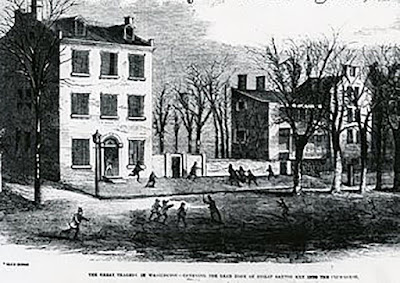
he was murdered by a member of Congress, Daniel Sickles of New York.

Sickles shot Key in February, 1859 in their Lafayette Square neighborhood
across from the White House.

Lafayette Square today

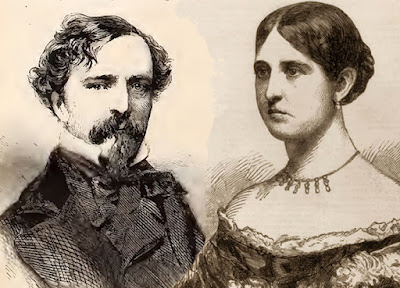
Daniel (1819-1914) and Teresa Bagnioli Sickles (1836-1867)
The issue was adultery. Teresa Sickles was flaunting an affair
with the District Attorney.


Mary Lloyd Key with a star spangled banner

Mary died less than 3 months after her son's murder. Sickles, freed by a pioneering claim of temporary insanity, continued to serve in Congress and as a Union General during the war. 

Harvard Libraries, Mrs Dan Sickles

He and Teresa remained married until she died of tuberculosis at age 34 in 1867.

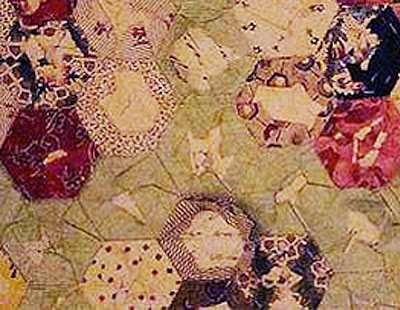
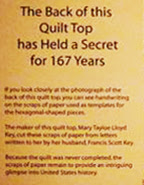
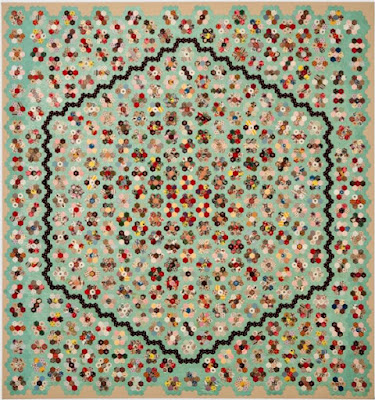
Mary Tayloe Lloyd Key is credited not only with the quilt above but a second hexagon quilt in the collection of the San Jose Museum of Quilts & Textiles. 


"The maker of this quilt top, Mary Tayloe Lloyd Key cut these scraps of paper from letters written to her by her husband Francis Scott Key."

The Key and Lloyd women of various generations seem to have been enthusiastic quiltmakers.


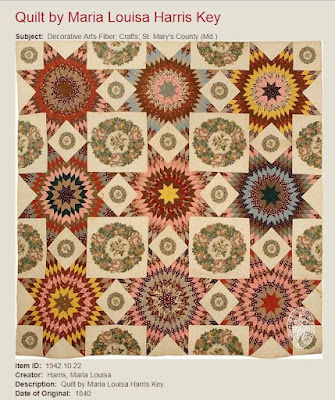
At least two quilts are credited to Maria Louisa Harris Key (1804-1879) of Leonardville, Maryland, married to a Key cousin of Frank's. This silk quilt, also in the D.A.R. Museum, has a label on reverse:
"John Baltzell Key 1879 made by his grandma M L Key aged 74."
Maryland Historical Society Collection
Maria Louisa Key pieced stars alternated
with a furniture panel, a wreath of roses.

Star-Spangled Four Patch by Nora Krein

See more family quilts at this post:

https://civilwarquilts.blogspot.com/2020/08/rebecca-lloyd-nicholsons-civil-war.html

The Lloyds were slave holders. Mary Lloyd's home Wye Plantation was home to 1,000 slaves at one point. Frederick Douglass was born on a Lloyd plantation in the 1820s.

Read about one woman who escaped:

https://civilwarquilts.blogspot.com/2021/06/amarians-escape-from-slavery.html

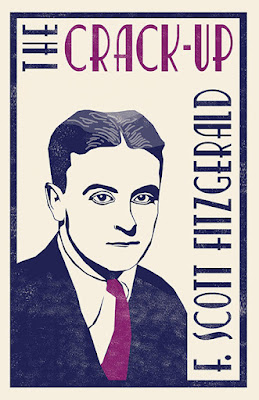
We haven't room to pursue later Key generations but consider Francis Scott Key Fitzgerald....

"The fault, dear Brutus is not in our stars, 
But in ourselves..." William Shakespeare, Julius Caesar

Star-Spangled Four Patch by Laura Steinert Chages

See what's up on our Facebook page:

And post on the Instagram page: