Saturday, April 16, 2016

Seven Stars/Seven Sisters 2

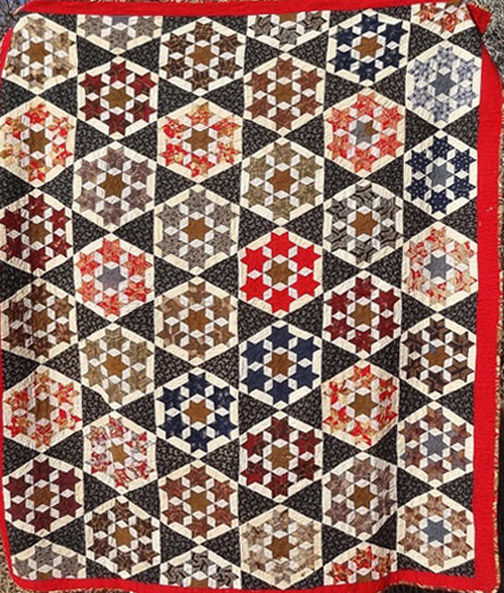
Most of us today would call the block "Seven Sisters."

We tend to believe in some Civil War symbolism, as in this caption from the International Quilt Study Center & Museum's website:
"Folklore has it that the seven stars in the block represented the first seven Southern States to secede from the United States before the inauguration of Abraham Lincoln as President on March 4, 1861."


See a Missouri quilt in their collection and a photograph here:
http://www.quiltstudy.org/collections/quilt_of_the_month/qom.html/title/february-2013-

A quilt signed Texas Fergerson from Cindy's Antique Quilts

Seven stars on a Confederate apron.

I have used the name Seven Sisters as a symbol of the early Confederacy.

 But I couldn't find a history of that name for this particular pattern before the 1930s.

Here's the pattern in BlockBase as #241.

The earliest published name I was able to find was Seven Stars,
which the Ladies Art Company of St. Louis included in their early catalogs
dating to about 1890


I would guess a similar quilt won a premium at the Nobles County, Minnesota, fair in 1892:
"Mrs. M. L. Belknap Quilt-seven stars."


Ruby McKim, whose patterns were so influential about 1930, called it Seven Stars...

and so did Eveline Foland when she sketched it for the Kansas City Star
in 1931.

The Star published it again with different shading as Seven Stars

In 1935 Carrie Hall called it Seven Stars
and wrote that the design offered "many possibilities
and makes a very attractive quilt." She didn't mention
any symbolism.

Here's her actual block at the Spencer Museum of Art (rather surprising to see that it's yellow.)

The Nancy Page syndicated newspaper column gave it two names in 1933.
"Seven Stars or Seven Great Lights"

Says Nancy:
"Mrs. John Evans of Pueblo, Colorado, is the donor of this old-time favorite. She says that her mother received it recently from the grandmother who made it when she lived in Arkansas. The grandmother called it "Seven Stars" but Mrs. Evans would like to rechristen it and call it "Seven Great Lights."
That name didn't catch on.
You may notice different designers
constructed the seven stars in
different fashion

When did the pattern get the name Seven Sisters?


The earliest reference: The Nancy Cabot column in the Chicago Tribune printed the pattern on March 13, 1933, and captioned it "Seven Sisters." Loretta Leitner Rising, the columnist, dedicated the quilt to the seven lovely daughters of old Virginia's Fowler family and gave the block two other names: Seven Stars and Virginia Pride. Nancy was a particularly imaginative writer so quilt historian tend to discount her accounts of names, dates and sources.

And who are the Fowler sisters? 

Perhaps I've made too much of the pattern and the symbolism. I certainly cannot find any kind of a paper trail that leads me to believe the pattern had the name Seven Sisters before 1933 or any Civil War meaning.

Wednesday, April 13, 2016

Grandmother's Choice Samplers

Mike Ellingsen
Grandmother's Choice
Mike did a great job with the color. 

Several years ago we did a Grandmother's Choice BOW with
a history of the women's rights movement.

From the Rural New Yorker in 1916. 
"Votes for Women: Beginning Early at a Great Question"

Here are some finishes.
Amanda ---1 of 3

Flo B - used the green and yellow symbolic colors of the Suffragettes.

Dustin Cecil
uses any darn color he wants to.

He's right. The sashing really pulls it all together.


Pink Deenster's second top

Sylvaine's

And Pillen Maja

I gave Grandmother's Choice its own blog address. It's not to late to start your own quilt. Here's a link to the first block.
http://grandmotherschoice.blogspot.com/2012/09/1-grandmothers-choice.html
They are posted once a week for much of 2012.

And see more finishes here:
https://www.flickr.com/photos/86465285@N08/galleries/72157636539803055/

I've been figuring out ways to use Pinterest to index my files. I started a page called FREE Historical BOM & BOW with links to the series I've been posting over the past few years. See it here:
https://www.pinterest.com/materialculture/free-historical-bom-bow-from-barbara-brackman/

Saturday, April 9, 2016

Seven Stars 1

Silk Star Quilt in the collection of the Museum of the Confederacy/American Civil War Museum, a gift for Jefferson Davis, attributed to the "stormiest part" of the Civil War, according to his wife Varina Davis.

You can look at the repeat pattern in several ways.
There are just two pieces, a diamond and a hexagon.


Read more about it at this post.

But you can also look at it like this as a hexagonal block.
and rotate it so it matches BlockBase #241.
We'd call it Seven Sisters


It's a hexagonal block of two pieces, a diamond and an irregular shaped, four-sided piece along the edges. The pattern was made by many quiltmakers North and South before and particularly after the Civil War.

The block was especially popular after about 1880.
Many surviving examples were pieced in
 fashionable colors from the
1880s and well into the 20th century.


Made by Mary Ellen and George James, Illinois, 1870-1900
Illinois State Museum. Union veteran George cut the pieces
for this after his return from the Civil War.

Detail of the James quilt

About the same time from the Michigan project
and the Quilt Index.

1880-1910
by the "Cheerful Workers of Concord" presented to their minister
W.R. McDowell,
Tennessee project and the Quilt Index


About 1890-1910 

About 1945 by Tomasita Ferro Bastardo,
Texas project and the Quilt Index

Detail of a silk quilt from about 1850 from
the collection of the Victorian and Albert Museum.
Related designs go back further in time

Quilt by Alice Bennett, date-inscribed 1873
Collection International Quilt Study Center and Museum
2003-003-0321

Alice Bennett's 1873 quilt is a variation. She pieced six stars instead of seven.

Unusual block from a 
Baltimore Album quilt in the collection of Colonial Williamsburg
with blocks dated 1844-1847
My first reaction to this pattern in the quilt donated by Varina Davis was that there is Confederate symbolism in the design. I've been working on this idea but I am not getting very far with it. More next week.


Wednesday, April 6, 2016

Block 2 as a Quilt

Indian Territory
I Photoshopped all the Block 2 (Indian) posts from the
Flickr page that were done in repro prints
and sketched a quilt.
A scrappy quilt.

Every other block is rotated 90 degrees.

8320-15 
I used this print (Lidian) from Old Cambridge Pike for the border.

Here are some of the blocks.


I like these blocks with triangles along the edges

Because they make Flying Geese when 
you set them side by side.