Saturday, March 29, 2014

Threads of Memory 3: New Garden Star for Catherine White Coffin

Block #3
New Garden Star by
Jean Stanclift

New Garden Star layers the classic eight-pointed star atop a four-pointed star. 

The patterns were free online for two years but now I am offering them for sale in two formats
at my Etsy shop. Buy a PDF or a Paper Pattern through the mail here:


New Garden Friends' Meeting House, Indiana
About 2008

The new star pattern is named for the New Garden Meeting House where Catherine Coffin, her family and friends offered help to many fugitive slaves. Their surviving minute book records the day-to-day financial details of the Underground Railroad, as in an 1849 entry about efforts "to procure a home for Marian Danse." The committee reported that "she has been removed to Canada at an expense of $20."


Catherine White Coffin in her 70s,
 portrait from her husband's 1876 book.

In 1826, young Catherine White Coffin, husband Levi and baby Jesse moved from New Garden, North Carolina, to Indiana for reasons that remain a bit mysterious. Like other westering couples they hoped to prosper. Levi flourished on the frontier, first as a merchant and later as a manufacturer of linseed oil. They chose the town of Newport because Quaker family and friends from Guilford County had also moved there, establishing a nearby meeting house they named New Garden after their old home.

In a speech towards the end of his life Levi said North Carolina had become dangerous for the antislavery Quakers. In his autobiography he claimed to be surprised that the highway near his new home was a branch of what came to be known as the Underground Railroad. His protestation of ignorance has a false ring, however. For years members of their North Carolina community had been cautiously smuggling runaway slaves north to Friends in Richmond, Indiana. Catherine and Levi must have carefully chosen their new home north of Richmond. Thanks to their generosity, courage and organizational skills, the number of fugitives escaping through eastern Indiana increased significantly.


The Coffin's Federal-style brick house, built in 1839, overlooks highway 27 in Fountain City, Indiana, the town they knew as Newport. It was placed on the National Register of Historic Places in 1966, restored and opened as a public museum in 1970 under the Indiana State Museum System


 The yellow star on the eastern border of Indiana is
the general location of the Coffin's Indiana home.

Block #3
New Garden Star by
Dustin Cecil
(I FORGOT to post this yesterday, sorry you fans of D.C)

Levi Coffin loved the metaphor of an underground railroad for the network of neighbors who helped escapees travel north. Of Newport he wrote, "The roads were always in running order, the connections were good, the conductors active and zealous, and there was no lack of passengers."


"Aunt Katy" Coffin (1803-1881) was at the heart of the Newport trunk line. "There never was a night too cold, or dark or rainy, for her to get up at any hour, and prepare a meal for the poor fugitives….many a time 12, 15, and even 17 sat down," recalled her husband at their fiftieth wedding anniversary party. In the twenty years they lived in Newport, Catherine gave birth to five more children, two girls and three boys, so there was always a baby or toddler to care for in addition to numerous houseguests. She organized a sewing society that stitched clothes for fugitives. Agents would meet ragged runaways to assess clothing needs and sizes and then choose garments from the Antislavery Sewing Society depository at the Coffin house.

Catherine was a woman "who wouldn't scare worth a cent," Levi bragged. Despite death threats, "they were never in the least terrified." As the years passed, the Quakers' Underground Railroad activities became accepted and they had little to fear in Newport. The "conductors" were politically and financially powerful and their Quaker neighbors, even those who felt no call to harbor ex-slaves, were not inclined to report fugitives to the sheriff.

New Garden Star by
Becky Brown

Nathan Coggswell remembered transporting refugees in his ox cart north towards Canada. Most came to him from the Coffins' organization. "When there were women and children we had to rig out a covered wagon. We sometimes hung chairs, spinning wheels and other articles on the wagon to give the outfit the appearance of movers."

Coggswell described the network of friends. "I knew every person between Richmond, Indiana and Michigan who would take us in and keep us all night….We talked over the situation freely among ourselves, but said little or nothing to others. We had no signs or secret words." During the 1840s and 1850s as national consciousness of slavery's evils developed, the need for secrecy in eastern Indiana subsided. "It was soon considered a disgrace to interrupt a colored person. The danger was about over."

New Garden Star by
Becky Brown

By then the Coffins had moved on to Cincinnati, again for vague reasons. Their 1847 visit was planned to be temporary but became permanent. Antislavery leaders requested Levi's help in running a store selling goods made by free labor there. 
Kentucky runaway Henry May had escaped, says the ad,
"in all probability to Cincinnati, Ohio." 1838.

But Cincinnati was the center of Underground Railroad activity along the Ohio/ Kentucky border. Unlike Newport, where the community agreed to ignore illegal activities, the river town was divided between antislavery and proslavery activists. Refugees crossing into the city were followed by masters who enlisted the authorities to return their human property and arrest anyone who helped in the escape.
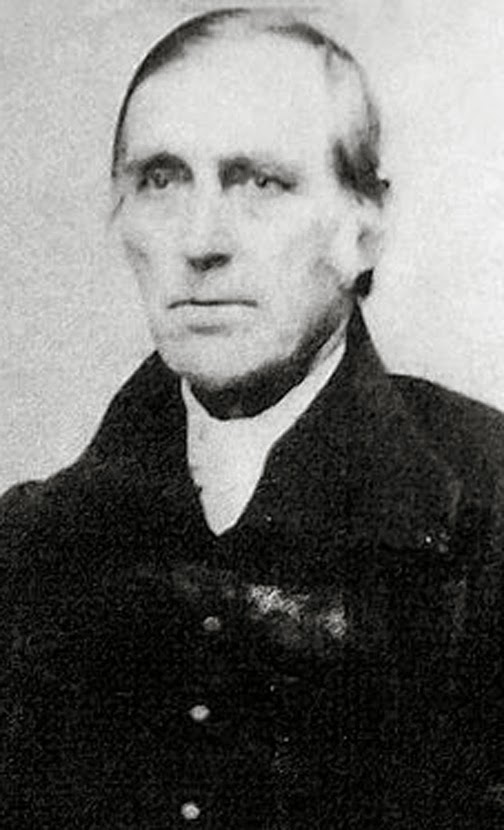
Levi Coffin, 1865

It seems that the Underground Railroad needed the Coffin's leadership and courage not so much for a store, but for the more dangerous job of smuggling refugees. Again Catherine fed and clothed people during their first days of freedom, but her Cincinnati house had a larger attic than the one in Newport. The 1860 census finds them maintaining a boarding house for 29 men and women ranging from 2 to 50 years old, an excellent cover for a underground railroad station.

The Quaker standing in the back row is thought to be Levi Coffin
and the bearded man at top right Jonathan Cable,
who assisted Coffin. The runaway family may be a group Coffin
recalled in his memoirs.

Read the excerpt from Coffin's book here: 
Read more about the photo at the Fulton Sun:

In 1852 Harriet Beecher Stowe published Life Among the Lowly, the newspaper serial that came to be known as Uncle Tom's Cabin. Like many fiction writers, she drew composite characters based on real people. Her kind Indiana Quakers named Simeon and Rachel Halliday have much in common with the Coffins. The couple known for their secretiveness became public figures.

Rachel Halliday from Uncle Tom's Cabin

 During the Civil War, the Coffins changed their focus to aiding freed people living in refugee camps. After the War, with their work done, the 1870 census counts them as living alone. The year before he died Levi published his autobiography, which added to their reputation as champions of freedom. Levi died in his eighties in 1877 and Catherine followed a few years later.


The Coffin's tombstone, raised as
 "A Tribute from the Colored People of Cincinnati,"
remembers Catherine with
"Her Work Well Done."

Block #3
New Garden Star by
Dustin Cecil in last year's Moda collection
Civil War Jubilee
(Forgot to post this too yesterday)


Make a Quilt a Month

Set nine New Garden Star blocks side by side with a 3" border to create a 42" quilt. Alternate five blocks with one background and four with another and you will get a checkerboard effect behind the stars.

What can we learn about the Underground Railroad from Catherine Coffin's story?

The Coffin network of conductors was based on personal acquaintance, a chain of stations. As Nathan Coggswell wrote, "I knew every person between Richmond, Indiana and Michigan who would take us in and keep us all night….We had no signs or secret words."

LINKS
Levi Coffin House is an Indiana State Historic Site, open to the public.
http://indianamuseum.org/explore/levi-coffin-house

Read about the free-labor cotton business at the Quaker Quilts blog by and Mary Holton Robare & Lynda Salter Chenowith:
http://www.quakerquilthistory.com/2013/07/levi-coffin-and-free-labor-cotton-goods_15.html

PRIMARY SOURCES---MEMOIRS & MANUSCRIPTS
Catherine Coffin's husband Levi published his autobiography in 1876. Many online book sites contain the full text of Reminiscences of Levi Coffin, the Reputed President of the Underground Railroad (Cincinnati: Western Tract Society, 1876) Click on this link to see an 1880 version of the book.

Documenting the American South (docsouth.com) is a digital publishing initiative sponsored by the University Library at the University of North Carolina at Chapel Hill with full text versions of materials from their collection and others. 
Click this link to their home page and search by authors, titles or collections.
Levi Coffin's cousin Addison also wrote an autobiography about his work on the Underground Railroad. See the full text of Life and Travels of Addison Coffin Written by Himself (Cleveland: W, G. Hubbard, 1897) by going to Google Books.

http://books.google.com/books?id=9ZMJKMXqjM4C&pg=PA2&lpg=PA2&dq=Life+and+Travels+of+Addison+Coffin&source=bl&ots=X8j_SYvTJH&sig=SKs04lQcCXCTW75kHws0G9FlAgY&hl=en&sa=X&ei=IRLoUtfmKI_xqQHEloGQBQ&ved=0CGEQ6AEwCg#v=onepage&q=Life%20and%20Travels%20of%20Addison%20Coffin&f=false

You can read about the Coffins in their friend Laura Smith Haviland's autobiography, A Woman's Life-Work: Labors and Experiences of Laura S. Haviland. (Walden & Stowe, 1882) which is also available online at Google Books.
http://books.google.com/books?id=LV7hAAAAMAAJ&printsec=frontcover&dq=Laura+Smith+Haviland.&hl=en&sa=X&ei=oxLoUpjFBI-0rgGh9YH4Bg&ved=0CDMQ6AEwAg#v=onepage&q=Laura%20Smith%20Haviland.&f=false


The Indiana Private Academic Library Network of Indiana (PALNI) has a remarkable collection of online manuscripts including the "Record of the Minutes of the New Garden Branch of the Committee on the Concerns of People of Color." To read these handwritten records, which begin after the Coffins moved to Cincinnati, click
http://replica.palni.edu/cdm4/document.php?CISOROOT=/ecplow&CISOPTR=35177&REC=17

The PALNI website also has more information about Catherine Coffin in the local history collection filed under the name of Robert Nixon Huff. Look  for her obituary among the other materials from Wayne County.

http://replica.palni.edu/cdm4/search.php
Click on the above link, which will bring you to the search page for PALNI and type the name Catherine Coffin in the search box. Then hit search. Click on the Huff collection (article 5). On the next page, scroll down the menu on the left until you see her name.

Saturday, March 22, 2014

Ladies' Auxiliaries Gift Quilts

Crazy Quilt about 1887

"A Massachusetts unit of the Women’s Relief Corps, an auxiliary to the Civil War veterans’ Grand Army of the Republic, made this quilt as a gift for a sister organization in Peace Dale, Rhode Island."


The quilt is in the collection of the Rhode Island School of Design, Gift of Mrs. Patricia Barrett #80.280


The Womans Relief Corps (also spelled Women's) was a ladies' auxiliary of the Grand Army of the Republic, the major Union veterans' organization. Making quilts was part of WRC activities and several quilts survive with an obvious link to the group.

Parade float about 1910

As with the RISD quilt above, members made gift quilts to honor hard-working officers and groups.

Crazy Quilt, 1890-1891, Scottish Rite Masonic Museum & Library 

"Mary Eliza C. Knowles received this quilt in recognition for her service as president of the Massachusetts Women's Relief Corps in 1890....Each of the 64 blocks of this quilt bears the identification number of the Women's Relief Corps' local chapter and, in some cases, the chapter's name and location."
See more here:
http://mdsmobius.supremecouncil.org/detail.php?t=objects&type=all&f=&s=quilt&record=11

I found mention of a similar gift quilt in the minutes of a WRC meeting in Minnesota in 1887.

"At this juncture Nettie A. Lewis, in her merry, loving way, presented Lulie A. Becker with a beautiful silk quilt, composed of embroidered eight-inch silk blocks, each Corps being represented by a block, their own handiwork."


There is another GAR Ladies' Auxiliary, the Ladies of the Grand Army of the Republic.

Center of a quilt in the collection of the 
San Jose Museum of Quilts and Textiles

"Made by the Ladies of the Grand Army of the Republic
Anna Ella Carroll Circle No. 1, San Jose, California
For Hattie Burgess Shattuck, December 1892"

For more about GAR auxiliary quilts see this post:

I can see I have made mistakes in the past assuming the WRC and the Ladies of the GAR were the same organization. I now realize they were competing organizations with LGAR founded in 1881 as the Loyal Ladies League and the WRC in 1883. The older group required members to be relatives of Union veterans, while the newer group did not. In 1886 the Loyal Ladies League changed their name to the Ladies of the GAR.

Now that the editorial we have this sorted out we can look around for more quilts by the LGAR.

Saturday, March 15, 2014

Elizabeth's Holmes's Union Star Quilt


The Union Star, Elizabeth Holmes, 1869, 90" x 71"
"This quilt was made 1869 by Elizabeth Holmes in her 68th Year."
"Abraham Lincoln: Grant Pr: Colfax VI: & The Union Forever."

"The Union Star"

Elizabeth Holmes probably made this quilt to show support for the Republican Presidential candidates U. S. Grant and Schuyler Colfax in the 1868 election. The memory of Republican Lincoln was an important touchstone in that first post-Civil-War election.

The quilt has passed from collector to collector over the years. Quilt dealer Laura Fisher noted she'd recently seen it in a photo in a shelter magazine. Like Laura, we hope its not hanging in the sun.
See Darra Williamson's post on the quilt here:

Bobbi Finley, Homage to Elizabeth, 1996

Bobbi Finley was inspired by Elizabeth Holmes to make an appliqued quilt pictured in my book Quilts From the Civil War.

Here's a link to Bobbi's quilt in Quilts From the Civil War: We didn't make a pattern for it.

http://books.google.com/books?id=zqB7ljI0ioMC&pg=PT110&lpg=PT110&dq=quilt+elizabeth+holmes+lincoln&source=bl&ots=UKESmAIwDq&sig=tXA9eZbx65l8D6q-f58bwZS-FXE&hl=en&sa=X&ei=hHwYU77YFIPlyQG-roDQCg&ved=0CFwQ6AEwDA#v=onepage&q=quilt%20elizabeth%20holmes%20lincoln&f=false

Saturday, March 8, 2014

Mary Carswell's Grand Army Quilt

Detail, "Grand Army Quilt " 
by Mary Carswell, 1885, Mattatuck Museum, Waterbury, Connecticut

Here's an embroidered, pieced and appliqued quilt
to add to the file of Civil War Commemorative Quilts.


Mary E. Carswell  of Waterbury made this quilt of "bits of silk from North and South."
The 49 blocks depict army corps badges and other symbols.


In the corners are 4 Saint Bernard dogs and in the borders,flags. 

"On the edging is the name of every President of the United
States with date and term of office and date of death."

Mary Carswell was a member of the Women's Relief Corps of the Grand Army of the Republic. Here's a page from the minutes of a 1901 convention. She's listed at the bottom as an alternate delegate.


See photos of the quilt at the Mattatuck Museum's website:

The quotes describing the quilt are from an 1885 New York Times article, copied from the Springfield Republican, See a PDF of that NYT article here:

Saturday, March 1, 2014

Homefront and Battlefield Exhibit Travels to New York


Made for “AK” in Pennsylvania by an unidentified quiltmaker, this textile from the Homefront and Battlefield exhibit illustrates the life of a Zouave soldier. It includes fabrics used by seamstresses at the Schuylkill Arsenal in Philadelphia to make Zouave uniforms. “AK” may have been Adam Keller or Albert Keen, both of whom served with the 88th Regiment, Pennsylvania Volunteers, which boasted two companies of Zouaves. Collection of Kelly Kinzle.


Homefront & Battlefield: Quilts & Context in the Civil War, the 2013 exhibit curated by Lynn Z. Bassett and Madelyn Shaw and organized by the American Textile History Museum,will travel to the New York Historical Society Museum and Library in New York City.

The show will be up April 4, 2014 through August 24, 2014.

Also in the exhibit, a Union shawl presented to Massachusetts Governor Henry Andrew in 1861, loaned by the Massachusetts Historical Society. See more here:

Lynne Zacek Bassett and Madelyn Shaw, co-authors of
 Homefront & Battlefield, with ATHM President Jonathan Stevens and 
Diane Fagan Affleck, Homefront & Battlefield Project Director

The American Textile History Museum (ATHM) was awarded a bronze medal in the 2013 Independent Publisher Book Awards for the U.S. History category for Homefront & Battlefield: Quilts & Context in the Civil War, the book that catalogs the show and examines how textiles were both an expression of and a motivating force behind American politics and culture during the Civil War.

The next two venues for the exhibit:
Shelburne Museum, Shelburne, VT, September 20, 2014 – January 1, 2015; and the Nebraska State Historical Society, Lincoln, NE, February 1, - June 30, 2015.

Read more about the book award here:
http://www.athm.org/about_us/news/ATHM-earns-independent-publishing-award.php


Saturday, February 22, 2014

Threads of Memory 2: Mercer County Star for Susan Lowe Wattles

Becky Brown
Block #2
Mercer County Star
The block's named for a refuge offering 
hope to free blacks and runaways in the 1830s and '40s. 

Dustin Cecil
Block #2
Mercer County Star---all ticking

The patterns were free online for two years but now I am offering them for sale in two formats
at my Etsy shop. Buy a PDF or a Paper Pattern through the mail here:

In the winter of 1835 revivalists and reformers thrilled American audiences. Susan E. Lowe, a 17-year-old schoolgirl in Oneida, New York, was swept away by a young man with a gift for public speaking. Augustus Wattles was a "Lane Rebel," one of Cincinnati's idealistic students who'd quit the Lane Seminary over issues of slavery and free speech. In Oneida the rebel issued a rousing call to action. 

Students at the Lane Seminary near Cincinnati
debated slavery and went on to create national issues.

As a white Quaker opposed to slavery, Wattles had once advocated what was called Colonization, a movement to return freed slaves to settlements in Africa. In the debates at the Lane Seminary he realized blacks had a right to remain. He told his Oneida listeners of his new beliefs that slavery should be abolished immediately and former slaves educated in skills enabling them to succeed in the Land of the Free.
"Instead of merely spouting pretty words like the other abolitionists, he had taken hold of the matter by the right end, and had taken steps to improve the free colored and thus emancipate them from the scorn that rests upon them in the North with the same weight as does servitude in the South." 
Thousands of refugees from slave states across the Ohio River had gathered in Cincinnati---some born free, many escapees, most lacking assets and hope. Wattles organized schools for Cincinnati's black men and boys and told his New York audience that he could be educating girls and women too if he only had female volunteers. Susan Lowe came forward.

Girls in school 60 years after
Augustus Wattles's radical idea.

Wattles enlisted Susan and three other "Cincinnati Sisters" on his lecture tour, each working without pay to create a school for enthusiastic students. They boarded with their students' families, as teachers at the time often did, but the Cincinnati Sisters caused a sensation. It was one thing to extend charity to African-Americans, another to associate with them and treat them as equals.

"The lady teachers…were daily hissed and cursed, loaded with vulgar and brutal epithets, oaths and threats. Filth and offal were often thrown at them as they came and went and the ladies especially were assailed by grossest obscenity, called by the vilest of names [and sent threats with] pictures of hearts thrust…with daggers; throats cut off, etc."


Susan admitted she “realized not the danger which I might be in till I had been there a number of weeks." Yet, she wrote to Wattles's good friend Theodore Weld, "We feel not in the least disheartened." And in a shy postscript: "We find Brother Wattles every thing we could desire in a coworker."

Becky Brown
Mercer County Star

Cincinnati is the black dot;
Mercer County the red star

She and Augustus married in 1836.  Disheartened by prejudice in Cincinnati, the Wattles believed blacks might prosper in unspoiled country away from the bigotry and temptations of city life. The couple moved their program north to Mercer County, Ohio, where the government offered land for $1.25 an acre.Wattles spent his own inheritance and probably some of Susan's family money to buy woodland near the western Ohio border. Their plan was to raise funds to buy more land to issue to black farmers, a sort of private homestead act before Congress devised one. The settlement, named Carthagena after the ancient African city of Carthage, advocated temperance and utopian ideals on 30,000 acres divided into small farms. 

Ex-slave Mary McCray remembered taking a canal boat pulled by mules up the Miami and Erie Canal to Mercer County. "On each of the farms there was a log cabin. Each farm contained eighty acres." The land was uncleared, some of it covered with swamps, but Mary was no stranger to hard work. She and her black neighbors created sustainable small farms from the rough land.

Canal boat pulled by mules

The Wattles reserved 200 acres for their own farm and a school and settled into married life with Susan's family as neighbors. She gave birth to four children in the decade they lived in Carthagena and often accompanied Augustus on the lecture circuit. 

A cemetery is all that remains of Carthagena, Ohio today.

“Brother Wattles was here and spoke one night to the great satisfaction of the people and to their infinite merriment," wrote a fellow abolitionist. "From all that I can learn he is doing wonders wherever he goes.”  A member of his audience recorded his passion about the Mercer County colony, which "he called Humanity’s Barn, where any human being might find a night’s shelter.” 

Maintaining a home for all humanity was a financial and emotional strain, particularly for a manager so indifferent to practicality. "Wattles is a strange fellow," wrote an antislavery editor, "deficient in common sense." But friends found him an inspiration, selfless and generous. "Dear noble, disinterested soul,” sighed Theodore Weld. The community became temporarily solvent when trustees for the estate of Samuel Emlen, a wealthy Quaker, offered $20,000 to create a manual arts and agriculture school for African and Native American boys. They built the Emlen Institute on their farm in the early 1840s.

Emlen Institute, Mercer County
Susan and Augustus taught here in the 1840s.

Mercer County's reputation as a haven for blacks reached another trustee looking for a way to assist former slaves. Virginian John Randolph had left money in his will to buy land for family slaves freed at his death. Randolph's executor bought $8,000 worth of acreage. In 1846, 400 hopeful Virginians came up the canal from Cincinnati. 
The Randolph Slaves gathered for a reunion 
at the turn of the 20th century.

Mercer County's white settlers balked at accepting the newcomers. A mob formed in the town of New Bremen to prevent the refugees from disembarking. After a two-day standoff the passengers returned to Cincinnati and scattered to find homes in other Ohio counties.

Augustus Wattles in later years

After the 1846 uprising by their white neighbors many settlers left, including the Wattles. Augustus was in bad health. Letters refer to depression and a breakdown, possibly aggravated by malaria, then called ague, a disease endemic in the Midwestern wetlands. Without his leadership the school and community foundered. A year later, white bigotry increased to the point that blacks were issued an ultimatum:

  "Respectfully requested to leave the county on or before the first day of March."


A decade later Susan and Augustus carried the war against slavery into the new Kansas Territory, where their farm harbored people in trouble, escaping slaves and fighters in the cause, most famously, radical John Brown and his boys. The Wattles hid the Browns after they massacred several Southerners along Pottawatomie Creek. A few years later they sheltered Missouri slaves Brown brought through Kansas. In one of his last letters, written while awaiting hanging in a Virginia jail, Brown remembered the women of the Wattles family as "Angels of Mercy….Only last year I lay sick for quite a number of weeks with them and was cared for by all."

The Kansas State Historical Society
owns this photo of the Wattles's house
in the now abandoned town of Moneka, Kansas.

KSHS also has the records of the Moneka 
Women's Rights Association
which Susan and her daughter 
Sarah Grimke Wattles signed.

Susan's voice became more public in Kansas, particularly advocating women's rights. We find her protesting her exclusion from the all-male Kansas Historical Society. With her sister-in-law and grown daughters she organized an effective Women's Rights Association, the first in the Territory.  In 1880 a fellow suffragist described Susan as one of the "women whose whole souls were in the work."

Mercer County Star
by Jean Stanclift

Mercer County Star is a new block with an old-fashioned look.The block is based on the traditional Ohio Star with a smaller star representing the county and the North Star, the runaway's beacon.

Dustin Cecil 
Mercer County Star in Civil War Jubilee


I visited the site of Carthagena about five years ago.
St Charles Seminary was built near the cemetery....

A rather magnificent structure on the site
of the Wattles's simple school.


South of Mercer County is a small town named North Star, founded in the 1850s. 
No one seems to remember how it got its name.

What We Can Learn About the Underground Railroad from Susan Lowe Wattles' Story
Places like Mercer County remained a haven for former slaves and free blacks only as long as the community welcomed them. The area along the Ohio/Indiana border was initially settled by a good many people seeking a free community, but as the prosperous farm land they created beckoned to more settlers with different politics, the balance tipped. When the consensus of opinion turned against them, refugees and idealists fled.

Make a Quilt a Month.

Set nine Mercer County Star blocks with a 2-inch sashing and a 3-inch border to get a quilt that is 50 inches square.

Links to Primary Sources & Newspaper Accounts  
Read the minutes of the Moneka, Kansas, Women's Rights Association from 1858 to 1860 on line. The Wattles mentioned are Susan (Mrs. S. A), her sister-in-law Esther (Mrs. J. or Mrs. E), and Susan's daughters Emma and Sarah Grimké Wattles (S. G.)

Esther Whinery Wattles was Susan's sister-in-law, married to Augustus' brother John. Her own life was as exciting and generous as Susan's. See a biography from Oberlin College Archives, which has her manuscripts. 

Lynne Marie Getz wrote a biography of the women in the Wattles family.
"Partners in Motion: Gender, Migration, and Reform in Antebellum Ohio and Kansas" is in the academic journal: Frontiers: A Journal of Women Studies, Volume 27, Number 2, 2006, pp. 102-135.
Read more about that article here:
http://muse.jhu.edu/login?auth=0&type=summary&url=/journals/frontiers/v027/27.2getz.html

For more about the people freed by John Randolph's will:
http://www.rootsweb.com/~ohafram/rand-slaves.html