Saturday, November 9, 2013

A Shield Quilt Pattern


I was looking through my Encyclopedia of Applique pattern book a couple of weeks ago and I came across this Shield pattern (my #60.86) from the Ladies Art Company about 1900. You don't see many published patriotic patterns before 1950 or so.

Did anybody ever make a quilt from this pattern?

This is the kind of question my old pattern detective friends Cuesta Benberry and Joyce Gross would have enjoyed. 


We'd have spent an afternoon looking through our books and filing cabinets and calling each other. Now things are digital so I looked through my files of 20th-century patriotic quilts. I spent a week looking at shields.

There are many patriotic quilts
from the first half of the century
and some feature shields.

But not the same shield.

Here's a spectacular full-sized example we uncovered
in the Kansas Quilt Project, made during World War I
when you'd guess someone might order
that Shield pattern and make it.


But n-o-o-o

I'd have to say the pattern started few projects.

Although it's not too late.

Last Minute Addition:


48 hours ago I was looking through Stella Rubin's fabulous collection of quilts for sale 
and came across this Patriotic Crib Quilt.


Here's the link:

I think I have to amend my blog post:
At least one quilter may have used the shield pattern.


ANOTHER UPDATE
Suzanne points out that the shield is similar to the Union Pacific railroad logo.

It's possible that several of the quilters looking for a shield would look to advertising.

Here are two others


AND YET ANOTHER UPDATE
Karan reminds me that the Roosevelt home at Hyde Park has a quilt in their collection made in the Ladies Art Company shield pattern. She found it in Sue Reich's recent book World War II Quilts, page 47. 

Shield Quilt

This rung a small bell in the back, way back of my memory. I did a little internet searching and found a list of quilts in the holdings at Hyde Park with some black and white photos. The caption on this one reads:

"U.S. Shield Quilt Red, white and blue taffeta quilt decorated with shields of the U.S. Designed by Rev John A. Stubbs and made by the young people's department of the Church of God, Cleveland, Tenn. The quilt was sent to FDR by Miss Willard H Boyles, Gen'l Sec. Victory Leaders Band, the Church of God on September 21, 1943."

The article on the Hyde Park quilts is in Joyce Gross's Quilters Journal #19 June 1982, page 10. You can read a PDF of the magazine at the Quilt Index website:

The good news is Karan is right. This looks very much like the Ladies Art Company pattern.

The bad news is I co-wrote that article. I went to Hyde Park and I looked at the quilts in 1981 and Joyce, Cuesta and I did the article for an issue that focused on New York quilt history.

Well, at least Karan still has a memory.

AND YET ANOTHER
From an online auction, looks to be about 1900.

UPDATE: 6 years later.
Dealer John Sauls showed this one from his long ago inventory.

13 stripes, just like the pattern.


Saturday, November 2, 2013

Dixie Dairy 11: Just Hominy

Dixie Diary 11
Just Hominy
8" Version

A two-tone star represents Sarah’s dilemma: 
Starvation or surrender.

After two years of war the Morgan women were hungry. Sarah's 56-year-old mother was suffering in the town of Clinton where food had run out. Confederate brother Gibbes hoped to find them a home in a city far from battles and poverty. Brother Philip living in Union-occupied New Orleans suggested they join him there, take an oath of loyalty to the Union and end their ordeal.

Confederate refugees in a Union camp

March 31, 1863, Linwood, East Feliciana Parish

"To be or not to be; that's the question." Whether 'tis nobler in the Confederacy to suffer the pangs of unappeasable hunger and never-ending trouble, or to take passage to a Yankee port, and there remaining end them. Which is best? I am so near daft that I cannot pretend to say; I only know that I shudder at the thought of going to New Orleans, and that my heart fails me when I think of the probable consequence to Mother if I allow a mere outward sign of patriotism to overbalance what should be my first consideration---her health. For Clinton is growing no better rapidly. To be hungry is there an everyday occurrence. For ten days mother writes, they have lived off just hominy enough to keep their bodies and souls from parting, without being able to procure another article---not even a potato.

Hominy is field corn boiled in an alkali solution such as lye.

Mother is not in a condition to stand such privation; day by day she grows weaker on her new regimen; I am satisfied that two months more of danger, difficulties, perplexities, and starvation will lay her in her grave….Lilly has been obliged to put her children to bed to make them forget they were supperless, and when she followed their example, could not sleep herself, for very hunger. 

Sarah's mother is in Clinton (the white star).
Sarah is at Linwood Plantation (white circle).
Gibbes has searched Augusta (blue heart) for shelter.
Union-held New Orleans is the blue arrow.


"We have tried in vain to find another home in the Confederacy. After three days spent in searching Augusta, Gibbes wrote that it was impossible to find a vacant room for us, as the city was already crowded with refugees….The question has now resolved itself to whether we shall see mother die for want of food in Clinton, or by sacrificing an outward show of patriotism (the inward sentiment cannot be changed), go with her to New Orleans.…

Sarah Fowler Morgan,
Sarah's mother, in better days.

Just Hominy by Sandi Brothers
 12" version with a 1" frame, set on point


Cutting a 12" Block

A Cut 1 square 4 3/4".

B Cut rectangles 5 1/8" x 2 5/8". Trim one end at a 45 degree angle to make the shape B. 
Cut 4 medium going one direction and 4 dark going the other direction.

C Cut 2 light squares and 2 dark squares 3 7/8". Cut each into 2 triangles with 1 cut. 
You need 4 triangles of each.

D Cut 1 square 7 1/4" (7-3/16th" if you use the 1/16th" default)
Cut into 4 triangles with 2 cuts. You need 4 triangles.

Cutting an 8" Block

Cut 1 square 3-3/8" (3-5/16")

UPDATE: I fixed the above measurements. Thanks to PinkD and Cheryl .

B Cut rectangles 3-5/8 x 1-7/8"". Trim one end at a 45 degree angle to make the shape B. 

Cut 4 medium going one direction and 4 dark going the other direction.

C Cut 2 light squares and 2 dark squares 2 7/8". Cut each into 2 triangles with 1 cut. 
You need 4 triangles of each.

D Cut 1 square 5-1/4".  (5-3/16th" if you use the 1/16th" default)

Cut into 4 triangles with 2 cuts. You need 4 triangles.


Optional applique:
Applique a star or a heart after piecing.
Go back to the January 5, 2013 post to see a JPG with the heart and the star.

Saturday, October 26, 2013

A Find

Strip Quilt Top from my collection

I was looking at this old top the other day. It seems to have
been set in the early 20th century. The seamstress included some great
black neon prints, characteristic of the 1900-1920 period..
But a few blocks, like the red and green basket,
are probably older. Perhaps she added some of her
old blocks left over from earlier projects.

I was looking for prints that might make
good reproductions

And for the first time noticed this...

A Union print
from the Civil War.
I don't have any of this so I was thrilled to find it.

Quite a bit of it was printed and it often wound
up in clothing.


The dress pictured above, although very indistinct, might be the same print.
The Smithsonian has a child's dress made from it. 


Saturday, October 19, 2013

A Union Apron


Apron
1855-59
Metropolitan Museum of Art
Gift of The Misses Faith and Delia Leavens, 1941
C.I.41.58.25

Here's another Union apron, this one in the collection of New York's Metropolitan Museum. We can't call it a Civil War apron as they attribute it to the late 1850s, before the war began.
See the whole apron here:
http://www.metmuseum.org/Collections/search-the-collections/122276

See my post on other patriotic aprons here:
http://civilwarquilts.blogspot.com/2013/01/dixie-diary-1-her-flag-flying.html

Saturday, October 12, 2013

The Cage Crinoline

Civil War Jubilee prints from my Moda repro collection.

In looking at costume during the 1850-70 period to see how dress prints reproduced in this line were used, I found many portraits with the classic Civil War silhouette of a bell-shaped skirt supported by a cage crinoline.


Because dress silhouette is a good clue to the date of a photo I read a little about the phenomenon of the hoop skirt or cage crinoline
 a much-ridiculed fashion.

The fashion for wide, round skirts developed in the 1850s. Steel hoops were patented mid-decade as a response to the need for functional support for a nonfunctional look.

Empress Eugenie with husband 
Napoleon III of France

Some credit the Empress Eugenie with it's invention, although this is not true. She and the royalty of the era wore exaggerated wide skirts and did much to make them a fashion necessity.

Queen Victoria with her bell-shaped daughters
about 1861, by
John Jabez Edwin Mayall,
National Portrait Gallery

The English royal family were difficult to gather into one photograph because Queen Victoria and her many daughters wore them.

Queen Victoria's mother,
The Duchess of Kent.
The fashion for bell-shaped skirts
was probably at its most extreme about 1860, the year
before the Duchess died.


Queen Victoria's daughter-in-law Alexandra
at her engagement to the Prince of Wales, 1862

The point of all this width was to set the rich aristocrat above the woman who had to work,
whether the work was housework, child care or any other practical labor.

Humorists loved to make fun of the crinoline.
Here is a series of stereo-card photos
showing  preparations for an evening out.


The pictures are French.


The problem with the cage crinoline was that
it became an inexpensive manufactured item
available to any woman who had fashionable inclinations.


The upper classes developed a new silhouette about 1863,
a more elliptical silhouette, narrower at the sides, larger in back.

1868 Fashion Plate

So when you see the exaggerated round skirt, think about 1856 to 1865...more or less.

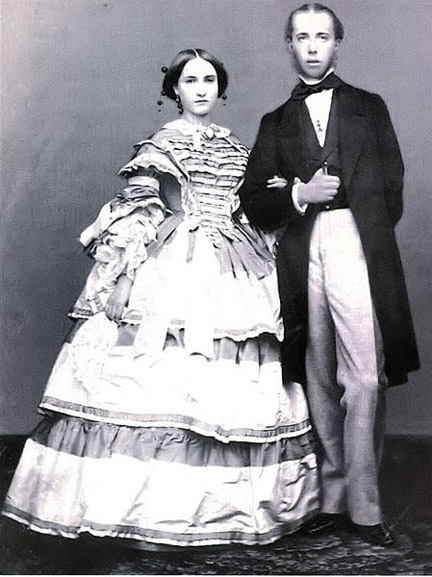
Carlotta and Maximilian
in 1857 before taking over the
short-lived Mexican empire.


The Metropolitan Museum of Art has quite a few cage crinolines in its costume collection: